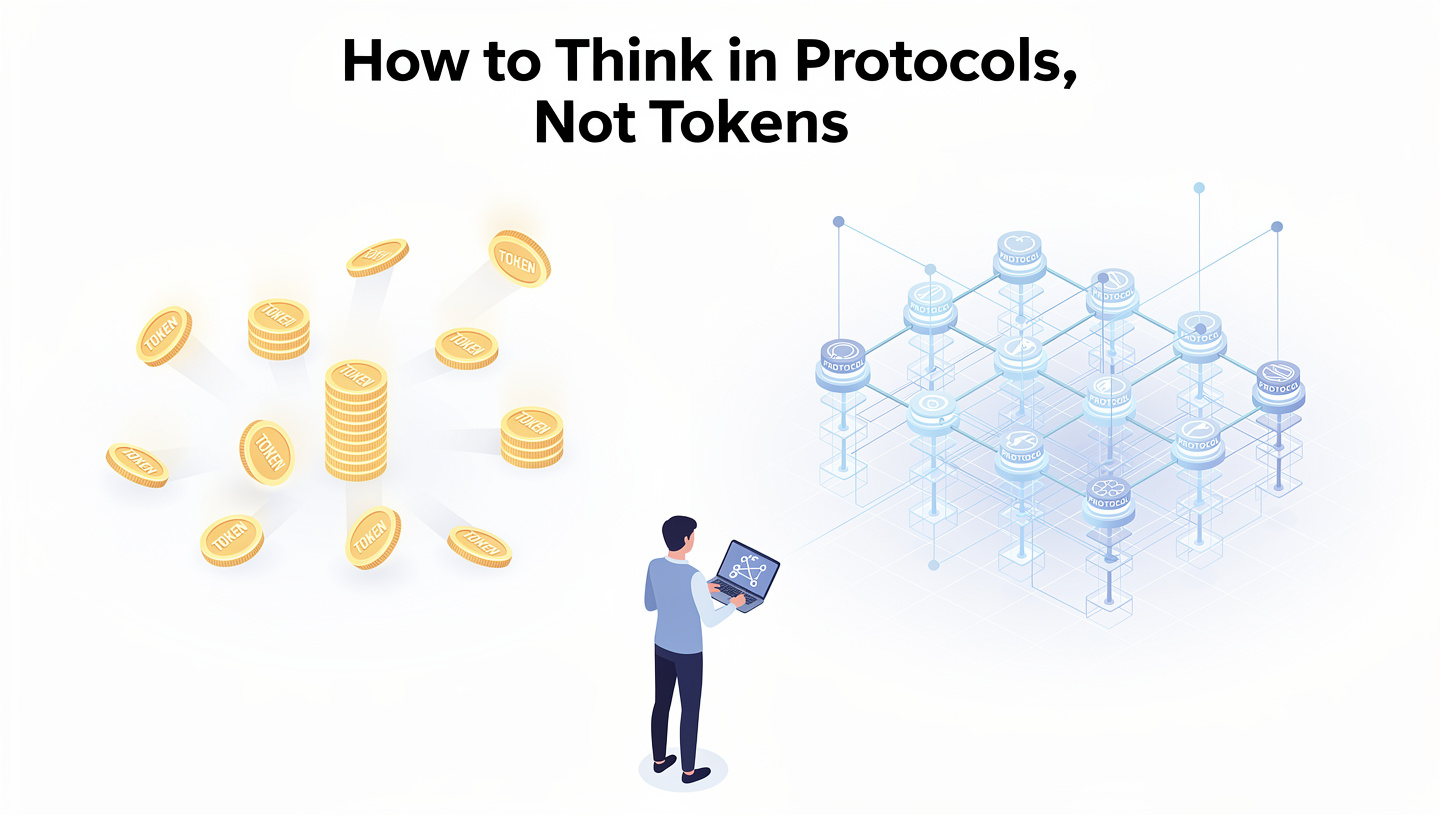
Most people enter crypto through a token.
A ticker symbol.
A price chart.
A promise of upside.
They buy ETH, SOL, AVAX, or the latest trending coin, refresh the chart a few times, feel a small rush when it goes up, a knot in the stomach when it goes down—and slowly, almost invisibly, they absorb a dangerous habit:
They start thinking in prices, not systems.
This is the quiet mistake that separates short-term speculation from long-term understanding. It’s also the reason why many people can spend years “in crypto” and still miss the real opportunity sitting right in front of them.
Because crypto is not fundamentally about tokens.
It’s about protocols.
And once you learn how to think in protocols instead of tokens, everything changes: how you evaluate projects, how you manage risk, how you spot durability versus hype, and how you position yourself for asymmetric upside that lasts longer than a single market cycle.
This article is about that mental shift—and why it may be the most important upgrade you can make as a crypto participant.
Tokens Are the Surface. Protocols Are the Engine.
A token is easy to see.
It has a name, a logo, a price, a market cap. It moves up and down. It triggers emotion. It invites comparison. It gives you something to brag—or complain—about.
A protocol, on the other hand, is quieter.
It’s a set of rules encoded in software.
A coordination mechanism.
A machine for aligning incentives between strangers.
You don’t “feel” a protocol the way you feel a chart. You understand it—or you don’t.
And that difference matters, because tokens can exist without meaningful protocols behind them. But protocols cannot exist without some form of value capture—whether it’s obvious or not.
When you focus only on the token, you’re staring at the exhaust pipe instead of the engine.
You see movement, noise, heat—but you don’t understand what’s actually doing the work.
Why Token Thinking Is So Seductive (and So Costly)
Token thinking isn’t just common—it’s almost inevitable.
Crypto markets are designed to pull your attention toward price:
- Charts update every second
- Social media amplifies pumps and crashes
- Influencers frame everything in ROI terms
- Exchanges rank assets by performance
Over time, your brain is trained to ask the wrong first question:
“How high can this token go?”
Instead of:
“What does this protocol do, and why would people keep using it?”
The cost of token thinking is subtle but brutal:
- You chase narratives instead of fundamentals
- You confuse attention with adoption
- You mistake liquidity for value
- You sell working systems too early and hold broken ones too long
Token thinking optimizes for excitement.
Protocol thinking optimizes for survival.
And in crypto, survival compounds.
Protocols Are Economic Organisms
To think in protocols, you need to stop seeing crypto projects as “products” and start seeing them as economic organisms.
A protocol is not just code. It is:
- A set of incentives
- A behavior-shaping environment
- A miniature economy with its own rules
Every protocol answers a few fundamental questions, whether explicitly or not:
- Who contributes value?
- Who extracts value?
- Who bears risk?
- Who gets paid, when, and why?
When these answers are aligned, the protocol grows naturally. When they are misaligned, no amount of marketing can save it.
Tokens may fluctuate daily.
Protocols either work or they slowly decay.
The Core Question: What Would Still Exist Without the Token?
Here’s a powerful mental test:
If you removed the token entirely, would the protocol still be useful?
If the answer is “no,” that doesn’t automatically make it bad—but it should raise your skepticism.
Strong protocols often have intrinsic utility:
- Decentralized exchanges enable permissionless trading
- Lending protocols enable capital efficiency
- Oracles enable smart contracts to interact with reality
- Rollups enable scalable execution
The token may help govern, secure, or coordinate—but the need for the protocol exists independently of price speculation.
Weak protocols often reverse this logic:
The token exists first.
The protocol is built to justify it later.
Thinking in protocols means learning to detect this inversion early—before the market does.
Usage Is a Stronger Signal Than Price
Token thinkers watch charts.
Protocol thinkers watch behavior.
They ask questions like:
- Are users coming back even during bear markets?
- Are developers still building when incentives drop?
- Does usage grow organically or only during farming campaigns?
- Do integrations persist after hype fades?
Price can lie. Usage rarely does.
A protocol with declining token price but stable or growing usage may be undervalued. A protocol with explosive token price but shallow, incentive-driven activity may be a mirage.
When you think in protocols, you stop asking, “Is the market bullish?” and start asking, “Is this system becoming harder to replace?”
Governance Is Not Politics—It’s Architecture
One of the most misunderstood aspects of protocol thinking is governance.
Many people treat governance tokens like political votes: noisy, emotional, easily manipulated. And sometimes, they are.
But at a deeper level, governance is about control over system parameters:
- Fees
- Collateral requirements
- Emissions
- Upgrade paths
- Risk tolerances
Protocol thinkers don’t ask, “Do I get a vote?”
They ask, “Who actually has power, and how is it exercised over time?”
A protocol with nominal decentralization but concentrated control behaves very differently from one where power diffuses naturally as it scales.
Tokens don’t guarantee decentralization.
Architecture does.
Revenue Matters—But Only in Context
Token thinkers obsess over “revenue” as a checkbox.
Protocol thinkers care about where revenue comes from and where it goes.
They look at questions like:
- Is revenue extracted from real users or recycled incentives?
- Does revenue strengthen the protocol or just reward insiders?
- Is value reinvested into security, liquidity, and resilience?
A protocol can generate revenue and still be fragile. Another can generate very little and yet be indispensable.
Revenue is a signal, not a verdict.
Composability Is a Force Multiplier
Protocols don’t exist in isolation.
They plug into each other, stack on top of each other, and quietly become infrastructure for things their creators never anticipated.
This is where protocol thinking shines.
Instead of asking, “Will this token outperform others?” you ask:
- How many other systems depend on this one?
- How painful would it be to remove or replace?
- Does it create optionality for future builders?
The most powerful protocols often feel boring—until you realize how many things quietly rely on them.
By the time the market notices, the moat is already built.
Protocol Thinking Changes Your Time Horizon
Token thinking compresses time.
You check prices daily. Sometimes hourly. Sometimes every few minutes.
Protocol thinking stretches time.
You start thinking in years:
- How will this protocol behave under stress?
- What happens when incentives drop to zero?
- Will it still matter after the next cycle?
This shift alone can dramatically improve outcomes—not because you predict better, but because you react less.
You stop trading noise and start accumulating conviction.
Builders Think in Protocols for a Reason
There’s a reason why serious builders talk about protocols, not tokens.
They know that:
- Tokens can be redesigned
- Tokenomics can change
- Narratives can flip
But if the protocol works—if it coordinates humans, capital, and code effectively—it will find a way to capture value eventually.
Speculators chase what’s visible.
Builders create what’s inevitable.
Learning to think like a builder, even as an investor or user, puts you closer to the source of long-term value.
The Quiet Power of Invisibility
Some of the most successful protocols in crypto are almost invisible to end users.
People don’t wake up excited about DNS.
They don’t speculate on TCP/IP.
Yet the internet would collapse without them.
Crypto is slowly moving in the same direction.
The protocols that matter most long-term may not trend on social media. They may not have flashy branding. They may not even promise life-changing returns.
But they will be used.
Relied upon.
Built on top of.
And value tends to follow necessity—eventually.
From Speculator to System Thinker
Thinking in protocols doesn’t mean ignoring tokens entirely.
Tokens matter. They align incentives. They secure networks. They coordinate governance.
But they are downstream from the real question:
Does this system make coordination easier, cheaper, or more trustworthy than before?
If the answer is yes—and if it continues to be yes even when hype fades—then the token is no longer just a bet.
It’s a claim on a living system.
And that is a very different kind of asset.
Final Thought: The Market Rewards What It First Ignores
Crypto history has a strange pattern.
The loudest things get attention first.
The strongest things get rewarded last.
Learning to think in protocols, not tokens, is an act of patience in a market addicted to speed. It’s choosing understanding over stimulation, structure over spectacle.
Most people will never make this shift. They’ll stay glued to charts, chasing the next narrative, wondering why the same mistakes repeat every cycle.
But if you do make it—if you learn to see crypto as a network of evolving economic systems rather than a casino of flashing tickers—you gain something far more valuable than a hot trade.
You gain clarity.
And in crypto, clarity is rare.