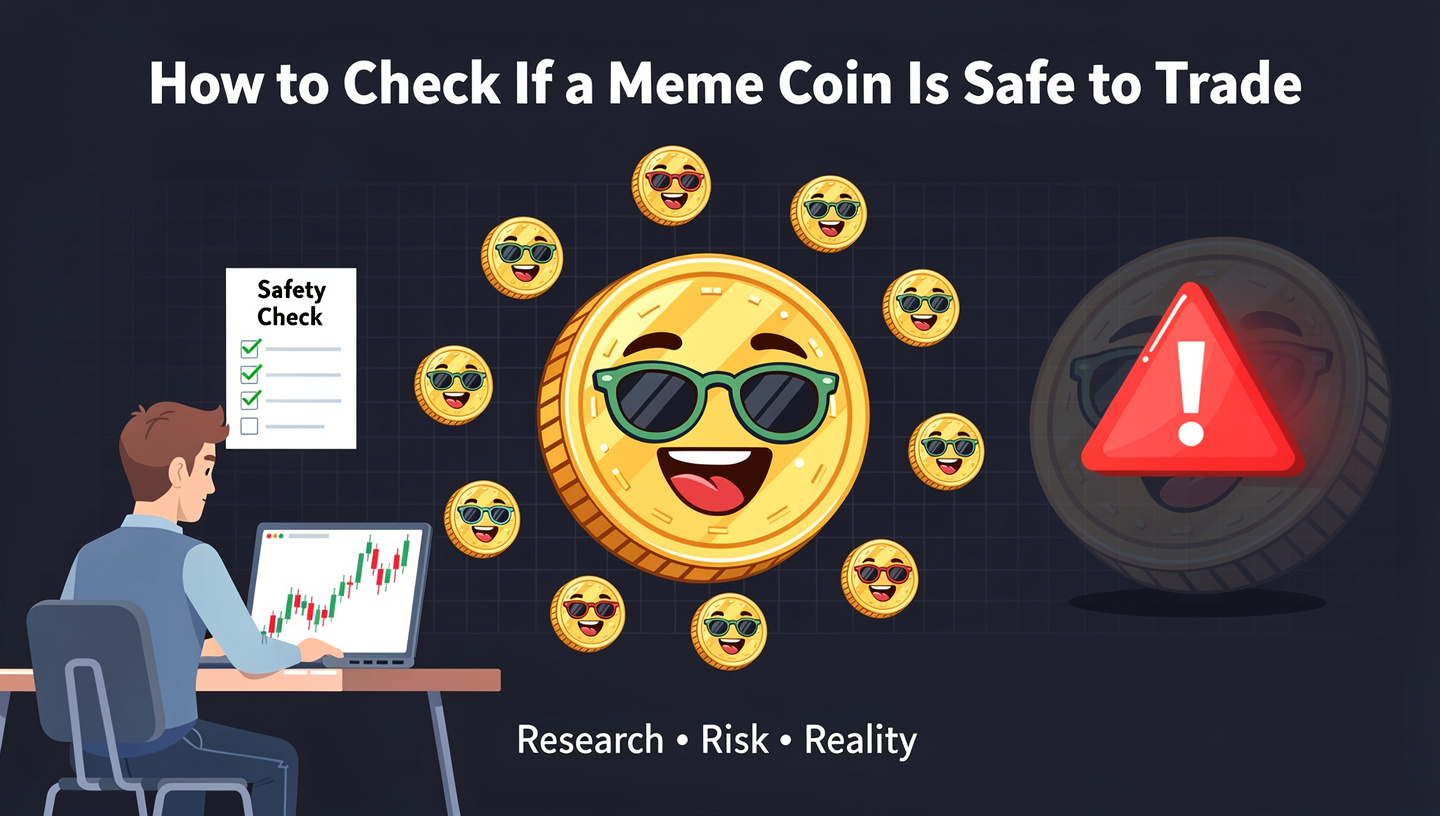
In meme coin markets, the question “Is this safe?” is often misunderstood.
Safety does not mean the token will not dump.
Safety does not mean the chart will only go up.
Safety means something far more specific and far more measurable:
If capital flows in, does the system structurally allow capital to flow out without manipulation, entrapment, or asymmetric information?
Most traders fail here because they approach meme coins emotionally or narratively. They look for vibes, community noise, or surface-level audits. That is insufficient.
A meme coin is safe to trade only if its architecture, incentives, and on-chain behaviors align in a way that makes catastrophic loss non-probabilistic, not merely unlikely.
This article lays out a practical, research-grade checklist for evaluating meme coin safety before entering a trade. Not theory. Not platitudes. No fairy tales. Just signal.
1. Redefining “Safe” in Meme Coin Trading
Before touching any checklist, we must redefine terms.
A meme coin can be:
- Unprofitable but safe
- Profitable but unsafe
- Temporarily safe but structurally doomed
Safety in this context means:
- You can enter and exit freely
- You are not dependent on the deployer’s goodwill
- The token’s rules cannot be changed mid-game
- Liquidity cannot be selectively removed
- Supply cannot be selectively inflated or frozen
If any one of these fails, the coin is unsafe — regardless of chart performance.
2. Contract-Level Safety: The Non-Negotiable Foundation
Everything begins with the smart contract. Social signals are downstream. Price action is downstream. The contract is upstream.
2.1 Contract Verification Is Mandatory
A meme coin without verified source code is not tradeable.
Verification allows:
- Independent review of logic
- Detection of hidden mint or blacklist functions
- Confirmation of tax mechanics
Unverified contracts introduce information asymmetry, and asymmetry equals risk.
2.2 Ownership Status: Renounced vs Multisig vs EOAs
Ownership determines who can change the rules.
Safest → Least Safe:
- Ownership renounced (immutable logic)
- Multisig ownership (distributed control)
- Single EOA ownership (centralized risk)
Key checks:
- Can the owner change fees?
- Can the owner pause trading?
- Can the owner blacklist wallets?
If the answer to any is “yes,” the coin is conditionally unsafe.
3. Liquidity: The Difference Between Price and Reality
Liquidity is not just “locked” or “unlocked.” That binary thinking is naive.
3.1 Liquidity Lock Duration Matters More Than Presence
A 7-day lock is functionally meaningless.
A 6-month lock is marginal.
A 1-year+ lock begins to reduce systemic risk.
Also verify:
- Lock platform reputation
- Whether LP tokens are burned or escrowed
- Whether multiple LP pools exist (fragmentation risk)
3.2 Liquidity Depth vs Market Cap Illusion
A $10M market cap with $150k liquidity is unsafe.
Rule of thumb:
- LP should be ≥ 8–12% of circulating market cap
- Shallow LP increases slippage and enables price control
Low liquidity turns every trade into a tax paid to insiders.
4. Tax Mechanics: Where Most “Safe” Coins Quietly Fail
Taxes are not inherently bad. Mutable taxes are.
4.1 Fixed vs Adjustable Taxes
Acceptable:
- Fixed buy/sell tax defined in contract
Unacceptable:
- Owner-adjustable tax
- Emergency tax toggles
- Anti-dump logic that targets wallets dynamically
A token that can raise sell tax to 99% is not safe, regardless of intent.
4.2 Fee Destination Transparency
Always track:
- Where fees are sent
- Whether they go to a wallet or are auto-liquified
- Whether that wallet is dumping on-chain
Opaque fee destinations equal delayed rugs.
5. Supply Mechanics and Hidden Inflation Vectors
Many meme coins appear “fair” but hide inflation paths.
5.1 Mint Functions (Explicit or Obfuscated)
Search for:
mint()increaseSupply()- Proxy upgrade patterns
Even unused mint functions are a red flag. Code paths matter more than promises.
5.2 Reflection and Rebase Side Effects
Reflection tokens:
- Inflate holder balances without price guarantees
- Distort true circulating supply
Rebase tokens:
- Change balances algorithmically
- Break traditional risk models
These mechanisms are advanced and often misunderstood — avoid unless you fully model them.
6. Wallet Distribution: The Silent Predictor of Failure
Wallet concentration predicts outcomes better than narratives.
6.1 Top Holder Thresholds
General safety benchmarks:
- Top 1 wallet < 5%
- Top 10 wallets < 20–25% (excluding LP)
- No unexplained clusters of related wallets
Cluster analysis matters more than raw percentages.
6.2 Developer Wallet Behavior
Monitor:
- Early sells
- Liquidity pulls masked as “rebalance”
- Bridging funds to CEXs prematurely
Developer selling is not always bad. Undisclosed selling is.
7. Trading Constraints and Honeypot Detection
Some dangers only appear at execution time.
7.1 Simulated Sells Are Not Optional
Before entering:
- Simulate buy and sell transactions
- Check real sellability, not theoretical
Honeypots often allow buys but block sells via:
- Gas manipulation
- Blacklist logic
- Transfer restrictions
7.2 Max Transaction and Wallet Limits
Reasonable limits:
- Temporary anti-bot measures with hard expiry
Unsafe limits:
- Permanent max wallet caps
- Owner-controlled exemptions
These mechanics are often used to trap late entrants.
8. Governance, Upgradability, and Proxy Risk
Upgradeable contracts are double-edged.
8.1 Proxy Contracts: Advanced Risk Tier
Proxy patterns allow:
- Logic changes without redeploy
- Feature injection post-launch
Unless governed by transparent multisig or DAO processes, proxy contracts introduce future unknowns, which are the enemy of safety.
9. Social Proof vs On-Chain Truth
This section is where most traders fail.
9.1 Community Size Is a Lagging Indicator
Telegram members, Twitter followers, Discord activity:
- Easy to fake
- Easy to buy
- Easy to bot
On-chain data cannot be faked cheaply.
9.2 Influencer Endorsements Are Not Safety Signals
If safety depended on influencers, rugs would not exist.
Treat endorsements as marketing input, not risk mitigation.
10. A Practical Safety Scoring Framework
Instead of “safe / unsafe,” use weighted confidence.
Example:
- Contract immutability: 25%
- Liquidity structure: 25%
- Wallet distribution: 20%
- Tax mechanics: 15%
- Governance & upgrade risk: 15%
If a coin scores under 70%, it is speculative exposure, not a safe trade.
Safety Is Designed, Not Claimed
The meme coin market does not reward belief.
It rewards structural understanding.
Safe meme coins are not found by scrolling faster or trusting louder voices. They are identified by eliminating asymmetric risk, verifying constraints, and respecting incentives encoded in smart contracts.
If you trade meme coins without a safety framework, you are not trading — you are donating volatility to someone who understands the system better than you do.
Safety is not about certainty.
It is about removing the ways you can be cheated.