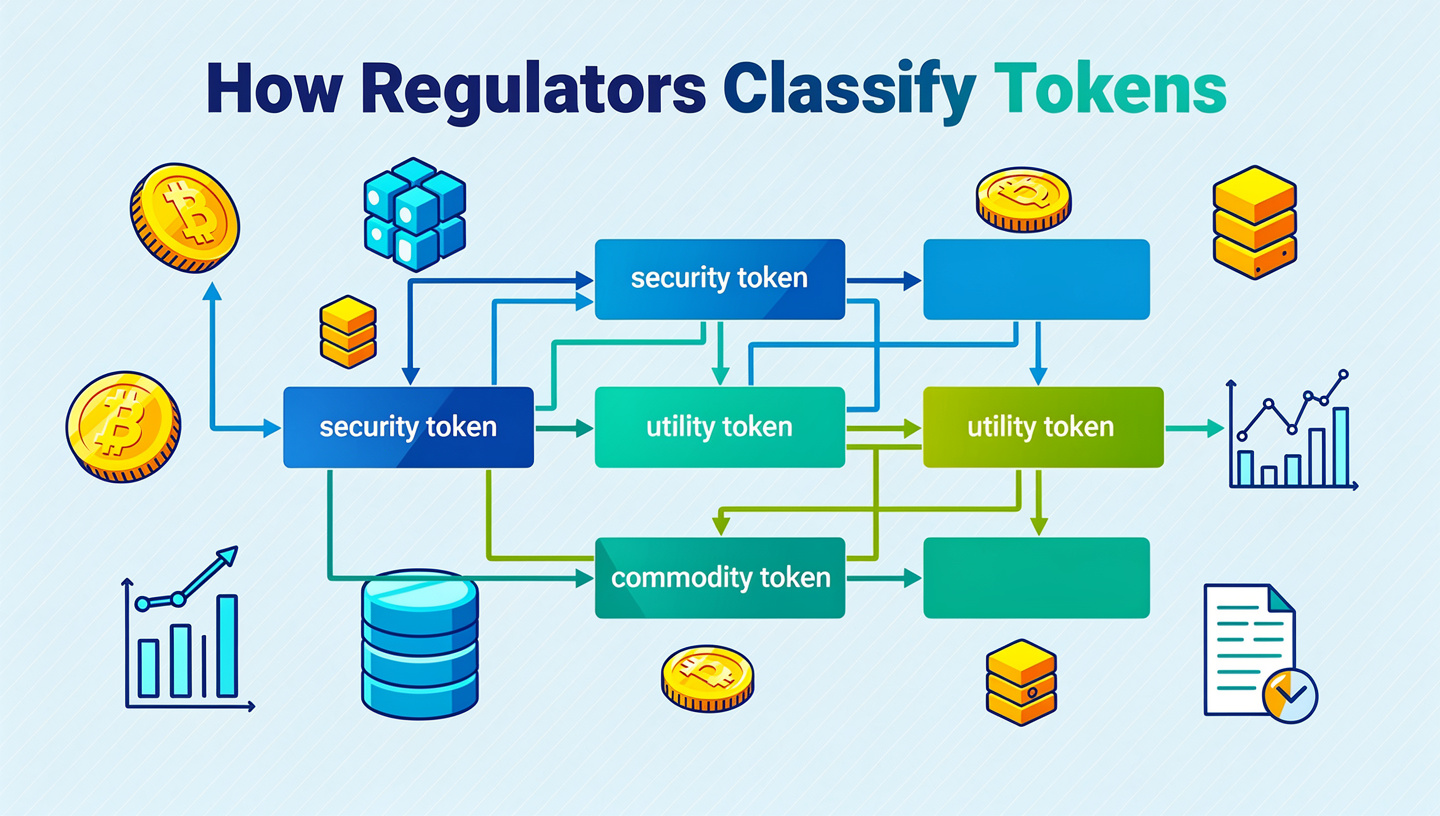
Token classification sits at the center of modern crypto law. It determines whether a digital asset is regulated as a security, a commodity, a payment instrument, a derivative, an e-money token, or something else entirely. That classification dictates disclosure obligations, licensing requirements, market conduct rules, custody standards, taxation consequences, and enforcement exposure.
Regulators worldwide are not debating whether to classify tokens—they are refining how. From the enforcement posture of the U.S. Securities and Exchange Commission to the commodities jurisdiction of the Commodity Futures Trading Commission, from the framework of the European Securities and Markets Authority to statutory regimes such as the European Union’s Markets in Crypto-Assets Regulation, the classification question has moved from theoretical to operational.
This article examines how regulators classify tokens across major jurisdictions, the doctrinal tools they use, the economic realities they assess, and the regulatory consequences that follow. It focuses on legal structure, enforcement trends, and comparative analysis.
I. Why Token Classification Matters
Token classification determines five core legal outcomes:
- Registration and disclosure requirements
- Licensing obligations for issuers and intermediaries
- Secondary market regulation
- Investor protection standards
- Enforcement exposure and penalties
Misclassification can trigger retroactive enforcement, rescission rights, civil penalties, and criminal liability. For exchanges and token issuers, classification errors are existential risks.
In practice, token classification is not merely labeling—it is regulatory allocation of authority. In the United States, whether a token is a “security” determines whether it falls under the jurisdiction of the U.S. Securities and Exchange Commission or potentially the Commodity Futures Trading Commission. In the European Union, classification under Markets in Crypto-Assets Regulation triggers specific whitepaper and authorization requirements.
II. The U.S. Framework: Securities vs. Commodities
A. The Howey Test
The central doctrinal tool in U.S. securities classification is derived from the Supreme Court’s decision in SEC v. W. J. Howey Co..
Under the Howey test, a transaction constitutes an “investment contract” if there is:
- An investment of money
- In a common enterprise
- With a reasonable expectation of profits
- To be derived from the efforts of others
This four-prong test is technology-neutral. It evaluates economic reality rather than labels.
Regulators consistently emphasize that calling a token a “utility token” has no legal significance if its distribution satisfies the Howey criteria.
B. The SEC’s Analytical Framework
In 2019, the U.S. Securities and Exchange Commission published a framework for analyzing digital assets under Howey. It focuses on factors such as:
- Degree of decentralization
- Ongoing managerial efforts
- Marketing emphasis on profit
- Token functionality at issuance
- Information asymmetry
The analysis is holistic. No single factor controls.
C. Enforcement Signals
High-profile enforcement actions against token issuers and exchanges have clarified the SEC’s view that many ICO-era tokens were unregistered securities offerings.
In parallel, the Commodity Futures Trading Commission has asserted that Bitcoin and certain other decentralized tokens are commodities.
The classification tension between securities and commodities remains unresolved legislatively, but judicial decisions increasingly shape boundaries.
III. Functional vs. Formal Classification
Regulators use two primary approaches:
- Substance-over-form (functional test)
- Statutory taxonomy (formal categories)
The United States primarily applies functional analysis through Howey. The European Union, by contrast, uses statutory categories under Markets in Crypto-Assets Regulation.
A. Functional Approach
Under functional analysis:
- The economic purpose of the token matters more than its technical design.
- Marketing representations are probative.
- Governance structure influences classification.
A token may begin as a security and evolve toward non-security status if decentralization materially reduces reliance on managerial efforts. However, regulators remain cautious about recognizing such transitions.
B. Statutory Categorization
Under MiCA, tokens are divided into:
- Asset-referenced tokens
- E-money tokens
- Utility tokens
Each category has defined legal consequences. This method provides predictability but requires careful boundary interpretation.
IV. Token Types and Regulatory Treatment
1. Security Tokens
Security tokens represent traditional financial interests such as equity, debt, or profit-sharing arrangements.
Characteristics include:
- Dividend rights
- Governance rights
- Revenue participation
- Investment expectation
In most jurisdictions, these tokens are regulated identically to traditional securities. Prospectus requirements, broker-dealer licensing, custody rules, and market abuse provisions apply.
2. Utility Tokens
Utility tokens purport to provide access to a platform or service.
However, regulators examine:
- Whether the network is operational at sale
- Whether purchasers are primarily users or investors
- Whether resale markets are promoted
If buyers reasonably expect profits based on managerial development, the token may be reclassified as a security despite “utility” branding.
3. Payment Tokens / Cryptocurrencies
Tokens such as decentralized cryptocurrencies are often treated as commodities or digital payment instruments rather than securities.
The classification of Bitcoin as a commodity by the Commodity Futures Trading Commission illustrates regulatory differentiation based on decentralization and absence of issuer control.
4. Stablecoins
Stablecoins present classification complexity.
Regulators analyze:
- Reserve structure
- Redemption rights
- Issuer control
- Promise of value stability
Under Markets in Crypto-Assets Regulation, asset-referenced tokens and e-money tokens face enhanced authorization and reserve requirements.
In the United States, stablecoin classification remains fragmented, involving banking law, securities law, and money transmission statutes.
5. Governance Tokens
Governance tokens allow voting on protocol decisions.
Regulators examine:
- Whether governance rights resemble equity rights
- Whether token value appreciation is expected
- Whether a core team maintains effective control
If governance is nominal while economic control remains centralized, securities classification risk increases.
V. International Comparative Approaches
A. European Union
The EU adopted a comprehensive regulatory regime through Markets in Crypto-Assets Regulation.
MiCA creates a harmonized framework across member states. It does not rely primarily on case-law interpretation but on defined token categories.
The European Securities and Markets Authority coordinates supervisory convergence.
B. United Kingdom
The UK applies existing financial services legislation to crypto tokens.
The Financial Conduct Authority distinguishes between:
- Security tokens
- E-money tokens
- Unregulated exchange tokens
The UK approach blends statutory interpretation with regulatory guidance rather than creating a fully bespoke crypto regime.
C. Singapore
The Monetary Authority of Singapore applies the Securities and Futures Act to tokens that constitute capital markets products.
Singapore’s framework emphasizes risk-based licensing and anti-money laundering compliance.
D. Japan
The Financial Services Agency distinguishes between crypto-assets and security tokens under the Financial Instruments and Exchange Act and Payment Services Act.
Japan’s early legislative clarity reduced classification ambiguity relative to the United States.
VI. Decentralization as a Legal Variable
Regulators increasingly analyze decentralization as a classification determinant.
Factors include:
- Governance distribution
- Developer influence
- Token concentration
- Control over protocol upgrades
- Marketing leadership
If identifiable promoters exert significant influence, the token is more likely to be treated as a security.
However, decentralization is not binary. It exists on a spectrum. Legal analysis must evaluate effective control, not rhetorical claims.
VII. Secondary Markets and Exchange Liability
Token classification directly affects crypto exchanges.
If a token is a security:
- The exchange may need to register as a securities exchange or alternative trading system.
- Broker-dealer obligations may apply.
- Custody rules become more stringent.
Failure to align exchange licensing with token classification has been central in multiple enforcement actions by the U.S. Securities and Exchange Commission.
VIII. Hybrid and Evolving Tokens
Some tokens shift functionality over time:
- ICO-stage token (capital raising)
- Network-launch token (utility functionality)
- Governance-stage token (decentralized management)
Regulators are skeptical of arguments that post-launch utility erases prior securities violations.
The legal focus is on the circumstances at the time of sale.
IX. The Role of Disclosure
Token classification is tied to information asymmetry.
Securities regulation is fundamentally disclosure-based. Where promoters possess material nonpublic information and investors rely on managerial execution, securities law is triggered.
In decentralized systems with no central managerial body, disclosure-based regulation becomes structurally difficult, which partially explains commodity-style classification for certain tokens.
X. Emerging Legislative Efforts
Several jurisdictions are considering explicit statutory definitions for digital assets to reduce reliance on judicial tests.
Proposals often include:
- Clear division between digital commodities and digital securities
- Registration pathways tailored to blockchain networks
- Safe harbor provisions for early-stage decentralization
Legislative reform aims to reduce enforcement-driven classification uncertainty.
XI. Key Classification Risk Factors
Regulators consistently examine:
- Pre-sale marketing emphasizing token price appreciation
- Centralized token allocation
- Insider lock-ups and vesting schedules
- Roadmaps tied to managerial execution
- Ongoing developer control
The more the token resembles venture capital fundraising, the higher the securities classification risk.
XII. Practical Implications for Issuers
Issuers should conduct:
- Multi-jurisdictional legal analysis
- Functional token assessment
- Marketing compliance review
- Governance decentralization evaluation
- Secondary trading impact analysis
Token classification is not static; it requires continuous legal monitoring.
Conclusion: Classification as the Structural Core of Crypto Regulation
Token classification is not a peripheral technical question. It is the structural core of crypto regulation.
Regulators evaluate economic reality, decentralization, managerial control, and investor expectation to determine legal identity. Whether under the Howey doctrine enforced by the U.S. Securities and Exchange Commission or under statutory frameworks such as Markets in Crypto-Assets Regulation, the analysis converges on one principle: substance prevails over form.
As digital asset markets mature, classification standards will continue to evolve. However, the foundational question remains constant: does the token function as an investment instrument or as a decentralized digital commodity?
The answer determines the entire regulatory architecture that follows.