Decentralized Finance was supposed to remove trust.
No banks. No middlemen. No human error.
And yet, year after year, billions of dollars vanish—not through masked intruders smashing servers, but through math, incentives, assumptions, and code that behaved exactly as written.
This is the uncomfortable truth of DeFi:
Most “hacks” are not hacks at all.
They are consequences.
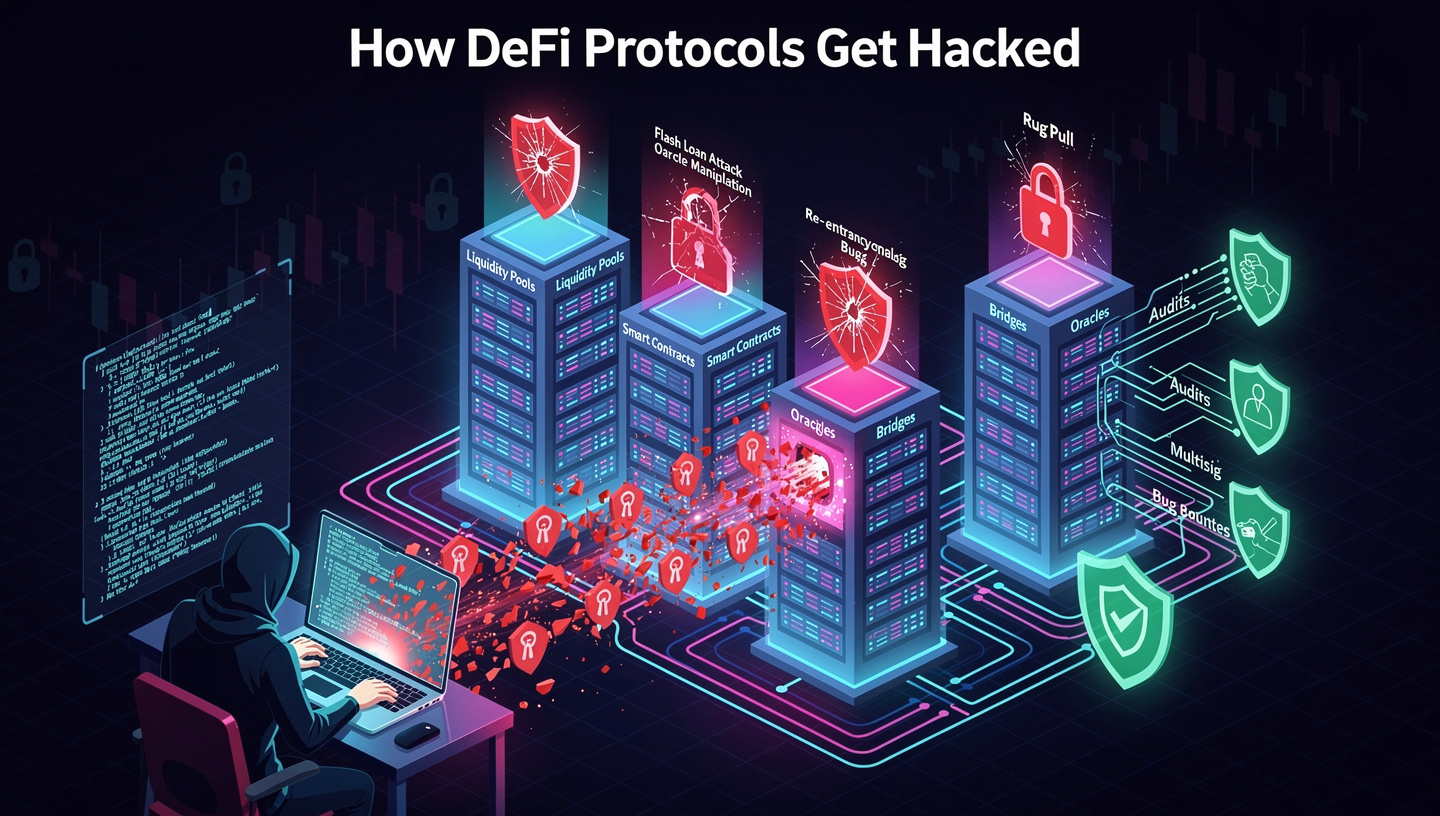
This article is a deep exploration of how DeFi protocols actually get hacked, not in theory, but in practice. We’ll peel back the layers—from smart contract bugs to economic manipulation, from governance failures to human psychology—and show why even well-funded, audited projects still fall apart.
If you’ve ever wondered “How did that even happen?”, this is for you.
1. The First Myth: “Smart Contracts Are Secure by Default”
Smart contracts feel solid. Immutable. Mathematical. Almost divine.
But here’s the reality:
Smart contracts are only as safe as the assumptions their creators make.
Every line of code encodes a belief about how the world behaves:
- Prices won’t move too fast
- Oracles won’t lie
- Users won’t act adversarially
- Liquidity won’t disappear
- Governance won’t be captured
Attackers exist precisely to break those assumptions.
And DeFi gives them three advantages:
- Open-source code (they can study it forever)
- Atomic transactions (everything happens instantly or not at all)
- Permissionless capital (they can borrow absurd sums temporarily)
This combination is lethal.
2. Smart Contract Bugs: The Obvious (and Boring) Ones
Let’s start with the most straightforward category.
Logic Errors
These are simple mistakes:
- Incorrect math
- Wrong order of operations
- Missing checks
- Incorrect state updates
Sometimes the bug is as small as:
- Updating balances after sending funds
- Trusting user input without validation
- Assuming a function can’t be called twice
The tragedy?
Many of these bugs are obvious in hindsight.
Reentrancy Attacks
One of the earliest and still recurring issues.
The pattern:
- Protocol sends funds to a user
- User’s contract calls back into the protocol
- The protocol hasn’t updated its internal state yet
- Funds get drained repeatedly
This exact mistake has been known for years—and still happens.
Why?
Because DeFi isn’t just code.
It’s composability. Contracts call contracts call contracts.
Complexity breeds blind spots.
3. Flash Loans: When Time Stops Being a Constraint
Flash loans didn’t invent DeFi hacks.
They removed friction.
A flash loan allows an attacker to:
- Borrow millions (or billions)
- Manipulate markets
- Execute complex strategies
- Repay everything
- Walk away with profit
All in one transaction.
No collateral. No trust. No second chances.
This changes everything.
Why Flash Loans Are So Dangerous
They let attackers:
- Manipulate on-chain prices temporarily
- Exploit protocols that assume price stability
- Attack governance systems that rely on token snapshots
- Drain poorly designed lending pools
Protocols that fail to consider flash loans are effectively living in the past.
4. Oracle Manipulation: When Reality Is Easy to Fake
A protocol doesn’t know the real world.
It knows what its oracle tells it.
And if the oracle is weak, reality becomes negotiable.
Common Oracle Failures
- Using a single DEX price as truth
- Relying on low-liquidity markets
- No time-weighted averages
- No sanity checks
An attacker doesn’t need to hack the protocol.
They just:
- Manipulate a price feed briefly
- Trigger a function that relies on it
- Extract value
- Let the price revert
The protocol behaved “correctly”—based on false input.
Garbage in, catastrophe out.
5. Economic Attacks: When Incentives Betray You
Some hacks don’t touch the code at all.
They exploit game theory.
Liquidity Drain Attacks
Protocols often assume liquidity will stick around.
But liquidity is mercenary.
If rewards drop, risks rise, or a better opportunity appears, capital leaves instantly.
Attackers can:
- Manipulate incentives
- Trigger cascading liquidations
- Force bad debt
- Create death spirals
No bug required.
Governance Attacks
Decentralized governance sounds noble.
Until someone buys enough tokens to:
- Pass malicious proposals
- Drain treasuries
- Change parameters in their favor
If governance power is:
- Cheap
- Concentrated
- Poorly timed
Then governance becomes an attack surface.
6. Composability: The Double-Edged Sword
DeFi loves Lego metaphors.
But Legos can collapse.
Protocols don’t exist in isolation. They depend on:
- Other protocols
- External tokens
- Shared liquidity
- Shared oracles
- Shared assumptions
Cascading Failures
If Protocol A depends on Protocol B:
- And B breaks
- A breaks too
Even if A’s code is flawless.
This is how systemic risk emerges.
One failure propagates across the ecosystem like a fault line snapping.
7. Upgradeability: The Hidden Backdoor
Immutable contracts feel safe.
Upgradeable contracts feel flexible.
Both have tradeoffs.
Upgrade Risks
- Admin keys get compromised
- Multisigs have weak signers
- Governance gets rushed
- Emergency upgrades introduce new bugs
Sometimes the “hack” is simply:
Someone had the keys.
Decentralization is a spectrum—and many protocols live uncomfortably close to the center.
8. Audits: Why They Don’t Save You
Audits are valuable.
But they are not magic.
What Audits Actually Do
- Review code at a specific moment in time
- Under specific assumptions
- Within limited scope
- Without full economic modeling
They do not:
- Predict every adversarial strategy
- Guarantee safety
- Replace rigorous internal testing
Many hacked protocols were audited.
Some were audited multiple times.
Security is not a checkbox.
It’s a mindset.
9. The Human Factor: The Weakest Link
DeFi pretends humans don’t matter.
They matter the most.
Common Human Failures
- Rushed launches
- Copy-paste code
- Ignoring warnings
- Overconfidence after audits
- Yield-chasing users ignoring risk
Attackers don’t just exploit code.
They exploit urgency, greed, and ego.
10. Why Most Hacks Feel “Obvious” Afterward
After every major exploit, the same comments appear:
“How did they miss this?”
“This was so obvious.”
“Anyone could see that coming.”
Hindsight is cruel.
In reality:
- Systems are complex
- Incentives interact
- Unknowns compound
- Attackers only need one path
Defenders must secure everything.
11. The Deeper Truth: DeFi Is Still an Experiment
This is the part many don’t want to hear.
DeFi is powerful—but immature.
We are:
- Stress-testing financial primitives
- With real money
- In adversarial conditions
- At internet speed
Hacks are not anomalies.
They are feedback.
Each exploit teaches:
- What assumptions failed
- What incentives broke
- What designs don’t survive reality
Progress is written in losses.
12. How Protocols Should Think About Security
The strongest protocols don’t ask:
“Is our code correct?”
They ask:
- “What assumptions are we making?”
- “How could this be abused?”
- “What happens in extreme conditions?”
- “What if users behave adversarially?”
- “What if liquidity disappears overnight?”
They design for worst-case scenarios, not happy paths.
Final Thoughts: DeFi Isn’t Dangerous—Naivety Is
DeFi doesn’t get hacked because it’s decentralized.
It gets hacked because:
- Code is law
- Incentives are sharp
- Capital is fluid
- Attackers are rational
- And mistakes are permanent
The real danger isn’t complexity.
It’s underestimating it.
If you understand how DeFi protocols fail, you’re already ahead of most participants—not because you can exploit them, but because you can avoid being collateral damage.
In a trustless system, knowledge is security.