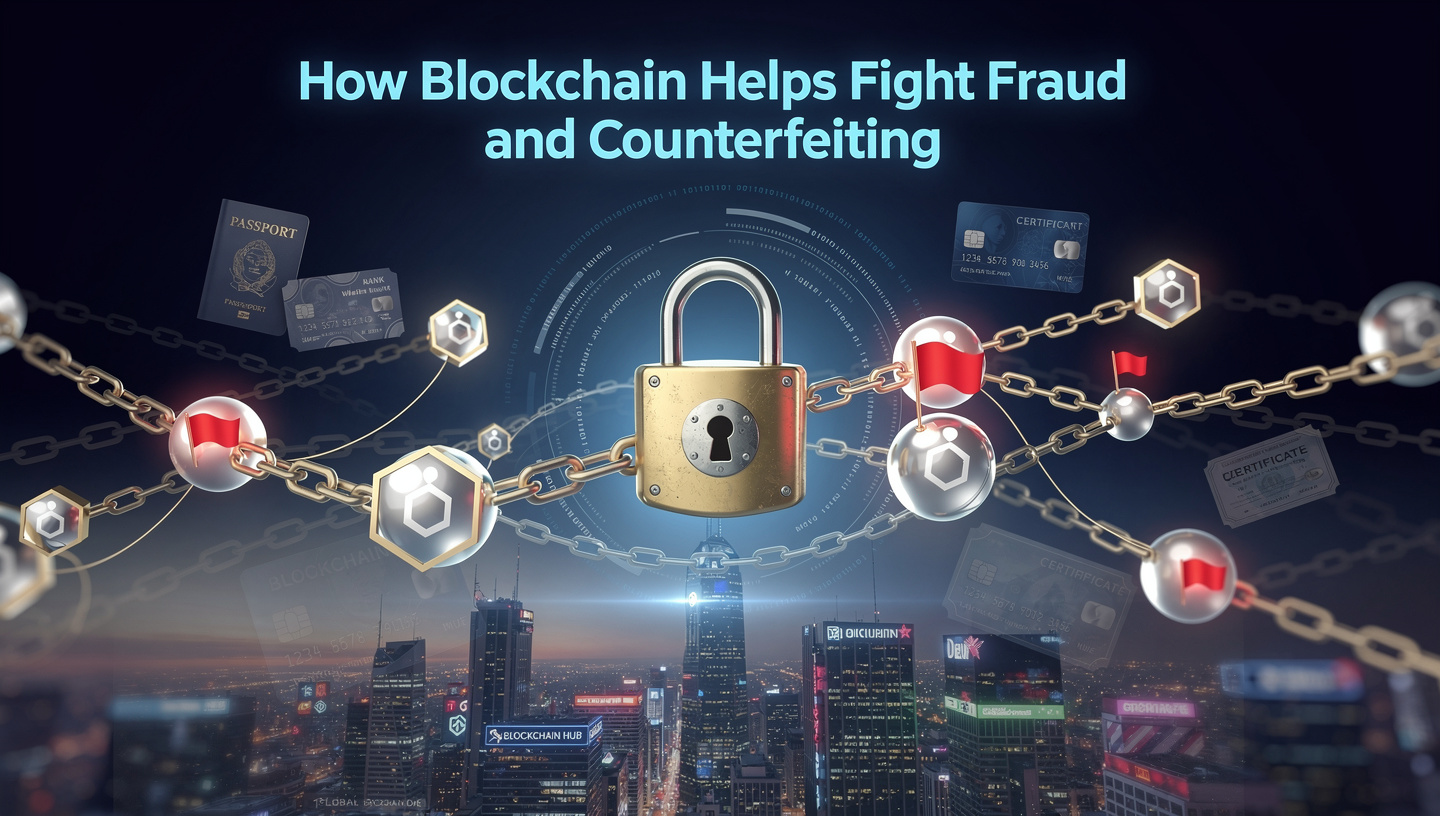
Fraud and counterfeiting are not new problems. For centuries, societies have battled fake currencies, forged documents, adulterated medicines, and counterfeit luxury goods. What has changed is scale. In today’s globalized, digital-first economy, fraud has become faster, cheaper, and harder to detect. Counterfeit products move across borders invisibly, false data spreads at the speed of light, and trust — once broken — is painfully difficult to restore.
Into this landscape enters blockchain technology, often misunderstood as merely the engine behind cryptocurrencies. In reality, blockchain represents something far more fundamental: a new way to create trust without relying on blind faith in intermediaries. When applied thoughtfully, blockchain can dramatically reshape how fraud and counterfeiting are detected, prevented, and discouraged.
This article explores how blockchain helps fight fraud and counterfeiting, why traditional systems struggle, and where blockchain’s promise meets real-world constraints.
1. The Modern Fraud and Counterfeiting Crisis
A Global Epidemic of Fakes
According to various international trade organizations, counterfeit goods account for hundreds of billions of dollars annually. They range from fake handbags and electronics to pharmaceuticals, food products, aircraft parts, and even academic credentials.
The consequences are severe:
- Consumers risk safety, health, and financial loss
- Businesses suffer revenue loss and brand erosion
- Governments lose tax revenue and regulatory control
- Supply chains become opaque and vulnerable
Fraud thrives where information is fragmented, records are mutable, and accountability is weak.
Why Traditional Anti-Fraud Systems Fail
Most current systems rely on centralized databases, paper documentation, or siloed digital records. These approaches have critical weaknesses:
- Single points of failure
- Limited transparency across organizations
- Easy record manipulation or deletion
- Costly and slow audits
- Heavy reliance on trust in intermediaries
In essence, fraud succeeds because truth is easy to rewrite.
2. Blockchain’s Core Strength: Immutable Truth
To understand how blockchain fights fraud, one must first understand its defining characteristic.
What Makes Blockchain Different?
At its core, blockchain is:
- A shared ledger accessible to multiple parties
- Append-only, meaning past records cannot be altered
- Cryptographically secured
- Decentralized, with no single controlling authority
Once data is written to a blockchain and validated by the network, changing it is practically impossible without detection.
This immutability transforms how trust works.
Instead of asking:
“Do I trust this company or authority?”
We ask:
“Can this data be independently verified?”
3. Fighting Fraud Through Transparency and Traceability
End-to-End Supply Chain Visibility
One of blockchain’s most powerful applications is supply chain traceability.
Each step in a product’s lifecycle — from raw material sourcing to manufacturing, shipping, and retail — can be recorded on-chain.
This creates:
- A single source of truth
- Shared visibility across suppliers, distributors, and regulators
- Real-time verification of product origin and movement
Fraud becomes harder when every transaction leaves a permanent footprint.
Case Example: Food and Agriculture
Food fraud — such as mislabeled origins or diluted products — costs billions annually.
With blockchain:
- A retailer can verify where produce was grown
- Regulators can trace contamination in seconds instead of weeks
- Consumers can scan a QR code to confirm authenticity
Fraud thrives in darkness. Blockchain turns on the lights.
4. Combating Counterfeiting with Digital Identity
Giving Products a Verifiable Identity
Counterfeit goods exist because physical products lack verifiable digital identities.
Blockchain changes that.
By assigning each product a unique digital identity — often represented by:
- QR codes
- NFC chips
- RFID tags
— manufacturers can link physical items to tamper-proof blockchain records.
A genuine product can be verified instantly.
A fake cannot forge its history.
Luxury Goods and Brand Protection
Luxury brands are among the earliest adopters of blockchain anti-counterfeiting solutions.
Blockchain enables:
- Proof of authenticity
- Verified ownership transfer
- Transparent resale histories
This protects not just brands, but also secondary markets and consumers.
5. Smart Contracts: Automating Fraud Prevention
Removing Human Manipulation
Smart contracts are self-executing programs stored on the blockchain. They execute automatically when predefined conditions are met.
This reduces fraud by:
- Eliminating manual approvals
- Preventing retroactive changes
- Enforcing rules consistently
Examples in Practice
- Insurance claims: Payments triggered only when verified data conditions are met
- Trade finance: Funds released only after shipment confirmation
- Royalty payments: Automatic distribution without intermediary interference
Fraud often relies on discretion and loopholes. Smart contracts close both.
6. Identity Fraud and Credential Verification
Decentralized Digital Identity
Identity fraud is one of the fastest-growing cybercrimes.
Blockchain enables self-sovereign identity (SSI) systems where individuals control their credentials rather than relying on centralized databases.
Key benefits:
- Credentials are cryptographically verifiable
- No single database to hack
- Reduced identity theft risk
- Instant verification without exposing sensitive data
Fighting Fake Degrees and Certifications
Academic fraud is rampant globally.
With blockchain-based credentialing:
- Universities issue verifiable diplomas
- Employers instantly validate authenticity
- Fake certificates become obvious
Trust becomes mathematical, not institutional.
7. Financial Fraud and Transaction Integrity
Real-Time Auditability
Traditional financial systems rely on after-the-fact audits.
Blockchain enables continuous auditing.
Every transaction is:
- Timestamped
- Traceable
- Verifiable
This dramatically reduces:
- Accounting fraud
- Double-spending
- False reporting
Reducing Insider Manipulation
Because records are shared and immutable, insiders cannot secretly alter data without detection.
Fraud shifts from “easy and hidden” to “risky and visible.”
8. Why Blockchain Doesn’t Eliminate Fraud Entirely
Blockchain is powerful — but not magical.
The “Garbage In, Garbage Out” Problem
If false data is entered honestly but incorrectly, blockchain will faithfully preserve the error.
Blockchain ensures data integrity, not data truthfulness.
This is why:
- IoT sensors
- Trusted oracles
- Regulatory oversight
are still critical components.
Adoption and Integration Challenges
- High implementation costs
- Legacy system compatibility
- Regulatory uncertainty
- User education barriers
Blockchain reduces fraud when properly designed, not by default.
9. The Psychological Impact: Changing Incentives
Perhaps blockchain’s most underrated impact is behavioral.
When actors know that:
- Records are permanent
- Actions are traceable
- Accountability is shared
Fraud becomes less attractive.
Blockchain doesn’t just catch fraud — it discourages it.
10. The Bigger Picture: Trust as Infrastructure
Fraud and counterfeiting are ultimately failures of trust.
Blockchain reframes trust as:
- A system property
- A shared resource
- An infrastructural layer
Instead of relying on promises, reputations, or centralized authorities, trust becomes embedded in the architecture itself.
This doesn’t remove humans from the system — it makes human behavior more accountable.
Conclusion: From Reaction to Prevention
For decades, fraud prevention has been reactive:
- Investigate after damage occurs
- Punish after harm is done
- Repair trust once broken
Blockchain enables a shift toward proactive integrity.
By making data immutable, traceable, and transparent, blockchain raises the cost of deception and lowers the cost of verification.
In a world where counterfeits grow smarter and fraudsters more sophisticated, blockchain doesn’t offer perfection — but it offers something profoundly valuable:
A future where truth is harder to fake.