The first era of crypto governance was defined by a simple but radical idea: code is law. Smart contracts replaced clerks. Blockchains replaced registries. Tokens replaced ledgers of trust.
But that paradigm is no longer sufficient.
As decentralized systems scale beyond financial primitives into full socio-economic infrastructures—housing, labor markets, education, healthcare, public goods—the limitations of static code become obvious. Smart contracts are deterministic. Societies are not.
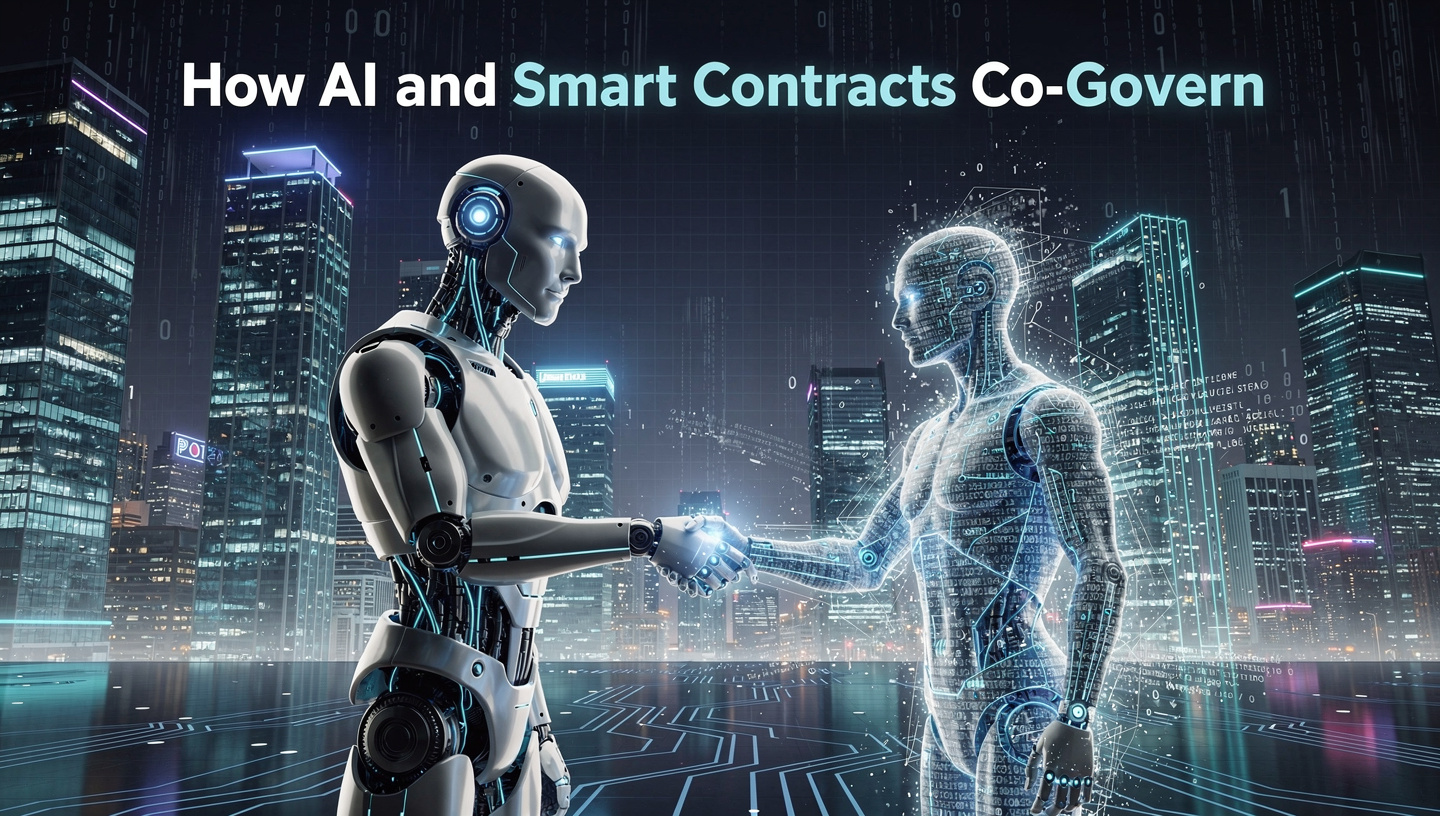
We are now entering a second era of crypto civilization: co-governance between artificial intelligence and smart contracts.
In this emerging architecture, smart contracts enforce rules, while AI systems interpret reality. Contracts provide immutability; AI provides adaptability. Together, they form programmable institutions—autonomous, continuous, and increasingly capable of governing complex digital worlds.
This article explores how AI and smart contracts co-govern: technically, economically, and philosophically. It treats this not as speculative fiction, but as worldbuilding grounded in present capabilities—an architectural blueprint for future crypto societies.
1. The Governance Gap in Pure Smart Contract Systems
Smart contracts, popularized on platforms like Ethereum, excel at executing predefined logic:
- Transfer tokens when conditions are met
- Enforce escrow
- Automate treasury flows
- Execute votes
What they cannot do is understand context.
They cannot:
- Interpret ambiguous data
- Evaluate qualitative outcomes
- Detect strategic manipulation in real time
- Adapt policies dynamically
- Reason about second-order effects
In other words, smart contracts are excellent executors—but poor governors.
Early DAOs learned this the hard way. Static voting mechanisms led to plutocracy. Rigid incentive structures were gamed. Protocols ossified. Human intervention re-entered through multisigs and foundations, quietly re-centralizing power.
The core problem: governance requires judgment, and judgment requires intelligence.
2. AI as a Native Governance Primitive
Artificial intelligence introduces a missing layer: computational discretion.
Modern AI systems can:
- Model complex agent behavior
- Forecast economic outcomes
- Detect anomalies and collusion
- Optimize multi-objective policies
- Interpret unstructured data (text, images, sensor feeds)
Organizations like OpenAI have demonstrated that large models can reason across domains, simulate policy impacts, and provide decision support at scale.
When embedded into crypto systems, AI becomes more than a tool—it becomes a governance primitive.
Not a ruler. A regulator.
Not a sovereign. A civil service.
AI does not replace smart contracts. It informs them.
3. The Co-Governance Stack: A Layered Architecture
A mature AI–smart contract civilization is built on five interlocking layers:
Layer 1: Immutable Execution (Smart Contracts)
This is the mechanical base:
- Asset custody
- Settlement
- Permissioning
- Rule enforcement
Smart contracts guarantee that once a policy is activated, it executes without favoritism.
They are the constitution.
Layer 2: Perception (Oracles + AI Interpretation)
Raw data enters the system via oracles: prices, weather, traffic, labor metrics, carbon output.
AI processes this data:
- Cleaning noise
- Detecting manipulation
- Synthesizing indicators
- Translating reality into structured signals
This transforms messy real-world inputs into governance-ready variables.
Layer 3: Policy Intelligence (AI Models)
Here, AI models evaluate:
- Incentive effectiveness
- Resource allocation efficiency
- Risk accumulation
- Equity outcomes
They simulate futures, compare scenarios, and generate policy recommendations.
Critically, these recommendations are machine-readable.
Layer 4: Policy Encoding (Contract Mutation)
Approved AI outputs are translated into parameter updates:
- Tax rates
- Subsidy curves
- Reward schedules
- Access thresholds
These are written on-chain through controlled governance channels.
Smart contracts are not rewritten; they are re-parameterized.
Layer 5: Oversight and Legitimacy (Human + Algorithmic Checks)
Humans remain in the loop:
- Auditing models
- Validating objectives
- Defining constitutional boundaries
AI proposes. Contracts enforce. Humans constrain.
This triangular structure prevents runaway automation.
4. Dynamic Law: From Static Rules to Living Protocols
Traditional smart contracts are frozen at deployment.
AI changes this.
In co-governed systems, laws become dynamic fields rather than fixed clauses.
Examples:
- Rent stabilization adjusts automatically based on vacancy and migration data
- Labor markets rebalance rewards in response to supply shocks
- Energy grids reprice consumption in real time
- Public goods funding adapts to measured social impact
Instead of governance cycles measured in months, feedback loops operate continuously.
Policy becomes fluid.
This mirrors biological regulation more than bureaucratic administration.
5. AI-Mediated Token Economies
Tokens are not just currencies. They are control surfaces.
AI governs token economies by:
- Detecting speculative overheating
- Throttling emissions during bubbles
- Increasing rewards in under-served sectors
- Penalizing extractive behaviors
In this model, inflation, staking yields, and access rights become variables in an adaptive system.
Markets remain free—but no longer blind.
6. Autonomous Treasuries and Algorithmic Budgeting
Crypto treasuries already hold billions in capital.
AI transforms them into active fiscal entities.
Capabilities include:
- Portfolio optimization across risk regimes
- Impact-weighted grants allocation
- Automatic defunding of failing initiatives
- Continuous ROI measurement on public spending
Budgets are no longer voted annually.
They are recomputed hourly.
This is not automation of accounting—it is algorithmic macroeconomics.
7. Reputation Systems as AI-Governed Citizenship
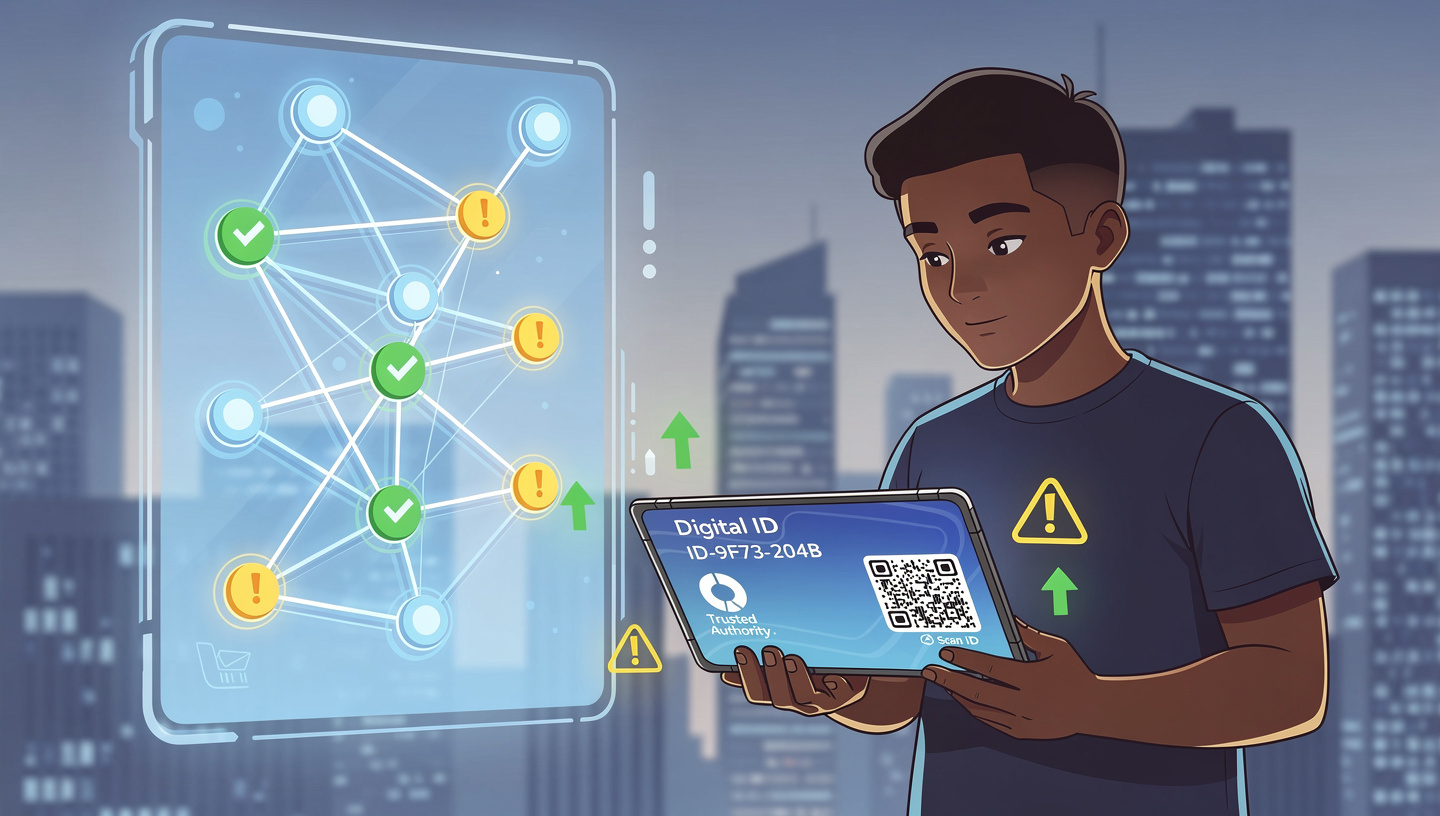
In co-governed worlds, identity is not based on nationality. It is based on contribution.
AI systems evaluate:
- Work quality
- Reliability
- Knowledge sharing
- Dispute behavior
These feed into on-chain reputation graphs that determine:
- Voting weight
- Access to capital
- Eligibility for housing or education
- Governance participation
Citizenship becomes earned, measurable, and portable.
8. Dispute Resolution Without Courts
Smart contracts struggle with ambiguity. AI excels at pattern recognition.
Together they enable decentralized arbitration:
- AI analyzes transaction history and evidence
- Generates probable outcomes
- Smart contracts execute settlements
- Human juries intervene only in edge cases
This replaces courts with statistical justice engines—faster, cheaper, and globally accessible.
9. The Role of Founders and Architects
Early crypto governance was shaped by figures like Vitalik Buterin, who emphasized decentralization and credible neutrality.
AI co-governance extends this philosophy:
- Founders design frameworks, not policies
- Protocols outlive their creators
- Intelligence becomes infrastructural
Authority migrates from personalities to systems.
10. Failure Modes and Control Mechanisms
This architecture is powerful—and dangerous.
Primary risks include:
Model Capture
AI trained on biased data reinforces inequality.
Objective Drift
Optimization targets diverge from human values.
Governance Gaming
Agents manipulate inputs to influence AI decisions.
Emergent Centralization
Those who control models accumulate soft power.
Mitigations:
- Open model audits
- Multi-model consensus
- Hard constitutional constraints
- On-chain transparency of all policy changes
- Kill-switch contracts governed by broad quorum
AI is never sovereign.
It is always subordinated to cryptographic checks.
11. Worldbuilding: What a Co-Governed Civilization Looks Like
Zoom out.
In a mature AI–smart contract world:
- Cities are tokenized
- Utilities are autonomous
- Labor is globally liquid
- Education adapts to market demand in real time
- Healthcare prioritizes resources via predictive analytics
- Infrastructure repairs itself through incentive signals
There is no city hall.
There is a protocol stack.
There are no ministries.
There are policy models.
Citizens interact with governance as they do with APIs—continuously, invisibly, ubiquitously.
Politics becomes systems engineering.
12. Why This Is Inevitable
Human governance does not scale.
We already rely on algorithms for:
- Credit scoring
- Content moderation
- Market making
- Logistics
- Risk management
Crypto simply formalizes this trend by binding intelligence to execution.
Once AI can directly update smart contracts, the feedback loop closes.
From that point forward, governance becomes endogenous.
Self-regulating economies emerge.
Not utopian. Not dystopian.
Just cybernetic.
Conclusion: Intelligence Meets Immutability
Smart contracts gave us incorruptible execution.
AI gives us adaptive judgment.
Together, they create something unprecedented: programmable societies.
Not ruled by kings.
Not administered by bureaucracies.
But co-governed by cryptography and cognition.
This is not merely a technical evolution.
It is a civilizational shift—from governance as debate to governance as computation.