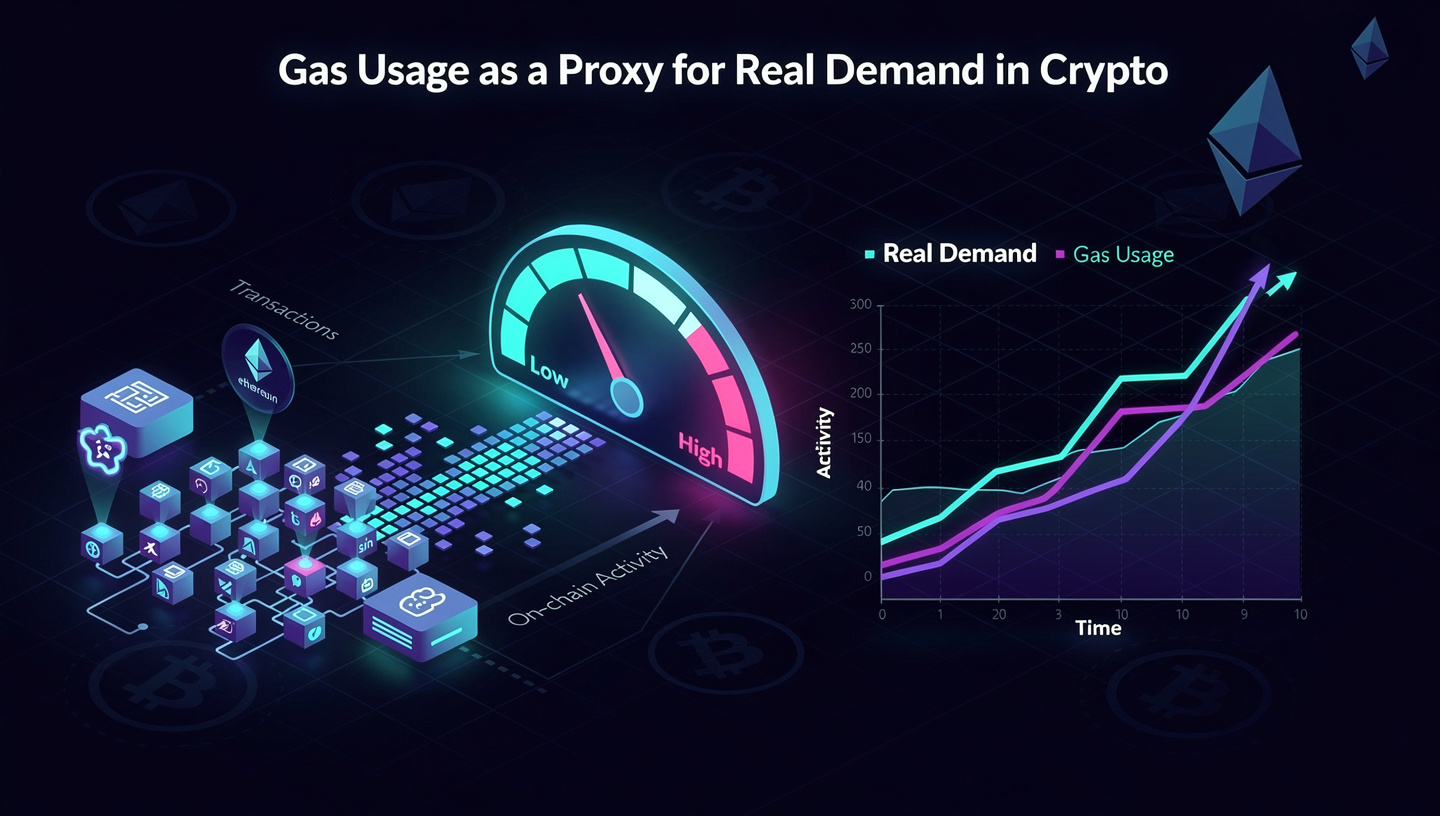
Markets lie. Tokens inflate. Incentives distort behavior. But gas is unforgiving.
Every transaction on a blockchain competes for scarce blockspace. Every smart contract execution consumes computational resources. And every unit of gas must be paid for with real economic value at the moment of execution. This is not theoretical demand. It is not survey-based adoption. It is economic pressure applied directly to a decentralized system.
In traditional markets, demand is inferred through price discovery. In crypto, price is often the last thing to reflect reality—and frequently the most misleading. Gas usage, by contrast, is demand expressed in the language of cost. It is capital voluntarily sacrificed to access blockspace.
If you want to know whether a blockchain is being used—not marketed, not speculated on, not farmed—gas usage is where the signal begins.
1. What Gas Actually Measures (And Why Most People Misunderstand It)
Gas is not a fee. It is not a tax. It is not merely a transaction cost.
Gas is a pricing mechanism for computation and state transition. It measures how much work the network must perform to execute a given action. This includes:
- Simple transfers
- Smart contract interactions
- DeFi protocol executions
- NFT minting and trading
- Layer-2 settlement proofs
- MEV-driven arbitrage
- Governance actions
Every unit of gas represents consumed blockspace, which is the core scarce resource of any blockchain.
Why this matters:
- You cannot generate gas usage without actually using the network.
- You cannot spoof it at scale without incurring proportional cost.
- You cannot inflate it indefinitely without economic consequence.
This makes gas one of the hardest on-chain signals—closer to proof-of-work economics than to social metrics or user counts.
2. Gas Usage vs. Popular Adoption Metrics
Most crypto dashboards prioritize:
- Daily active addresses
- Transaction count
- Wallet growth
- TVL
- Token velocity
Each of these can be manipulated.
Common distortions:
- Airdrop farming inflates active addresses
- Sybil wallets distort user counts
- Wash trading inflates transactions
- Liquidity incentives artificially boost TVL
Gas usage, however, aggregates all activity into a single economic denominator: cost paid for execution.
An address that sends one expensive transaction contributes more to real demand than a thousand dust wallets sending meaningless transfers.
In short:
Gas measures intensity, not just participation.
3. The Economic Logic: Why Gas Reflects Willingness to Pay
Demand is not interest. Demand is not curiosity. Demand is willingness to pay at market price.
Gas fees emerge from:
- User urgency
- Competition for blockspace
- Expected return from execution
- Time sensitivity
When gas usage rises persistently, it implies:
- Users find the network valuable despite cost
- Applications generate sufficient economic return
- The chain is performing economically relevant work
This mirrors traditional infrastructure economics:
- Toll roads measure traffic
- Data centers measure compute utilization
- Payment rails measure transaction throughput
Blockchains are no different. They are economic machines, and gas is the tachometer.
4. Historical Case Studies: When Gas Told the Truth
Ethereum (2017–2024)
Ethereum’s gas usage spiked during:
- ICO boom (2017)
- DeFi Summer (2020)
- NFT cycle (2021)
- Layer-2 settlement growth (2023–2024)
Notably, gas demand persisted even during price drawdowns. This divergence revealed something crucial:
- Speculators left
- Builders and users stayed
Gas usage stabilized at structurally higher levels after each cycle, demonstrating ratcheting real demand, not cyclical hype.
Solana
Solana’s transaction count is massive—but gas-equivalent cost per transaction is near zero.
Result:
- High activity does not equal high economic pressure
- Spam and low-value execution dominate metrics
Gas-normalized demand tells a very different story than raw throughput.
Bitcoin
Bitcoin does not use gas in the EVM sense, but fee pressure per block plays a similar role.
Ordinals and inscription activity revealed:
- Non-monetary demand for blockspace
- Fee markets reacting independently of price
- Users competing economically for inclusion
Again, blockspace demand surfaced before narrative consensus.
5. Gas Usage and Network Valuation
If blockspace is the product, gas is revenue.
This reframes valuation models entirely.
Key implications:
- High gas usage = strong product-market fit
- Persistent fees = monetizable infrastructure
- Fee burn (e.g., EIP-1559) = shareholder return
Networks with sustained gas demand are not “chains.”
They are decentralized compute monopolies.
A network with:
- Low gas usage
- High token price
- Aggressive emissions
…is not early. It is fragile.
6. The Difference Between Organic and Incentivized Gas Demand
Not all gas is equal.
Organic demand:
- User-initiated
- Economically rational
- Repeatable without subsidies
Incentivized demand:
- Reward-driven loops
- Short-lived spikes
- Collapses when rewards end
Advanced analysis requires:
- Segmenting gas by application category
- Tracking post-incentive decay
- Measuring gas per unique economic outcome
True demand persists without bribery.
7. Layer-2s, Rollups, and the Migration of Gas Demand
As execution moves off-chain:
- L2 gas rises
- L1 settlement gas consolidates
- Demand does not disappear—it compresses
This shifts analysis from:
“Which chain has the most gas?”
to:
“Where is gas ultimately settled and paid?”
Ethereum’s role evolves from execution engine to global settlement layer, monetizing rollups through data availability and proof verification.
Gas demand does not vanish. It abstracts upward.
8. Where Gas Fails as a Proxy
Gas is powerful, but not omniscient.
Limitations include:
- Spam in ultra-low-fee environments
- MEV loops inflating short-term demand
- Protocol-level inefficiencies
- Cross-chain activity fragmentation
Gas must be contextualized with:
- Fee per unit of gas
- Revenue retained by the protocol
- Long-term trend consistency
Gas is a necessary signal, not a sufficient one.
9. A Framework for Interpreting Gas Like a Professional
Serious analysis asks:
- Is gas usage rising structurally or cyclically?
- Is it correlated with real fee revenue?
- Is it diversified across applications?
- Does it persist through market drawdowns?
- Is it subsidy-independent?
If the answer is “yes” to most, the network is doing real economic work.
Gas Is the Voice of Reality
In crypto, everything can be simulated—except cost.
Gas usage is not sentiment. It is not belief. It is not marketing. It is capital voluntarily spent to execute computation.
When gas demand rises, the network is being used.
When it persists, the network is needed.
When it monetizes, the network becomes infrastructure.
Ignore price. Ignore narratives. Ignore follower counts.
If you want to know whether a blockchain matters, ask one question:
Who is willing to pay to use it—today, without incentives, at market price?
The answer is written in gas.