Every candle on a crypto chart is a compressed record of thousands of micro-decisions—hesitation, impulse, regret, conviction—executed by people who believe they are rational while quietly negotiating with adrenaline and cortisol. Crypto simply exposes this reality more brutally than any asset class before it. Twenty-four hours a day. No circuit breakers. No closing bell. No institutional pacing. Just raw psychology meeting global liquidity in real time.
This is why crypto feels different.
Not because of blockchains or decentralization—but because emotional feedback loops run faster here than anywhere else in finance.
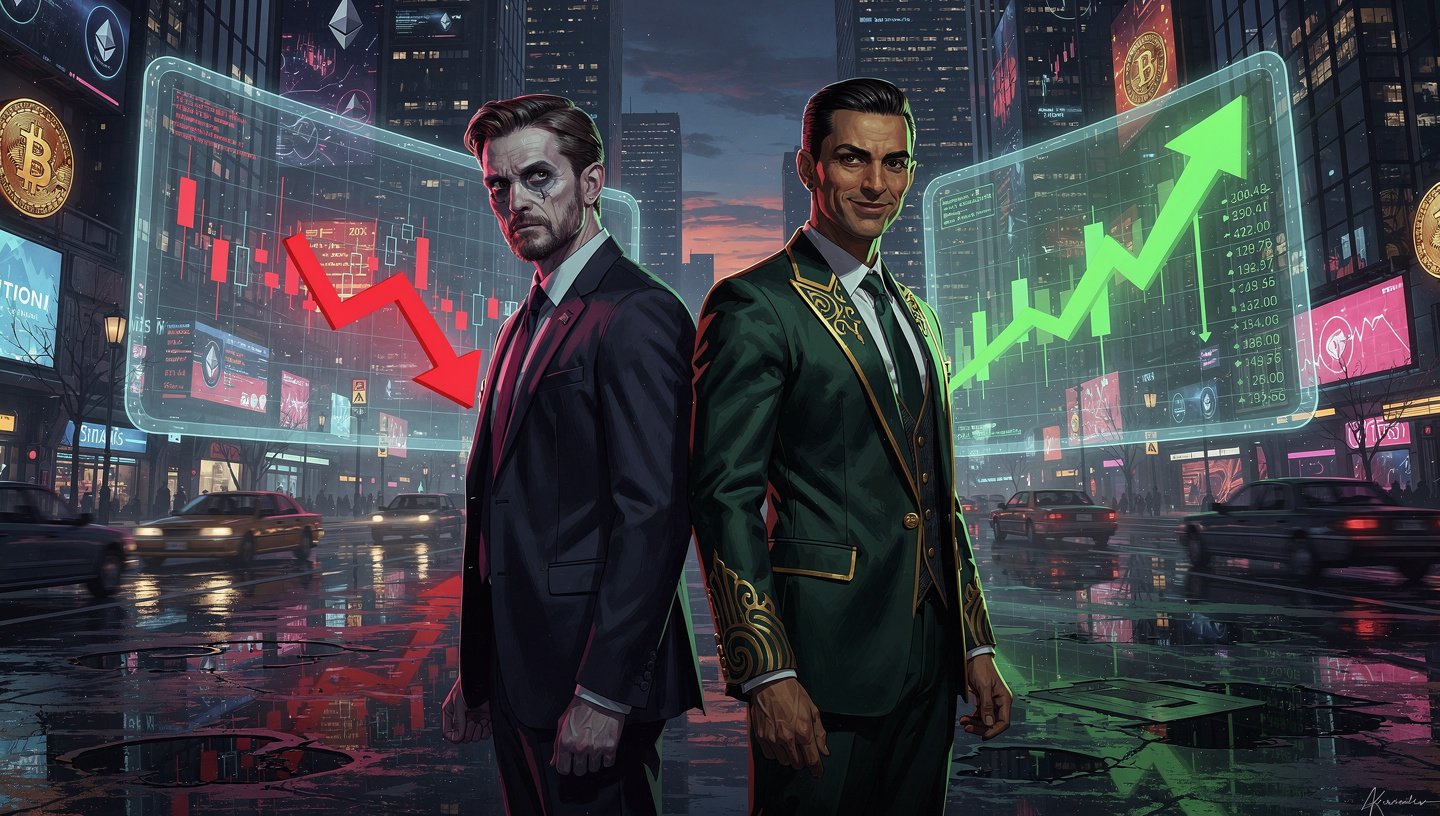
Fear and greed are not side effects of crypto markets. They are the market.
This article dissects how those forces operate, how they propagate through price, volume, and narrative, and—most importantly—how serious participants learn to operate inside them without becoming collateral.
The Emotional Engine of Crypto
Traditional finance evolved guardrails: trading hours, settlement delays, regulatory friction. Crypto removed nearly all of them.
What remains is a pure behavioral laboratory.
In equities, fear and greed unfold over weeks or quarters. In crypto, they compress into minutes.
A single liquidation cascade can erase billions in market cap before lunch. A rumor on X can ignite a parabolic rally in under an hour. A macro headline can turn euphoria into panic across five continents simultaneously.
This acceleration amplifies three psychological traits:
- Loss aversion
- Recency bias
- Social proof
Each one compounds the others.
Loss aversion causes traders to exit winners too early and hold losers too long. Recency bias makes the latest candle feel more important than a year of data. Social proof converts isolated opinions into mass behavior.
Together, they form the emotional flywheel of crypto.
Fear: The Dominant Force in Downtrends
Fear operates faster than greed.
Neurologically, threats receive priority processing over opportunities. When price starts falling, rational analysis gives way to survival instincts. Traders stop asking, “Is this undervalued?” and start asking, “How much worse can this get?”
Fear in crypto manifests in recognizable phases:
1. Denial
Early drawdowns are dismissed as “healthy pullbacks.” Dip buyers step in aggressively. Influencers reassure their audiences. Funding rates remain elevated.
This is not fear yet. This is disbelief.
2. Anxiety
Support levels break. Volatility expands. Long liquidations begin to accelerate.
Traders reduce position sizes. Search interest spikes for phrases like “crypto crash” and “is Bitcoin dead.”
Anxiety replaces confidence.
3. Capitulation
This is the emotional low.
Volume surges as forced liquidations meet panic selling. Long-term holders finally give up. Social feeds fill with anger, mockery, and resignation. Everyone suddenly becomes bearish at the same time.
Ironically, this is where risk is lowest.
Not because price cannot fall further—but because sellers are exhausted.
4. Despair
After capitulation comes silence.
Price moves sideways. Participation collapses. Retail disappears. Media coverage fades. Even professional traders become bored.
This is accumulation territory.
Fear has done its job.
Greed: The Architect of Bubbles
Greed is slower to arrive but far more creative.
Fear destroys capital. Greed convinces people to abandon discipline.
In crypto, greed does not show up as simple optimism. It manifests as narrative expansion.
Suddenly everything has a story:
- This cycle is different
- Institutions are coming
- Mass adoption is inevitable
- Supply shock is guaranteed
Price appreciation invites justification. Justification invites leverage.
Greed evolves through its own stages:
1. Recovery
After a prolonged bear market, price begins to trend higher. Early buyers feel vindicated. Skeptics remain cautious.
This phase is quiet and highly profitable.
2. Confidence
Pullbacks become shallow. Breakouts become frequent. Traders increase exposure. New participants arrive.
Greed is still subtle here.
3. Euphoria
This is where reality bends.
Every dip is bought instantly. Leverage expands. People quit jobs. Influencers gain massive followings overnight. Valuations become untethered from fundamentals.
During euphoria, risk management is framed as pessimism.
This is also when public figures like Elon Musk start materially influencing market psychology with a single post.
Greed peaks not when price peaks—but when skepticism disappears.
Measuring Collective Emotion
Because crypto markets are transparent, emotion leaves measurable fingerprints.
Traders use multiple proxies to quantify fear and greed:
Sentiment Indexes
The most cited benchmark aggregates volatility, volume, social media activity, and momentum into a single score published by Alternative.me. Extreme readings often coincide with local tops or bottoms—not because the indicator predicts price, but because it reflects emotional saturation.
Funding Rates
Perpetual futures funding reveals positioning bias. Excessively positive funding indicates overcrowded longs (greed). Deeply negative funding reflects panic hedging (fear).
Open Interest
Rising open interest during price advances signals speculative leverage. Falling open interest during drawdowns signals forced deleveraging.
Stablecoin Flows
Large inflows into exchanges often precede buying pressure. Large outflows indicate capital seeking safety.
Emotion always precedes price.
The data simply confirms it.
The Feedback Loop: How Emotion Becomes Volatility
Crypto volatility is not random. It is reflexive.
Price moves trigger emotion. Emotion triggers behavior. Behavior amplifies price moves.
Consider a typical liquidation cascade:
- Price drops below a key level
- Leveraged longs are liquidated
- Forced selling pushes price lower
- Stop-losses activate
- Panic selling accelerates
- Social sentiment turns negative
- More traders exit
Each step reinforces the next.
This is George Soros’ reflexivity theory operating at digital speed.
Greed works the same way in reverse.
Breakouts attract momentum traders. Momentum attracts leverage. Leverage creates squeezes. Squeezes attract headlines. Headlines attract retail.
The loop closes.
Why Retail Always Buys High and Sells Low
This pattern persists because of structural asymmetry.
Retail traders enter markets through emotion-first channels: social media, influencers, headlines. Professionals enter through data-first channels: order flow, volatility metrics, liquidity maps.
Retail sees price after it moves.
Professionals position before it moves.
By the time most participants feel confident enough to buy, early adopters are distributing.
By the time most participants capitulate, smart money is accumulating.
This is not conspiracy. It is mechanics.
The Role of Exchanges in Emotional Amplification
Centralized platforms like Binance and Coinbase accelerate emotional cycles by offering:
- High leverage
- Instant execution
- Perpetual derivatives
- Push notifications
These features reduce friction and increase impulsivity.
In traditional finance, emotional mistakes require effort.
In crypto, they require a tap.
Narrative Cycles and Crowd Psychology
Every crypto cycle follows a familiar narrative arc:
- Innovation phase
- Speculation phase
- Mania phase
- Collapse phase
- Forgetting phase
Technological progress continues steadily throughout. Price does not.
Narratives fill the gap between fundamentals and valuation. During bull markets, narratives expand to justify excess. During bear markets, narratives shrink to rationalize despair.
Understanding this cycle allows traders to separate signal from noise.
Professional Strategies for Operating Inside Fear and Greed
Elite traders do not eliminate emotion. They design systems that function despite it.
Here are practical frameworks used by professionals:
1. Predefined Risk Parameters
Entries, exits, and invalidation levels are set before trades are placed. Decisions made in calm states outperform decisions made under stress.
2. Position Sizing Over Conviction
No idea deserves unlimited exposure. Professionals size positions based on volatility, not belief.
3. Scaling Instead of All-In
Accumulation during fear happens in tranches. Distribution during greed happens incrementally.
Binary thinking destroys capital.
4. Sentiment Fading
When consensus becomes extreme, professionals reduce exposure. When sentiment collapses, they quietly build positions.
They do not chase confirmation.
5. Journaling Emotional State
Many serious traders log emotional context alongside trades. Patterns emerge quickly.
Most losses trace back to impatience or overconfidence—not bad analysis.
The Long-Term Investor’s Advantage
Short-term traders fight emotion daily.
Long-term investors exploit it structurally.
By dollar-cost averaging through fear and rebalancing during greed, they convert volatility into opportunity. They do not attempt to time tops or bottoms. They let human behavior work in their favor.
Time arbitrage beats emotional arbitrage.
Crypto as a Mirror
Crypto does not create fear and greed.
It reveals them.
Every boom exposes how easily humans extrapolate recent success. Every crash exposes how quickly conviction evaporates. The technology is neutral. The psychology is not.
This is why crypto remains one of the most educational markets in existence.
It forces participants to confront their biases at full volume.
Final Thoughts
Fear and greed are not flaws in crypto markets. They are features of human participation.
You cannot trade crypto effectively without understanding them.
Charts matter. Fundamentals matter. On-chain data matters.
But psychology governs execution.
Those who master this internal terrain survive cycles. Those who ignore it become liquidity.
In crypto, capital does not transfer randomly.
It moves from the emotionally reactive to the emotionally disciplined.
Every cycle confirms this.