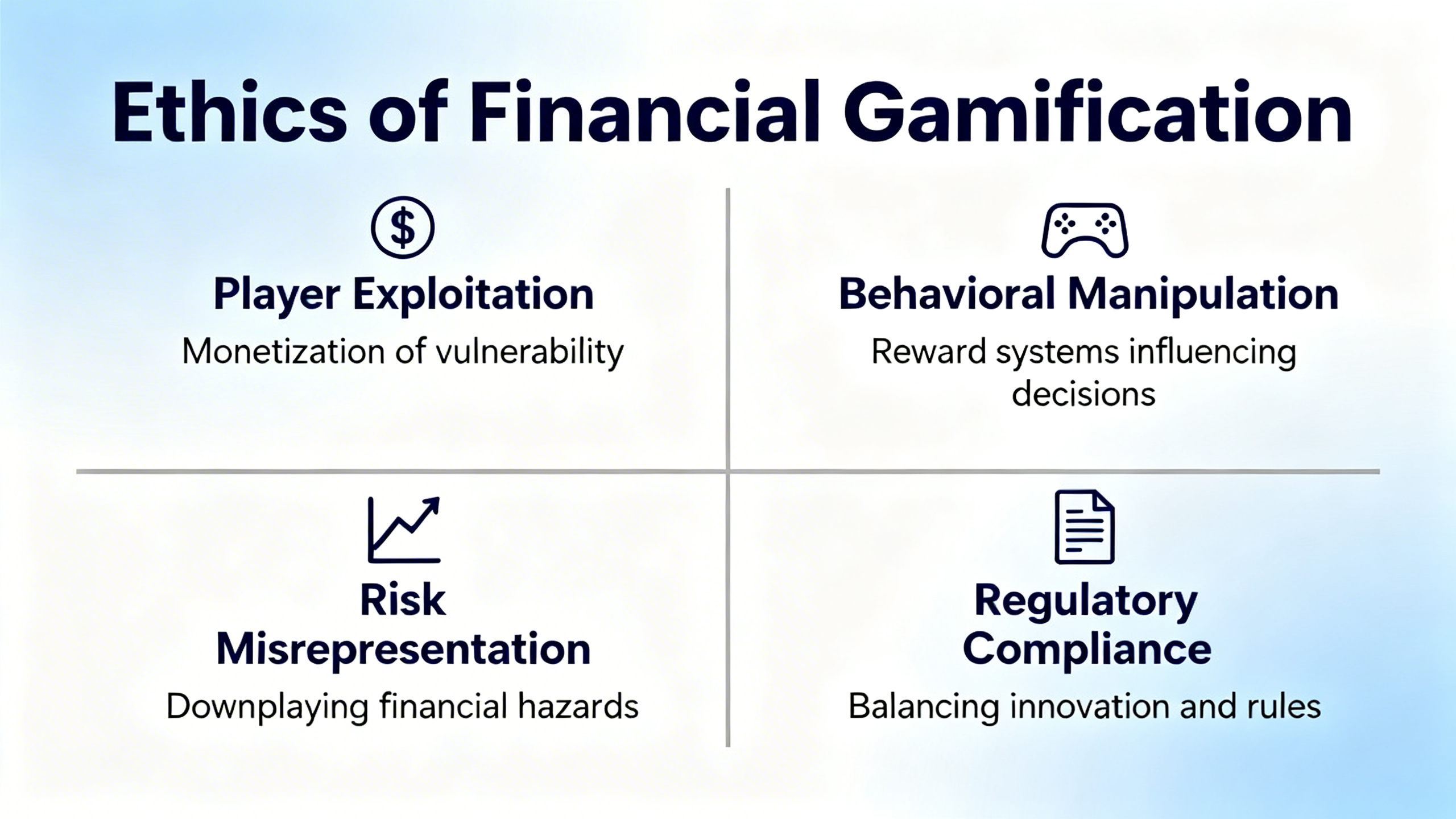
Over the past decade, the financial system has undergone a radical interface transformation. Trading platforms now resemble mobile games. Cryptocurrency exchanges issue badges, leaderboards, and streak rewards. Decentralized finance (DeFi) protocols distribute token incentives for participation. Mobile apps celebrate trades with animations and push notifications engineered to stimulate engagement. What was once austere, institutional, and information-dense has become visually optimized, frictionless, and behaviorally tuned.
This phenomenon—financial gamification—sits at the intersection of behavioral economics, interface design, tokenomics, and digital finance. In crypto markets, where volatility is extreme and retail participation is high, gamification is not a marginal design choice; it is a core growth strategy.
The ethical implications are substantial.
Gamified financial systems alter risk perception, time preference, and decision-making behavior. They can increase accessibility and engagement, but they can also amplify speculative behavior, normalize excessive risk-taking, and blur the distinction between entertainment and capital allocation. In crypto ecosystems built on programmable incentives, these design choices are not incidental. They are structural.
This article provides a research-oriented examination of the ethics of financial gamification in crypto. It analyzes the behavioral mechanisms involved, the moral frameworks applicable, the regulatory tensions emerging globally, and the standards that should guide ethical implementation.
Defining Financial Gamification in Crypto
Financial gamification refers to the application of game design elements in financial products to increase user engagement, retention, and activity. These elements include:
- Reward systems (tokens, yield incentives, badges)
- Variable reinforcement mechanisms
- Leaderboards and rankings
- Streak bonuses
- Progress bars and leveling systems
- Social competition mechanics
- Animated feedback for transactions
- Narrative framing of financial participation
In the crypto sector, gamification operates across multiple layers:
- Centralized exchanges (CEXs) with trading competitions
- DeFi liquidity mining programs
- NFT minting events
- Airdrop campaigns
- Prediction markets
- Play-to-earn ecosystems
- Tokenized governance participation
Unlike traditional finance, where gamification is primarily interface-level, crypto embeds incentives directly into protocol architecture. Token emissions are programmable. Yield structures are algorithmic. Governance rewards are code-enforced.
This distinction makes crypto gamification uniquely powerful—and ethically complex.
Behavioral Foundations: Why Gamification Works
To evaluate ethics, one must first understand mechanisms.
Financial gamification leverages well-documented behavioral science principles:
1. Variable Reward Schedules
Borrowed from behavioral psychology, variable reward systems—similar to slot machine mechanics—create strong engagement loops. In crypto, these appear in:
- Randomized NFT traits
- Lottery-based yield pools
- Unpredictable token price volatility
- Airdrop eligibility speculation
Uncertainty increases dopamine response. The anticipation becomes reinforcing independent of expected value.
2. Loss Aversion and FOMO
Gamified systems exploit loss aversion and fear of missing out (FOMO). Limited-time staking rewards or countdown-based token sales create urgency that overrides deliberative reasoning.
3. Social Comparison
Leaderboards and public wallet tracking foster competitive trading behavior. Relative performance often becomes more motivating than absolute financial health.
4. Immediate Feedback Loops
Push notifications and celebratory animations reward micro-decisions. This reduces psychological friction and increases trade frequency.
5. Sunk Cost Reinforcement
Streak bonuses and tier-based systems encourage continued participation to avoid forfeiting accumulated progress.
These mechanisms are not inherently unethical. However, when applied to high-risk financial environments—especially volatile crypto assets—the stakes escalate.
Crypto-Specific Amplifiers of Ethical Risk
Financial gamification in crypto differs from traditional fintech in several structural ways:
1. Extreme Volatility
Crypto markets exhibit higher volatility than most traditional asset classes. Gamifying participation in such markets amplifies financial harm potential.
2. 24/7 Global Access
Unlike stock exchanges, crypto operates continuously. Gamified incentives can drive around-the-clock engagement without natural cooling-off periods.
3. Tokenized Incentive Structures
Protocols distribute tokens for behavior (liquidity provision, governance voting, staking). These incentives can distort rational economic participation and incentivize short-term extraction over long-term value creation.
4. Pseudonymity
Reduced identity verification lowers barriers to entry. While promoting financial inclusion, it also reduces protective friction for vulnerable users.
5. Youth Demographics
Crypto adoption skews younger. Younger users are more susceptible to gamified reinforcement dynamics and higher risk tolerance.
The combination of these factors increases ethical responsibility for designers and platform operators.
Ethical Frameworks for Evaluating Financial Gamification
Several moral frameworks can be applied:
Utilitarian Analysis
Does gamification increase aggregate welfare? If increased access to financial tools leads to broader participation and wealth creation, benefits may outweigh harms. However, if increased trading frequency correlates with net financial losses, aggregate harm may dominate.
Empirical evidence in retail trading suggests higher trading frequency often reduces net returns due to fees and behavioral biases.
Deontological Ethics
Does gamification respect user autonomy?
If design intentionally manipulates cognitive biases to increase activity against users’ financial interest, it violates autonomy principles. Deception or opaque incentive structures are ethically impermissible under duty-based frameworks.
Virtue Ethics
Does gamification cultivate responsible financial behavior?
Systems that encourage discipline, long-term thinking, and financial literacy align with virtue-based ethics. Systems that reward impulsivity and speculative behavior do not.
Fiduciary Responsibility
Although many crypto platforms avoid formal fiduciary classification, ethical standards analogous to fiduciary duty should apply when platforms influence user capital decisions.
Case Studies in Crypto Gamification
Yield Farming and Liquidity Mining
Protocols such as early decentralized exchanges incentivized liquidity provision through token emissions. While innovative, these systems often led to unsustainable token inflation and short-term extraction strategies.
Participants chased annual percentage yields without understanding impermanent loss or token dilution dynamics.
The ethical question: Is it responsible to market triple-digit APYs through gamified dashboards without prominently displaying downside risks?
NFT Mint Hype Cycles
Limited supply drops combined with social leaderboard tracking and reveal mechanics generate speculative frenzy. Buyers often act under extreme time pressure.
The ethical concern lies in asymmetry of information and artificial scarcity mechanisms designed primarily for hype generation.
Trading Competitions
Centralized exchanges frequently host leaderboard-based trading competitions with rewards for highest volume or profit.
Such competitions incentivize excessive leverage and risk-taking, especially among inexperienced users.
Psychological Harm and Financial Well-Being
Research in behavioral finance suggests that excessive trading correlates with lower long-term returns. Gamification increases transaction frequency.
Potential harms include:
- Financial loss amplification
- Increased gambling-like behaviors
- Stress and compulsive monitoring
- Overestimation of skill
- Desensitization to risk
The boundary between trading and gambling becomes blurred when reward mechanisms resemble casino structures.
Crypto platforms often reject gambling comparisons. However, when behavioral reinforcement mechanisms align with those used in regulated gambling industries, ethical parallels are unavoidable.
Regulatory and Policy Implications
Globally, regulators are increasingly scrutinizing gamified financial products.
In the United States, agencies such as the Securities and Exchange Commission have expressed concern over digital engagement practices in retail trading platforms.
The European Union’s European Securities and Markets Authority has also evaluated the impact of gamification on retail investor protection.
In the crypto domain, regulatory frameworks remain fragmented. However, as digital asset markets mature, financial gamification will likely fall under investor protection and consumer protection regimes.
Key policy questions include:
- Should reward-based trading competitions be restricted?
- Should volatility warnings be mandated alongside gamified interfaces?
- Should platforms be required to disclose behavioral design strategies?
- Should token incentive structures be stress-tested for sustainability?
Regulation alone cannot solve ethical concerns, but it establishes minimum standards.
The Distinction Between Engagement and Exploitation
Engagement is not exploitation. The ethical boundary depends on:
- Transparency of risk
- Alignment of incentives
- Proportionality of rewards
- User informed consent
- Behavioral impact data
An ethically designed crypto platform might:
- Provide clear downside scenarios
- Cap leverage for new users
- Offer educational modules before unlocking advanced features
- Avoid exploitative variable reward mechanics
- Measure long-term user financial outcomes
An unethical platform prioritizes short-term revenue metrics over user well-being.
Designing Ethical Financial Gamification
Ethical implementation requires design principles grounded in responsible innovation:
1. Informed Consent by Design
Risk disclosures must be contextual and unavoidable—not buried in documentation.
2. Default Risk Controls
Leverage limits, cooldown periods, and loss reminders can reduce impulsive decisions.
3. Outcome Transparency
Users should see net profit/loss metrics prominently.
4. Incentive Alignment
Token rewards should reinforce sustainable ecosystem participation rather than extractive speculation.
5. Behavioral Impact Auditing
Platforms should conduct internal assessments measuring how gamification affects trading frequency, holding periods, and loss distribution.
Long-Term Implications for Crypto’s Legitimacy
Crypto markets aim to build parallel financial infrastructure. Legitimacy depends on trust.
If gamified systems systematically encourage reckless speculation, they undermine long-term credibility.
Conversely, gamification can be harnessed to:
- Encourage savings through staking
- Promote governance participation
- Incentivize financial education
- Reward long-term holding behavior
The ethical challenge is directional: whether game mechanics are used to amplify volatility or stabilize participation.
Financial Inclusion Versus Behavioral Manipulation
Proponents argue that gamification lowers psychological barriers to financial participation. Simplified interfaces make complex systems accessible.
Critics argue that simplification obscures complexity and risk.
Financial inclusion is ethically valuable only when accompanied by comprehension. Access without understanding creates asymmetric harm.
Conclusion: Responsibility in Programmable Finance
Financial gamification is not inherently unethical. It is a powerful design methodology capable of increasing engagement, education, and adoption. In crypto ecosystems, however, the line between engagement and exploitation is thin.
When capital allocation is treated as entertainment, the consequences are not virtual. They are economic.
Ethical financial gamification requires transparency, alignment of incentives, behavioral accountability, and structural safeguards. Without these, gamified crypto platforms risk replicating the worst excesses of speculative markets under a veneer of innovation.
The ethical standards adopted today will determine whether crypto evolves into a mature financial system or remains a volatility-driven game.
The responsibility lies not only with regulators, but with protocol designers, exchange operators, token economists, and governance communities.
Programmable finance demands programmable ethics.