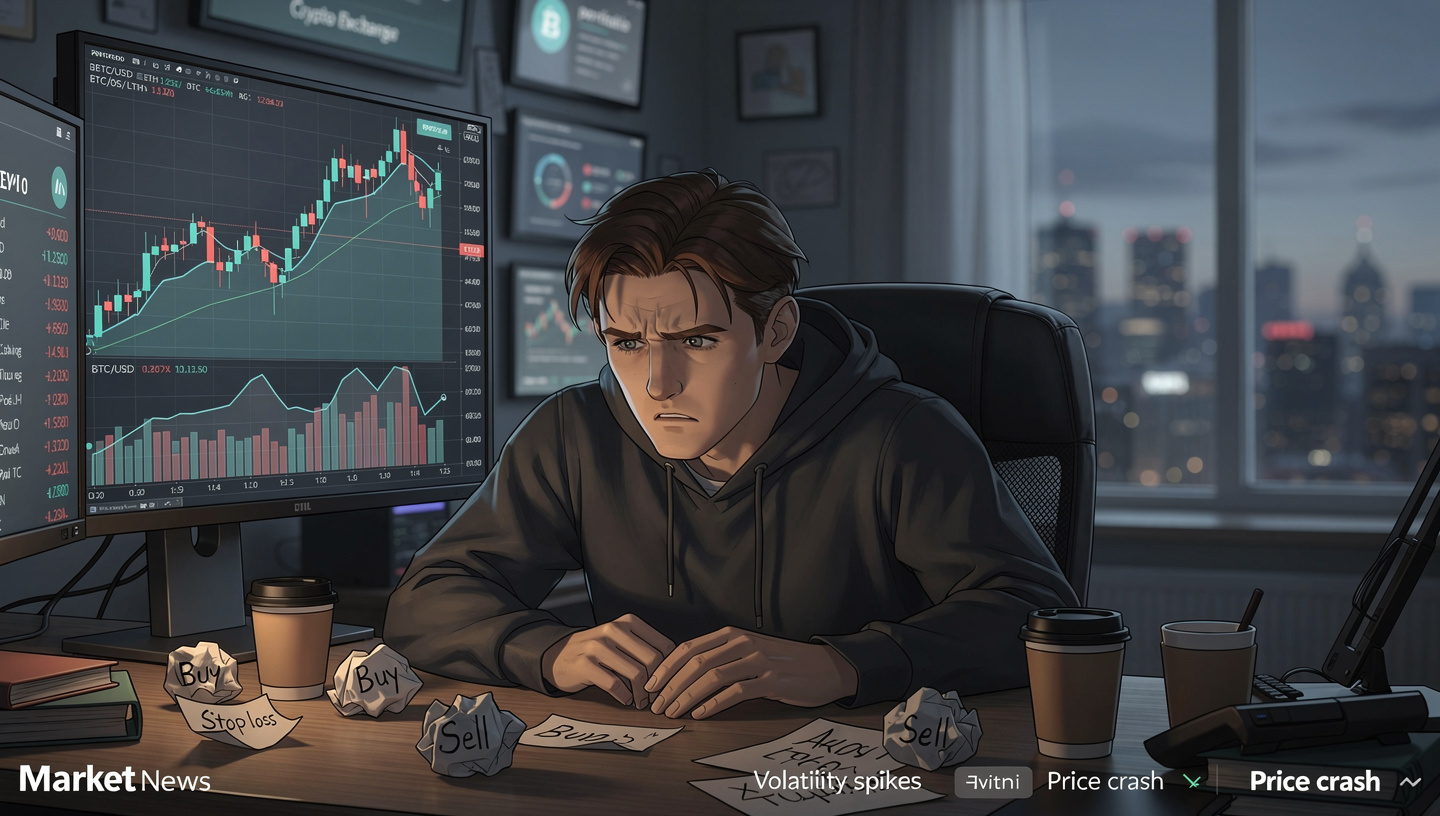
Markets don’t move on logic alone.
They move on fear, pride, impatience, tribalism, hope, regret — and a dozen other invisible forces that live inside the human nervous system.
Crypto simply amplifies all of it.
Twenty-four-hour trading. Extreme volatility. Public P&L screenshots. Influencers calling tops and bottoms in real time. A culture that celebrates overnight millionaires while quietly burying blown accounts.
In this environment, technical knowledge is table stakes. Chart patterns, order books, funding rates — everyone learns those eventually.
What separates consistent survivors from emotional casualties is not intelligence.
It’s psychological control.
You are not competing against algorithms.
You are competing against your own cognitive wiring.
This article dissects the most destructive emotional biases in crypto trading, why they exist, how they manifest in real portfolios, and — critically — how professional traders neutralize them.
No motivational fluff. No vague mindset talk.
Just practical behavioral finance applied to crypto.
Crypto Is a Bias Accelerator
Traditional markets move slowly enough to mask emotional mistakes.
Crypto doesn’t.
When an asset can swing 20% in an afternoon, every unresolved bias becomes expensive fast.
Behavioral economists like Daniel Kahneman proved decades ago that humans are not rational decision-makers. We rely on shortcuts (heuristics) that evolved for survival, not speculative markets. Crypto strips away the guardrails that once protected those flaws.
Instant liquidity.
Permanent visibility.
Global participation.
Social amplification.
This creates a psychological pressure cooker where emotional errors compound at machine speed.
Let’s examine the major ones.
1. FOMO (Fear of Missing Out)
FOMO is the gateway drug of crypto losses.
It emerges when price moves faster than your preparation. You see candles expanding. Twitter fills with rocket emojis. Group chats erupt. Your brain interprets momentum as opportunity — and delay as danger.
So you chase.
You buy extended moves.
You enter without a plan.
You accept bad risk-to-reward.
This bias is rooted in social proof and scarcity perception. Your nervous system treats price acceleration like a limited survival resource.
In practice, FOMO creates:
- Late entries near local tops
- Oversized positions
- Ignored stop losses
- Emotional re-entries after exits
Professionals counter FOMO with pre-defined execution rules:
- Entry levels mapped before price arrives
- Maximum allowable slippage
- Mandatory cooling-off periods after missed trades
If a setup leaves without you, it is invalidated, not chased.
Missing trades is normal. Chasing them is optional.
2. Loss Aversion (Why You Hold Losers Too Long)
Humans feel losses roughly twice as strongly as equivalent gains.
This asymmetry drives one of the most destructive habits in trading:
Cutting winners early.
Letting losers bleed.
In crypto, loss aversion manifests as:
- Moving stop losses lower “just in case”
- Refusing to close underwater positions
- Averaging down without structural confirmation
- Hoping instead of acting
Hope is not a strategy. It’s an emotional delay mechanism.
Every professional trader internalizes one brutal truth:
Small losses are business expenses. Large losses are career-ending mistakes.
They treat stops as mechanical. No debate. No negotiation.
If invalidated, they exit.
Your job is not to be right.
Your job is to survive.
3. Confirmation Bias
Once you enter a position, your brain switches roles.
It stops evaluating objectively and starts defending.
You selectively consume information that supports your trade and ignore contradictory signals. Bullish? You follow bullish analysts. Bearish? You seek bearish narratives.
This bias becomes especially dangerous during major moves in assets like Bitcoin or Ethereum, where narrative momentum often outpaces on-chain or technical reality.
Confirmation bias causes traders to:
- Dismiss weakening volume
- Ignore failed retests
- Rationalize breakdowns
- Hold through obvious reversals
Institutional traders combat this by forcing disconfirmation:
- Actively searching for reasons they might be wrong
- Tracking invalidation levels
- Maintaining bearish and bullish scenarios simultaneously
If you cannot argue against your own position, you are emotionally attached.
And attachment kills accounts.
4. Overconfidence After Wins
Nothing inflates ego faster than a hot streak.
You catch a few clean trades. Your P&L climbs. Suddenly you feel sharper. Faster. Smarter.
Then position sizes increase.
Risk parameters loosen.
Patience evaporates.
Overconfidence is particularly lethal in crypto because volatility rewards recklessness temporarily before punishing it catastrophically.
Classic symptoms:
- Increasing leverage without statistical justification
- Deviating from your system
- Entering marginal setups
- Trading more frequently
Professional traders impose anti-euphoria controls:
- Fixed risk per trade regardless of recent performance
- Daily loss limits
- Mandatory breaks after large wins
They know that confidence is earned over thousands of trades — not five.
5. Recency Bias
Your brain overweights what just happened.
If the market has been bullish for weeks, you expect continuation.
If it dumped yesterday, you anticipate further downside.
This leads to trend-chasing at exhaustion points and panic-selling near bottoms.
Recency bias explains why traders buy tops and sell lows even while understanding technical analysis.
Their short-term memory overrides long-term probabilities.
Combat strategy:
- Use higher timeframe context
- Review historical analogs
- Track rolling statistics rather than emotional impressions
Markets oscillate. Your perception doesn’t.
6. Anchoring
Anchoring occurs when you fixate on a specific price:
- Your entry
- A previous high
- A round number
- Someone else’s target
Once anchored, you evaluate everything relative to that number instead of current market structure.
Examples:
- “I’ll sell when it gets back to my entry.”
- “It already dropped 30%, it can’t go lower.”
- “It hit $X before, so it must again.”
Markets do not care where you bought.
Professionals trade structure, not memories.
7. Sunk Cost Fallacy
Time invested becomes emotional capital.
You researched the project.
You followed the dev updates.
You defended it online.
Now exiting feels like admitting failure.
So you stay.
Even when the thesis breaks.
Crypto is littered with traders who rode collapsing projects to zero because they were psychologically invested.
Capital preservation requires emotional detachment.
If the setup is invalid, the past is irrelevant.
8. Herd Mentality
Crypto culture glorifies consensus.
Narratives spread instantly across Telegram, X, Discord, and YouTube. Entire communities synchronize emotionally around price action.
When everyone is euphoric, risk is highest.
When everyone is terrified, opportunity is near.
Retail traders follow crowds.
Professionals fade them.
This doesn’t mean blindly counter-trading sentiment. It means recognizing when positioning becomes one-sided and volatility asymmetry flips.
Crowds optimize for belonging. Markets reward independence.
9. Authority Bias
A large following does not equal consistent profitability.
Yet traders routinely outsource thinking to influencers, founders, or high-profile figures like Elon Musk.
Authority bias causes traders to:
- Enter without validation
- Hold despite broken setups
- Override personal rules
- Ignore risk management
Smart traders treat every opinion — including their own — as unverified until confirmed by price.
10. Revenge Trading
This one is pure cortisol.
You take a loss. It feels unfair. You want it back immediately.
So you increase size.
You enter impulsively.
You abandon your plan.
Revenge trading turns one small loss into a cascade.
Professionals enforce cooldown protocols:
- Hard stops after consecutive losses
- Mandatory breaks
- Journaling emotional state before re-entry
If your heart rate is elevated, you should not be trading.
The Hidden Cost: Emotional Drawdown
Most traders track financial drawdown.
Few track emotional drawdown.
Every loss consumes psychological capital. Every stressful session reduces decision quality. Over time, this leads to:
- Burnout
- Overtrading
- Risk aversion
- System abandonment
Elite traders manage energy as carefully as capital.
They sleep.
They exercise.
They limit screen time.
They schedule breaks.
Trading is cognitive performance. Treat it like one.
How Professionals Engineer Emotional Neutrality
Consistent traders don’t rely on willpower.
They rely on systems.
Here’s what that typically includes:
1. Rule-Based Execution
Every trade has predefined:
- Entry
- Stop
- Target
- Position size
No improvisation mid-trade.
2. Fixed Risk Models
Risk is constant per trade — usually 0.5%–2% of capital.
Never more.
3. Journaling
They log:
- Setup quality
- Emotional state
- Execution errors
- Outcomes
Patterns emerge. Adjustments follow.
4. Statistical Thinking
They operate in probabilities, not certainties.
Each trade is one data point in a large sample.
5. Identity Separation
They do not identify as bulls or bears.
They identify as risk managers.
The Final Edge Is Psychological
Everyone eventually learns charting.
Everyone can access indicators.
Everyone sees the same order books.
What most never master is themselves.
The difference between blown accounts and long-term profitability is not intelligence, access, or speed.
It is emotional regulation under uncertainty.
Crypto exposes your cognitive flaws with brutal honesty.
It doesn’t care about your conviction.
It doesn’t reward your loyalty.
It doesn’t respect your opinions.
It pays discipline.
If you want to survive this market:
- Respect risk
- Question your impulses
- Build mechanical systems
- Detach from outcomes
- Track your behavior as rigorously as your P&L
Because in crypto, the most dangerous asset on your screen is not leverage.
It’s you.