Let’s start with a simple question.
If you buy a movie on an online platform, do you own it?
If you spend years building followers on social media, do you own that audience?
If you buy a skin in a video game, do you own that item?
Most people instinctively say yes.
And most people are wrong.
In the digital world, ownership is a slippery concept. You feel like you own things, but in reality, you are often just borrowing access — under rules you didn’t negotiate, from companies you don’t control, until they decide otherwise.
This article is not about crypto jargon, speculation, or get-rich-quick schemes.
It’s about something more fundamental:
What does it actually mean to own something online?
And why does digital ownership matter — even if you never touch crypto?
1. Ownership in the Physical World: Simple and Obvious
In the physical world, ownership is intuitive.
If you own a book:
- You can read it
- You can lend it
- You can sell it
- You can burn it (not recommended, but you can)
No one can remotely delete your book.
No company can revoke your access.
No software update can change the rules.
Ownership is enforced by possession + law.
Simple.
2. The Digital World Quietly Changed the Rules
Now compare that to digital goods.
Example 1: Digital Movies
You “buy” a movie online.
Years later, the platform loses a license.
The movie disappears from your library.
You didn’t lose your password.
You didn’t break any rules.
You just… stopped “owning” it.
Example 2: Social Media Accounts
You spend 10 years building an audience.
One algorithm change later, your reach drops 90%.
One policy violation (real or mistaken), your account is gone.
Your content, your followers, your work — vanished.
Example 3: Video Games
You buy in-game items.
The game shuts down.
Everything disappears.
Not refunded.
Not transferred.
Not preserved.
This is the core reality:
Most digital “ownership” today is actually permission.
And permission can be revoked.
3. Why This Happened (And Why We Barely Noticed)
This shift didn’t happen because companies are evil villains twirling mustaches.
It happened because of convenience.
Centralized platforms:
- Store your data
- Manage accounts
- Handle payments
- Make everything easy
And we happily traded ownership for ease.
Nobody reads the Terms of Service.
Nobody thinks about data custody.
Nobody asks who truly controls the asset.
Until something goes wrong.
4. The Hidden Difference: Control vs Access
Here’s the key distinction most people miss:
- Access: You can use something as long as someone allows you to.
- Control: You decide what happens to it.
In the digital world today, most users have access without control.
Platforms can:
- Change rules
- Freeze accounts
- Delete assets
- Restrict transfers
You don’t own the thing.
You own a relationship with the platform.
And relationships are fragile.
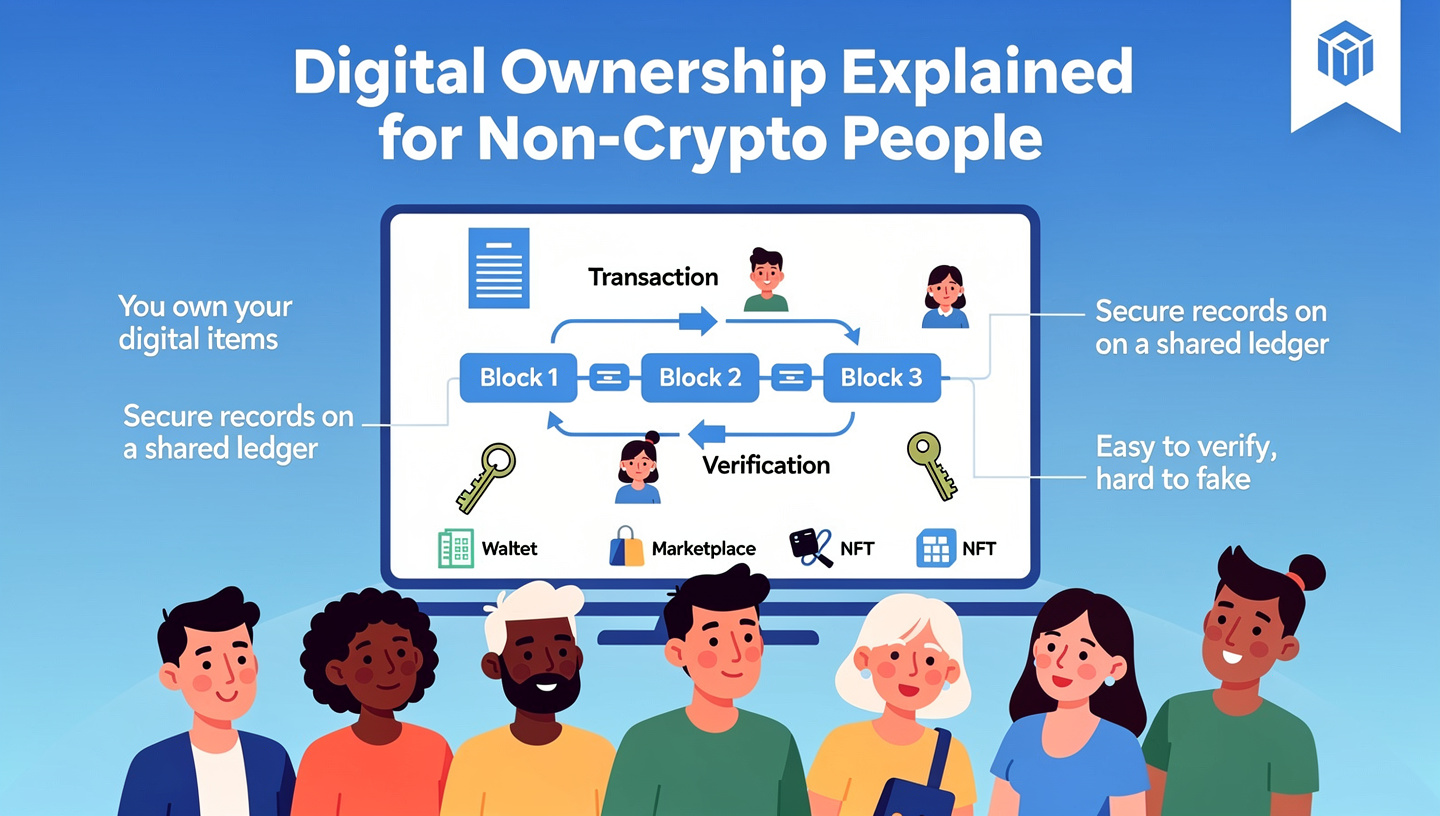
5. Digital Ownership: The Core Idea (No Crypto Required)
Digital ownership, at its core, means:
You control a digital asset directly, without needing permission from a central authority.
That’s it.
No buzzwords required.
True digital ownership means:
- You can hold it independently
- You can transfer it freely
- You can verify it exists
- No one can take it away arbitrarily
This idea sounds obvious.
But implementing it digitally is hard.
6. Why Files Alone Don’t Solve the Problem
Some people say:
“I already own my files. I can download them.”
But files alone don’t solve:
- Scarcity
- Authenticity
- Transfer history
- Duplication
A JPEG can be copied infinitely.
A text file doesn’t prove uniqueness.
A database entry can be edited.
Ownership needs verifiability, not just possession.
This is where modern digital ownership systems come in.
7. A New Model: Ownership Without Trusting a Company
Imagine this:
You own a digital item that:
- Exists independently of any single company
- Can be verified by anyone
- Cannot be altered secretly
- Can be transferred peer-to-peer
No login.
No customer support ticket.
No “please contact us.”
Ownership is enforced by math and networks, not corporate policy.
This is the breakthrough idea behind blockchain-based ownership — but you don’t need to care about blockchains to understand the benefit.
The benefit is self-custody.
8. What This Enables (Beyond Crypto Speculation)
When people hear “digital ownership,” they often think of overpriced JPEGs.
That’s missing the forest for the trees.
Real implications include:
1. Creators Owning Their Work
Artists publish work without platforms owning the distribution.
Writers sell directly without intermediaries.
Musicians earn without opaque royalty systems.
2. Users Owning Their Identity
Your digital identity isn’t locked to one platform.
You move across apps without starting from zero.
3. Games Where Items Actually Belong to Players
Your items persist beyond one game.
You can trade, sell, or keep them independently.
4. Communities Without Central Gatekeepers
Membership isn’t revoked by a moderator’s mood.
Rules are transparent and predictable.
9. Why This Feels Uncomfortable at First
True ownership comes with responsibility.
If you control your asset:
- You are responsible for security
- Mistakes can’t be undone
- There’s no “reset password” button
This scares people — and for good reason.
We’ve been trained to outsource responsibility in exchange for safety nets.
Digital ownership flips that tradeoff.
More power.
More responsibility.
10. “Isn’t This Just for Tech Nerds?”
Not anymore.
Email was once for nerds.
Online banking was once scary.
Cloud storage was once unthinkable.
Every foundational technology starts complex and becomes invisible.
You don’t need to understand TCP/IP to send an email.
You won’t need to understand cryptography to own digital assets.
What matters is who holds the keys — literally and metaphorically.
11. The Real Question Isn’t “Should I Use Crypto?”
The real question is:
Do you want to depend on companies for your digital existence?
Some people are fine with that.
Others want alternatives.
Digital ownership isn’t about rejecting platforms.
It’s about having an exit.
Choice matters.
Conclusion: You Don’t Notice Ownership Until You Lose It
You don’t think about ownership when things work.
You think about it when:
- Accounts get banned
- Assets disappear
- Platforms shut down
- Rules change overnight
Digital ownership is about resilience.
It’s about ensuring that the things you build, buy, and create online don’t vanish because someone else flipped a switch.
You don’t need to be “into crypto.”
You just need to care about agency.