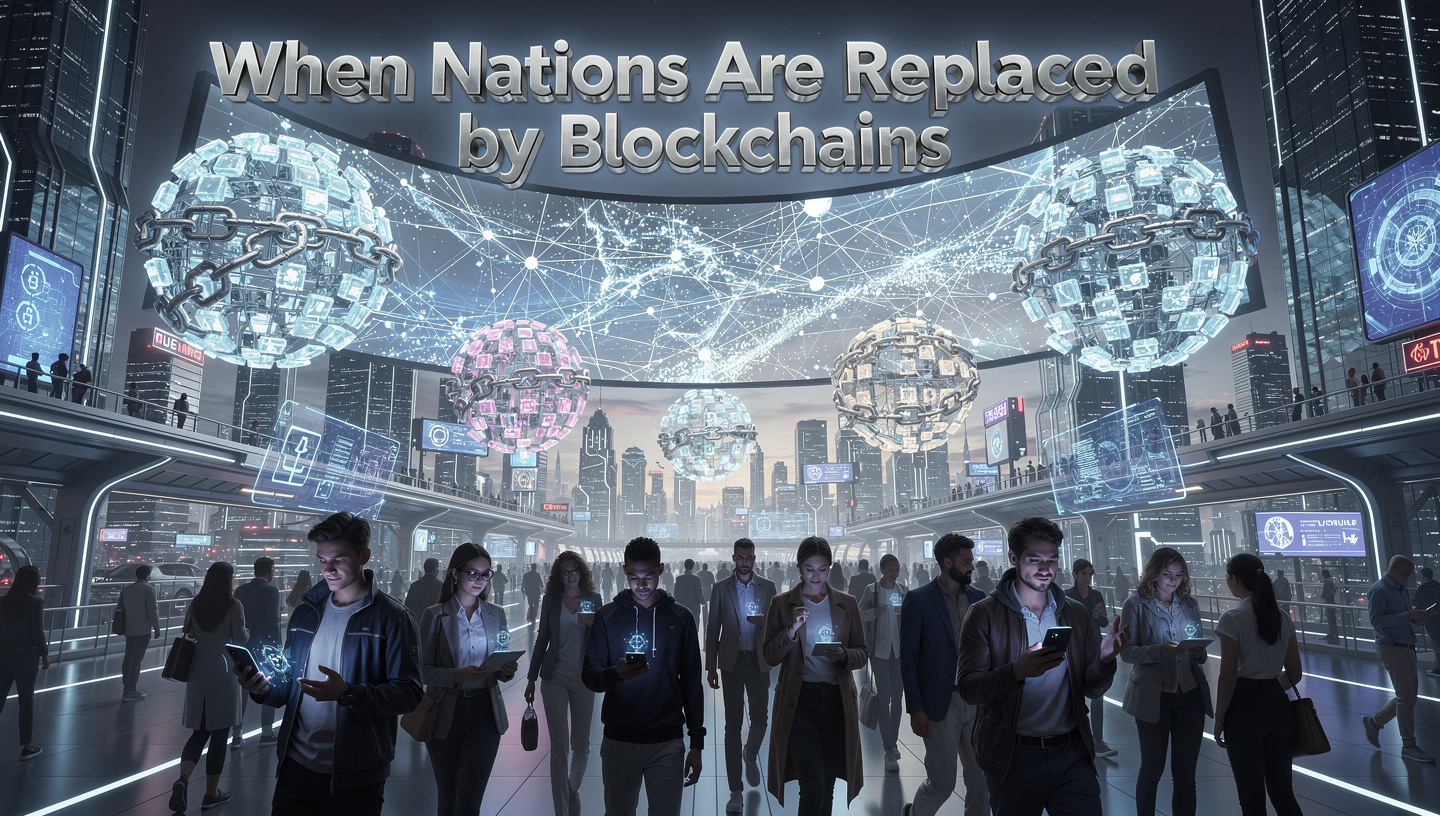
Every civilization eventually collides with the limits of its identity systems.
Paper passports fracture under migration pressure. National ID registries centralize trust into brittle databases. Platform logins outsource personhood to corporations. Even biometric systems—sold as neutral—collapse into surveillance primitives once deployed at scale.
Crypto did not emerge to optimize payments alone. It emerged to answer a deeper question:
What does identity look like when trust is no longer delegated to institutions—but embedded directly into code?
Designing on-chain passports is not merely a technical exercise. It is an act of speculative governance. It requires us to model citizenship without states, credentials without authorities, reputation without platforms, and rights without borders.
This article approaches on-chain passports as worldbuilding infrastructure: a composable identity layer for a post-institutional society. Not a product. Not a startup pitch. A systemic architecture.
We will cover:
- Why legacy identity fails at global scale
- What “on-chain passports” actually are (and are not)
- Core primitives: attestations, zero-knowledge, soulbound state
- Governance models for decentralized citizenship
- Privacy, coercion resistance, and adversarial design
- Economic implications of portable identity
- Failure modes and civilizational risks
- A reference architecture for a planetary identity stack
This is not a story. It is a design blueprint.
1. The Identity Crisis of the Physical World
Modern identity systems are artifacts of nation-states.
They assume:
- Fixed geography
- Central registrars
- Manual verification
- Physical documents
- Jurisdictional silos
These assumptions break under digital globalization.
Today:
- Over one billion people lack formal ID.
- Refugees lose credentials during displacement.
- Data breaches expose entire populations.
- Corporations mediate identity via email addresses and OAuth.
- Governments weaponize registries for control.
Identity has become:
- Fragmented across platforms
- Non-portable across borders
- Monetized without consent
- Revocable by centralized actors
Crypto challenges this by introducing sovereign key ownership.
If you control a private key, you control an address.
If you control an address, you control assets.
The next logical step:
If you control an address, why not also control your identity?
2. From Wallets to Persons
Blockchains already host proto-identities.
Every address expresses behavior:
- Transaction history
- Contract interactions
- Social graph adjacency
- Governance participation
On networks like Ethereum, addresses function as persistent agents. They vote. They stake. They deploy code.
But wallets lack semantic meaning. They represent keys, not people.
An on-chain passport adds:
- Human continuity
- Credential aggregation
- Reputation memory
- Rights attribution
It transforms a wallet from a financial container into a civic object.
This is a categorical shift.
3. Defining an On-Chain Passport
An on-chain passport is not a JPEG NFT.
It is a cryptographically anchored identity container with the following properties:
3.1 Self-Custody
The user—not a registry—controls the root key.
Identity is wallet-native.
Lose the key, lose the passport.
No helpdesk. No reset email.
This is harsh—but it eliminates institutional dependency.
3.2 Composable Credentials
The passport aggregates attestations:
- Education proofs
- Employment history
- Residency claims
- DAO memberships
- Skill certifications
Each attestation is:
- Signed by an issuer
- Stored on-chain or via content-addressed storage
- Revocable by the issuer
- Selectively discloseable by the holder
No single authority defines identity.
It emerges from many issuers.
3.3 Zero-Knowledge Selectivity
You never reveal raw data.
Instead, you generate proofs:
- “I am over 18”
- “I passed KYC”
- “I am not on this sanctions list”
- “I hold this credential”
without revealing:
- Birthdate
- Name
- Address
- Credential contents
Zero-knowledge circuits enforce this boundary.
Privacy becomes structural—not policy-based.
3.4 Non-Transferability
A passport cannot be sold.
This is often implemented via soulbound state: identity tokens bound permanently to an address.
Financial assets are liquid.
Identity is not.
This prevents markets for citizenship.
4. Core Technical Primitives
Designing on-chain passports requires five foundational layers.
4.1 Decentralized Identifiers (DIDs)
DIDs define how identities are resolved without central servers.
They map:
did:chain:address → public keys + service endpoints
This standardization effort is stewarded by World Wide Web Consortium.
DIDs enable:
- Key rotation
- Multi-device access
- Recovery schemes
- Cross-chain portability
They are the DNS of decentralized identity.
4.2 Verifiable Credentials
Credentials are cryptographically signed claims.
Example:
“University X attests that Address Y earned Degree Z.”
They are:
- Machine-verifiable
- Human-readable
- Selectively revealable
Stored off-chain. Anchored on-chain.
Think of them as identity atoms.
4.3 Attestation Registries
Smart contracts that track:
- Credential hashes
- Issuer signatures
- Revocation status
These registries act as global notaries.
Anyone can verify claims without contacting issuers.
4.4 Zero-Knowledge Proof Systems
ZK allows identity without exposure.
You prove statements about credentials without revealing credentials themselves.
This is non-negotiable.
Without ZK, on-chain passports become surveillance passports.
4.5 Social Recovery Graphs
Key loss is inevitable.
Recovery is handled through:
- Trusted contacts
- DAO guardians
- Multi-signature thresholds
Identity persists even when hardware fails.
5. Governance: Who Defines a Citizen?
A passport implies membership.
Membership implies governance.
In a decentralized world, citizenship becomes programmable.
Possible models:
5.1 DAO Citizenship
DAOs issue passports to contributors.
Rights include:
- Proposal submission
- Treasury access
- Voting power
Citizenship becomes performance-based.
5.2 Proof-of-Personhood
Systems attempt to ensure:
- One human = one passport
Some experiments (such as Worldcoin) pursue biometric uniqueness.
This approach is controversial:
- Hardware trust assumptions
- Biometric permanence
- Centralized issuance risk
Alternative methods rely on:
- Web-of-trust graphs
- Randomized verification ceremonies
- Social attestations
No solution is perfect.
This remains an open research domain.
5.3 Reputation-Weighted Governance
Voting power scales with:
- Historical participation
- Attested expertise
- Economic stake
- Social trust
This replaces plutocracy with reputation markets.
6. Economic Implications of Portable Identity
On-chain passports collapse friction across systems.
6.1 Credit Without Banks
Lenders evaluate:
- Transaction history
- Employment attestations
- DAO participation
No credit bureaus.
Capital flows directly to provable actors.
6.2 Labor Without Platforms
Workers present:
- Skill credentials
- Project history
- Peer endorsements
Employment becomes peer-to-peer.
6.3 Borders Without States
Residency rights are granted by communities.
Cities become DAOs.
Nations become networks.
Mobility becomes permissionless.
7. Privacy Is Architecture, Not Policy
Most identity systems fail because they bolt privacy on later.
On-chain passports must embed privacy from genesis.
Key principles:
- Minimal disclosure by default
- ZK proofs everywhere
- No global identity index
- No universal identifier
- Multiple personas per human
A person may hold:
- A professional passport
- A civic passport
- A pseudonymous creative passport
These identities must remain unlinkable unless the user consents.
Anything less produces a total surveillance layer.
8. Adversarial Design: Assume Hostility
You must assume:
- Governments will demand backdoors
- Corporations will attempt capture
- Criminals will try to forge credentials
- Users will lose keys
- Sybil attackers will flood the system
Therefore:
- Issuers must be decentralized
- Proof systems must be open-source
- Recovery must be social, not custodial
- Identity graphs must be anti-sybil
- Governance must be forkable
An on-chain passport system that cannot fork is already authoritarian.
9. Civilizational Risk Scenarios
Worldbuilding requires modeling failure.
Scenario A: Identity Becomes Financialized
Passports accrue yield.
Reputation is traded.
Citizenship becomes collateral.
Result: neo-feudalism.
Mitigation: strict non-transferability and reputation decay.
Scenario B: State Capture
Governments mandate specific issuers.
Blacklists propagate globally.
Result: cryptographic authoritarianism.
Mitigation: multi-jurisdictional issuance and forkable registries.
Scenario C: Biometric Centralization
A single proof-of-personhood provider dominates.
Result: irreversible global identity monopoly.
Mitigation: pluralistic personhood protocols.
10. Reference Architecture: A Planetary Identity Stack
A robust on-chain passport system includes:
Layer 1 – Settlement
Base blockchain (e.g., Bitcoin or Ethereum)
Handles:
- Finality
- Security
- Root identity anchors
Layer 2 – Identity Contracts
Smart contracts for:
- DID resolution
- Credential registries
- Revocation lists
Layer 3 – Proof Layer
ZK circuits for:
- Age proofs
- Sanctions checks
- Credential ownership
Layer 4 – Issuer Network
Universities, DAOs, employers, cities issue attestations.
No privileged issuers.
Layer 5 – Wallet UX
Users manage:
- Personas
- Disclosure preferences
- Recovery guardians
UX determines adoption.
Layer 6 – Governance Meta-Protocol
Defines:
- Citizenship rules
- Voting mechanisms
- Fork conditions
This is the constitutional layer.
11. The Philosophical Shift
Traditional identity answers:
Who are you according to the state?
On-chain passports ask:
What can you cryptographically prove about yourself?
This reframes personhood from bureaucratic classification to voluntary signal.
It aligns with the original crypto ethos articulated by figures like Vitalik Buterin: systems should minimize trust and maximize verifiability.
Identity becomes:
- Emergent
- Composable
- Permissionless
- Globally legible
Not granted. Constructed.
Conclusion: Citizenship as Code
Designing on-chain passports is not about replacing paper IDs.
It is about redefining civilization’s identity substrate.
In this world:
- You carry your credentials across borders instantly.
- Your reputation cannot be erased by institutions.
- Your rights are enforced by cryptography.
- Your identity exists independent of any state.
This is not utopian.
It is simply the logical consequence of programmable trust.
Blockchains already let us own money.
On-chain passports let us own ourselves.
The question is no longer if decentralized identity will exist.
The question is whether it will be built with pluralism, privacy, and forkability—or whether it will calcify into a new digital empire.
Worldbuilding is design under uncertainty.
On-chain passports are where cryptography meets citizenship.
And whoever designs them is not just building software.
They are writing the constitutional layer of a post-national world.