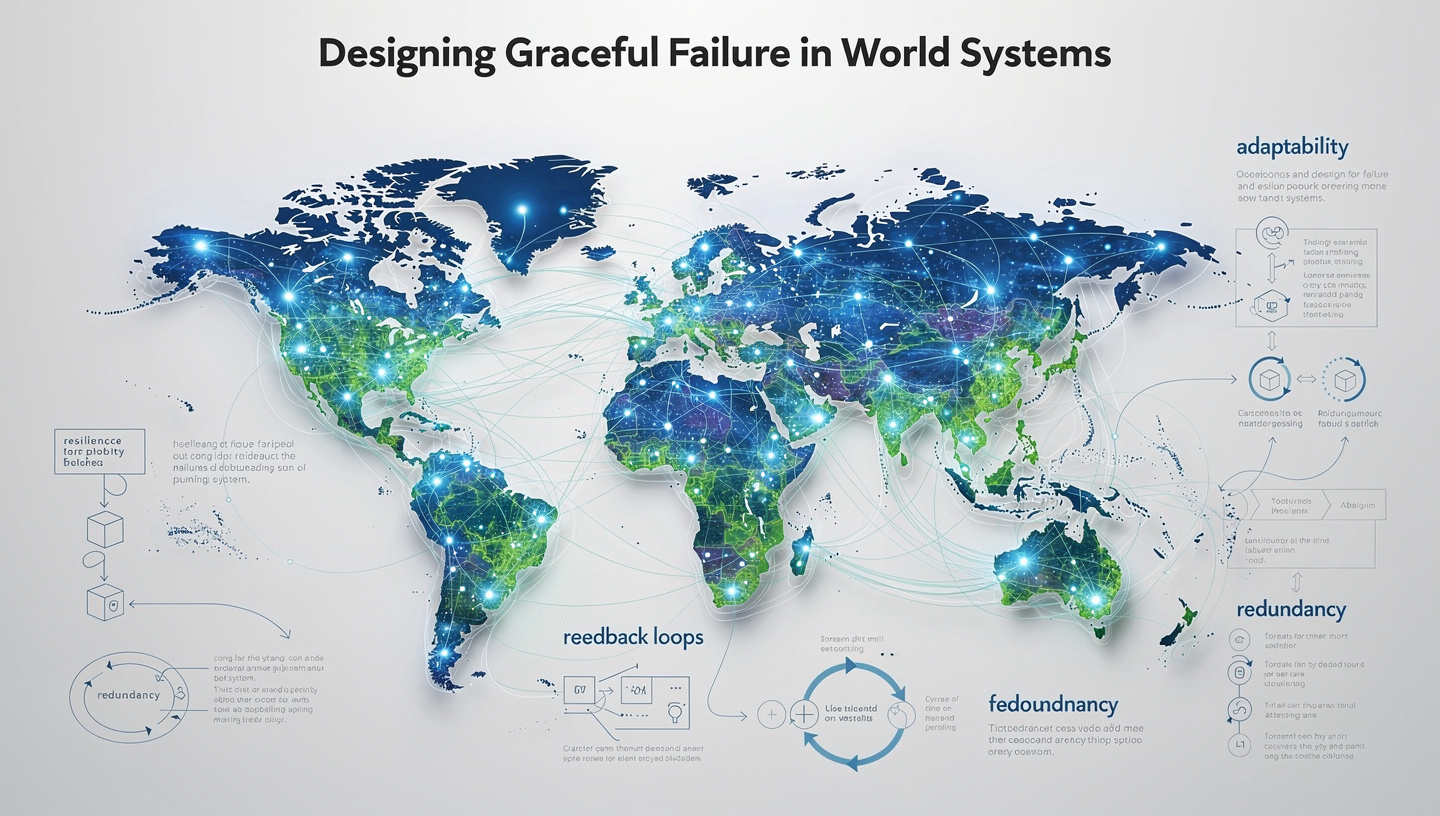
Every complex system fails. The only question is how.
In traditional institutions, failure is often treated as an aberration—something to be concealed, litigated away, or patched over after the damage is done. In decentralized crypto ecosystems, failure is unavoidable, observable in real time, and permanently archived on-chain. This radical transparency forces a different design philosophy: failure must be anticipated, shaped, and metabolized.
Worldbuilding in crypto is not merely about building protocols. It is about constructing entire socio-technical civilizations: economies, governance regimes, incentive architectures, cultural norms, and mythologies—each layered atop fragile code. When these worlds fracture, they do so publicly. Capital migrates instantly. Communities fork. Narratives rewrite themselves overnight.
Graceful failure, therefore, becomes a civilizational primitive.
This article explores how crypto systems can be architected to fail well: to degrade safely, preserve human coordination, minimize systemic contagion, and enable regeneration rather than collapse. We will examine failure as an ecological process, not an engineering exception—and outline concrete design patterns for building resilient crypto worlds.
1. World Systems, Not Products
Most crypto projects are still framed as products: chains, apps, tokens, or protocols.
That framing is insufficient.
Mature crypto ecosystems behave more like world systems:
- They have populations (users, validators, builders).
- They possess economies (tokens, fees, liquidity flows).
- They encode laws (smart contracts, governance processes).
- They develop cultures (memes, norms, shared language).
- They experience migration, conflict, and ideological schisms.
Once a system reaches this level of complexity, linear failure models break down. A bug is no longer just a bug—it is a political event. A governance vote is not just a parameter change—it is a constitutional moment.
Designing graceful failure means designing for:
- Social coordination under stress
- Capital flight dynamics
- Narrative realignment
- Power redistribution
- Cultural continuity
In other words, you are no longer building software. You are shaping emergent civilizations.
2. The Inevitability of Breakdown
Complex adaptive systems obey a consistent pattern:
- They grow.
- They specialize.
- They centralize.
- They become brittle.
- They rupture.
Crypto is not exempt.
Even canonical networks such as Bitcoin and Ethereum—often mythologized as antifragile—have experienced:
- Consensus crises
- Client bugs
- Governance deadlocks
- Miner or validator centralization
- Narrative fractures
Failure is not a sign of weakness. It is a structural certainty of scale.
The design question is not whether failure will occur.
It is:
- Will failure be localized or systemic?
- Will recovery be possible without elite intervention?
- Will participants retain agency during collapse?
- Will trust evaporate—or transmute?
Graceful failure treats breakdown as a managed phase transition rather than an existential threat.
3. Hard Failure vs. Graceful Failure
Hard Failure
Hard failure is characterized by:
- Abrupt halts
- Frozen assets
- Irreversible corruption
- Legal or administrative rescues
- Social panic
- Permanent loss of legitimacy
Examples include centralized exchange implosions, algorithmic stablecoin death spirals, or governance coups.
Hard failure destroys worlds.
Graceful Failure
Graceful failure, by contrast, exhibits:
- Progressive degradation
- Partial functionality retention
- Transparent fault visibility
- Voluntary exits
- Forkability
- Narrative continuity
Graceful failure allows a system to bend, fragment, and recombine.
It enables what might be called civilizational composting: old structures decay, nutrients flow forward, and new ecosystems emerge from the remnants.
4. Crypto’s Unique Failure Substrate
Crypto worlds operate on substrates unavailable to traditional systems:
a. Programmable Exit
Users can withdraw capital permissionlessly.
This creates instantaneous feedback loops. Design must assume that confidence shocks propagate at machine speed.
b. Forkability
Code and communities can split. This enables evolutionary branching rather than terminal collapse.
c. On-Chain Memory
Failures are immutably recorded. There is no historical erasure—only reinterpretation.
d. Pseudonymous Identity
Participants can shed reputations and re-emerge, creating fluid social topology.
These properties make crypto uniquely capable of graceful failure—if consciously designed.
5. Modular Architecture as Civilizational Shock Absorber
Monolithic systems fail catastrophically.
Modular systems fail locally.
Graceful crypto worlds are built from semi-autonomous components:
- Execution layers
- Settlement layers
- Governance frameworks
- Liquidity venues
- Identity primitives
When one module collapses, others can survive.
This is not merely technical modularity—it is social modularity. Independent sub-communities, DAOs, or application clusters can detach without tearing the entire fabric.
The lesson: avoid single points of social truth.
6. Redundancy Without Centralization
Redundancy is not optional in world systems.
But centralized redundancy (one canonical client, one governance body, one treasury) simply moves fragility upstream.
Graceful design distributes redundancy across:
- Multiple client implementations
- Competing governance forums
- Diverse validator geographies
- Parallel liquidity sources
Plurality prevents synchronized failure modes.
7. Designing Economic Degradation Paths
Most token economies assume permanent growth.
This is fantasy.
Real systems require degradation pathways:
- Fee markets that adapt downward
- Inflation schedules that can reparameterize
- Incentives that soften rather than snap when participation declines
Without these, economic stress cascades directly into social breakdown.
Graceful failure means encoding recession scenarios into tokenomics—not just bull markets.
8. Governance That Survives Stress
Governance systems usually fail first.
Why?
Because they are optimized for normal conditions.
Under crisis, voter apathy spikes, whales consolidate power, and emergency measures bypass legitimacy.
Design patterns for graceful governance failure include:
- Time-delayed execution
- Multi-chamber proposal pipelines
- Emergency-only parameter scopes
- Explicit “constitutional pause” mechanisms
Governance must degrade into smaller, slower, more conservative forms—not accelerate toward authoritarianism.
9. Cultural Memory as Infrastructure
Code is not enough.
Crypto worlds persist through stories.
Narratives about past failures—fork wars, exploits, ideological schisms—become cultural antibodies. Communities that ritualize their own disasters build resilience.
This is why early events like the The DAO collapse remain foundational myths rather than embarrassing footnotes.
Graceful failure requires memorialization, not erasure.
10. Migration as a First-Class Primitive
Participants do not stay in dying worlds.
They migrate.
Designing graceful failure means formalizing migration:
- Portable identity
- Reputation bridges
- Asset exit ramps
- Data exportability
Without these, users are trapped—turning technical failure into moral injury.
Migration pathways allow civilizations to dissolve without becoming prisons.
11. Observability Over Illusion
Opacity amplifies panic.
Graceful systems expose:
- Treasury health
- Validator participation
- Governance activity
- Protocol risks
Real-time dashboards are not cosmetic—they are stabilizing forces. People tolerate decline when they understand it.
Silence breeds conspiracy.
12. Failure Budgets for Protocols
Just as engineering teams maintain error budgets, crypto worlds require failure budgets:
- Maximum acceptable drawdowns
- Governance participation floors
- Validator churn thresholds
- Liquidity concentration limits
When thresholds are crossed, pre-programmed responses activate.
This transforms surprise catastrophes into managed transitions.
13. Avoiding Civilizational Debt
Short-term growth hacks accumulate civilizational debt:
- Unsustainable APYs
- Over-incentivized liquidity
- Centralized backstops
- Narrative overpromising
These choices defer pain while amplifying its eventual magnitude.
Graceful failure requires paying costs early and visibly.
14. Designing for Partial Death
Not everything must survive.
Graceful systems allow parts of themselves to die:
- Deprecated protocols
- Sunsetting DAOs
- Archived applications
Planned obsolescence prevents uncontrolled rot.
Civilizations that cannot let go accumulate undead infrastructure.
15. Simulation and Chaos Engineering for Societies
Crypto teams routinely simulate load.
Few simulate collapse.
Worldbuilders should run:
- Governance attack drills
- Liquidity evaporation scenarios
- Validator mass-exit models
- Narrative shock tests
Chaos engineering should include social variables, not just infrastructure.
16. Power Diffusion Under Stress
Failure concentrates power unless actively resisted.
Emergency multisigs, core dev cabals, or foundation interventions may stabilize systems—but they also rewrite constitutions by precedent.
Graceful failure disperses emergency authority across:
- Multiple independent signers
- Transparent deliberation channels
- Time-locked responses
Power must fragment during crisis, not consolidate.
17. Forkability as Evolutionary Pressure
Forks are often framed as disasters.
They are evolutionary events.
The ability for communities to split ensures ideological diversity and reduces zero-sum capture. Forks convert conflict into parallel experimentation.
Design worlds that make forking socially and technically viable.
18. The Role of Minimalism
Overengineered systems collapse under their own weight.
Graceful worlds favor:
- Simple primitives
- Composable modules
- Sparse governance layers
Minimalism reduces surface area for catastrophic interaction effects.
19. Measuring Gracefulness
You cannot optimize what you do not measure.
Key indicators include:
- Recovery time after shocks
- User retention during drawdowns
- Governance participation volatility
- Capital exit velocity
- Narrative sentiment dispersion
Graceful failure is empirically observable.
20. Toward Regenerative Crypto Civilizations
The ultimate goal is not resilience.
It is regeneration.
World systems should emerge from failure transformed:
- New norms
- Revised governance
- Refined economics
- Stronger cultural identity
Collapse becomes curriculum.
Conclusion: Failure as a Civilizational Skill
Crypto is teaching humanity how to build worlds in public.
These worlds will fail. Repeatedly.
The question is whether they fail like brittle empires—or like living ecosystems.
Graceful failure is not softness. It is structural maturity.
It requires humility in architecture, restraint in governance, pluralism in culture, and foresight in economics. It demands that builders accept impermanence as a design constraint and treat collapse as a phase of growth rather than a terminal event.
The crypto systems that endure will not be those that avoid failure.
They will be those that learn how to fall without shattering.
Design accordingly.