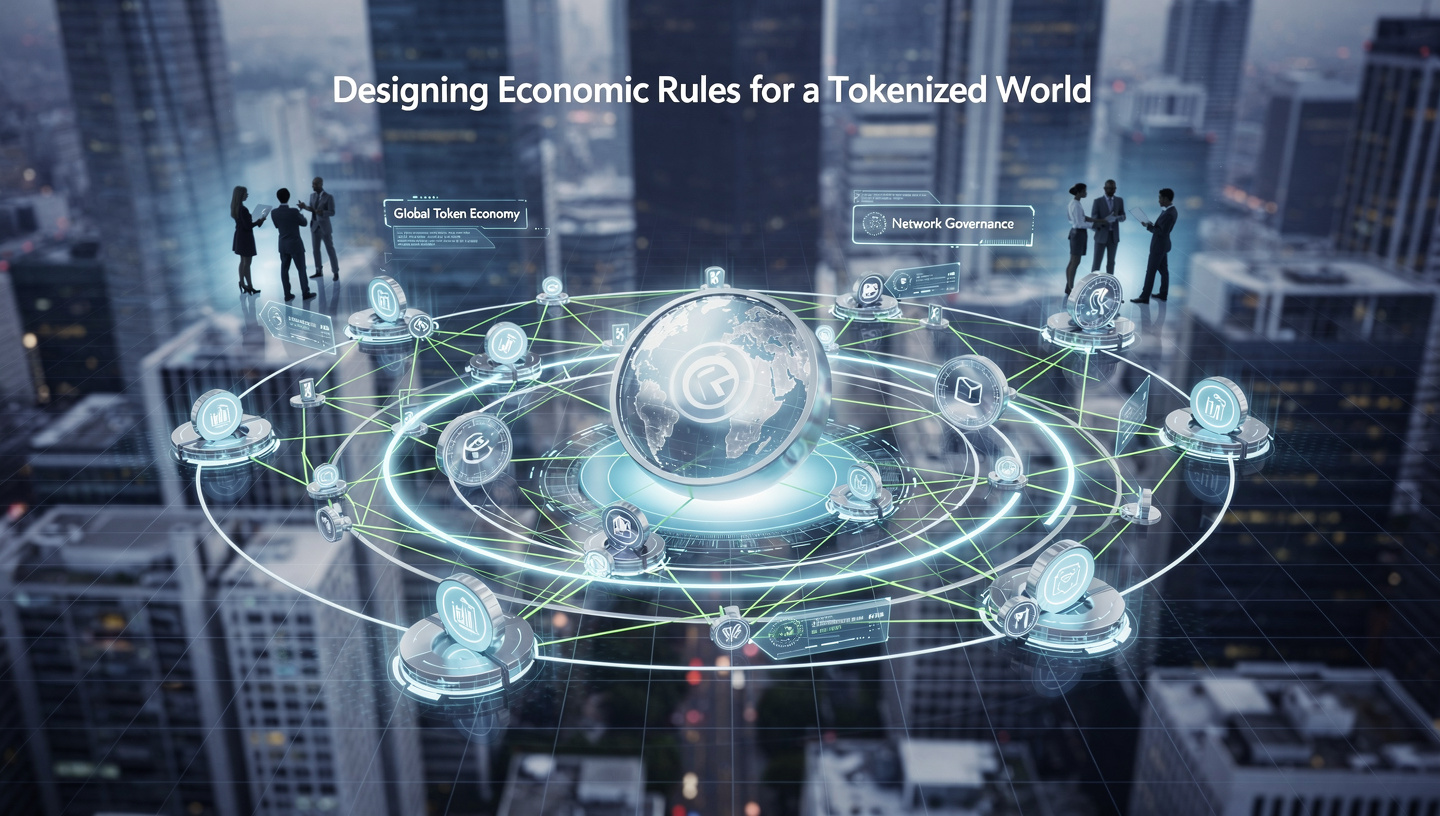
Every civilization that endured learned the same lesson in different ways: economies are not emergent accidents. They are designed systems, shaped by incentives, constraints, and collective belief. Coins replaced barter. Banks replaced vaults. Digital ledgers replaced paper trails.
Now, cryptographic networks are attempting something far more radical.
They are encoding economics directly into software.
Public blockchains such as Bitcoin and Ethereum are not merely payment rails. They are programmable civilizations—global economic laboratories where monetary policy, property rights, governance, and social coordination are expressed as executable logic.
This article examines how to design economic rules for such a world.
Not as a speculative story, but as a serious act of worldbuilding: defining currencies, incentives, institutions, and failure modes inside tokenized systems that may soon rival nation-states in scale.
1. Tokenization as a New Economic Substrate
Tokenization converts real or abstract value into on-chain units: currencies, governance rights, access credentials, reputation, or ownership claims.
Unlike traditional finance, where legal systems arbitrate disputes and central authorities adjust policy, tokenized environments rely on deterministic rules. Once deployed, these rules execute automatically.
This creates a structural inversion:
- Law becomes code
- Policy becomes parameters
- Trust becomes cryptography
The result is an economic substrate where:
- Scarcity is enforced by consensus
- Transfers are final
- Contracts are autonomous
- Participation is permissionless
This is not merely financial innovation. It is institutional engineering.
Worldbuilding begins here.
2. Monetary Design: Issuance, Scarcity, and Temporal Value
Every economy starts with money.
In crypto-native systems, monetary policy is transparent and pre-committed. Supply curves are not debated annually—they are hard-coded.
The original blueprint came from Satoshi Nakamoto, who introduced a deflationary issuance model: a capped supply released on a predictable schedule. This embedded digital scarcity directly into protocol design.
Ethereum, guided initially by Vitalik Buterin, took a different path: flexible monetary policy combined with programmable execution, enabling entire financial ecosystems to be built on top.
When designing a tokenized world, you must explicitly answer:
Core monetary questions
- Is supply fixed, elastic, or algorithmically adaptive?
- Who controls issuance—code, governance, or a hybrid?
- Does the system reward holding (deflationary) or spending (inflationary)?
- Are tokens purely monetary, or multifunctional?
Each choice shapes behavior:
- Fixed supply incentivizes hoarding.
- Inflation incentivizes circulation.
- Yield mechanisms encourage financialization.
- Utility tokens encourage participation.
There is no neutral configuration.
Monetary design is behavioral design.
3. Incentive Engineering: Turning Participation into Infrastructure
Traditional economies rely on external enforcement: taxes, regulations, contracts, courts.
Tokenized economies rely on incentives.
Participants operate infrastructure—validators, liquidity providers, oracles—not because they are mandated to, but because they are paid to.
This is incentive engineering: aligning individual profit with systemic stability.
Key primitives include:
a. Proof mechanisms
Consensus systems reward those who secure the network. Whether through computational work or staked capital, participants are compensated for maintaining integrity.
This replaces centralized operators with economically motivated actors.
b. Liquidity incentives
Decentralized markets bootstrap themselves by rewarding early liquidity providers with governance tokens or yield. This accelerates network effects.
c. Slashing and penalties
Bad behavior is punished automatically. Misconfigured nodes, malicious actors, or rule breakers lose capital.
This embeds discipline directly into protocol logic.
In worldbuilding terms, this is a radical shift:
Infrastructure is no longer funded by governments or corporations.
It is sustained by game theory.
4. Property Rights Without Courts
Ownership in tokenized worlds is cryptographic.
If you control the private key, you control the asset.
There are no clerks. No registries. No appeals.
This creates unprecedented clarity—and unforgiving finality.
Design implications:
- Lost keys mean lost wealth.
- Bugs become legal facts.
- Smart contracts replace escrow.
To compensate, systems introduce abstractions:
- Multisignature wallets
- Social recovery mechanisms
- Time-locked transactions
- Programmable inheritance
These are not convenience features. They are attempts to recreate centuries of legal safeguards in code.
You are rebuilding property law from scratch.
5. Governance: From Representation to Execution
Most crypto systems begin with informal leadership and gradually decentralize.
Eventually, they confront governance.
Who decides protocol upgrades?
Who controls treasury funds?
Who resolves disputes?
Tokenized governance typically relies on:
- Token-weighted voting
- Proposal frameworks
- On-chain execution
Unlike traditional politics, outcomes are enforced automatically. Passed proposals can modify parameters, deploy contracts, or distribute funds without intermediaries.
This eliminates bureaucratic delay—but introduces plutocracy risk.
Large holders dominate votes.
Design strategies to counterbalance this include:
- Quadratic voting
- Delegated representation
- Reputation systems
- Time-weighted participation
Governance is not a feature.
It is the constitution of your digital society.
6. The Financial Stack: Native, Composable, Autonomous
Once tokens exist, finance emerges naturally.
In tokenized worlds, financial primitives are composable:
- Lending protocols feed into derivatives platforms.
- Stable assets back decentralized exchanges.
- Yield strategies stack recursively.
This creates autonomous financial systems that operate continuously, globally, and without human intervention.
However, this composability introduces systemic fragility:
- Smart contract exploits cascade.
- Liquidity shocks propagate instantly.
- Feedback loops amplify volatility.
Traditional finance contains failures through regulation and circuit breakers.
Tokenized finance must encode resilience directly:
- Rate limits
- Emergency shutdowns
- Insurance funds
- Formal verification
You are not building apps.
You are building a planetary-scale financial machine.
7. Identity, Reputation, and Social Capital
Pure anonymity undermines trust.
Full transparency destroys privacy.
Tokenized worlds must navigate this tension.
Emerging approaches include:
- Pseudonymous identifiers
- Zero-knowledge proofs
- On-chain reputation
- Credential NFTs
These enable selective disclosure: proving facts without revealing identity.
This unlocks:
- Credit without banks
- Access without surveillance
- Governance without passports
Economic participation becomes detached from nationality.
Citizenship becomes cryptographic.
8. Labor in a Tokenized Civilization
In traditional economies, labor is mediated by corporations and governments.
In tokenized systems, contributors interact directly with protocols.
Developers, designers, moderators, marketers—all compensated via tokens.
This gives rise to:
- Decentralized autonomous organizations (DAOs)
- On-chain payroll
- Global, permissionless labor markets
Compensation is transparent. Performance is measurable. Hierarchies flatten.
But volatility introduces instability:
- Salaries fluctuate with token price.
- Treasuries depend on market cycles.
- Workers bear macroeconomic risk.
Designing sustainable labor systems requires:
- Stable compensation layers
- Diversified treasuries
- Long-term vesting
Otherwise, talent becomes mercenary.
9. External Interfaces: Bridging Physical Reality
Tokenized worlds cannot remain isolated.
They must interact with:
- Real-world assets
- Legal systems
- Governments
- Corporations
Oracles import data. Wrapped assets mirror physical value. Compliance layers emerge.
Institutions such as the World Economic Forum already study how blockchain-based economies might integrate with global regulation.
This boundary—between code and reality—is where most failures occur.
Bridges are attacked. Oracles are manipulated. Jurisdictional conflicts arise.
Designing economic rules means designing safe interfaces to the physical world.
10. Failure Modes: What Breaks First
Every economic system fails somewhere.
Tokenized worlds exhibit unique vulnerabilities:
- Smart contract bugs
- Governance capture
- Liquidity death spirals
- Regulatory shocks
- Social fragmentation
Unlike traditional systems, these failures are public, instantaneous, and irreversible.
There is no central bank bailout.
Resilience must be proactive:
- Redundant architectures
- Conservative parameters
- Transparent risk dashboards
- Continuous audits
Worldbuilding is incomplete without collapse modeling.
11. Ethics Embedded in Code
Finally, there is a deeper question:
What values are you encoding?
Every parameter expresses ideology:
- Fixed supply favors early adopters.
- Token voting favors capital.
- Permissionless access favors openness.
- Immutable contracts favor certainty over compassion.
You are not building neutral infrastructure.
You are hard-coding ethics.
Conclusion: Architects of Digital Economies
Designing economic rules for a tokenized world is not software development.
It is civilization design.
You are defining:
- What money means
- Who gets power
- How trust is established
- How value flows
- How communities govern themselves
Blockchains have transformed economic theory into executable reality.
The next generation of systems will not merely digitize existing institutions. They will replace them with autonomous frameworks that operate beyond borders, beyond intermediaries, and increasingly beyond human discretion.
We are witnessing the emergence of programmable societies.
Those who design their economic rules are not just engineers.
They are architects of the future.