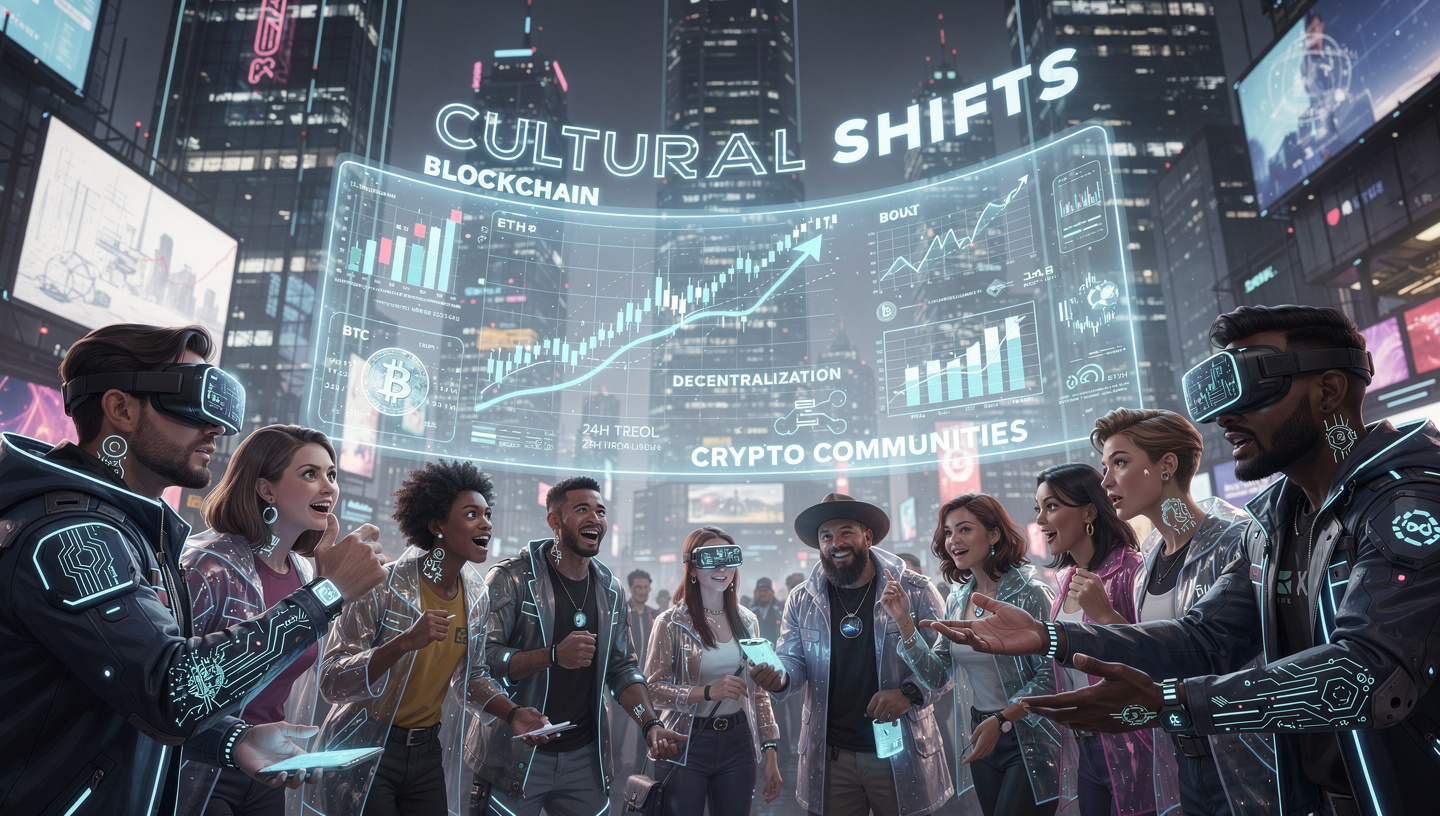
Over the past decade, the crypto ecosystem has undergone a series of deep cultural transformations—moving from fringe cypherpunk idealism to institutional participation, from anonymous forums to influencer-driven discourse, from pure speculation to product-centered ecosystems. These shifts matter because crypto is not just software or finance. It is a social technology. And social technologies succeed or fail based on culture.
This article examines the major cultural shifts inside crypto communities: how values have changed, how participation has transformed, and why the next phase of crypto adoption will be determined less by protocols—and more by people.
From Cypherpunks to Global Networks
Early crypto communities were small, technically dense, and philosophically coherent. They were populated by developers, cryptographers, libertarians, and privacy advocates. The prevailing ethos emphasized decentralization, censorship resistance, and self-sovereignty.
Participation required technical competence. Running nodes, compiling wallets, and engaging in protocol discussions were standard expectations. Capital was secondary to conviction.
That world no longer exists.
Crypto today is a mass-participation phenomenon. Millions of users enter through centralized exchanges like Coinbase and Binance, not command lines. They learn about tokens on Reddit and X, not mailing lists. Cultural onboarding now happens through memes, influencers, and viral threads.
This transition reshaped crypto’s internal hierarchy.
Where once technical contributors dominated discourse, attention now flows toward traders, content creators, and community managers. Reputation is increasingly built on reach rather than code. Cultural gravity shifted from engineering excellence to narrative control.
That does not mean builders disappeared. It means builders are no longer the only cultural center.
The Financialization of Identity
One of the most profound changes inside crypto communities is how identity became financialized.
In traditional online communities, identity is shaped by interests or beliefs. In crypto, identity is often expressed through holdings.
People do not merely use protocols—they align with them. Wallet allocations become tribal markers. Owning a token signals affiliation, optimism, and ideological alignment. This dynamic created highly polarized micro-communities around specific ecosystems, where criticism is perceived as financial attack.
The result is a new form of social capital: portfolio-based identity.
This phenomenon intensified during NFT and DeFi cycles, where profile pictures, governance tokens, and Discord roles became visible status symbols. Platforms like OpenSea helped normalize public displays of digital ownership, reinforcing the idea that culture and capital are inseparable.
Crypto communities increasingly operate like decentralized shareholder bases, emotionally invested in price trajectories while simultaneously advocating for product adoption.
This fusion of belief and balance sheet changed how people communicate. Debate becomes defensive. Skepticism becomes hostility. Optimism becomes evangelism.
It also explains why crypto discourse often feels unusually charged: people are not just arguing ideas—they are defending net worth.
Builders vs Traders: A Structural Tension
Every crypto cycle replays the same internal conflict: builders versus traders.
Builders care about infrastructure, usability, and long-term protocol health. Traders care about liquidity, momentum, and timing. Both are necessary. But culturally, they operate on different time horizons.
When markets are quiet, builders dominate. GitHub activity rises. Documentation improves. Developer conferences fill calendars.
When volatility returns, traders take over. Telegram channels explode. Influencer timelines accelerate. Product roadmaps are drowned out by price speculation.
This oscillation produces cultural whiplash.
Protocols that spent years cultivating thoughtful communities can suddenly find themselves surrounded by transient capital with little interest in fundamentals. Conversely, projects born in speculative environments struggle to rebuild credibility when attention fades.
Some ecosystems attempt to resolve this tension through structured governance. Others rely on informal norms. Few manage it consistently.
The challenge is not eliminating speculation—it is integrating it without allowing it to hollow out community values.
The Professionalization of Crypto Participation
Crypto communities have become dramatically more professional.
Early participants were hobbyists. Today, entire career paths exist around crypto: analysts, DAO operators, token economists, growth strategists, community leads. Venture funds employ research teams. Protocols run structured contributor programs. Content creation is monetized.
This shift reflects maturation—but it also changes incentives.
As crypto became a viable profession, authenticity competed with optimization. People now build audiences with explicit monetization strategies. Thought leadership is often coupled with affiliate links, token allocations, or advisory roles.
Even open-source contributions are increasingly career-driven.
This professional layer introduced higher-quality output—better dashboards, cleaner documentation, stronger branding—but it also blurred lines between genuine advocacy and financial promotion.
Communities now operate in an environment where almost every opinion has embedded incentives.
Understanding this context is essential when evaluating crypto discourse.
The Rise of Product-Centered Communities
Another major cultural shift is the movement away from abstract protocol worship toward product-first communities.
Earlier crypto culture focused on technical primitives: block size debates, consensus mechanisms, scalability trade-offs. Today, users care more about experiences: wallet UX, on-chain games, NFT marketplaces, and yield strategies.
This transition mirrors broader tech adoption curves. Infrastructure becomes invisible. Interfaces become everything.
Protocols that succeed now tend to cultivate communities around concrete use cases rather than ideological purity. Decentralized exchanges, on-chain social platforms, and NFT ecosystems foster engagement through daily interaction—not whitepapers.
Even developer-centric ecosystems increasingly prioritize onboarding flows and documentation over theoretical elegance.
This pragmatic turn reflects a deeper cultural reality: crypto is no longer proving it can exist. It is proving it can be used.
Decentralization Meets Human Nature
Crypto communities often promote decentralization as both architecture and philosophy. But human behavior does not decentralize easily.
Influence concentrates.
Certain accounts shape narratives. Certain wallets move markets. Certain founders become symbolic anchors. Even in permissionless systems, social gravity forms around visible leaders.
Figures like Vitalik Buterin and organizations such as the Ethereum Foundation illustrate this dynamic. While Ethereum is technically decentralized, cultural authority still clusters around recognizable entities.
This is not hypocrisy—it is sociology.
Communities seek coherence. They look for interpreters. They gravitate toward trusted voices during uncertainty. Crypto did not escape these patterns; it reproduced them in new forms.
The difference is transparency. On-chain data exposes influence in ways traditional systems never could.
Meme Culture as Market Infrastructure
Memes are not decoration in crypto. They are infrastructure.
They compress complex ideas into shareable formats. They establish in-group language. They accelerate narrative transmission. Entire market cycles have been catalyzed by meme velocity.
What began as inside jokes evolved into coordination mechanisms.
Meme coins demonstrated that attention itself can be financialized. Viral imagery became liquidity. Humor became market signal. Cultural resonance proved capable of mobilizing capital faster than whitepapers ever could.
This forced crypto communities to confront an uncomfortable truth: rational analysis is only one input into collective behavior.
Emotion scales better.
As a result, communities increasingly invest in aesthetics, storytelling, and symbolic branding. Logos matter. Catchphrases matter. Even protocol mascots matter.
Crypto learned what marketing professionals already knew: culture moves markets.
Governance Fatigue and the Reality of DAOs
Decentralized Autonomous Organizations promised participatory governance at scale. In practice, most communities discovered that voting is hard, attention is scarce, and power consolidates.
Token-based governance often suffers from low turnout. Proposal fatigue is real. Technical complexity discourages broad participation.
Over time, many DAOs evolved informal leadership structures: core teams, trusted delegates, or working groups that handle most decisions.
This pragmatic shift reflects a broader cultural realization: decentralization is a spectrum, not a binary.
Crypto communities increasingly prioritize operational effectiveness over ideological purity. They accept layered governance models as necessary compromises.
The narrative moved from “everyone governs everything” to “those who show up decide.”
That is not failure. It is institutional learning.
Regionalization of Crypto Culture
Crypto is global—but its communities are not culturally uniform.
Asia emphasizes speed and trading culture. Europe leans regulatory and academic. North America blends venture capital with creator economies. Emerging markets prioritize remittances and financial access.
These regional differences influence protocol adoption patterns, UX expectations, and community norms.
Global Discord servers often contain multiple subcultures operating simultaneously, each interpreting the same product through different economic realities.
Understanding crypto today requires recognizing this geographic fragmentation. There is no single crypto culture—only overlapping ones.
What These Shifts Mean for the Next Cycle
The next crypto expansion will not be driven purely by technology. It will be driven by communities that successfully integrate:
- Product usability with financial incentives
- Narrative coherence with open participation
- Professional execution with grassroots authenticity
Projects that ignore culture will struggle, regardless of technical merit.
The winning ecosystems will be those that design for human behavior—not just cryptographic security.
They will invest in onboarding, storytelling, governance UX, and social architecture. They will treat communities as core infrastructure, not marketing afterthoughts.
Crypto has already solved many hard engineering problems. Its remaining challenge is cultural.
Closing Perspective
Crypto communities are no longer experimental gatherings of technologists. They are living, evolving social systems with their own power structures, norms, and economic feedback loops.
They shape markets. They influence development priorities. They determine which ideas survive.
Understanding crypto now requires cultural literacy as much as technical fluency.
Because in this ecosystem, code may define what is possible—but communities decide what matters.