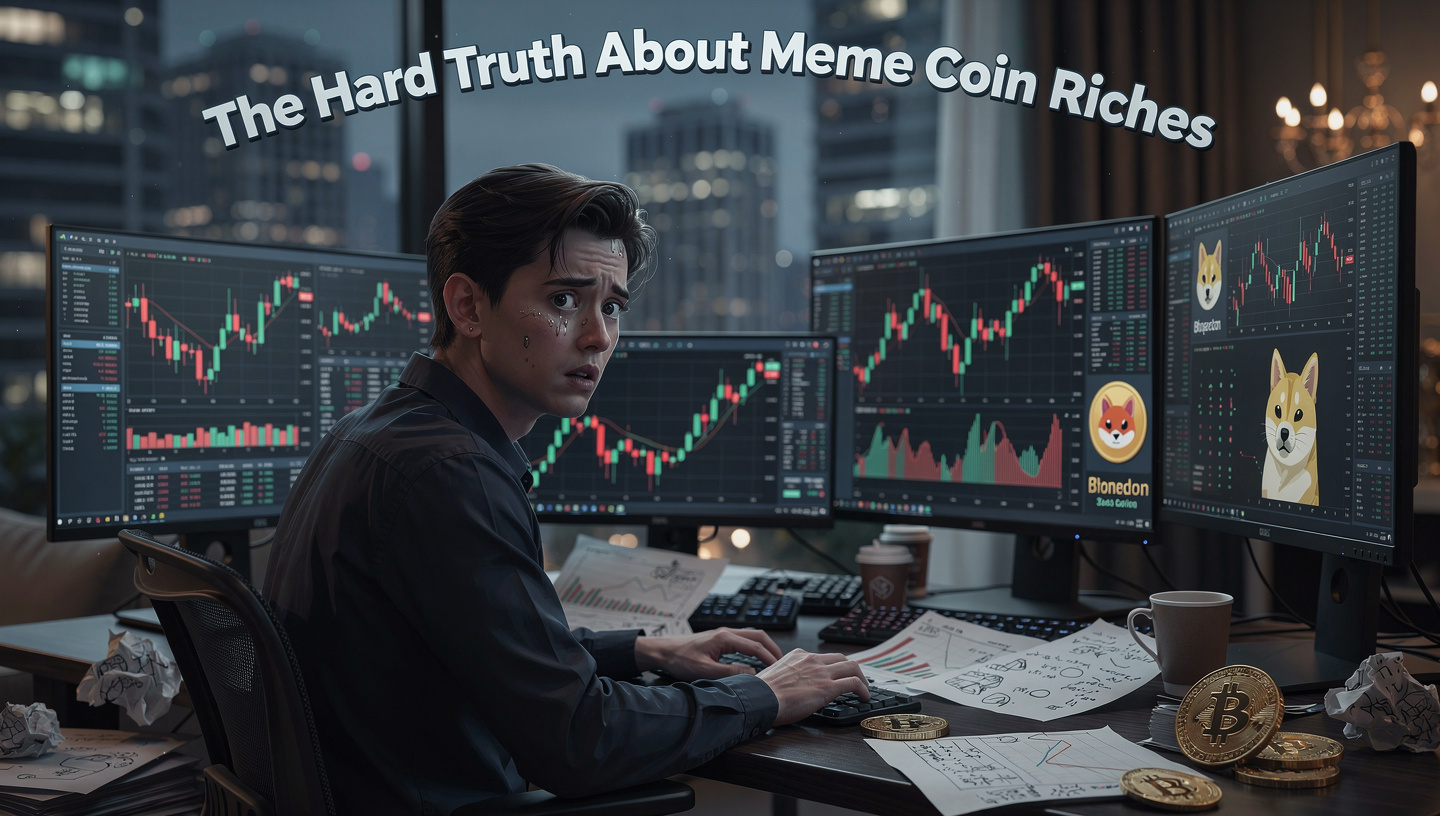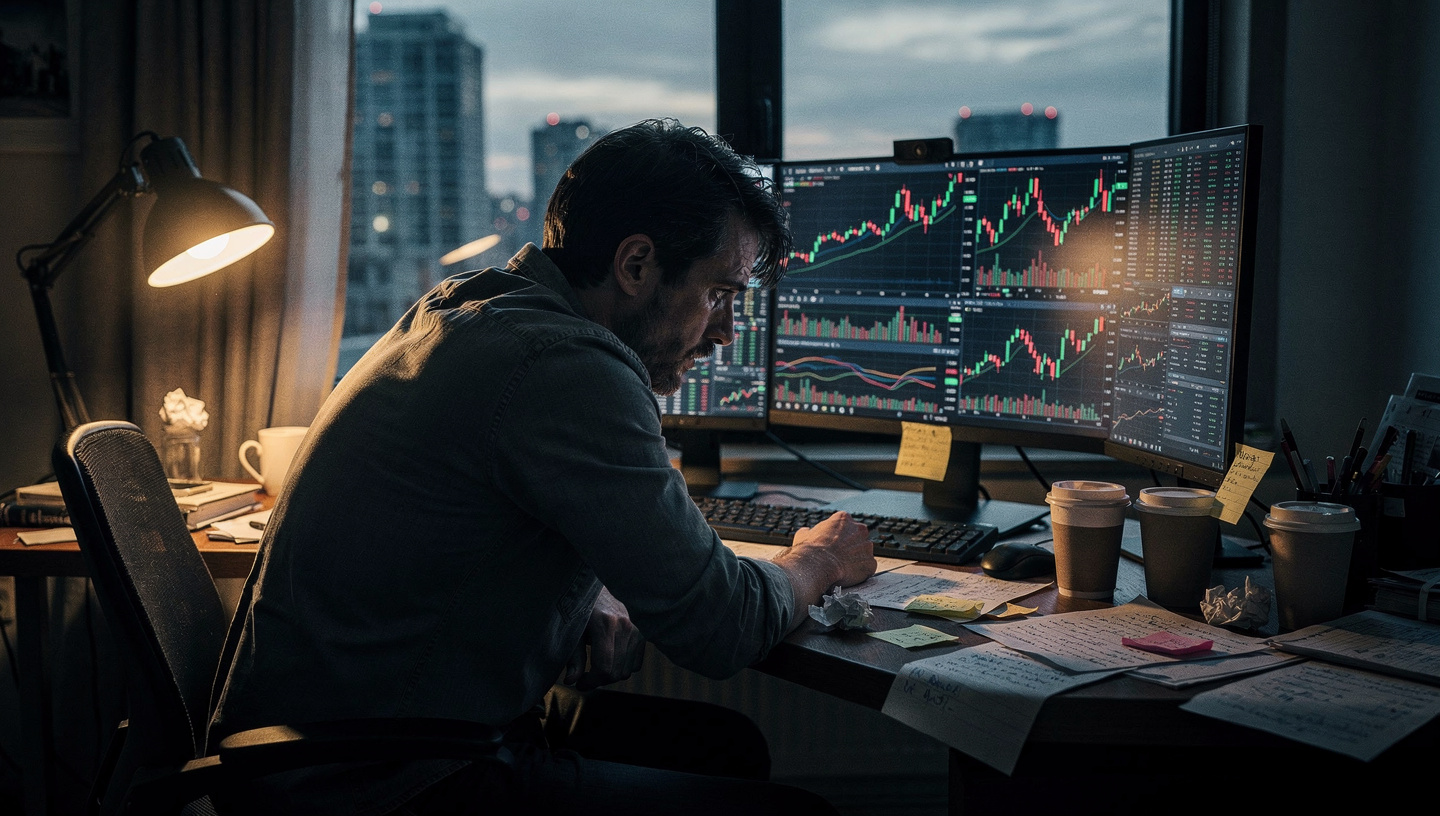
The most dangerous moment in crypto trading is not the crash.
It’s not the liquidation wick.
It’s not the red portfolio screenshot at 3 a.m.
It’s the quiet moment when you realize you’ve stopped thinking clearly — when charts blur together, trades feel automatic, and your inner dialogue has shifted from analysis to survival.
That is burnout.
Not the dramatic kind. The invisible kind. The slow cognitive erosion that turns disciplined traders into impulsive gamblers, long before the capital is gone.
Crypto doesn’t usually destroy people financially first.
It breaks them mentally.
And once that happens, the money simply follows.
This article is about that process — how crypto trading burnout actually forms, why it’s far more common than most admit, how it silently sabotages performance, and how to design your trading life so you don’t hollow yourself out chasing volatility.
This is not motivational fluff. It’s operational psychology.
What Crypto Trading Burnout Really Is (And Why Most Traders Misdiagnose It)
Burnout in crypto is rarely experienced as exhaustion.
It shows up as:
- Emotional numbness toward wins and losses
- Compulsive chart checking
- Declining trade quality
- Overtrading despite knowing better
- Shortened time horizons
- Increased risk-taking after losses
- A creeping sense that you’re “behind”
In professional psychology, burnout is defined as a triad:
- Emotional exhaustion
- Depersonalization (detachment from your work and decisions)
- Reduced sense of personal efficacy
Crypto accelerates all three.
Traditional careers burn people out over years. Crypto can do it in months.
Why?
Because crypto trading compresses stressors that normally occur over long periods into tight, relentless cycles:
- Continuous global markets (no real “close”)
- Extreme volatility
- Public profit/loss comparison
- Algorithmic competition
- Social media amplification
- Financial consequences tied directly to moment-to-moment decisions
Your nervous system evolved for seasonal threats, not 24/7 price discovery.
This mismatch matters.
The Unique Psychological Load of Crypto Markets
Crypto is not just a financial system. It’s a cognitive pressure cooker.
Three characteristics make it uniquely burnout-inducing:
1. Perpetual Vigilance
Unlike equities, crypto doesn’t sleep.
There is no bell. No overnight pause. No natural stopping point.
Your brain never fully disengages.
Even when you step away, part of your attention remains tethered to price.
This creates what neuroscientists call continuous partial attention — a state where your cognitive bandwidth is permanently fragmented.
Over time, this degrades:
- Working memory
- Emotional regulation
- Decision quality
You become reactive instead of strategic.
2. Variable Reinforcement Loops
Crypto rewards are unpredictable.
Sometimes impulsive trades win. Sometimes disciplined setups fail.
This mirrors the same dopamine mechanism used in slot machines: variable ratio reinforcement.
Your brain learns:
“Maybe this next trade will be the one.”
That’s not trading psychology.
That’s behavioral conditioning.
3. Identity Entanglement With P&L
Many traders subconsciously tie self-worth to performance.
Green days feel like validation. Red days feel like personal failure.
Over time, this collapses the boundary between who you are and how your trades performed.
That’s a fragile way to exist.
Why Burnout Destroys Performance Before It Destroys Capital
Burnout doesn’t announce itself.
It degrades decision-making quietly.
Here’s what changes under the hood:
Executive Function Declines
You lose the ability to:
- Delay gratification
- Stick to predefined rules
- Evaluate probabilities objectively
Trades become emotionally framed instead of statistically framed.
Risk Perception Warps
Burned-out traders oscillate between:
- Excessive caution after losses
- Reckless sizing to “make it back”
This inconsistency kills edge.
Time Horizons Shrink
Long-term thinking collapses.
You start optimizing for the next trade instead of the next year.
That’s when systems break.
The Myth of “Grinding Harder”
Crypto culture glorifies intensity.
Screenshots of 18-hour chart sessions. Tweets about “sleeping when the cycle ends.” Influencer narratives about obsession.
Even figures like Elon Musk are often cited as examples of extreme work ethic — but people miss the critical distinction:
High performers operate in structured intensity.
Most traders operate in chaotic overexposure.
There is a difference.
Grinding without recovery doesn’t create mastery.
It creates cognitive debt.
And debt always comes due.
Burnout Isn’t a Personal Weakness — It’s a Structural Risk
This matters:
Burnout is not caused by lack of discipline.
It’s caused by system design.
If your trading environment includes:
- Unlimited screen time
- No predefined rest cycles
- Constant social comparison
- Undefined goals
- Emotional exposure to every tick
Then burnout is not a possibility.
It’s an inevitability.
Professional traders treat mental energy as capital.
Retail traders usually don’t.
The Hidden Pipeline From Burnout to Blow-Up
Most account failures follow a predictable path:
- Initial excitement and rapid learning
- Early wins or near-misses
- Increased screen time
- Emotional investment intensifies
- Fatigue accumulates
- Small rule breaks appear
- Overtrading starts
- Risk increases
- A large loss occurs
- Revenge trading follows
- Capital collapses
The blow-up is just the final act.
The real damage happened earlier — in the nervous system.
Why Crypto Traders Burn Out Faster Than Traditional Traders
Institutional traders operate inside constraints:
- Fixed hours
- Risk managers
- Position limits
- Mandatory breaks
Crypto traders often have:
- Infinite access
- No oversight
- No enforced structure
- No circuit breakers
Platforms like Binance and Coinbase make markets globally accessible in seconds.
This is powerful.
It’s also dangerous.
Unlimited access without internal governance creates self-destructive feedback loops.
How to Recognize Burnout Early (Before It Costs You Money)
Watch for these signals:
- You enter trades without writing them down
- You feel urgency without clear setups
- You check price during unrelated activities
- You trade to escape boredom
- You feel detached from outcomes
- You increase size after losses
- You stop reviewing mistakes
These are not minor habits.
They are precursors.
Designing an Anti-Burnout Trading System
Avoiding burnout is not about willpower.
It’s about architecture.
Here’s what actually works.
1. Define Finite Trading Windows
Decide in advance when you trade.
Examples:
- Two fixed sessions per day
- Only New York open
- Only London close
Outside those windows, charts are closed.
No exceptions.
This restores psychological boundaries.
2. Separate Analysis From Execution
Never analyze while placing trades.
Have two modes:
- Planning mode (market structure, levels, scenarios)
- Execution mode (following predefined rules)
Blending them creates emotional noise.
3. Limit Decision Volume
Professional performance degrades after ~150 meaningful decisions per day.
Crypto traders often exceed this before lunch.
Reduce:
- Number of pairs
- Number of strategies
- Number of timeframes
Complexity amplifies fatigue.
4. Journal Emotion, Not Just Trades
Most journals track entries and exits.
Few track:
- Emotional state
- Sleep quality
- Impulses
- Rule adherence
Those variables predict performance better than win rate.
5. Use Risk as a Psychological Regulator
Risk per trade is not just a financial parameter.
It’s a nervous system parameter.
If losses feel heavy, your size is too large — regardless of math.
The Long Game: Trading as a Cognitive Profession
Serious trading resembles elite performance domains like aviation or surgery.
It requires:
- Attention management
- Stress tolerance
- Pattern recognition
- Emotional regulation
You are not just trading charts.
You are managing your internal state under uncertainty.
That is the real job.
Rebuilding After Burnout
If you’re already burned out:
Do not push through.
Instead:
- Step away from live trading
- Reduce size to symbolic levels
- Rebuild routines (sleep, movement, nutrition)
- Review past trades objectively
- Redesign your process
- Return slowly
Capital can be replaced.
Cognitive integrity takes longer.
The Final Truth Most Traders Learn Too Late
Crypto rewards patience more than intensity.
It rewards structure more than obsession.
And it rewards longevity more than brilliance.
Markets will always be here.
Your clarity may not be.
Protect it.
Because once you lose your internal equilibrium, no strategy will save you.