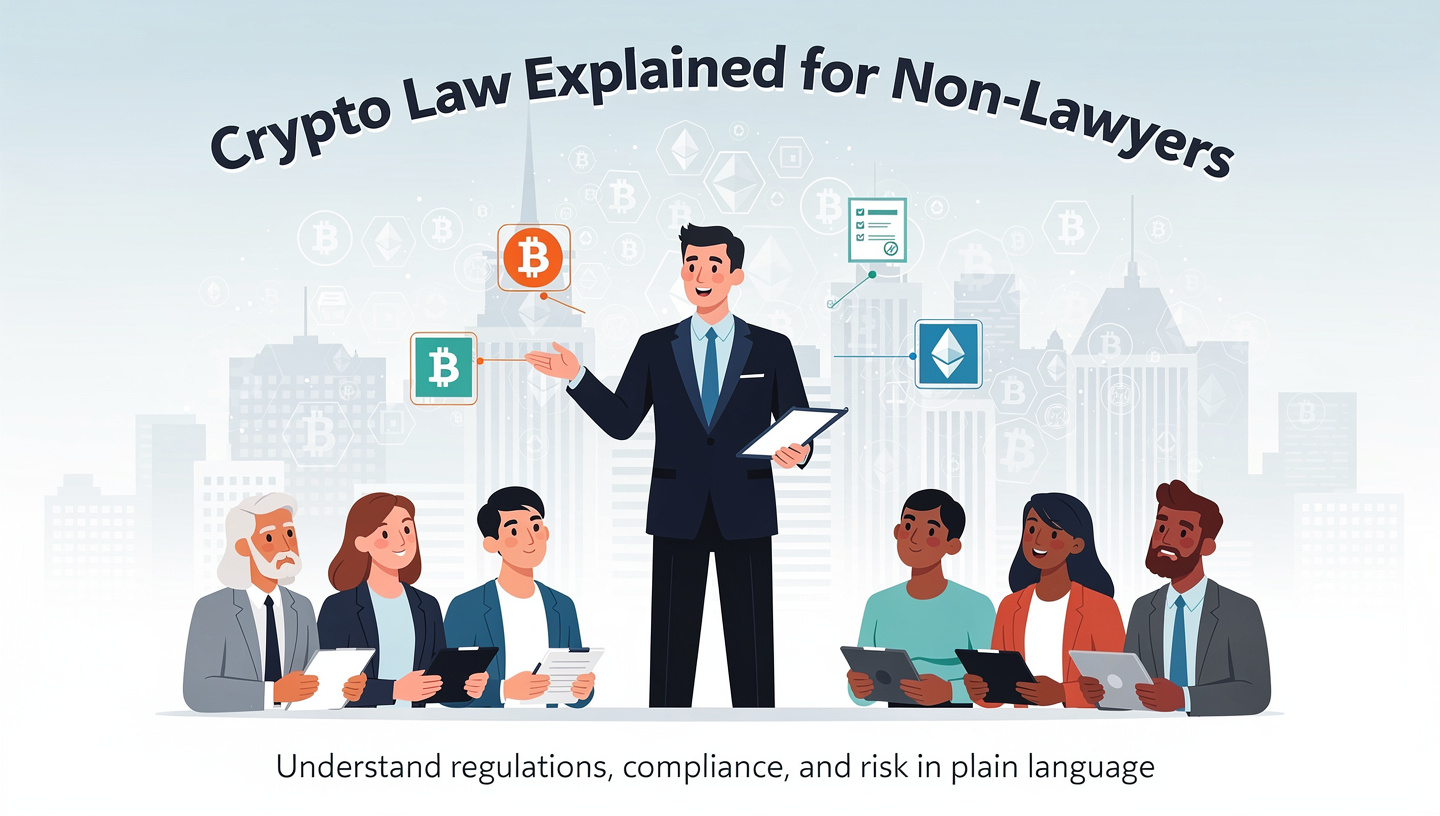
Cryptocurrency emerged as a technical innovation. It has matured into a regulatory problem, a compliance industry, a geopolitical issue, and a legal frontier. What began with the release of Bitcoin has evolved into a global financial ecosystem that challenges traditional legal frameworks governing money, securities, commodities, taxation, banking, and consumer protection.
Crypto law is not a single statute or treaty. It is a composite of overlapping regulatory regimes, judicial interpretations, administrative guidance, and enforcement actions. It spans multiple jurisdictions and disciplines: financial regulation, contract law, property law, anti-money laundering (AML), sanctions compliance, securities regulation, and tax law.
This article explains crypto law in structured, non-technical legal language while maintaining analytical precision. It covers:
- What crypto law actually regulates
- How regulators classify digital assets
- Securities law vs. commodities law
- Stablecoin and payments regulation
- AML and compliance obligations
- DeFi and DAO legal treatment
- NFTs and intellectual property
- Tax treatment of digital assets
- Enforcement trends and global differences
- The direction of future regulation
1. What Is “Crypto Law”?
“Crypto law” is shorthand for the application of existing legal frameworks to blockchain-based digital assets, plus the development of new regulatory structures specifically designed for decentralized systems.
It governs:
- Issuance of digital assets (token offerings, ICOs, airdrops)
- Trading on centralized and decentralized platforms
- Custody and safekeeping of private keys
- Intermediaries (exchanges, brokers, custodians)
- Financial reporting and taxation
- Anti-money laundering compliance
- Consumer protection and fraud enforcement
Crypto law does not replace traditional financial law. It overlays onto it.
2. The Core Legal Question: What Is a Crypto Asset?
The most consequential legal issue is classification. Regulators ask: What is this asset legally equivalent to?
Possible classifications include:
- Security
- Commodity
- Currency
- Property
- Payment instrument
- Derivative
- Utility token
The classification determines which regulator has authority and what compliance obligations apply.
Securities Classification
In the United States, the U.S. Securities and Exchange Commission applies the Howey Test (derived from a Supreme Court case) to determine whether a token is an “investment contract.”
A crypto asset is likely a security if there is:
- An investment of money
- In a common enterprise
- With an expectation of profit
- Derived from the efforts of others
Tokens sold in fundraising events often meet this definition.
Commodities Classification
The U.S. Commodity Futures Trading Commission treats certain crypto assets as commodities, similar to gold or oil.
Bitcoin and Ethereum are generally treated as commodities in U.S. derivatives markets.
The distinction matters because securities are heavily regulated at issuance and trading levels, while commodities regulation primarily governs derivatives and anti-manipulation.
3. Centralized Exchanges: Regulatory Obligations
Centralized exchanges such as Coinbase and Binance operate under multiple overlapping regimes.
They may be required to:
- Register as securities exchanges or broker-dealers
- Register as money services businesses (MSBs)
- Implement AML/KYC procedures
- File suspicious activity reports
- Maintain capital reserves
- Segregate customer assets
- Comply with sanctions screening
The legal exposure includes:
- Unregistered securities offerings
- Operating unlicensed trading venues
- Misleading disclosures
- Market manipulation
Enforcement actions against exchanges have defined much of crypto law in practice.
4. Anti-Money Laundering (AML) and KYC Requirements
AML law is one of the most consistently applied areas of crypto regulation.
Under global standards set by the Financial Action Task Force (FATF), virtual asset service providers (VASPs) must:
- Identify customers (Know Your Customer – KYC)
- Monitor transactions
- Report suspicious activity
- Comply with the “Travel Rule” (transmit sender/recipient information)
These obligations apply even though blockchain transactions are pseudonymous. Compliance is placed on intermediaries rather than protocols.
Decentralized protocols without identifiable operators raise complex enforcement challenges.
5. Stablecoins and Payment Regulation
Stablecoins introduce a hybrid regulatory issue. They function as digital payment instruments but may resemble money market funds.
Tether and USD Coin are designed to maintain 1:1 value with fiat currency.
Legal questions include:
- Are reserves fully backed?
- Are they securities?
- Are issuers operating as banks?
- Do they require payment institution licenses?
Some jurisdictions treat stablecoin issuers as:
- E-money institutions
- Payment service providers
- Deposit-taking institutions
Regulatory focus centers on reserve transparency and systemic risk.
6. Decentralized Finance (DeFi): Who Is Liable?
DeFi platforms operate without traditional intermediaries. Smart contracts automate lending, trading, and derivatives.
Key legal issues:
- Who is the “operator”?
- Are developers liable for code deployment?
- Are governance token holders responsible?
- Can a protocol register as a legal entity?
Regulators argue that decentralization does not eliminate responsibility if identifiable individuals control development or governance.
Liability theories include:
- Aiding and abetting unregistered securities offerings
- Operating unlicensed exchanges
- Conspiracy or facilitation
The absence of corporate structure complicates enforcement.
7. DAOs and Legal Personality
Decentralized Autonomous Organizations (DAOs) use token-based governance.
Without legal recognition, DAOs may be treated as:
- General partnerships
- Unincorporated associations
This can expose participants to joint liability.
Some jurisdictions allow DAO registration as legal entities. However, legal clarity remains limited.
8. NFTs: Ownership vs. Intellectual Property
Non-fungible tokens (NFTs) represent unique blockchain entries. Platforms such as OpenSea facilitate NFT trading.
Purchasing an NFT does not automatically transfer:
- Copyright
- Reproduction rights
- Commercial rights
Unless explicitly stated in the underlying contract, the buyer owns the token, not the intellectual property.
NFTs may also trigger securities analysis if marketed with profit expectations.
9. Taxation of Cryptocurrency
Tax treatment varies by jurisdiction, but common principles include:
- Crypto is treated as property, not currency
- Capital gains tax applies to disposals
- Each trade is a taxable event
- Mining rewards are taxable income
- Staking rewards may be taxable upon receipt
Tax complexity increases with:
- Cross-border transactions
- Airdrops
- Token swaps
- DeFi yield strategies
Failure to report can result in penalties and criminal liability.
10. Custody and Private Key Control
Custody law addresses who controls private keys.
Custodial platforms hold keys on behalf of users. Legal questions include:
- Are customer assets segregated?
- Are they property of the estate in bankruptcy?
- Are they held in trust?
Bankruptcy proceedings have demonstrated that contractual language determines recovery priority.
Self-custody eliminates intermediary risk but transfers responsibility entirely to the holder.
11. Enforcement Trends
Regulators increasingly pursue:
- Unregistered securities offerings
- Fraudulent token promotions
- Insider trading
- Market manipulation
- AML violations
Enforcement shapes industry standards faster than legislation.
High-profile enforcement actions signal jurisdictional boundaries and compliance expectations.
12. Global Regulatory Approaches
Crypto law is jurisdiction-specific.
United States
Fragmented regulatory system with overlapping authority among federal and state agencies.
European Union
The Markets in Crypto-Assets Regulation (MiCA) establishes a harmonized framework across EU member states.
Asia
Regulatory clarity varies significantly. Some jurisdictions adopt licensing regimes; others impose restrictions.
Offshore Jurisdictions
Some countries position themselves as crypto-friendly hubs, though international compliance pressure limits regulatory arbitrage.
13. Consumer Protection and Disclosure
Consumer protection law applies to:
- Misleading marketing
- False profit guarantees
- Undisclosed conflicts of interest
Influencer promotions and token endorsements have attracted enforcement scrutiny.
Disclosure requirements are central to securities regulation and increasingly applied to crypto offerings.
14. Sanctions and Geopolitical Constraints
Crypto transactions must comply with sanctions regimes.
Platforms must:
- Screen wallet addresses
- Block sanctioned entities
- Monitor cross-border exposure
Sanctions compliance applies even to digital assets.
15. The Future of Crypto Law
The direction of crypto law is toward:
- Greater disclosure requirements
- Formalized licensing regimes
- Enhanced reserve transparency for stablecoins
- Clearer commodity vs. security distinctions
- Integration with traditional financial systems
Regulators aim to reduce systemic risk without eliminating innovation.
Conclusion
Crypto law is not a theoretical construct. It is the application of established legal doctrines to a new technological substrate.
Digital assets exist within:
- Securities law
- Commodities regulation
- Tax frameworks
- AML obligations
- Consumer protection statutes
Legal classification determines compliance burden. Compliance determines operational viability.
For non-lawyers, the essential principle is structural: cryptocurrency is not outside the law. It is being progressively absorbed into existing regulatory architecture.
Understanding crypto law requires recognizing that decentralization does not eliminate accountability. It redistributes it.
Legal clarity will not emerge from ideology. It will emerge from enforcement, litigation, and legislative codification.
That process is already underway.