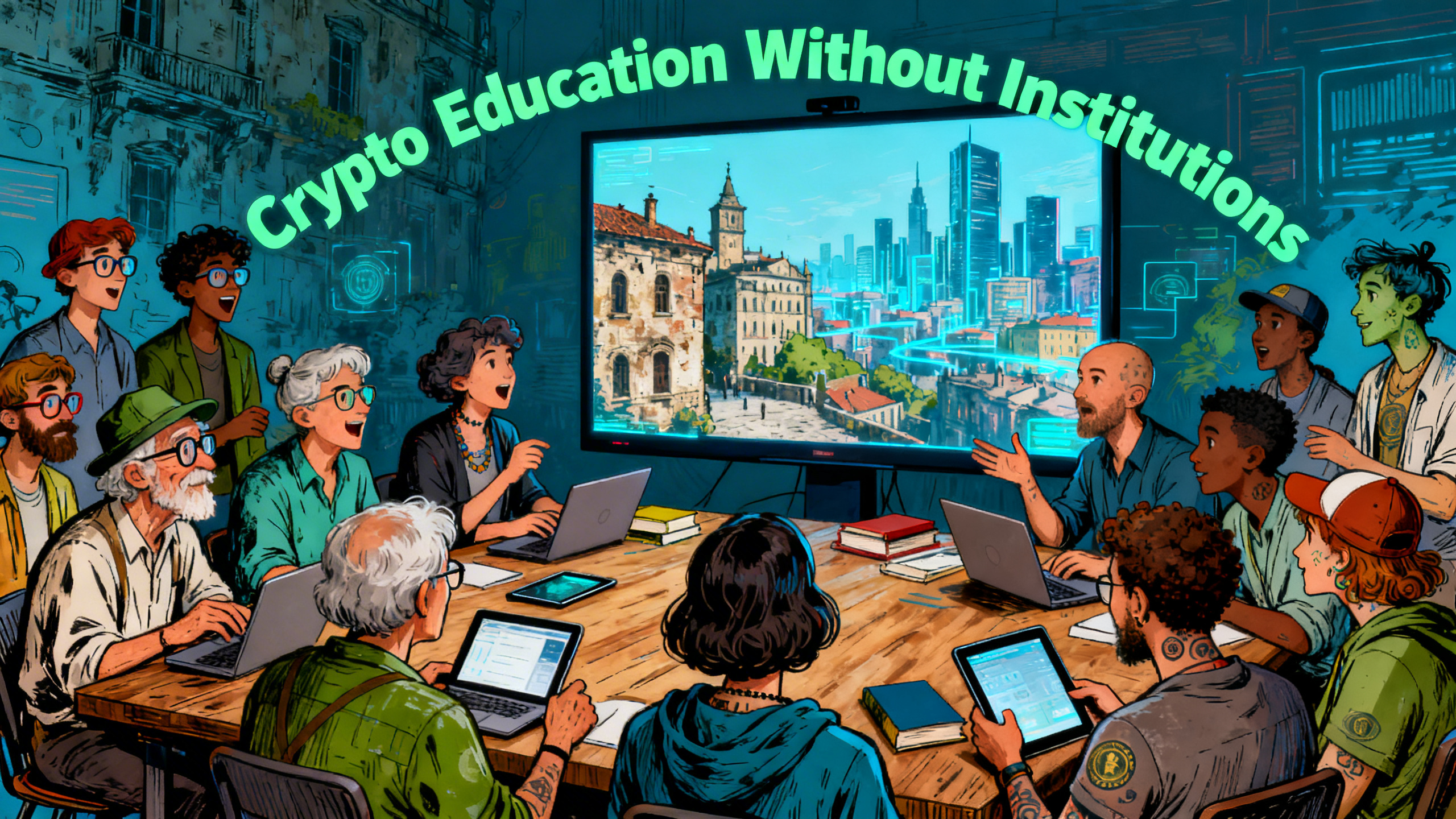
Cryptocurrency was born from a radical proposition: that trust in centralized institutions can be replaced by transparent code and decentralized consensus. In 2008, the publication of the Bitcoin: A Peer-to-Peer Electronic Cash System by Satoshi Nakamoto did more than introduce digital money. It launched a new paradigm of coordination—one that reimagined finance, governance, and increasingly, education itself.
For centuries, education has been institutional by default. Universities, accreditation boards, and centralized curricula determined what was worth knowing and who was qualified to teach it. But the cryptocurrency ecosystem evolved outside these traditional channels. Developers learned from open repositories, traders from Discord servers, node operators from GitHub issues, and security researchers from public postmortems. Knowledge propagated peer-to-peer, much like the networks it described.
Today, crypto education without institutions is not an anomaly—it is the norm. From open-source documentation to decentralized autonomous organizations (DAOs), from on-chain credentialing to tokenized learning incentives, a parallel education system is emerging. It is global, permissionless, dynamic, and often chaotic. It is also profoundly powerful.
This article offers a comprehensive, research-oriented exploration of crypto education without institutions. We will examine its philosophical foundations, technological infrastructure, governance models, incentive mechanisms, risks, and future trajectory. We will analyze how decentralized learning ecosystems function, why they matter, and how they can be designed responsibly.
1. The Institutional Model vs. the Crypto Ethos
1.1 The Traditional Educational Paradigm
Traditional education is characterized by:
- Centralized curriculum design
- Credential-based validation
- Tuition-based access
- Hierarchical authority structures
- Geographic and linguistic boundaries
Universities and certification bodies serve as gatekeepers. Knowledge is standardized, degrees are scarce signals, and reputation flows from institutional brands.
This model works well for many disciplines. However, it struggles in fields defined by rapid technological change and open innovation. Cryptocurrency is one such field.
1.2 Crypto’s Anti-Institutional DNA
Cryptocurrency emerged from open-source culture. Projects such as Bitcoin Foundation and later communities around Ethereum did not depend on academic accreditation. Instead, they relied on:
- Public code repositories
- Open mailing lists
- Community calls
- Transparent governance forums
- Permissionless experimentation
In crypto, legitimacy comes from contribution, not credentials. A pseudonymous developer can gain global respect through code commits. A researcher can influence protocol upgrades through a well-argued improvement proposal.
This shift from institutional validation to cryptographic and community validation defines crypto education without institutions.
2. The Infrastructure of Decentralized Learning
Crypto education without institutions is not unstructured. It relies on a stack of tools, protocols, and communities.
2.1 Open-Source Documentation
Documentation is the first layer of crypto education. Whitepapers, technical specs, and GitHub READMEs serve as foundational texts.
Examples include:
- Ethereum Whitepaper by Vitalik Buterin
- Improvement proposals like EIPs (Ethereum Improvement Proposals)
- Community-driven documentation portals
These resources are:
- Publicly accessible
- Iteratively updated
- Peer-reviewed informally through community feedback
Unlike textbooks, they are living documents.
2.2 GitHub and Code Repositories
GitHub functions as a decentralized university for developers. Learning occurs through:
- Reading production code
- Reviewing pull requests
- Participating in issue discussions
- Contributing patches
This apprenticeship-style learning is meritocratic. Feedback loops are immediate and public.
2.3 Social Learning Platforms
Crypto-native education thrives in:
- Discord servers
- Telegram groups
- X (formerly Twitter) threads
- Community forums
- Podcasts and YouTube channels
Influential educators often operate independently. For example, long-form conversations on The Pomp Podcast or research essays from Messari shape discourse without institutional mediation.
2.4 On-Chain Learning Platforms
A new wave of platforms integrates blockchain infrastructure directly into education:
- NFT-based certificates
- Token-gated course access
- On-chain proof-of-completion
- DAO-governed curricula
These models experiment with cryptographic credentials rather than paper diplomas.
3. Learning Models in the Wild
3.1 Peer-to-Peer Knowledge Transmission
In decentralized communities, learning is dialogical rather than lecture-based. Developers ask questions in public channels. Traders share strategies. Security analysts dissect exploits in real time.
The collapse of FTX, for example, became a global educational event. Analysts on platforms like Nansen tracked wallet movements. Independent researchers published breakdowns. Lessons about counterparty risk, centralized custody, and proof-of-reserves spread organically.
No institution coordinated this. The network did.
3.2 Bounty-Based Learning
Many crypto projects offer bounties:
- Bug bounties
- Documentation bounties
- Governance proposal rewards
Learning is incentivized through token rewards. Instead of paying tuition, learners earn tokens for contributions.
This model aligns economic incentives with educational outcomes.
3.3 DAO-Based Education
DAOs increasingly serve as educational hubs. Members learn:
- Governance processes
- Treasury management
- Smart contract design
- Community coordination
Participating in a DAO is experiential education. Governance votes replace exams; treasury allocations replace case studies.
4. Incentives and Tokenized Learning
4.1 Learn-to-Earn Mechanics
Learn-to-earn (L2E) models distribute tokens for:
- Completing courses
- Passing quizzes
- Contributing to forums
- Publishing research
These incentives bootstrap engagement but require careful design to avoid low-quality participation.
4.2 Reputation Systems
On-chain reputation systems can:
- Track contributions
- Issue soulbound tokens
- Encode skill attestations
Rather than a university transcript, a wallet address becomes a public portfolio.
4.3 Risks of Token Incentives
However, tokenized learning can create:
- Sybil attacks
- Farming behavior
- Superficial engagement
- Overemphasis on rewards over mastery
Effective crypto education without institutions must balance incentives with intrinsic motivation.
5. Governance and Curriculum Without Central Authorities
5.1 Who Decides What Is Worth Learning?
In institutional education, curriculum committees determine content. In decentralized education, content emerges organically.
Core topics typically include:
- Cryptography fundamentals
- Consensus mechanisms
- Smart contract security
- Tokenomics
- Regulatory frameworks
Community consensus, rather than formal authority, shapes priorities.
5.2 Improvement Proposals as Educational Tools
Improvement proposals (like Bitcoin Improvement Proposals and Ethereum Improvement Proposals) serve dual roles:
- Governance mechanisms
- Educational artifacts
Reading and debating proposals trains participants in protocol literacy.
6. The Role of Self-Custody in Educational Philosophy
Self-custody is not just a technical practice; it is an educational principle.
Using wallets like MetaMask teaches:
- Private key management
- Gas fee mechanics
- Transaction verification
- Network selection
Hands-on usage is a form of experiential learning unmatched by classroom simulation.
7. Risks and Ethical Challenges
7.1 Misinformation and Hype
Without institutions, quality control is decentralized. This leads to:
- Influencer-driven hype cycles
- Pump-and-dump education
- Misleading tutorials
The line between education and marketing can blur.
7.2 Security Vulnerabilities
Poorly informed users risk:
- Phishing attacks
- Smart contract exploits
- Social engineering
Incidents involving protocols like The DAO underscore the importance of security education.
7.3 Regulatory Uncertainty
Educational content may intersect with financial advice. In jurisdictions worldwide, regulatory frameworks continue to evolve. Learners must understand legal contexts without relying on centralized certification bodies.
8. Global Accessibility and Localization
Crypto education without institutions is inherently global.
Anyone with internet access can:
- Read whitepapers
- Join communities
- Deploy smart contracts
However, language barriers remain significant. Translation collectives and regional DAOs are increasingly vital. In emerging markets, informal crypto education networks often outperform formal fintech curricula.
For users in countries like Vietnam, grassroots Telegram groups and localized YouTube channels often serve as primary educational hubs—illustrating how decentralized learning adapts to local contexts without institutional mediation.
9. Measuring Mastery Without Degrees
9.1 Portfolio-Based Validation
Instead of diplomas, learners showcase:
- GitHub repositories
- Governance participation
- Smart contract deployments
- Published research threads
Employers and DAOs evaluate proof-of-work rather than paper credentials.
9.2 On-Chain Credentials
NFT certificates and soulbound tokens provide cryptographic proof of participation. Though still experimental, they offer portable, verifiable credentials independent of universities.
10. Designing Responsible Decentralized Education
To build sustainable crypto education ecosystems without institutions, projects should:
- Prioritize security-first curricula
- Separate marketing from pedagogy
- Implement anti-Sybil mechanisms
- Reward depth over volume
- Encourage peer review
- Promote open discussion of failures
Education must include risk literacy—not just opportunity narratives.
Conclusion: Education as a Public Protocol
Crypto education without institutions reflects the deeper logic of blockchain itself. It is:
- Open
- Transparent
- Iterative
- Incentivized
- Community-governed
Just as blockchains distribute trust, decentralized education distributes knowledge authority. It empowers individuals to learn, contribute, and verify without centralized gatekeepers.
This model is not flawless. It demands critical thinking, self-discipline, and skepticism. It exposes learners to volatility and misinformation. But it also unlocks unprecedented autonomy.
In the long arc of history, institutions have mediated knowledge. Cryptocurrency challenges that mediation. It invites a world where education is not conferred but constructed—block by block, contribution by contribution, address by address.
Crypto education without institutions is not merely an alternative pathway. It is a prototype for how humans may learn in the decentralized century.