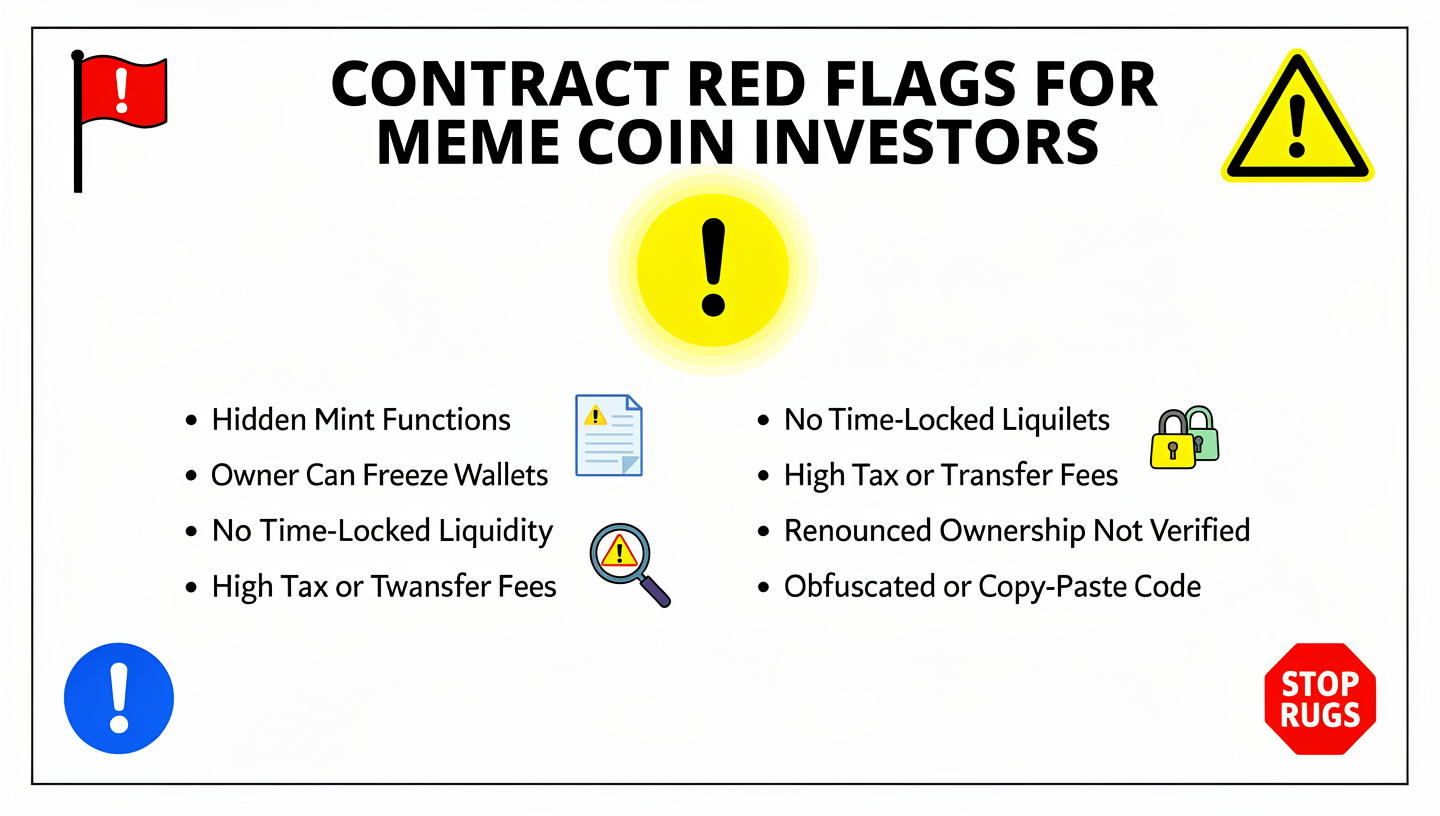
Meme coin investors believe the battlefield is price.
They obsess over five-minute candles, volume spikes, influencer tweets, and Telegram hype cycles. They think if they are fast enough—early enough—they can outmaneuver risk.
That belief is wrong.
The real battlefield is not the chart.
It is the smart contract.
Price is just the surface reflection of incentives embedded deep inside code. Every rug pull, every honeypot, every “unexpected” 99% drawdown was already written into the contract long before the first buyer pressed swap.
Meme coins do not fail randomly.
They fail mechanically.
And the harsh truth is this: most losses in meme coins are not caused by market volatility, but by unread or misunderstood contracts.
This article is not about fear.
It is about mechanical literacy.
If you understand the red flags below, you will not become immune to losses—but you will stop donating capital to projects that were mathematically designed to extract it from you.
Why Meme Coin Contracts Are More Dangerous Than They Look
At a surface level, meme coin contracts often look “simple”:
- A name
- A symbol
- A total supply
- A tax
- A liquidity pool
But simplicity is an illusion.
Meme coin contracts are often forked, obfuscated, or selectively modified versions of known templates. A single extra function—hidden behind a friendly variable name—can completely alter the economic outcome for holders.
Unlike traditional investments:
- There is no regulator reviewing the code
- There is no disclosure requirement
- There is no fiduciary duty
The contract is the truth.
Everything else is marketing.
Red Flag #1: Owner Privileges That Can Be Changed After Launch
The Silent Kill Switch
One of the most common and most misunderstood dangers in meme coin contracts is mutable ownership.
Many contracts include functions such as:
setTaxFee()setMaxTxAmount()setBlacklist()excludeFromFee()
Individually, these functions are not inherently malicious.
The danger is who controls them, and whether that control can ever be revoked.
If the contract owner can:
- Increase buy or sell tax at any time
- Exclude their own wallets from fees
- Limit transaction sizes selectively
Then the market is not free—it is permissioned, with asymmetric power.
The Illusion of “Renounced Ownership”
Projects often claim:
“Ownership will be renounced after launch.”
This statement is meaningless unless verified on-chain.
Even worse, some contracts include:
- Fake renounce functions
- Ownership transfers to proxy contracts
- Secondary privileged roles (operator, controller, tax wallet)
Key principle:
If any address retains the ability to change economic parameters, the contract is not trustless.
Red Flag #2: Dynamic or Hidden Sell Taxes
Taxes Are Not the Problem. Asymmetry Is.
A 5% tax is not dangerous.
A 10% tax is not inherently malicious.
What is dangerous is non-deterministic taxation.
Some contracts implement logic such as:
- Higher sell tax than buy tax
- Time-based tax changes
- Wallet-specific tax rules
- Tax increases after a certain block
In extreme cases, sell tax can be programmatically increased to 90–100%, effectively trapping holders.
This is how many honeypots technically operate—not by blocking sells outright, but by making them economically impossible.
The Technical Tell
Watch for:
- Conditional statements tied to
msg.sender - Tax logic depending on block number or transaction count
- Functions that allow the owner to “adjust” tax thresholds
If the tax logic is not static and transparent, you are not trading—you are renting exit liquidity.
Red Flag #3: Transfer Restrictions Disguised as “Anti-Bot” Measures
The Anti-Bot Excuse
“Anti-bot protection” has become one of the most abused justifications in meme coin contracts.
While genuine anti-bot logic exists, many contracts weaponize it to:
- Blacklist wallets post-purchase
- Block sells during specific windows
- Selectively prevent transfers to liquidity pools
Once blacklisted, a wallet may never be able to sell—without any on-chain appeal mechanism.
What to Look For
Red flags include:
blacklist(address)orisBot(address)- Owner-controlled lists with no expiration
- Transfer hooks that reject transactions under vague conditions
Key insight:
Any contract that can decide who is allowed to transact is no longer decentralized.
Red Flag #4: Liquidity That Is Technically “Locked” but Economically Unstable
Locked Liquidity Is Not a Guarantee
Liquidity locks are often treated as a seal of legitimacy.
They are not.
A liquidity pool can be:
- Locked for a short duration
- Locked under a third-party contract with loopholes
- Paired with a token whose supply can still be inflated
Even worse, some contracts allow:
- Minting new tokens
- Rebalancing liquidity ratios
- Redirecting tax flow away from LP support
The result?
Liquidity technically exists, but price collapses anyway.
The Structural Risk
If the contract allows:
- Unlimited minting
- Owner-controlled burns
- Tax routing changes
Then liquidity lock alone is irrelevant.
Red Flag #5: Obfuscated Code and Excessive Indirection
Complexity Is Not Neutral
Many malicious contracts rely on intentional opacity.
Techniques include:
- Excessive use of internal functions
- Misleading variable names
- Redundant logic paths
- Hard-coded addresses disguised as constants
This is not done for gas optimization.
It is done to hide intent.
A clean meme coin contract should be:
- Short
- Readable
- Deterministic
If reading the code feels like navigating a maze, that is not an accident.
Red Flag #6: Mint Functions That “Should Never Be Used”
The Most Dangerous Line of Code
The existence of a mint function is not always fatal.
The existence of a mint function callable by a privileged role is.
Common excuses include:
- “For future partnerships”
- “For CEX liquidity”
- “For ecosystem incentives”
None of these require unlimited discretionary minting.
If supply can be expanded post-launch, then:
- Your percentage ownership is unstable
- Price discovery is artificial
- Long-term value is undefined
Inflation is not a bug.
It is a feature—when designed to extract value.
Red Flag #7: Fee Routing to External Contracts
The Invisible Drain
Some contracts route fees not to wallets, but to other contracts.
This introduces second-order risk:
- Those contracts may be upgradeable
- They may execute swaps
- They may trigger additional minting or transfers
You are no longer analyzing one contract—you are analyzing an ecosystem of opaque dependencies.
For meme coins, this is unnecessary and dangerous.
Red Flag #8: Proxy Contracts and Upgradeability
Upgradeable = Mutable Reality
Proxy patterns allow developers to upgrade logic without redeploying the contract.
This is powerful—but in meme coins, it is a red flag.
Why?
Because it means:
- Today’s contract is not tomorrow’s contract
- Audits become obsolete
- Risk profile can change overnight
If a meme coin is upgradeable, it is permissioned speculation, not decentralized ownership.
The Meta Red Flag: When You Are Asked to Trust Intent Instead of Code
Any project that relies on statements like:
- “We would never do that”
- “The dev is doxxed”
- “The community would revolt”
Is already asking you to suspend rational analysis.
Markets do not reward trust.
They reward structure.
Code does not care about reputation, intention, or narrative.
A Mental Model That Actually Works
Before touching any meme coin, ask one question:
“If the team disappeared tomorrow, would the contract still treat me fairly?”
If the answer is anything other than yes, you are not investing—you are speculating on human behavior under financial stress.
That is the most fragile bet in crypto.
Most Meme Coin Losses Are Preventable
The meme coin market is not a casino.
It is a mechanism design arena.
Those who read contracts understand the rules.
Those who don’t subsidize the winners.
You do not need to be a Solidity developer.
You need to recognize patterns of extraction.
Once you see them, you cannot unsee them.
That alone will save you more money than any alpha group ever will.