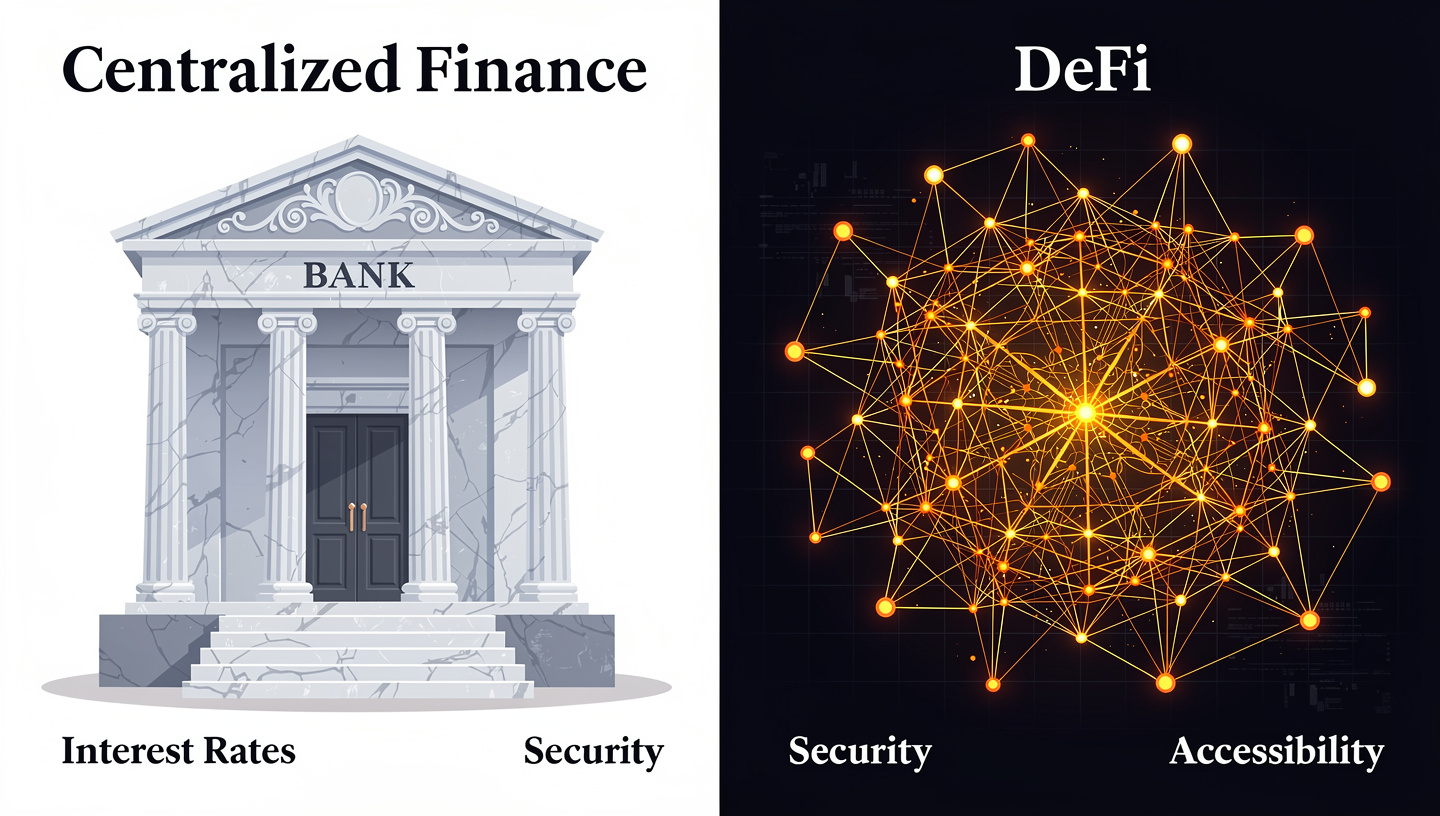
For as long as modern civilization has existed, money has needed structure: rules, intermediaries, and institutions that keep records and enforce trust. For decades, that structure has been dominated by centralized finance — banks, payment processors, brokers, insurers, and regulators. Then, almost suddenly, an entirely new paradigm emerged from open-source code and cryptography: decentralized finance, or “DeFi.”
One side is familiar, regulated, and deeply integrated into the global economy. The other is experimental, borderless, and powered by blockchains instead of bankers.
So the question is not just “Which is better?” The better question is:
Better for whom, for what purpose, and under which conditions?
Let’s take a disciplined, in-depth look.
What Is Centralized Finance (CeFi)?
Centralized finance refers to the traditional financial system where trusted intermediaries sit in the middle of every transaction.
Banks safeguard deposits.
Brokerages custody assets.
Payment networks route transactions.
Lenders decide who qualifies for credit.
In CeFi:
- Institutions hold your funds.
- Institutions control accounts and permissions.
- Institutions set terms, fees, and interest.
- Governments regulate and oversee nearly everything.
Examples include:
- Commercial banks like JPMorgan, HSBC, Vietcombank
- Payment networks like Visa and Mastercard
- Central banks like the Federal Reserve and ECB
- Exchanges and brokers like Coinbase, Binance (when used custodially), Fidelity
It is “centralized” because control, decision-making, and infrastructure concentrate in organizations that operate under licensing frameworks and legal jurisdictions.
Strengths of CeFi
- Stability and oversight
Central banks, deposit insurance programs, stress tests, and regulatory audits all exist to reduce systemic risk. Consumers have structured recourse when something goes wrong.
- Ease of use
Opening a bank account, getting a mortgage, or wiring money is relatively simple for people inside the system.
- Fraud protection
If your card is stolen or hacked, the bank can often reverse transactions or reimburse losses.
- Integration with daily life
Payrolls, taxes, retail payments, investments — almost everything connects to CeFi.
Limitations of CeFi
- Custodial risk
When you hand control to an intermediary, you rely on them not to mismanage funds, freeze your account, or fail as an institution.
- Gatekeeping
Banks can deny service, close accounts, restrict movement of capital, or apply discriminatory lending practices.
- Slow and expensive cross-border transactions
International transfers often involve multiple intermediaries, delays, and fees.
- Limited transparency
Users cannot audit balance sheets in real time. Much happens behind closed systems.
What Is Decentralized Finance (DeFi)?
Decentralized Finance is a system of financial services built on public blockchains — most famously Ethereum and similar networks.
Instead of institutions controlling the ledger, code executes financial logic autonomously. Smart contracts replace middlemen. Users hold their own assets. Markets run 24/7.
In DeFi:
- You control your wallet and private keys.
- Protocols are open-source and auditable.
- Transactions settle globally in minutes.
- Access is permissionless — no bank manager required.
Examples include:
- Decentralized exchanges (Uniswap, SushiSwap)
- Lending markets (Aave, Compound)
- Stablecoins (DAI, USDC in some contexts)
- Yield aggregators, derivatives markets, insurance protocols, and more
Strengths of DeFi
- Self-custody
You own your assets directly. “Not your keys, not your coins” is the fundamental principle.
- Open access
Anyone with internet access and a wallet can participate. No KYC gates on many protocols.
- Transparent infrastructure
Code is public. Transactions are visible on-chain. Liquidity, collateral levels, and risks are measurable in real time.
- Programmability
Developers can compose financial services like building blocks — creating new products at extraordinary speed.
- Borderless operations
No currency conversions, no banking hours, and no reliance on local institutions.
Limitations of DeFi
- Smart contract risk
A bug, exploit, or design flaw can wipe out funds instantly. “Code is law,” even when code behaves unexpectedly.
- User responsibility
Lose your private keys, and funds are effectively gone. There is rarely customer support or recovery.
- Regulatory uncertainty
Governments are still determining how to oversee DeFi — which introduces legal ambiguity.
- Volatility and complexity
Token economics, liquidity pools, gas fees, leverage — the learning curve is steep.
CeFi vs DeFi: Head-to-Head Comparison
1. Control
- CeFi: Institution controls custody and permissions.
- DeFi: User controls keys and transactions.
Winner? Depends on preference. Control equals freedom — but also responsibility.
2. Trust Model
- CeFi: Trust institutions, regulators, auditors, and courts.
- DeFi: Trust mathematics, cryptography, and code.
Both systems involve trust — they simply allocate it differently.
3. Transparency
- CeFi: Limited, delayed, and often opaque.
- DeFi: Real-time, on-chain transparency.
DeFi leads clearly in transparency.
4. Accessibility
- CeFi: Restricted by geography, documentation, and financial status.
- DeFi: Global, permissionless access — but technically intimidating.
DeFi expands inclusion, yet increases cognitive risk.
5. Security
- CeFi: Strong consumer protections but vulnerable to insider fraud and systemic failures.
- DeFi: No intermediaries to fail, but exposed to hacks and irreversible errors.
Security is not binary — just different vectors of risk.
6. Innovation Speed
- CeFi: Slow, cautious, highly regulated.
- DeFi: Rapid, experimental, iterative.
Innovation favors DeFi — maturity favors CeFi.
Myths and Misunderstandings
“DeFi eliminates all risk.”
False. It transforms risk from institutional to technological and behavioral risk.
“CeFi is always safer.”
Not necessarily. History is full of bank collapses, exchange failures, and mismanaged funds.
“DeFi is for criminals.”
The majority of blockchain activity today is legitimate, traceable, and increasingly regulated at on-ramps.
The Emerging Reality: Convergence
The future is unlikely to be DeFi versus CeFi. More realistically, it will be:
CeFi + DeFi = Hybrid Finance
Banks integrating blockchain rails.
Stablecoins bridging traditional settlement systems.
Regulated custodians offering DeFi access.
Protocols complying with risk frameworks.
Consumers may not even notice the infrastructure shift — they will simply enjoy faster, cheaper, more transparent services.
So, Which Is Better?
The answer is context-dependent.
Choose CeFi if you value:
- Simplicity
- Legal recourse
- Familiar user experience
- Institutional oversight
Choose DeFi if you value:
- Self-custody
- Global access
- Transparency
- Financial sovereignty
- Participation in cutting-edge innovation
For most people, a balanced approach makes sense: use CeFi for everyday financial life, and explore DeFi carefully, gradually, and with a strong understanding of risk.
Practical Guidance for New Users
- Start small. Treat DeFi like a high-risk learning environment.
- Never invest money you cannot afford to lose.
- Read audits, documentation, and community discussions before interacting with a protocol.
- Use hardware wallets for meaningful sums.
- Diversify across platforms and strategies.
- Understand taxes and local regulations before committing deeply.
Final Thought
Finance is evolving from a world dominated by intermediaries into one where infrastructure is increasingly open, programmable, and decentralized. Centralized finance will not disappear — but it will be challenged and reshaped.
DeFi is not “better” by default. CeFi is not “obsolete” by default. Each solves different problems for different people at different times.
The individuals and institutions that win in the future will be those who learn to navigate both worlds with clarity, discipline, and respect for risk.