Networks such as Bitcoin and Ethereum enable peer-to-peer transfers secured by cryptographic keys rather than financial institutions. This architecture has fostered a persistent assumption: that digital assets are beyond the reach of governments.
That assumption is incorrect.
Governments around the world have repeatedly demonstrated their capacity to trace, freeze, confiscate, and auction cryptocurrencies. From criminal forfeiture proceedings in the United States to regulatory enforcement in the European Union and Asia, state authorities have adapted traditional seizure doctrines to blockchain-based assets.
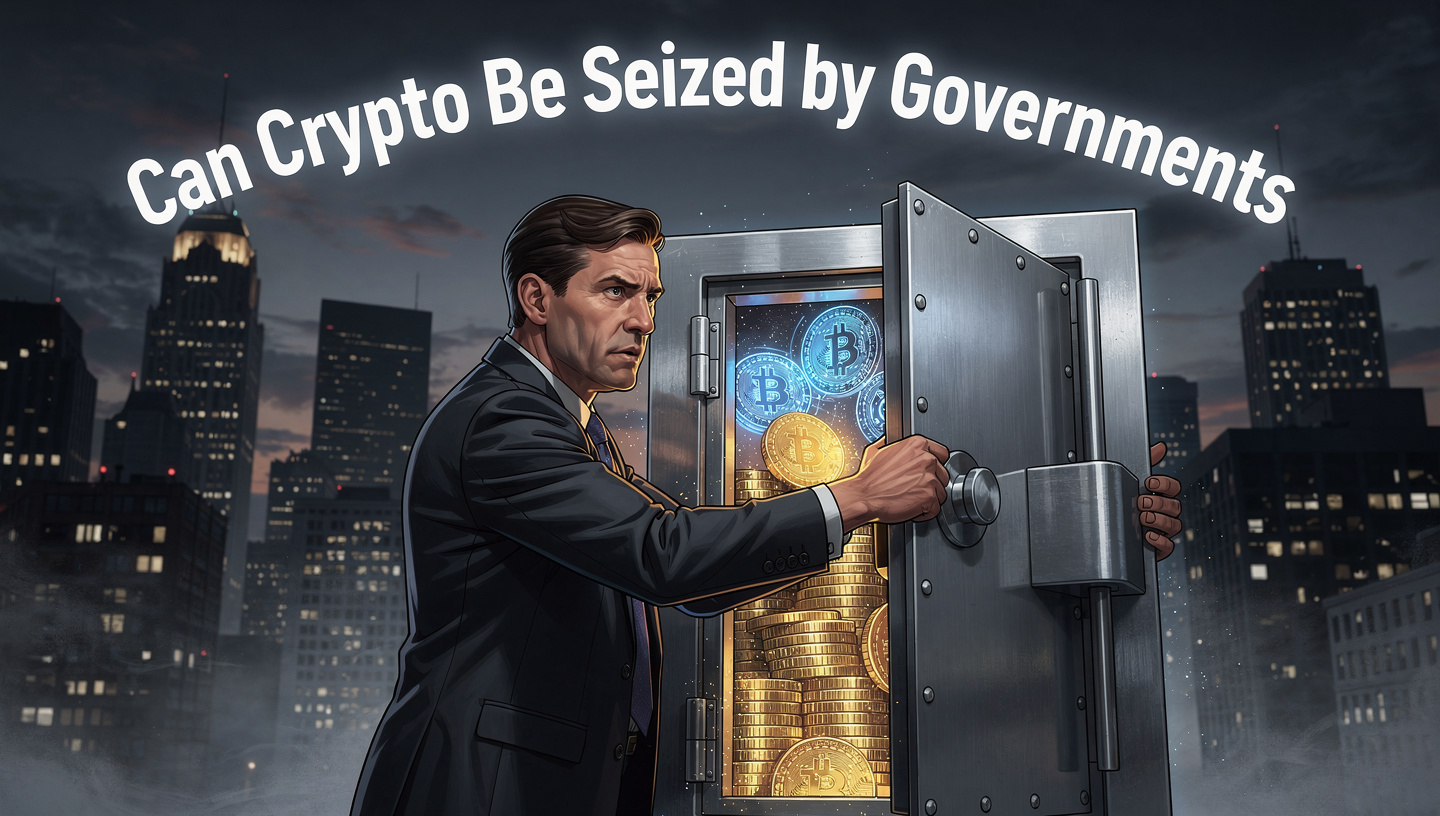
This article examines, in technical and legal detail, whether crypto can be seized by governments. It analyzes statutory authority, procedural mechanisms, blockchain forensics, custodial versus self-custodial holdings, cross-border enforcement, and emerging regulatory frameworks. The conclusion is unequivocal: cryptocurrency can be seized—but the mechanism depends heavily on custody structure, jurisdiction, and operational security.
1. Legal Foundations of Government Seizure
1.1 Asset Forfeiture and Confiscation Law
Most governments rely on established asset forfeiture regimes to seize crypto. These frameworks predate blockchain technology and were originally developed to target proceeds of crime such as narcotics trafficking, fraud, and money laundering.
In the United States, seizure authority arises under:
- Civil and criminal forfeiture statutes (e.g., 18 U.S.C. § 981 and § 982)
- Money laundering provisions
- Racketeer Influenced and Corrupt Organizations (RICO) statutes
- Sanctions enforcement laws
Courts have consistently classified cryptocurrency as “property.” This classification allows digital assets to fall within forfeiture statutes without new legislation.
In the European Union, asset freezing and confiscation are governed by:
- Directive 2014/42/EU on freezing and confiscation
- AMLD5 and AMLD6 anti-money laundering directives
- National criminal codes implementing EU directives
Other jurisdictions—including Singapore, South Korea, and Japan—have amended asset recovery laws to explicitly include virtual assets.
1.2 Crypto as Property Under Law
Judicial recognition of crypto as property is foundational. Courts have held that cryptocurrencies represent a form of intangible property subject to ownership rights and seizure orders. This classification enables:
- Court-issued freezing orders
- Search warrants for private keys
- Exchange account seizures
- Compelled disclosure orders
Without property status, enforcement would be significantly constrained. With it, crypto becomes legally analogous to bank balances, securities, or commodities.
2. Technical Mechanisms of Seizure
Government seizure of crypto depends on one central issue: control of private keys.
2.1 Custodial Holdings: The Simplest Target
When crypto is held on centralized exchanges such as Coinbase or Binance, governments can compel the exchange to:
- Freeze the account
- Transfer funds to a government-controlled wallet
- Provide transaction histories
- Reveal KYC information
Because exchanges custody private keys, they can execute transfers without the user’s cooperation. Regulatory regimes requiring KYC/AML compliance make account identification straightforward.
In practice, custodial seizure resembles bank account freezing. The blockchain is not altered; rather, the exchange initiates a transfer pursuant to court order.
2.2 Self-Custody: The Private Key Problem
When assets are stored in self-custodial wallets, seizure becomes more complex.
Governments can:
- Physically seize hardware wallets
- Compel disclosure of private keys (in some jurisdictions)
- Extract keys from digital devices via forensic analysis
- Use contempt powers for non-compliance
However, if the private key is unknown and irrecoverable, seizure becomes functionally impossible.
This distinction is critical: blockchain immutability does not prevent seizure. Lack of key access does.
3. Blockchain Forensics and Tracing
A common misconception is that crypto is anonymous. In reality, public blockchains are transparent.
3.1 Transaction Traceability
Every transaction on Bitcoin and Ethereum is permanently recorded. Blockchain analytics firms cluster wallet addresses, identify exchange inflows, and correlate metadata.
Law enforcement agencies use tools provided by companies such as:
- Chainalysis
- TRM Labs
These platforms enable authorities to:
- Trace illicit proceeds across wallets
- Identify exchange endpoints
- Link addresses to real-world identities
- Monitor sanctions compliance
Seizure often follows identification of custodial off-ramps.
3.2 High-Profile Enforcement Actions
The U.S. Department of Justice has conducted large-scale crypto seizures, including assets linked to darknet markets and ransomware operators. The dismantling of Silk Road resulted in one of the largest Bitcoin confiscations in history.
Similarly, assets connected to exchange failures—such as those involving FTX—have been subject to government oversight and recovery efforts.
These cases demonstrate that blockchain transparency often aids, rather than impedes, seizure.
4. Can Governments Freeze Wallets Directly?
4.1 Protocol-Level Freezing
On decentralized networks like Bitcoin, governments cannot unilaterally freeze a wallet address at the protocol level. The network does not contain a centralized administrator capable of blacklisting addresses globally.
However, governments can:
- Sanction addresses (e.g., via OFAC)
- Prohibit regulated entities from interacting with certain wallets
- Pressure infrastructure providers
For example, when the U.S. Treasury sanctions an address, compliant exchanges block transactions involving it. The blockchain remains operational, but liquidity access collapses.
4.2 Smart Contract Controls
On some blockchains, tokens include administrative control features. Stablecoins such as USDC and USDT allow issuers to freeze specific addresses.
Issuers can blacklist addresses pursuant to court orders or sanctions. In these cases, tokens become non-transferable even though the underlying blockchain remains active.
This creates a hybrid enforcement model: decentralized infrastructure with centralized token controls.
5. Civil vs. Criminal Seizure
Governments may seize crypto through:
5.1 Criminal Forfeiture
Requires conviction. Assets are confiscated following a criminal judgment. Standard of proof: beyond reasonable doubt (varies by jurisdiction).
5.2 Civil Forfeiture
Does not require criminal conviction. The asset itself is treated as the defendant. Standard of proof is lower (preponderance of evidence in the U.S.).
Civil forfeiture has been used extensively in crypto enforcement, particularly where asset ownership is disputed or criminal defendants are unavailable.
6. Cross-Border Seizure and International Cooperation
Crypto is borderless; enforcement is not.
Governments rely on:
- Mutual Legal Assistance Treaties (MLATs)
- Interpol coordination
- FATF compliance standards
- Extradition agreements
The Financial Action Task Force (FATF) “Travel Rule” requires Virtual Asset Service Providers (VASPs) to transmit originator and beneficiary information. This facilitates cross-border identification and freezing.
Where exchanges operate in cooperative jurisdictions, cross-border seizure is feasible. Where exchanges operate offshore without regulatory oversight, recovery becomes more difficult but not impossible.
7. Seizing DeFi Assets
Decentralized Finance (DeFi) introduces additional complexity.
Smart contracts operate autonomously. However, governments can:
- Seize governance tokens
- Compel front-end operators
- Sanction protocol-associated addresses
- Target developers in certain jurisdictions
While DeFi reduces custodial chokepoints, user interaction frequently intersects with regulated entities (e.g., centralized exchanges for fiat conversion).
Purely on-chain assets secured solely by private keys remain resistant to seizure absent key compromise.
8. What Happens After Seizure?
Seized cryptocurrency is typically:
- Transferred to government-controlled wallets.
- Stored securely.
- Auctioned to the public.
In the United States, seized Bitcoin has been auctioned through the U.S. Marshals Service. These auctions have historically involved substantial holdings originating from criminal investigations.
Proceeds are deposited into government funds or victim restitution programs.
9. Limits of Government Power
Government seizure authority has constraints:
- Constitutional protections (e.g., Fourth Amendment in the U.S.)
- Due process requirements
- Burden of proof standards
- Jurisdictional limitations
- Encryption barriers
If a suspect dies without revealing private keys, funds may become permanently inaccessible. If keys are stored in multisignature arrangements across jurisdictions, enforcement becomes exponentially more complex.
Nonetheless, practical enforcement demonstrates that most crypto eventually intersects with regulated entities, creating identifiable leverage points.
10. Is Crypto “Seizure-Proof”?
No.
The belief that cryptocurrency is inherently immune from state power misunderstands both law and infrastructure.
Crypto can be seized when:
- Held on regulated exchanges
- Linked to identifiable individuals
- Associated with criminal conduct
- Subject to court orders
- Stored in recoverable hardware
Crypto becomes difficult to seize when:
- Private keys are unknown
- Custody is fully decentralized
- Operational security is robust
- Jurisdictional reach is limited
Even then, indirect methods—sanctions, exchange blacklisting, liquidity isolation—can render assets practically unusable.
11. Regulatory Evolution
Governments continue refining seizure capabilities through:
- Expanded AML reporting
- Mandatory exchange registration
- Travel Rule enforcement
- Stablecoin oversight
- Blockchain analytics integration
As regulatory harmonization increases, cross-border enforcement efficiency improves.
Crypto markets are no longer operating in a legal vacuum. They exist within a rapidly maturing compliance ecosystem.
Conclusion
Cryptocurrency can be seized by governments. The determinative factor is not the blockchain itself, but control over private keys and access points within the financial system.
Custodial assets are straightforward to confiscate. Self-custodial assets require key access but are not immune to legal compulsion or forensic recovery. Public blockchains provide a transparent audit trail that often enhances law enforcement capability.
Crypto does not abolish state authority. It alters the technical mechanics through which authority is exercised.
For investors, developers, and compliance professionals, the relevant question is no longer whether governments can seize crypto. It is under what conditions, through which mechanisms, and with what procedural safeguards that seizure occurs.