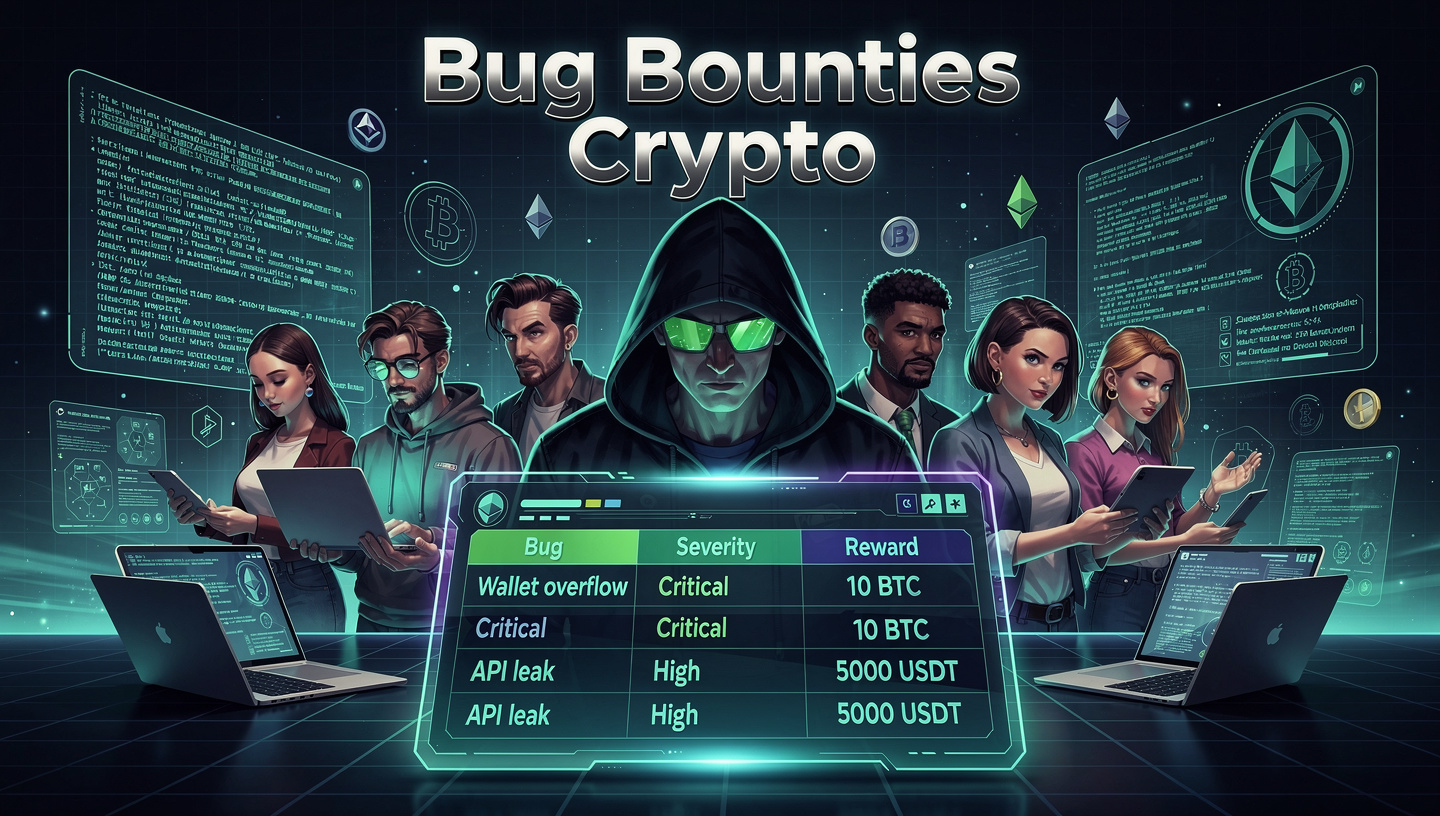
Security in crypto is not a feature. It is not a checkbox. It is not a marketing slogan or a post-launch patch.
Security in crypto is an economic system.
Every protocol that moves value is participating in a silent, global auction for adversarial attention. Hackers, whitehats, auditors, and opportunists are constantly evaluating one question: Is it worth my time to break this system—or to protect it?
Bug bounties exist precisely at that intersection.
They are not acts of goodwill. They are not charity. They are not community engagement programs. They are markets for vulnerability discovery, governed by incentive alignment, information asymmetry, and rational actors responding to price signals.
Yet despite their widespread adoption, bug bounties in crypto remain deeply misunderstood. Many protocols run them. Few design them well. Even fewer understand whether they actually work.
This article examines bug bounties in crypto not as a feel-good security practice, but as what they truly are: a mechanism for reallocating offensive talent toward defensive outcomes—when designed correctly, and a false sense of safety when not.
What Bug Bounties Actually Are (And What They Are Not)
Bug bounties are a permissionless vulnerability market.
Instead of relying solely on closed-door audits performed at fixed points in time, a protocol opens itself to continuous scrutiny by an undefined, global pool of security researchers. In exchange for responsibly disclosing vulnerabilities, participants are paid.
This structure matters because crypto systems differ fundamentally from traditional software:
- They custody irreversible value
- They are open-source by default
- They are composable, meaning a single bug can cascade across multiple protocols
- They are attacked in real time, not hypothetically
In such an environment, static security reviews are insufficient. Attack surfaces evolve. Incentives evolve. Code interacts with other code that did not exist at the time of deployment.
Bug bounties attempt to address this by transforming security from a one-time expense into a continuous competitive process.
But they only work if the economics are correct.
The Core Economic Question: Why Would a Hacker Choose Disclosure Over Exploitation?
Every bug bounty program competes with an alternative option: exploitation.
A rational attacker evaluates:
- Expected payout from responsible disclosure
- Expected profit from exploiting the bug
- Risk of detection
- Legal, reputational, and operational costs
- Time to execute
If the expected value of exploitation exceeds the bounty—adjusted for risk—the bounty has failed.
This is not theoretical. It is observable.
In crypto, where a single vulnerability can drain tens or hundreds of millions of dollars in minutes, many bounties are economically irrelevant. A $50,000 payout does not compete with a $20 million exploit. It does not even register as an alternative.
Effective bug bounties therefore do not hinge on good intentions. They hinge on credible economic deterrence.
Severity Calibration: The Most Common Failure Mode
One of the most widespread flaws in crypto bug bounty programs is mispriced severity tiers.
Many programs define categories such as:
- Low
- Medium
- High
- Critical
But the mapping between these labels and real-world economic impact is often incoherent.
A “critical” bug that allows partial fund manipulation might be capped at $100,000, even if realistic exploitation could yield $50 million. From the attacker’s perspective, the protocol is signaling that it does not understand its own risk profile.
Effective programs reverse this logic.
They anchor rewards not to abstract severity labels, but to maximum credible loss scenarios. The best programs openly state that critical vulnerabilities can receive payouts in the seven-figure range, sometimes higher.
This is not generosity. It is market pricing.
Bug Bounties vs Audits: A False Dichotomy
A common misconception is that bug bounties replace audits.
They do not.
Audits and bug bounties operate at different layers of the security lifecycle:
- Audits are structured, time-bounded, and reviewer-constrained
- Bug bounties are open-ended, adversarial, and incentive-driven
Audits are effective at identifying known classes of vulnerabilities and systemic design flaws before deployment. Bug bounties excel at discovering edge cases, integration risks, and incentive exploits that only emerge under live conditions.
The protocols with the strongest security posture treat audits as table stakes, and bounties as continuous insurance.
Protocols that skip audits and rely on bounties are signaling immaturity. Protocols that skip bounties after launch are signaling complacency.
The Role of Whitehats: Professionals, Not Hobbyists
Another misconception is that bug bounties primarily attract casual hackers.
In reality, the top tier of crypto security researchers operate more like specialized financial analysts than hobbyists. They:
- Track protocol upgrades across ecosystems
- Model economic attacks, not just code bugs
- Understand MEV, oracle manipulation, and cross-chain risk
- Collaborate in private groups with shared intelligence
For these actors, time is capital. They allocate it where the expected return is highest.
Well-designed bounty programs signal seriousness by:
- Paying quickly and transparently
- Communicating clearly during triage
- Publicly acknowledging valid reports
- Avoiding adversarial or dismissive behavior
Reputation matters in this market. Protocols that mishandle disclosures are quietly deprioritized by elite researchers.
Disclosure Process: Where Many Programs Break Down
Even when payouts are competitive, poor disclosure processes can neutralize effectiveness.
Common issues include:
- Slow or opaque triage
- Unclear scope definitions
- Disputes over severity classification
- Legal intimidation or ambiguous liability
- Payment delays
Each of these increases the non-monetary cost of disclosure.
From the researcher’s perspective, a program that introduces uncertainty, friction, or hostility is inferior—even if the headline bounty looks attractive.
The best programs behave predictably, professionally, and with urgency. They understand that speed is a form of security.
Bug Bounties as Signaling Mechanisms
Beyond vulnerability discovery, bug bounties serve an underappreciated function: credible signaling.
A protocol that offers a $2 million maximum bounty is implicitly stating:
- We believe our code is valuable
- We acknowledge that failure would be catastrophic
- We are willing to pay market rates for defense
This matters to users, integrators, and institutional participants. In an environment where trust is minimized, signals replace promises.
However, signaling cuts both ways.
A program with a $10,000 cap on “critical” bugs signals either ignorance or insincerity. Markets notice. Sophisticated users notice.
Data: Do Bug Bounties Actually Reduce Losses?
Empirical analysis in crypto is difficult due to survivorship bias and underreported vulnerabilities. However, several patterns are observable:
- Protocols with long-running, well-funded bounty programs report higher rates of pre-exploit disclosure
- Many of the largest hacks historically occurred in systems with no meaningful bounty or newly launched programs
- Repeated exploits often occur in ecosystems where bounty reports were previously ignored or underpaid
Bug bounties do not eliminate risk. They shift the distribution of outcomes away from catastrophic loss toward manageable remediation.
That alone justifies their existence.
Limitations: What Bug Bounties Cannot Do
Bug bounties are not a panacea.
They are less effective against:
- Insider threats
- Governance attacks
- Social engineering exploits
- Oracle manipulation dependent on external market behavior
- Attacks requiring significant capital coordination
They also cannot compensate for fundamentally flawed protocol design. Incentives embedded in the system itself may encourage exploitation regardless of bounty size.
Security is ultimately architectural.
The Strategic View: Bug Bounties as Part of Capital Allocation
From a capital allocation perspective, bug bounties should be evaluated like insurance premiums.
A protocol managing billions in TVL that spends $500,000 per year on bounties is not overspending. It is under-insuring.
Security budgets should scale with:
- Total value at risk
- Composability exposure
- Upgrade frequency
- Governance attack surface
Protocols that understand this treat security spending not as cost minimization, but as value preservation.
Incentives Decide Outcomes
Crypto is not secured by trust. It is secured by incentives.
Bug bounties work when they respect this reality. They fail when they pretend goodwill is enough.
A well-designed bug bounty program acknowledges an uncomfortable truth: the same minds capable of breaking a system are often the only ones capable of securing it. The question is not whether those minds exist—but who pays them, and why.
In the long run, capital flows to systems that survive adversity. Survival in crypto depends less on perfection than on responsiveness. Bug bounties, properly designed, are not about finding every bug.
They are about ensuring that when bugs exist—and they always do—the market rewards disclosure over destruction.
That is not idealism.
That is economic realism.