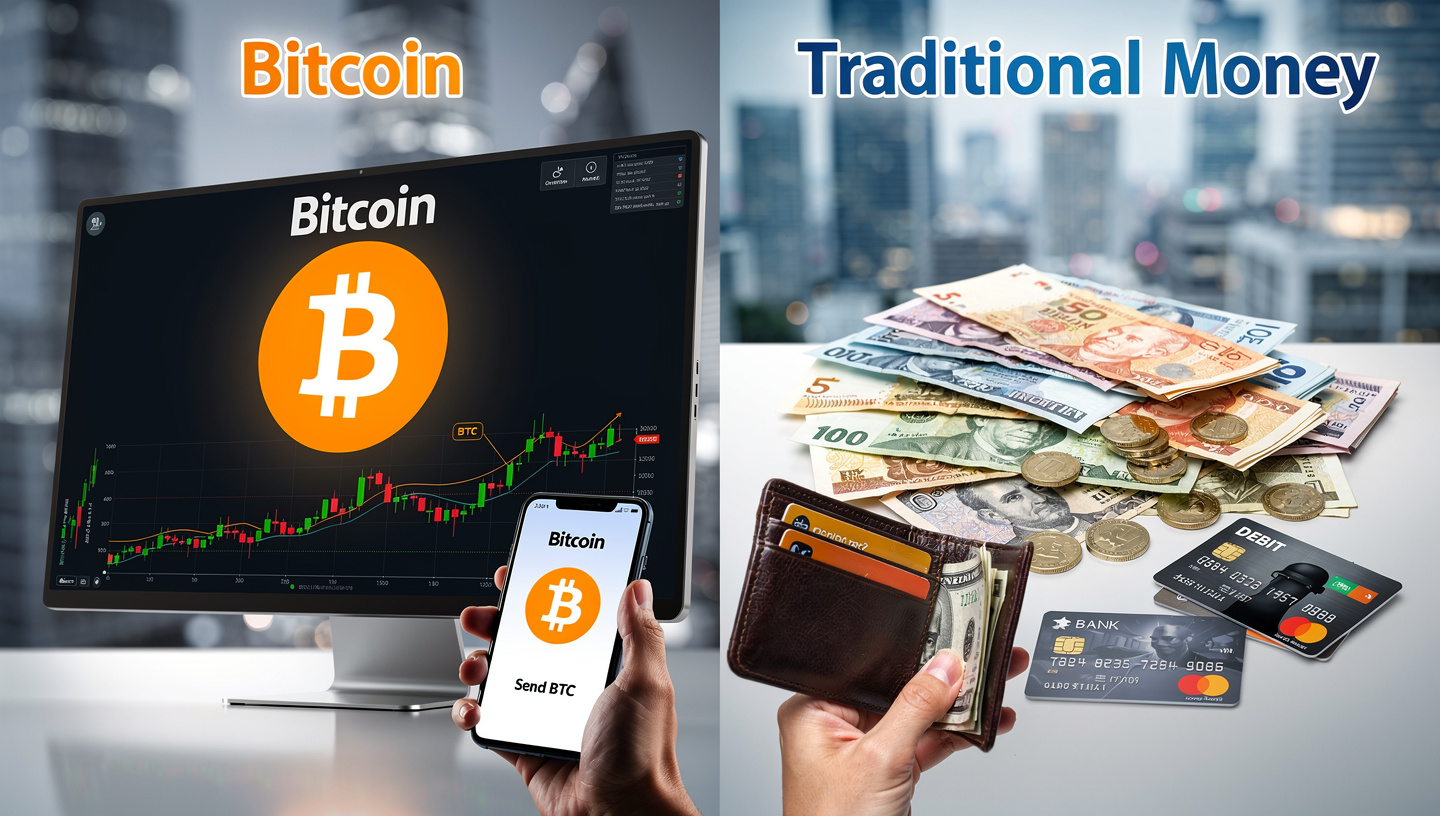
For most of human history, money has taken familiar forms: shells, metal coins, paper bills, and, eventually, numbers stored inside banks. Then Bitcoin appeared — a digital asset governed not by banks or governments, but by code.
Some people call Bitcoin the future of finance. Others say it is risky, volatile, and overrated.
The truth is more nuanced.
To understand whether Bitcoin truly challenges traditional money — or simply offers an alternative — we need to look beyond hype, fear, and speculation. We need to analyze how each form of money works, what problems they solve, and what trade-offs they introduce.
This article takes you on that journey.
1. What Is Money, Really?
Before comparing Bitcoin with traditional money, it helps to answer a fundamental question:
What makes something “money”?
Economists generally agree: money serves three key functions.
1. Medium of Exchange
You use money to buy goods and services.
2. Unit of Account
Money allows prices to be measured and compared.
3. Store of Value
Money should hold purchasing power over time — at least reasonably well.
Traditional money (also called fiat currency) — such as the U.S. dollar, euro, or Vietnamese dong — performs these roles because governments issue it, enforce its use through laws, and manage financial systems around it.
Bitcoin, created in 2009 by the mysterious Satoshi Nakamoto, approaches money differently. Instead of governments controlling supply, Bitcoin relies on mathematics, cryptography, and decentralized networks.
This difference shapes everything that follows.
2. How Traditional Money Works
Traditional money is government-backed and centralized.
Central Banks Control Supply
Institutions like the Federal Reserve or European Central Bank:
- Issue new currency
- Control interest rates
- Influence inflation
- Attempt to stabilize economies
They can print more money during crises (stimulus programs), restrict credit when inflation rises, and regulate banks.
Banks Hold and Move Your Money
Commercial banks:
- Store deposits
- Offer loans
- Process payments
- Maintain account ledgers
This creates trust — but also dependency.
You rely on banks and governments to:
- Keep records accurate
- Prevent fraud
- Protect deposits
- Maintain stability
Strengths of Traditional Money
Traditional money is powerful because it is:
- Widely accepted
- Legal tender (required for payment of debts and taxes)
- Stable relative to assets like stocks or crypto
- Supported by financial infrastructure: ATMs, cards, banking apps, payment rails
Weaknesses of Traditional Money
However, fiat systems carry problems:
- Inflation erodes value over time
- Governments can freeze accounts
- Banks can fail or restrict withdrawals
- Cross-border transfers can be expensive and slow
- People without bank access are excluded
Traditional money is stable, but not always fair — and not always efficient.
3. How Bitcoin Works
Bitcoin flips the traditional model upside down.
Instead of a central authority, Bitcoin operates on a decentralized blockchain — a public ledger maintained by thousands of computers worldwide.
Key Features of Bitcoin
1. Limited Supply
Only 21 million Bitcoin will ever exist.
No central bank can “print” more.
This scarcity is part of why many compare Bitcoin to digital gold.
2. Decentralization
No government, bank, or corporation controls Bitcoin.
Rules are enforced by software and consensus among participants.
3. Transparency
Every transaction is recorded on the blockchain and visible to anyone.
4. Peer-to-Peer Payments
Bitcoin enables direct transfers without intermediaries like banks.
5. Security Through Cryptography
Transactions are validated by miners using computing power, making forgery extremely difficult.
Strengths of Bitcoin
Bitcoin offers:
- Protection from inflation (fixed supply)
- Financial independence
- Ability to move value globally, 24/7
- Resistance to censorship and asset seizure
- Ownership without needing permission
For people in countries with unstable currencies or restrictive banking systems, Bitcoin can be especially appealing.
Weaknesses of Bitcoin
Bitcoin also has real challenges:
- High price volatility
- Limited everyday acceptance
- Slow transaction speeds compared to modern payment networks
- Irreversible transactions (mistakes cannot be undone)
- Requires digital knowledge and security awareness
Bitcoin is powerful — but it is not simple, nor risk-free.
4. Bitcoin vs Traditional Money: Head-to-Head Comparison
Let’s break the comparison down across critical dimensions.
1. Control and Governance
| Feature | Bitcoin | Traditional Money |
|---|---|---|
| Who controls it? | Decentralized network | Governments & central banks |
| Policy decisions | Open-source rules | Political and economic decisions |
| Supply limits | Hard cap of 21M | Unlimited; managed by policy |
Bitcoin prioritizes independence. Traditional money prioritizes stability through management.
2. Inflation and Value Over Time
Fiat currencies lose value gradually due to inflation. This is intentional — inflation encourages spending and investment.
Bitcoin attempts to do the opposite:
- Scarcity → potential long-term value preservation
- But short-term → volatility can be intense
Bitcoin can rise or fall dramatically in weeks. Fiat rarely behaves this way.
3. Security
| Aspect | Bitcoin | Traditional Money |
|---|---|---|
| Counterfeiting | Extremely difficult | Possible, but policed |
| Fraud/Reversal | Irreversible transactions | Banks can reverse and investigate |
| Personal responsibility | High (you secure your keys) | Shared between banks and users |
With Bitcoin, you are your own bank.
That power is liberating — but losing your private keys means losing your funds permanently.
4. Accessibility and Inclusion
Traditional banking systems exclude millions due to regulations, costs, or geography.
Bitcoin requires:
- Internet connection
- A wallet
- Basic technical understanding
This can expand access — but digital literacy becomes essential.
5. Transaction Speed and Cost
Small payments:
- Fiat networks (credit cards, mobile payments) are fast and cheap for users
- Bitcoin can be slower and more expensive during busy network periods
Large, international transfers:
- Fiat systems may take days and incur high fees
- Bitcoin may move value globally within minutes
Different systems excel in different contexts.
6. Legal Status and Regulation
Traditional money operates under strict legal frameworks.
Bitcoin exists in a complex regulatory landscape:
- Legal in some countries
- Restricted or banned in others
- Tax implications vary
Governments continue to adapt as Bitcoin evolves.
5. Is Bitcoin “Better” Than Traditional Money?
The question is misleading.
Bitcoin is not designed to replace every function of fiat money.
Instead, it:
- Challenges centralized control
- Offers an alternative store of value
- Provides a censorship-resistant payment system
- Enables financial autonomy in restrictive economies
Traditional money remains superior for:
- Daily transactions
- Stability
- Government services
- Business accounting
- Consumer protections
The future is likely coexistence, not domination.
6. The Future: Hybrid Financial Systems
We are entering a world where:
- Governments create digital currencies (CBDCs)
- Banks custody digital assets
- Bitcoin continues as a hedge and alternative asset
- Payment systems blend old and new technologies
Bitcoin pushes financial innovation forward. Traditional systems provide structure and reliability.
Together, they shape a more dynamic monetary future.
Final Thoughts
Bitcoin forces us to rethink what money is, who should control it, and how value should move across the world.
Traditional money represents history, institutions, and stability.
Bitcoin represents innovation, autonomy, and digital sovereignty.
Understanding both — and their trade-offs — is essential in a world where finance is rapidly evolving.