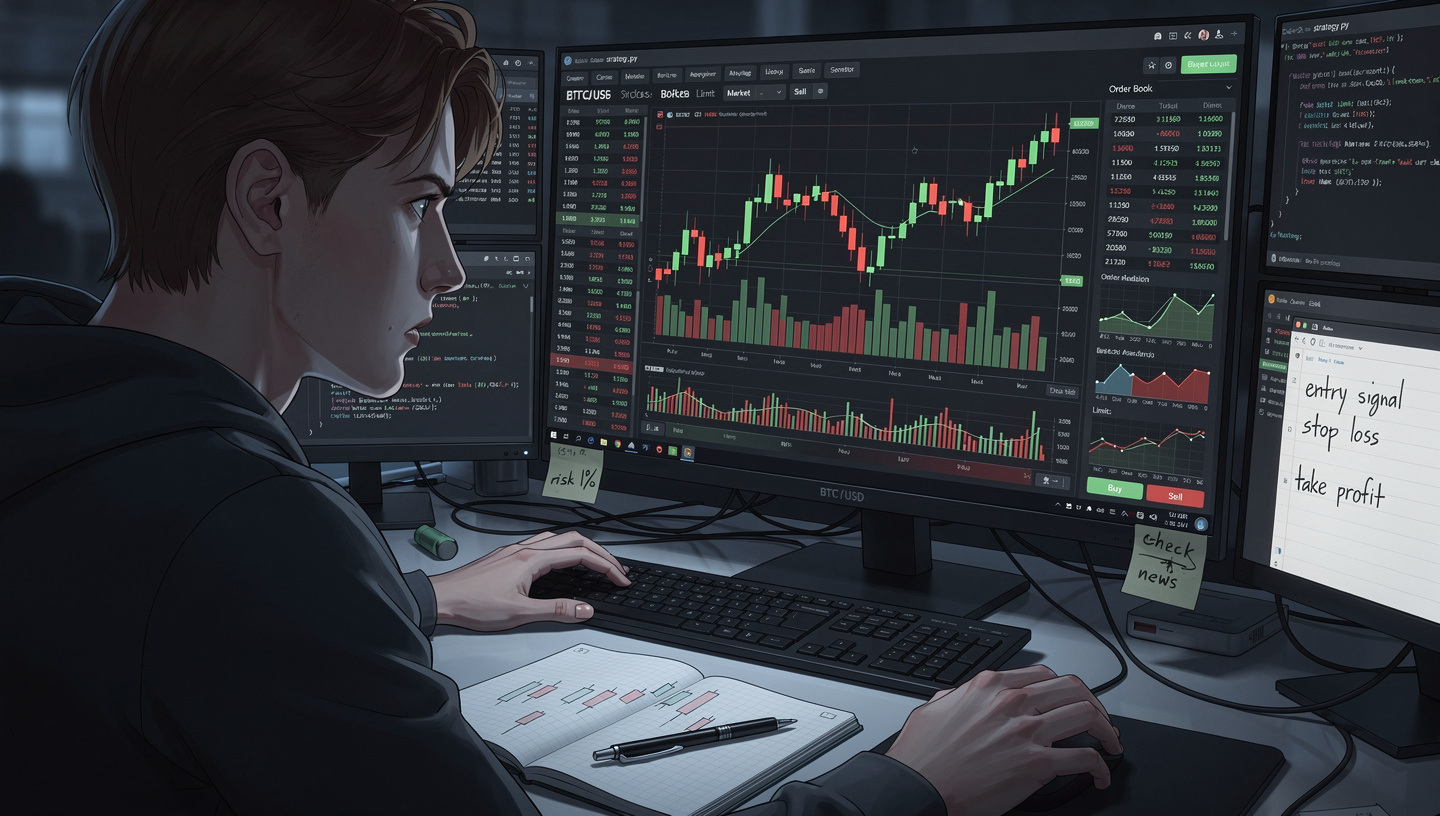
Price charts do not care about opinions. Order books do not respect conviction. And markets certainly do not reward confidence without evidence.
Crypto trading is one of the few domains where retail participants compete directly with quant funds, latency-optimized market makers, and automated strategies running twenty-four hours a day. Yet most traders still evaluate their ideas the same way gamblers judge slot machines: by remembering wins more vividly than losses.
Backtesting exists to eliminate that weakness.
Proper backtesting replaces intuition with data. It forces strategies to survive contact with history. It exposes hidden fragility. It reveals whether your edge is structural—or imaginary.
This article is not about drawing indicators and hoping for green candles. It is about building statistically defensible crypto trading systems. You will learn how professional-grade backtesting works, why most retail backtests are dangerously flawed, and how to construct pipelines that approximate real-world execution.
This is engineering, not astrology.
What Backtesting Actually Means (And What It Does Not)
Backtesting is the systematic evaluation of a trading strategy against historical market data under clearly defined execution rules.
That definition matters.
A real backtest must include:
- Exact entry and exit logic
- Position sizing rules
- Fees and slippage
- Time-based constraints
- Capital allocation
- Risk management
- Market microstructure assumptions
Anything less is curve-fitting disguised as research.
Backtesting does not mean:
- Scrolling charts and spotting patterns
- Running indicators on TradingView and eyeballing results
- Optimizing parameters until the equity curve looks beautiful
- Assuming fills at candle close with zero friction
If your strategy only works under perfect fills and zero latency, it does not work.
Why Crypto Makes Backtesting Harder Than Traditional Markets
Crypto markets introduce unique complexities that invalidate many stock-market backtesting assumptions.
1. Fragmented Liquidity
Unlike equities, crypto trades across dozens of venues simultaneously—such as Binance, Coinbase, and OKX.
Prices differ. Spreads vary. Order book depth changes by venue.
Backtesting against a single exchange feed while assuming global liquidity is a structural error.
2. Regime Instability
Crypto does not follow stable macro cycles. It shifts violently between:
- Speculative mania
- Liquidity droughts
- Volatility compression
- Reflexive crashes
Strategies that thrive in one regime often collapse in another.
Backtests must span multiple market environments—or they are meaningless.
3. Structural Alpha Decays Fast
Crypto is hyper-competitive.
Once an inefficiency becomes visible, automated capital erases it.
What worked six months ago is often dead today.
Backtesting must emphasize robustness, not historical perfection.
The Psychology Trap: Why Most Traders Fool Themselves
Humans are not wired for probabilistic thinking.
We overweight recent wins. We rationalize losses. We see patterns in noise.
This is why traders fall in love with strategies that “feel right.”
Backtesting exists to counteract this bias.
If your system does not survive thousands of trades across multiple years, it is not a strategy—it is a narrative.
Core Components of a Professional Crypto Backtest
A serious backtest includes the following layers.
1. High-Quality Historical Data
Garbage in. Garbage out.
Minimum requirements:
- Tick or high-resolution candle data
- Bid/ask spreads (not just mid price)
- Volume profiles
- Funding rates (for perpetuals)
- Corporate-action equivalents (forks, listings, delistings)
Aggregated OHLCV alone is insufficient for most intraday strategies.
2. Realistic Execution Modeling
You must simulate:
- Maker vs taker fills
- Partial fills
- Slippage based on order size vs book depth
- Latency assumptions
- Queue position for limit orders
Assuming fills at candle close produces fantasy PnL.
3. Position Sizing Logic
Fixed lot sizing is amateur hour.
Professional systems size positions based on:
- Volatility (ATR or realized)
- Risk per trade
- Portfolio heat
- Correlation exposure
Risk management is part of the strategy, not an afterthought.
Strategy Types and How They Should Be Backtested
Different strategy archetypes require different testing methodologies.
Trend-Following Systems
These rely on persistent directional movement.
Key testing requirements:
- Long historical samples (multiple bull and bear cycles)
- Walk-forward validation
- Volatility normalization
Common mistake: optimizing lookback windows until past trends align perfectly.
Mean Reversion Strategies
These exploit short-term overextensions.
They demand:
- Tick-level or very fine-grain data
- Accurate spread modeling
- Realistic fill assumptions
Without microstructure modeling, results are fiction.
Arbitrage and Market-Neutral Systems
These include:
- Cross-exchange spreads
- Funding rate capture
- Statistical pairs
They require synchronized feeds across venues and precise fee modeling.
Ignoring transfer delays or withdrawal limits invalidates the test.
Overfitting: The Silent Strategy Killer
Overfitting occurs when a model learns historical noise instead of market structure.
Symptoms include:
- Excessive parameters
- Sharp performance drop out-of-sample
- Equity curves that look “too smooth”
- Sensitivity to tiny parameter changes
Professional backtesting uses:
- Out-of-sample validation
- Monte Carlo resampling
- Parameter stability analysis
- Walk-forward optimization
If performance collapses under minor perturbations, your edge is imaginary.
Metrics That Actually Matter
Forget raw profit.
Serious evaluation focuses on:
- Sharpe ratio
- Sortino ratio
- Maximum drawdown
- Calmar ratio
- Win/loss expectancy
- Profit factor
- Time underwater
A strategy that doubles capital but suffers 70% drawdowns is not tradable.
Risk-adjusted returns define viability.
The Importance of Market Impact
Retail traders underestimate market impact because their order sizes are small—until they scale.
Market impact grows nonlinearly.
Backtests must account for:
- Order book depth
- Liquidity decay during volatility spikes
- Self-induced slippage
Ignoring this leads to strategies that break precisely when capital increases.
Tooling: What Professionals Actually Use
Retail traders often rely on charting platforms like TradingView. That is fine for visualization—but insufficient for serious research.
Professional pipelines typically use:
- Python-based frameworks
- Custom simulators
- Vectorized execution engines
- Event-driven architectures
Python libraries such as pandas and NumPy form the foundation, with bespoke execution layers built on top.
At the institutional level, entire research stacks exist solely to test one idea rigorously.
Walk-Forward Analysis: Your Reality Check
Walk-forward testing simulates how a strategy would have evolved in real time:
- Train on past data
- Trade forward on unseen data
- Re-optimize
- Repeat
This exposes:
- Parameter drift
- Regime sensitivity
- Structural decay
If your system cannot survive walk-forward testing, it will not survive live markets.
Portfolio-Level Backtesting (Most Traders Skip This)
Single-strategy evaluation is incomplete.
Real trading involves portfolios.
You must test:
- Strategy correlation
- Capital allocation dynamics
- Risk concentration
- Drawdown overlap
Two profitable strategies can destroy each other when combined.
Backtesting must operate at portfolio scale.
Common Crypto Backtesting Mistakes
These errors are endemic:
- Ignoring delisted coins (survivorship bias)
- Using future data accidentally (lookahead bias)
- Over-optimizing indicators
- Assuming infinite liquidity
- Forgetting funding rates
- Excluding black swan events
Any one of these invalidates results.
Backtesting vs Forward Testing
Backtesting proves historical viability.
Forward testing (paper trading) proves operational viability.
Both are required.
No strategy goes live without surviving:
- Historical testing
- Walk-forward validation
- Paper trading
- Limited-capital deployment
Skipping steps accelerates losses.
A Practical Framework for Building Your Own Backtesting Pipeline
At minimum:
- Acquire raw exchange data
- Normalize timestamps and symbols
- Build execution simulation
- Encode strategy logic
- Apply realistic fees and slippage
- Run parameter sweeps
- Perform walk-forward analysis
- Stress test with Monte Carlo
- Evaluate portfolio interaction
- Only then consider live deployment
Anything less is speculation.
Final Thoughts: Backtesting Is a Filter, Not a Crystal Ball
Backtesting does not predict the future.
It filters bad ideas.
It eliminates emotional bias.
It replaces hope with probability.
Crypto markets are unforgiving. They do not reward creativity alone. They reward verified edges implemented with discipline.
If your strategy cannot survive historical reality under realistic constraints, it does not deserve real capital.
Proper backtesting is not optional.
It is the price of admission.