The first automated systems in finance were built to reduce human error. Web3 is doing something more radical: it is redesigning agency itself. Instead of automating clerical tasks or execution speed, blockchains are automating trust, coordination, and economic logic. Code is no longer just a tool. It is becoming an autonomous participant in markets.
That shift changes everything.
In Web2, automation optimized businesses. In Web3, automation becomes the business.
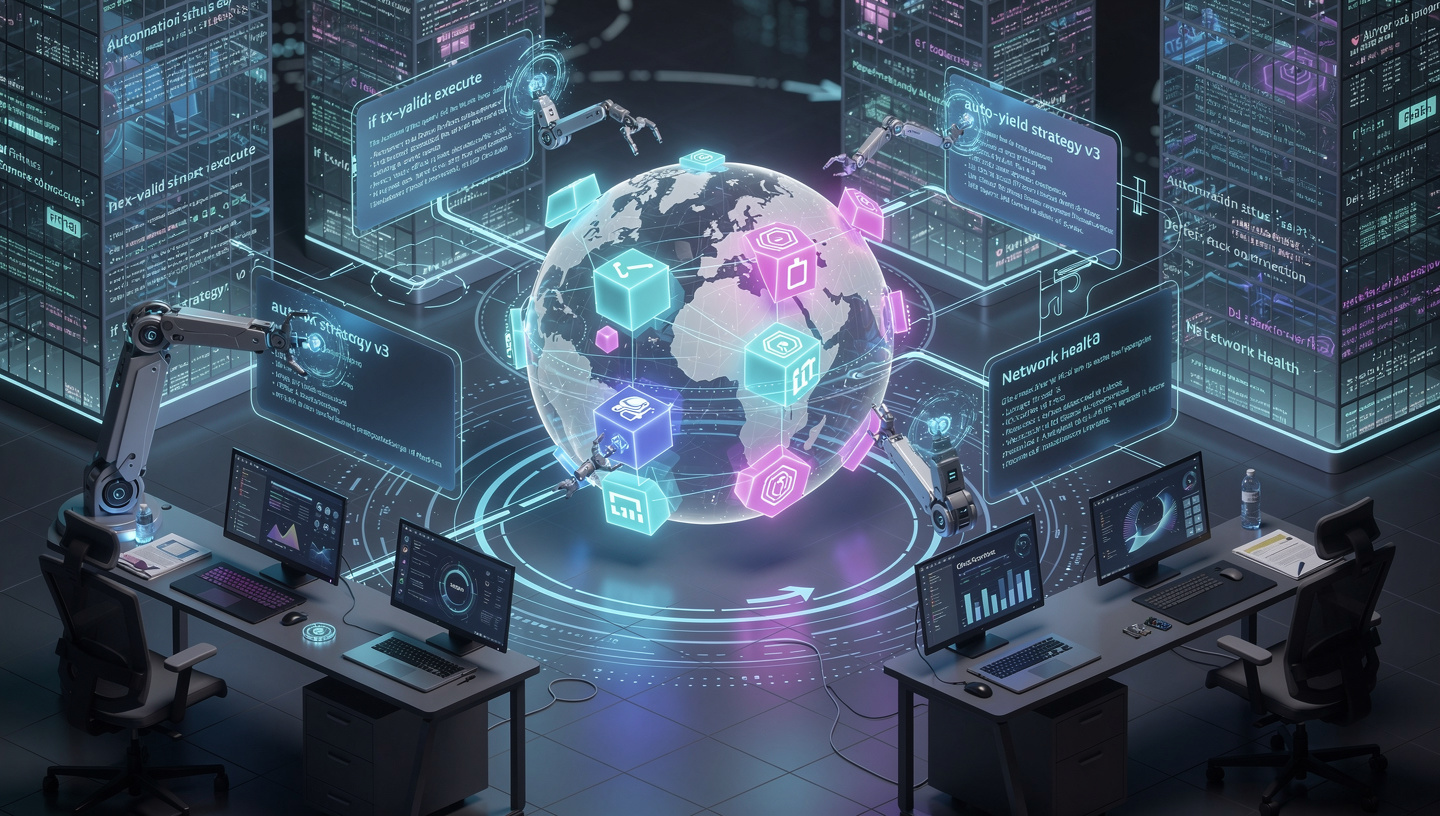
What we are witnessing today is not simply smarter contracts or faster bots. It is the early formation of self-operating financial ecosystems—networks that sense conditions, execute strategy, manage risk, distribute value, and adapt in real time, often without a single human click. This is the moment where decentralized infrastructure begins behaving less like software and more like a living system.
This article examines how automation is reshaping Web3—from smart contract orchestration and DeFi agents to oracle-driven execution, AI-enhanced protocols, and autonomous organizations—and why this evolution represents the next structural leap in crypto.
From Programmable Money to Programmable Economies
Crypto’s first breakthrough was programmable scarcity, introduced by Bitcoin. It proved that value could exist natively on the internet without centralized issuance.
The second breakthrough arrived with Ethereum, which transformed blockchains into general-purpose computation layers. Smart contracts turned money into software.
Automation is the third breakthrough.
Instead of humans manually interacting with protocols—depositing, trading, rebalancing, voting—logic now executes continuously in the background. Markets operate 24/7. Risk engines monitor positions in real time. Yield strategies rebalance automatically. Governance actions trigger based on on-chain signals.
This marks a transition from programmable money to programmable economies.
In these systems:
- Capital deploys itself.
- Liquidity migrates automatically.
- Risk parameters adjust dynamically.
- Rewards distribute without intermediaries.
- Entire organizations run on code.
Automation is no longer an accessory. It is becoming the core operating system of Web3.
Smart Contracts Evolve Into Autonomous Workflows
Early smart contracts were static: “if X, then Y.”
Modern Web3 automation builds multi-step workflows that resemble financial assembly lines.
A single user action can now trigger a cascade:
- Funds move into liquidity pools.
- LP tokens are staked.
- Rewards are harvested.
- Profits are reinvested.
- Risk thresholds are monitored.
- Positions rebalance automatically.
This orchestration layer is what separates primitive DeFi from industrial-grade crypto infrastructure.
Protocols like Uniswap enabled automated market making. Aave introduced algorithmic lending rates. MakerDAO pioneered automated collateralized debt.
Each of these platforms embeds automation directly into their economic design. No employees manage liquidity. No credit committees approve loans. No treasurers rebalance reserves. The code executes continuously.
The result is a financial stack that operates at machine speed.
Oracles: Teaching Blockchains to Sense Reality
Automation requires awareness. Blockchains, by default, are isolated environments. They cannot see prices, interest rates, weather data, or macro conditions.
This is where oracles become foundational.
Chainlink pioneered decentralized data feeds that allow smart contracts to react to real-world information. Prices update automatically. Liquidations trigger instantly. Insurance contracts pay out without claims departments.
Modern automation pipelines depend on oracles to:
- Execute trades based on off-chain prices
- Adjust collateral ratios dynamically
- Trigger governance proposals
- Manage cross-chain activity
- Coordinate DeFi strategies
Without oracles, autonomous finance collapses into a closed simulation. With them, Web3 becomes reactive, adaptive, and economically aware.
This sensory layer is what allows blockchains to participate in global markets rather than merely mirror them.
DeFi Agents: Capital That Thinks
The next phase of automation is agent-based finance.
Instead of static strategies, protocols increasingly deploy autonomous agents—software entities that monitor conditions, optimize yield, and manage positions across multiple platforms.
These agents can:
- Compare lending rates across protocols
- Rotate liquidity based on volatility
- Hedge exposure automatically
- Harvest rewards and compound profits
- Exit positions during risk spikes
What makes this powerful is composability. Agents are not confined to a single application. They traverse the entire DeFi stack, coordinating activity across exchanges, lending markets, bridges, and derivatives.
This creates a new asset class: self-managing capital.
Investors no longer allocate funds to static pools. They deploy capital into systems that actively adapt to market structure.
The human role shifts from execution to supervision.
Automation as Risk Management Infrastructure
Volatility is crypto’s defining characteristic. Automation is becoming its primary stabilizer.
Liquidation engines monitor millions of positions simultaneously. Interest rates adjust in real time. Treasury balances rebalance automatically. Circuit breakers halt markets when thresholds are breached.
These mechanisms perform tasks once handled by centralized risk desks.
Consider how automated liquidations prevent insolvency cascades, or how algorithmic interest models stabilize lending markets. These systems operate continuously, without fatigue or emotion.
Importantly, automation also introduces transparency. Risk logic is visible on-chain. Parameters are auditable. Outcomes are deterministic.
This represents a structural upgrade over opaque traditional finance models where risk decisions are buried inside institutions.
Autonomous Organizations: DAOs Grow Up
Decentralized Autonomous Organizations were once glorified voting clubs. Automation is transforming them into operational entities.
Modern DAOs automate:
- Payroll distribution
- Treasury diversification
- Grant funding
- Contributor onboarding
- Revenue sharing
- Protocol upgrades
Governance proposals increasingly trigger executable code rather than symbolic approvals. Once passed, smart contracts implement decisions directly.
This closes the loop between governance and action.
DAOs are evolving from coordination experiments into programmable corporations—entities that allocate resources, compensate contributors, and execute strategy with minimal human overhead.
Automation removes bureaucracy. It replaces committees with algorithms.
Cross-Chain Automation and Interoperability
Web3 is no longer a single ecosystem. Capital flows across dozens of chains.
Automation now extends across this fragmented landscape.
Cross-chain routers rebalance liquidity. Arbitrage bots synchronize prices. Bridges trigger transfers based on predefined conditions. Yield strategies span multiple networks simultaneously.
This interoperability layer is essential for scaling automation beyond isolated blockchains.
The future is not one dominant chain—it is an automated mesh of interconnected protocols, with capital moving frictionlessly between them.
AI Meets Web3 Automation
The convergence of artificial intelligence and blockchain automation introduces a new dimension.
AI models enhance:
- Market prediction
- Portfolio optimization
- Fraud detection
- Governance analysis
- Strategy simulation
When combined with smart contracts, AI enables systems that not only execute logic but refine it over time.
Imagine protocols that adjust parameters based on learned behavior. DAOs that simulate policy outcomes before voting. Treasury bots that adapt allocations using predictive analytics.
This does not require centralized control. AI can operate off-chain while execution remains on-chain, preserving transparency while adding intelligence.
The result is a hybrid architecture: deterministic settlement powered by probabilistic reasoning.
Economic Implications: The Rise of Machine-Native Finance
Automation creates markets optimized for machines, not humans.
Execution speeds exceed human reaction time. Strategies operate continuously. Capital compounds without intervention.
This favors participants who deploy automated infrastructure. Retail traders increasingly interact with abstractions—vaults, strategies, agents—rather than raw protocols.
Over time, we will see:
- Shrinking spreads
- Faster price discovery
- Lower operational costs
- Increased protocol efficiency
- Reduced reliance on intermediaries
But also:
- Higher technical complexity
- Greater reliance on infrastructure providers
- New systemic risks from automated feedback loops
Machine-native finance is efficient—but fragile. A bug propagates instantly. A mispriced oracle cascades across ecosystems.
Automation amplifies both resilience and risk.
Regulatory Pressure and the Automation Paradox
Automation challenges traditional regulatory frameworks.
Who is responsible when autonomous code executes harmful behavior? Who audits self-evolving systems? How do you enforce compliance on protocols without operators?
Jurisdictions worldwide are grappling with these questions.
The paradox is clear: automation reduces human discretion, but regulation assumes human accountability.
Expect hybrid models to emerge—where compliant interfaces wrap autonomous cores, and governance frameworks evolve to accommodate machine-driven finance.
Automation will not eliminate regulation. It will force it to adapt.
What Comes Next: Toward Self-Sustaining Crypto Economies
The trajectory is unmistakable.
We are moving toward ecosystems where:
- Protocols manage their own treasuries
- Agents optimize capital flows
- DAOs execute strategy automatically
- AI enhances decision-making
- Oracles synchronize on-chain logic with real-world data
Human participation shifts upward in the stack—from operators to designers, auditors, and governors.
Web3 is becoming a substrate for autonomous economic activity.
This is not about replacing people. It is about building systems that scale beyond human bandwidth.
Final Perspective
Automation in Web3 is not a convenience feature. It is the structural foundation of the next crypto cycle.
Speculation brought users. Infrastructure brought legitimacy. Automation brings sustainability.
As blockchains learn to operate without constant human input, they begin to resemble digital organisms—networks that sense, adapt, allocate, and evolve.
The winners of this era will not be the loudest projects or the flashiest narratives. They will be the protocols that quietly build resilient automation pipelines beneath the surface.
Because the future of crypto is not just decentralized.
It is autonomous.