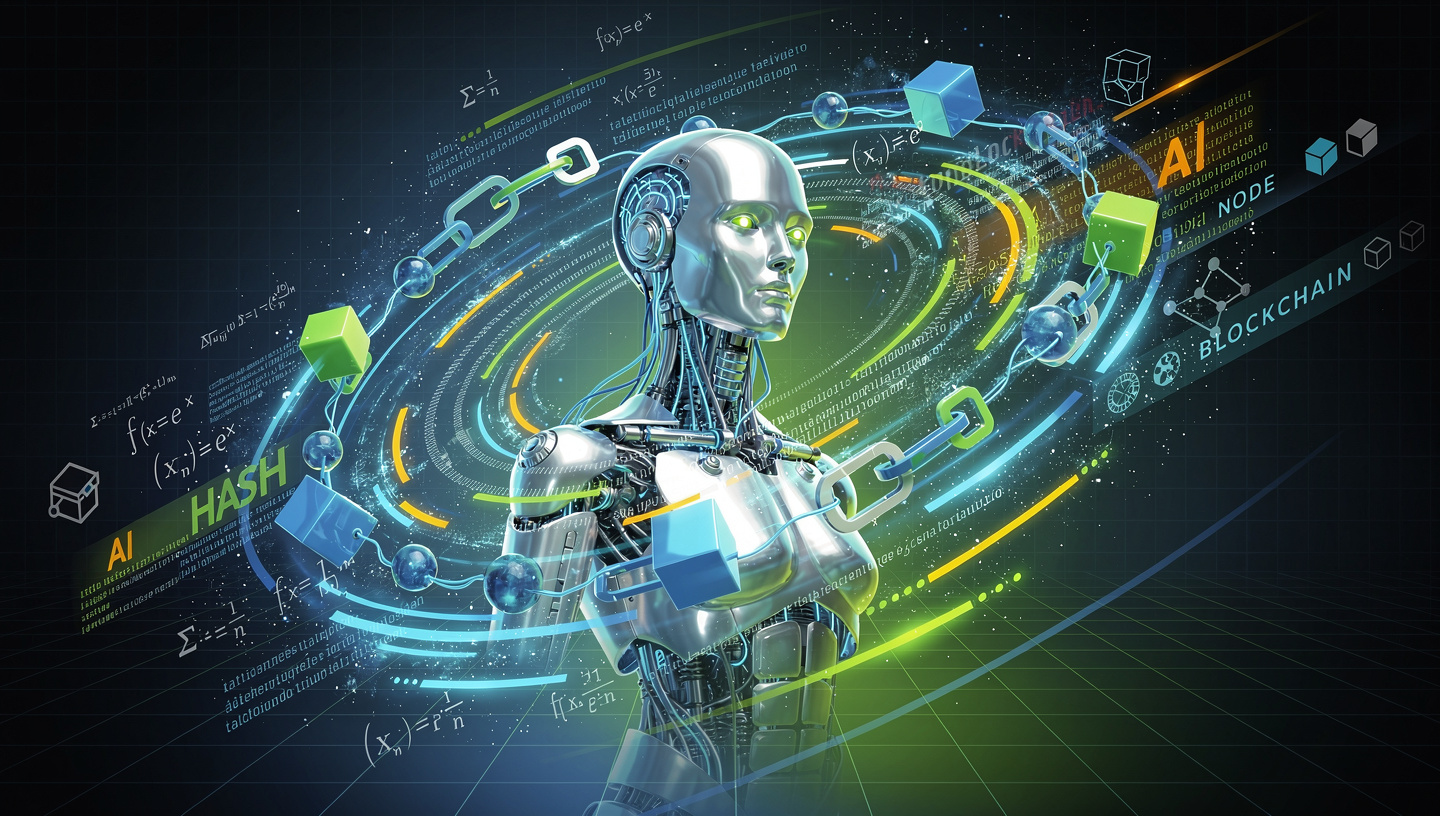
Few technologies in modern history have generated as much excitement, fear, and misunderstanding as Artificial Intelligence (AI) and Blockchain. Each, on its own, promises to reshape industries, redefine trust, and challenge long-standing assumptions about how systems should work.
But when AI meets Blockchain, something far more profound begins to emerge — not merely a combination of tools, but a new technological paradigm.
AI is about intelligence, learning, prediction, and autonomy.
Blockchain is about trust, transparency, decentralization, and immutability.
One thinks.
The other remembers.
Together, they hint at a future where machines can make decisions that are not only intelligent, but also verifiable, accountable, and trustless — a future where power shifts from centralized platforms to decentralized networks guided by algorithmic intelligence.
So what should we really expect from this convergence? Hype? Revolution? Or something subtler — and more transformative — than both?
1. Understanding the Core Strengths: Why AI and Blockchain Need Each Other
AI’s Superpower — And Its Greatest Weakness
Artificial Intelligence excels at:
- Pattern recognition
- Optimization
- Prediction
- Automation at scale
Yet AI systems suffer from critical limitations:
- Opacity (black-box decision-making)
- Centralized control
- Data manipulation risks
- Bias hidden in training data
- Lack of accountability
In short, AI is powerful — but trusting AI is hard.
Blockchain’s Promise — And Its Blind Spot
Blockchain offers:
- Immutable records
- Decentralized consensus
- Transparent verification
- Resistance to tampering
But blockchain alone:
- Cannot interpret data
- Cannot learn
- Cannot adapt intelligently
- Is computationally inefficient for complex logic
Blockchain records truth, but it doesn’t understand it.
👉 This is where the magic happens:
AI brings intelligence to blockchain.
Blockchain brings trust to AI.
2. The Central Question: Can We Trust Intelligent Machines?
As AI systems increasingly:
- Approve loans
- Diagnose diseases
- Trade financial assets
- Moderate speech
- Control autonomous vehicles
A terrifying question arises:
Who watches the machines?
Blockchain introduces a radical answer:
Everyone — and no one — at the same time.
By anchoring AI decisions, model updates, and data provenance on-chain, blockchain allows:
- Auditability of AI decisions
- Verification of model integrity
- Transparent accountability without central authority
This is not about slowing AI down — it’s about making intelligence credible.
3. Decentralized AI: Breaking the Monopoly on Intelligence
The Problem with Centralized AI
Today, AI power is concentrated among:
- Big tech corporations
- Governments
- Cloud providers
They control:
- Training data
- Models
- Compute infrastructure
- Distribution channels
This creates:
- Data monopolies
- Surveillance risks
- Algorithmic censorship
- Unequal access to intelligence
Blockchain-Enabled Decentralized AI
Blockchain enables:
- Open AI marketplaces
- Permissionless model sharing
- Tokenized incentives for data providers
- Distributed model training
Imagine:
- AI models owned by communities
- Data contributors rewarded transparently
- Models evolving through decentralized governance
In this world, intelligence becomes a public good — not a corporate asset.
4. Verifiable AI: From “Trust Me” to “Prove It”
One of AI’s biggest flaws is explainability.
Blockchain introduces:
- Cryptographic proofs
- Immutable logs
- Tamper-resistant audit trails
This allows:
- Verification of training datasets
- Proof that models haven’t been altered
- On-chain records of decision logic execution
Why This Matters
In regulated industries like:
- Finance
- Healthcare
- Law
- Government
“Trust us” is no longer enough.
Blockchain transforms AI from:
“Believe this output”
into
“Verify how this output was produced.”
5. AI-Driven Smart Contracts: When Code Learns
Traditional smart contracts are:
- Deterministic
- Rule-based
- Inflexible
AI introduces:
- Adaptability
- Context awareness
- Optimization over time
The Rise of Intelligent Smart Contracts
AI-powered smart contracts can:
- Adjust parameters dynamically
- Detect fraud patterns
- Optimize pricing models
- Respond to real-world signals
Yet blockchain ensures:
- AI actions are constrained
- Rules remain enforceable
- Outcomes remain transparent
This balance is critical.
Uncontrolled AI is dangerous.
Controlled AI without intelligence is useless.
6. Data Is the New Oil — Blockchain Is the Refinery
AI depends on data.
Blockchain reshapes how data is:
- Collected
- Owned
- Shared
- Monetized
Decentralized Data Markets
Blockchain enables:
- User-owned data
- Permission-based access
- Micropayments for data usage
- Privacy-preserving computation
Instead of:
Platforms extracting data for free
We move toward:
Individuals licensing data on their own terms
This fundamentally changes the AI economy.
7. AI Enhancing Blockchain: Making Decentralization Smarter
The relationship is not one-directional.
AI improves blockchain by:
- Detecting network anomalies
- Optimizing consensus mechanisms
- Predicting congestion and fees
- Enhancing security monitoring
AI can:
- Identify malicious nodes
- Predict attacks before they happen
- Optimize validator behavior
Blockchain networks become:
Not just decentralized — but self-aware.
8. Governance: Machines That Follow Rules Humans Can Enforce
One of the most underestimated applications is AI-driven decentralized governance.
Blockchain DAOs struggle with:
- Voter apathy
- Poor decision-making
- Complex proposals
AI can:
- Summarize proposals
- Simulate outcomes
- Flag risks
- Optimize governance participation
But blockchain ensures:
- AI cannot override human sovereignty
- Decisions remain collectively enforced
This creates a hybrid governance model:
Humans define values.
Machines optimize execution.
9. Risks and Reality Checks: Where the Dream Can Break
This convergence is not without dangers.
Key Challenges
- Scalability constraints
- High computational costs
- Model bias preserved immutably
- Regulatory uncertainty
- Ethical dilemmas
Once bad data is on-chain, it’s permanent.
Once flawed AI is automated, damage scales rapidly.
The future depends not on technology alone — but design philosophy.
10. What to Expect in the Next Decade
Short Term (1–3 Years)
- AI-assisted blockchain analytics
- On-chain AI audit trails
- Early decentralized AI marketplaces
Mid Term (3–7 Years)
- Autonomous economic agents
- AI-governed DAOs
- User-owned data economies
Long Term (7–10+ Years)
- Self-optimizing decentralized systems
- Global AI coordination without central authority
- New social contracts between humans and machines
Conclusion: Intelligence With Memory, Power With Restraint
AI without blockchain risks becoming too powerful to trust.
Blockchain without AI risks becoming too rigid to evolve.
Together, they represent something rare in technology:
Progress with restraint. Innovation with accountability. Power with memory.
This is not about replacing humans.
It is about building systems that respect human values at machine speed.
The convergence of Artificial Intelligence and Blockchain is not a moment —
it is a direction.
And once intelligence learns how to remember truth,
the world will never work the same way again.