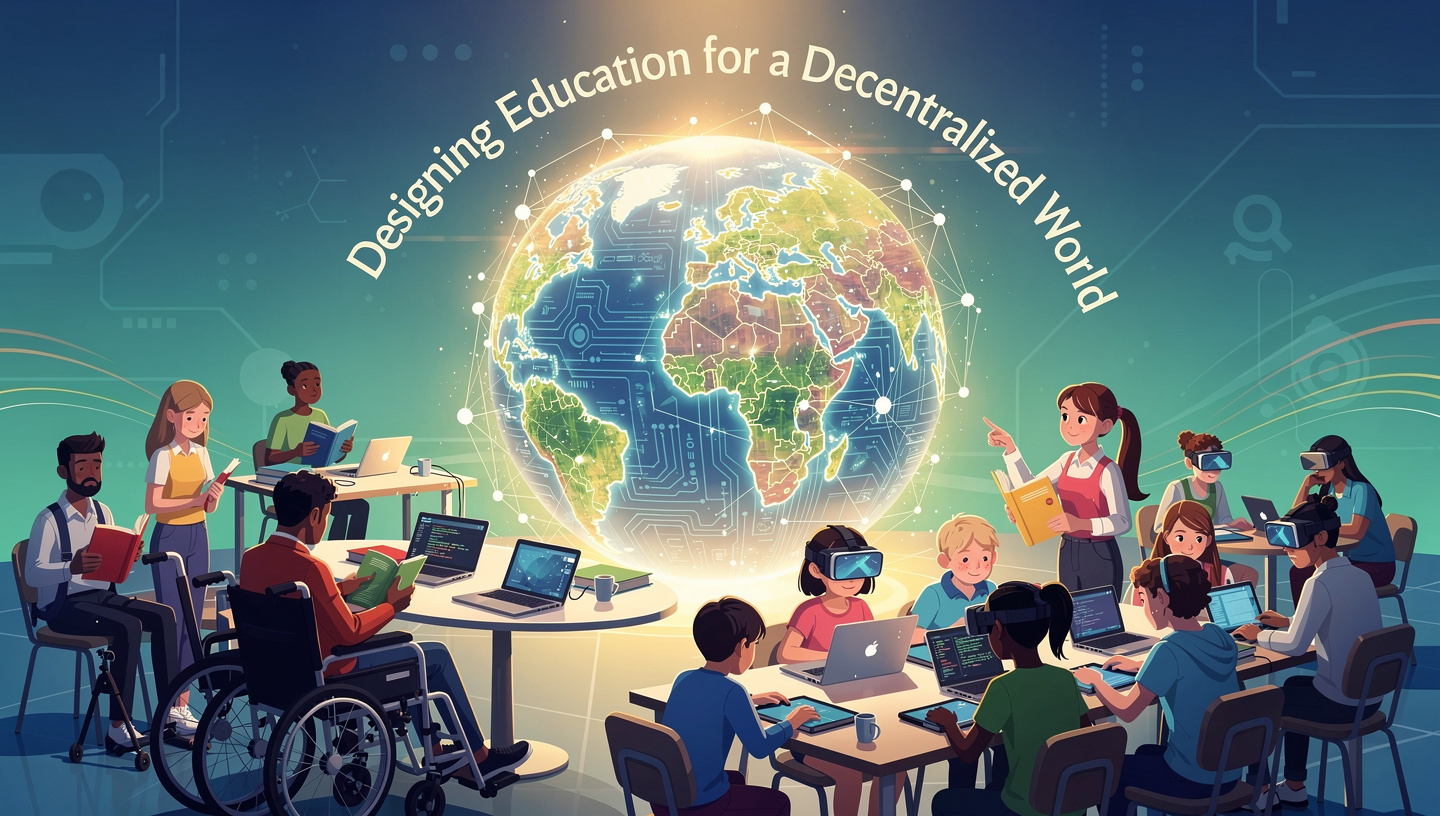
Education has always mirrored the architecture of society. Agrarian civilizations taught seasons and survival. Industrial societies taught discipline and specialization. The digital age taught code and connectivity. Now, a decentralized era is emerging—powered by cryptography, distributed networks, programmable value, and peer-to-peer coordination—and education has not yet caught up.
Most existing educational systems were designed for centralized knowledge: textbooks, lectures, authorities, and standardized answers. But decentralized technologies invert those assumptions. In a world where trust is algorithmic, ownership is verifiable, governance is distributed, and identity is self-sovereign, learning cannot remain hierarchical. It must become modular, verifiable, adaptive, and participatory.
Designing education for a decentralized world is not about adding a “crypto class” to the curriculum. It is about rethinking how knowledge is created, validated, shared, and applied. This article explores the philosophical foundations, structural frameworks, pedagogical strategies, technological infrastructure, and societal implications of building an educational model suited for decentralized systems.
1. Understanding Decentralization as an Educational Paradigm
Decentralization is often reduced to technology, but at its core it is a philosophical shift. It redistributes authority, replaces institutional trust with mathematical proof, and empowers individuals to interact directly without intermediaries. In education, this challenges three long-standing assumptions:
Assumption 1: Knowledge must be centralized to be credible.
Decentralized networks show that consensus can emerge without a central authority.
Assumption 2: Credentials must be issued by institutions.
Cryptographic verification enables proof of skill without traditional gatekeepers.
Assumption 3: Learning must follow linear curricula.
Distributed knowledge systems thrive on modular, composable information.
To design decentralized education, we must first recognize that decentralization is not a subject—it is an epistemology, a way of knowing.
2. Why Traditional Education Models Struggle With Crypto Literacy
Most institutions approach crypto education the same way they approached computer literacy in the 1990s: as an optional specialization rather than a foundational competency. This leads to three systemic problems:
2.1 Surface-Level Understanding
Students learn terminology without systems thinking. They memorize definitions of wallets, tokens, or consensus mechanisms but fail to grasp why these systems exist or what problems they solve.
2.2 Overemphasis on Speculation
Public discourse around crypto is dominated by price movements. As a result, learners associate the field with trading rather than infrastructure, governance, or innovation.
2.3 Institutional Inertia
Educational institutions are structurally centralized. Decentralized paradigms can appear threatening because they challenge traditional authority and credentialing power.
Designing education for a decentralized world requires addressing these structural limitations rather than simply updating syllabi.
3. Core Competencies for Decentralized Literacy
To function effectively in decentralized systems, learners must develop a new literacy stack. This stack is interdisciplinary and cannot be confined to a single subject.
3.1 Cryptographic Thinking
Students should understand not just how cryptography works, but why it matters. Concepts such as hashing, digital signatures, and zero-knowledge proofs are not merely technical—they redefine trust.
3.2 Systems Architecture
Decentralized networks are complex adaptive systems. Learners must grasp distributed consensus, network incentives, fault tolerance, and emergent behavior.
3.3 Economic Design
Token economies introduce programmable incentives. Understanding game theory, mechanism design, and behavioral economics becomes essential.
3.4 Governance Literacy
Decentralized systems often rely on community governance. Students must learn how collective decision-making works without centralized authority.
3.5 Digital Sovereignty
Self-custody, privacy, identity control, and permissionless participation are fundamental skills for decentralized citizenship.
4. A New Pedagogical Framework: Learn, Verify, Contribute
Traditional education follows a pattern: learn → test → certify. Decentralized education should follow a different model:
Learn → Verify → Contribute
Learn
Acquire foundational knowledge through modular resources.
Verify
Demonstrate mastery through cryptographically verifiable proof.
Contribute
Apply knowledge directly within real decentralized ecosystems.
This model shifts education from passive consumption to active participation.
5. Modular Learning as the Foundation
Decentralized systems are composable. Education should be too.
Instead of multi-year degrees, decentralized education favors stackable learning modules. Each module represents a specific competency and can be independently verified. Learners build personalized knowledge stacks based on goals rather than institutional requirements.
Advantages of modular learning:
- Faster skill acquisition
- Greater flexibility
- Lifelong adaptability
- Cross-disciplinary integration
- Immediate applicability
In decentralized ecosystems, relevance evolves quickly. Modular education ensures learners evolve with it.
6. Verifiable Credentials and the End of Paper Certificates
Traditional diplomas rely on institutional reputation. Decentralized credentials rely on cryptographic proof.
Verifiable credentials enable:
- Instant authenticity verification
- Tamper-proof records
- Global portability
- Ownership by the learner rather than the institution
This changes the role of institutions. Instead of being credential gatekeepers, they become knowledge providers competing on educational quality.
7. Learning by Participation: Education as Network Contribution
The most effective way to understand decentralized systems is to participate in them. Passive instruction cannot replicate the experience of interacting with a distributed network.
Educational design should include:
- Running nodes
- Participating in governance votes
- Writing smart contracts
- Auditing protocols
- Contributing to open-source repositories
In decentralized education, participation is assessment. Contribution is proof of understanding.
8. The Role of Educators in a Decentralized World
Teachers are not eliminated by decentralization. Their role evolves.
Instead of being authorities, educators become:
- Curators of knowledge
- Guides through complexity
- Facilitators of exploration
- Designers of learning environments
- Mentors for systems thinking
Authority shifts from positional power to demonstrated expertise. Credibility is earned through contribution rather than title.
9. Designing Curriculum for Decentralized Systems
A decentralized curriculum should be structured around concepts rather than tools. Technologies change quickly; principles endure.
A strong curriculum would include:
Foundational Layer
- History of trust systems
- Evolution of money
- Basics of cryptography
- Distributed computing principles
Intermediate Layer
- Consensus algorithms
- Tokenomics
- Security models
- Governance frameworks
Advanced Layer
- Protocol design
- Economic simulations
- Formal verification
- Cross-chain architectures
This layered approach ensures learners build deep understanding before specialization.
10. The Psychology of Learning Without Authority
Decentralized environments require self-directed learners. This demands psychological preparation, not just intellectual preparation.
Students must develop:
- Curiosity without supervision
- Discipline without enforcement
- Skepticism without cynicism
- Confidence without validation
Traditional education often rewards compliance. Decentralized ecosystems reward initiative. Designing education for this world means training minds that can navigate uncertainty independently.
11. Equity and Access in Decentralized Education
One of decentralization’s greatest promises is open access. Anyone with an internet connection can participate. However, access does not guarantee understanding.
Challenges include:
- Digital literacy gaps
- Language barriers
- Resource inequality
- Cultural differences in learning styles
Solutions must include:
- Multilingual educational resources
- Offline-capable learning tools
- Community-driven mentorship networks
- Open educational repositories
Decentralized education must be intentionally inclusive, not accidentally exclusive.
12. Assessment Without Standardized Testing
Standardized tests measure memorization. Decentralized systems require problem-solving.
Alternative assessment methods include:
- Proof-of-work portfolios
- Public contribution records
- Peer validation
- Reputation systems
- Skill demonstrations
In decentralized environments, your work is visible. Your competence is observable. Your reputation is transparent. Exams become obsolete because performance is continuous.
13. Institutional Transformation: From Gatekeepers to Nodes
Educational institutions must decide whether they want to resist decentralization or integrate into it. Those that adapt can become nodes within global learning networks.
Future institutions may:
- Issue verifiable credentials
- Host decentralized research collaboratives
- Provide infrastructure rather than authority
- Serve as knowledge hubs rather than certification monopolies
The institutions that thrive will be those that understand decentralization as evolution, not disruption.
14. Ethical Education in Decentralized Systems
Decentralization removes intermediaries—but it does not remove responsibility. In fact, it increases it.
Learners must understand:
- Security ethics
- Responsible disclosure
- Economic fairness
- Privacy rights
- Governance accountability
Without ethical grounding, decentralized tools can be misused. Education must therefore integrate ethics as a core component, not an optional discussion.
15. The Role of Community in Knowledge Formation
Decentralized ecosystems are community-driven. Knowledge is refined through discussion, debate, and iteration. Education must reflect this collaborative dynamic.
Community-based learning includes:
- Open forums
- Collaborative research
- Peer review
- Collective problem-solving
- Distributed mentorship
In this model, learning is not isolated. It is networked.
16. Lifelong Learning as Default
In centralized systems, education is front-loaded early in life. In decentralized systems, learning is continuous.
Reasons include:
- Rapid technological evolution
- Changing protocols
- New economic models
- Emerging governance mechanisms
Education must therefore be designed as an ongoing process rather than a fixed phase.
17. Infrastructure for Decentralized Education
To support decentralized learning, infrastructure must include:
- Open knowledge repositories
- Credential verification systems
- Distributed storage for educational materials
- Identity frameworks for learners
- Peer-to-peer collaboration platforms
Without infrastructure, decentralized education remains theory. With it, it becomes reality.
18. Preparing the Next Billion Learners
The next generation of learners will not distinguish between online and offline worlds. For them, decentralized interaction may feel as natural as email feels today.
Preparing them requires:
- Early exposure to systems thinking
- Interactive simulations
- Hands-on experimentation
- Problem-based learning
- Collaborative projects
The goal is not to produce crypto specialists. The goal is to produce individuals capable of understanding decentralized systems regardless of field.
19. Strategic Principles for Designing Decentralized Education
To summarize, effective decentralized education should follow these design principles:
- Permissionless Access – Anyone can learn.
- Verifiable Competence – Skills are provable.
- Modular Structure – Knowledge is composable.
- Practical Participation – Learning happens through doing.
- Community Validation – Credibility emerges collectively.
- Adaptive Curriculum – Content evolves continuously.
- Learner Ownership – Individuals control their educational records.
These principles form the blueprint for future educational systems.
Conclusion: Education as a Distributed Network
The shift toward decentralization is not merely technological. It is civilizational. Just as the printing press transformed literacy and the internet transformed communication, decentralized systems are transforming trust itself.
Designing education for this world requires abandoning the idea that knowledge must be delivered from the top down. Instead, education must become a distributed network—open, verifiable, collaborative, and continuously evolving.
In the decentralized era, the most valuable skill will not be memorizing information. It will be navigating systems.
And the most powerful educational institutions will not be those that control knowledge—but those that help humanity understand how to use it.
The future of learning is not centralized. It is networked.