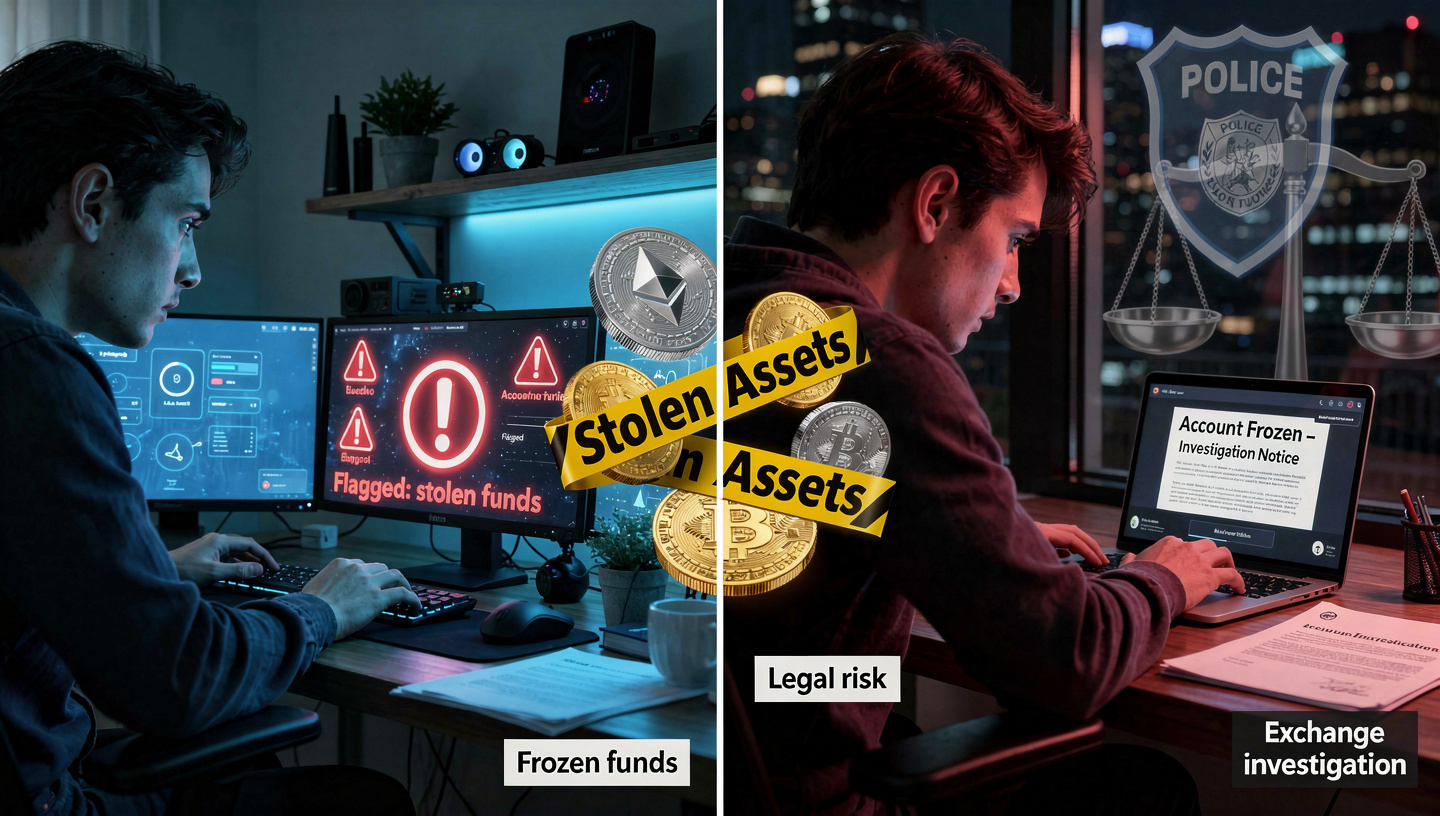
Cryptocurrency transactions are pseudonymous, irreversible, and borderless. These characteristics are often framed as strengths—efficiency, censorship resistance, and autonomy. Yet they also create a complex legal question: what happens if you receive stolen crypto?
This scenario is not hypothetical. Digital assets are routinely traced to hacks, phishing schemes, ransomware attacks, exchange breaches, and smart contract exploits. When stolen tokens move through wallets, decentralized exchanges, mixers, bridges, and centralized platforms, they can eventually land in the hands of someone who had no role in the original crime. That recipient may be an investor, a liquidity provider, a trader, or a business accepting crypto as payment.
From a crypto law perspective, the consequences depend on multiple factors: jurisdiction, knowledge, intent, custody structure, and regulatory framework. This article provides a comprehensive, research-driven analysis of the legal implications of receiving stolen cryptocurrency, including property law doctrines, criminal exposure, civil liability, regulatory enforcement, asset freezing, restitution, and practical risk mitigation.
1. Is Stolen Crypto Still “Stolen” After It Moves?
1.1 The Legal Nature of Crypto as Property
Courts across multiple jurisdictions increasingly recognize cryptocurrency as property. In the United Kingdom, the UK Jurisdiction Taskforce concluded that cryptoassets are capable of being property at common law. Courts in the United States, Singapore, New Zealand, and other jurisdictions have reached similar conclusions.
Once crypto is classified as property, traditional legal principles apply:
- Theft does not extinguish the original owner’s property rights.
- A thief cannot pass good title to stolen property.
- Subsequent transfers may remain legally defective.
The legal maxim nemo dat quod non habet—one cannot give what one does not have—becomes central. If a hacker steals Bitcoin, the hacker does not obtain lawful ownership. Any subsequent transfer may remain tainted.
1.2 Tracing and Constructive Trusts
Blockchain transparency enables forensic tracing. Firms specializing in blockchain analytics can follow funds across wallets and exchanges. Courts increasingly grant:
- Proprietary injunctions
- Freezing orders
- Disclosure orders
- Constructive trust claims
If stolen crypto is traceable into your wallet, you may be deemed to hold it on constructive trust for the true owner. This applies even if you acquired it in good faith.
2. Criminal Exposure: When Does Receiving Stolen Crypto Become a Crime?
Criminal liability typically depends on knowledge and intent.
2.1 Receiving Stolen Property
Most jurisdictions criminalize knowingly receiving stolen property. In the United States, this can fall under state statutes or federal laws depending on circumstances. In the United Kingdom, it may constitute “handling stolen goods” under the Theft Act 1968.
Key elements usually include:
- The property was stolen.
- The defendant received, retained, or disposed of it.
- The defendant knew or believed it was stolen.
If you unknowingly receive stolen crypto, criminal liability is unlikely. If you suspect it is stolen and proceed anyway, risk escalates.
2.2 Money Laundering Statutes
Money laundering laws are broader and more dangerous in crypto contexts.
Under U.S. federal law (e.g., 18 U.S.C. §§ 1956, 1957), it is illegal to engage in transactions involving proceeds of specified unlawful activity with knowledge of their illicit origin.
The same principle applies in the European Union under AML directives, and globally under FATF standards.
If you:
- Convert stolen crypto into fiat,
- Trade it for other tokens,
- Move it through multiple wallets to conceal origin,
and you know or are willfully blind to its illicit source, you risk money laundering charges.
Willful blindness—deliberately ignoring red flags—can satisfy knowledge requirements in some jurisdictions.
3. Civil Liability: Can the Original Owner Sue You?
Even absent criminal liability, civil exposure remains significant.
3.1 Proprietary Claims
The original victim may bring a proprietary claim asserting continuing ownership. If successful, a court can:
- Order you to return the assets.
- Freeze your accounts.
- Impose a constructive trust.
- Award equitable remedies.
If the crypto has appreciated, courts may order return of the asset itself rather than its historical value.
3.2 Unjust Enrichment
If you benefited from stolen crypto—e.g., through staking rewards, yield farming, or appreciation—you may face unjust enrichment claims. Courts may require disgorgement of gains.
3.3 Bona Fide Purchaser Defense
In traditional property law, a bona fide purchaser for value without notice can sometimes obtain clean title. Whether this doctrine applies to crypto varies by jurisdiction and legal classification.
In many cases involving stolen property (as opposed to voidable title), good faith does not cure the defect. If crypto was stolen outright, the purchaser often does not acquire good title.
This remains an evolving area in crypto jurisprudence.
4. Exchange Intervention: Freezes, Suspensions, and Asset Seizure
4.1 Centralized Exchanges
If stolen crypto reaches a centralized exchange such as Coinbase, Binance, or Kraken, compliance teams may:
- Freeze accounts.
- Restrict withdrawals.
- File suspicious activity reports.
- Cooperate with law enforcement.
Exchanges operate under AML and sanctions compliance frameworks. Once notified of theft or illicit activity, they are incentivized to act quickly.
If you unknowingly deposited stolen funds, your account may be frozen during investigation. Access to unrelated funds may also be restricted.
4.2 Government Seizure
Law enforcement agencies have demonstrated technical and legal capacity to seize crypto assets. The Federal Bureau of Investigation has seized digital assets tied to ransomware and hacking operations. The U.S. Department of Justice has pursued civil forfeiture proceedings for crypto assets connected to crime.
If authorities trace stolen crypto into your possession, they may:
- Obtain seizure warrants.
- Freeze exchange accounts.
- Initiate forfeiture proceedings.
Even innocent holders may need to litigate to recover access.
5. DeFi and Smart Contracts: Does Code Immunize You?
Decentralized finance complicates recovery but does not eliminate legal consequences.
5.1 Automated Protocol Interactions
If stolen crypto is deposited into a liquidity pool, lending protocol, or staking contract, issues arise:
- Who is liable: the liquidity provider? the protocol developers?
- Can victims trace into pooled assets?
- Are governance token holders exposed?
Courts increasingly look beyond code to human actors: developers, founders, governance participants, and front-end operators.
5.2 Tainted Funds in DeFi
Even if funds move through decentralized exchanges, blockchain analytics may preserve traceability. If you withdraw assets that can be traced to a hack, plaintiffs may assert proprietary tracing claims.
DeFi does not erase legal risk. It complicates enforcement, but legal exposure remains.
6. Ransomware and Sanctions Risk
6.1 Sanctioned Addresses
If stolen crypto is linked to sanctioned entities, risk escalates significantly. The Office of Foreign Assets Control (OFAC) has designated crypto addresses associated with illicit actors.
Transacting with sanctioned addresses can violate U.S. sanctions laws, even absent direct knowledge, under strict liability frameworks in certain contexts.
6.2 Secondary Exposure
If you receive crypto previously linked to a sanctioned wallet, exchanges may block your account to mitigate sanctions risk. Compliance frameworks are increasingly automated and risk-sensitive.
7. What If You Truly Had No Knowledge?
Knowledge and intent are central.
7.1 Innocent Recipient
If you received stolen crypto:
- As payment for goods or services,
- Through a legitimate trade,
- Without knowledge or red flags,
criminal liability is unlikely in most jurisdictions.
However:
- Civil restitution may still be required.
- Exchanges may freeze assets.
- You may need legal representation to assert good faith.
7.2 Red Flags That Undermine Good Faith
Courts may infer knowledge if:
- You acquired assets at a steep discount.
- The counterparty was anonymous and evasive.
- The transaction involved known exploit tokens.
- There was public reporting of the hack.
Willful ignorance can be legally equivalent to knowledge.
8. Bankruptcy and Insolvency Implications
If an exchange or custodian becomes insolvent while holding stolen crypto, complex priority issues arise.
For example, after the collapse of FTX, questions emerged about asset ownership, segregation, and tracing.
If stolen crypto was commingled:
- Victims may assert proprietary claims.
- Innocent account holders may face dilution.
- Courts must determine asset classification (customer property vs estate property).
Crypto insolvency litigation is reshaping digital asset property law.
9. Cross-Border Complications
Cryptocurrency transactions routinely cross jurisdictions. Legal consequences depend on:
- Location of the victim.
- Location of the recipient.
- Location of exchanges involved.
- Applicable regulatory frameworks.
Conflicts of law issues may determine:
- Which court has jurisdiction.
- Which property law applies.
- Whether foreign judgments are enforceable.
International cooperation is increasing but remains uneven.
10. Tax Implications
Receiving stolen crypto creates tax complexity.
If you later must return it:
- Was it taxable income?
- Can you deduct restitution?
- What if value changed?
Tax authorities may treat crypto as property. If you exercised dominion and control, income recognition may occur. Subsequent repayment may generate deductible losses, subject to jurisdiction-specific rules.
Tax treatment requires jurisdiction-specific analysis.
11. Practical Steps If You Receive Stolen Crypto
Immediate action reduces risk.
- Do not move the funds.
- Preserve transaction records.
- Consult legal counsel experienced in crypto law.
- Notify relevant exchanges if funds were routed through them.
- Avoid converting assets to fiat.
Proactive cooperation may mitigate enforcement exposure.
12. Emerging Legal Trends
Courts and regulators are converging on several principles:
- Crypto is property.
- Theft does not extinguish ownership.
- Tracing is legally viable.
- Exchanges are compliance gatekeepers.
- AML and sanctions frameworks apply fully.
Legislative proposals increasingly address digital asset recovery, seizure, and compliance obligations.
Conclusion: Possession Is Not Ownership
Receiving stolen crypto is not a neutral event. Even absent wrongdoing, the legal consequences can include asset freezes, civil litigation, forfeiture proceedings, and reputational damage.
The central rule remains consistent with centuries-old property doctrine: theft does not create valid title. Blockchain immutability does not override legal ownership. Code does not displace courts.
In a transparent ledger environment, traceability is permanent. The assumption that crypto’s pseudonymity shields recipients is legally and practically incorrect.
For investors, traders, businesses, and institutions, due diligence is not optional. The regulatory and judicial infrastructure surrounding digital assets has matured rapidly. Stolen crypto remains legally tainted, and recipients—innocent or otherwise—operate within an increasingly enforceable legal framework.
Understanding this framework is essential to managing risk in the modern digital asset economy.