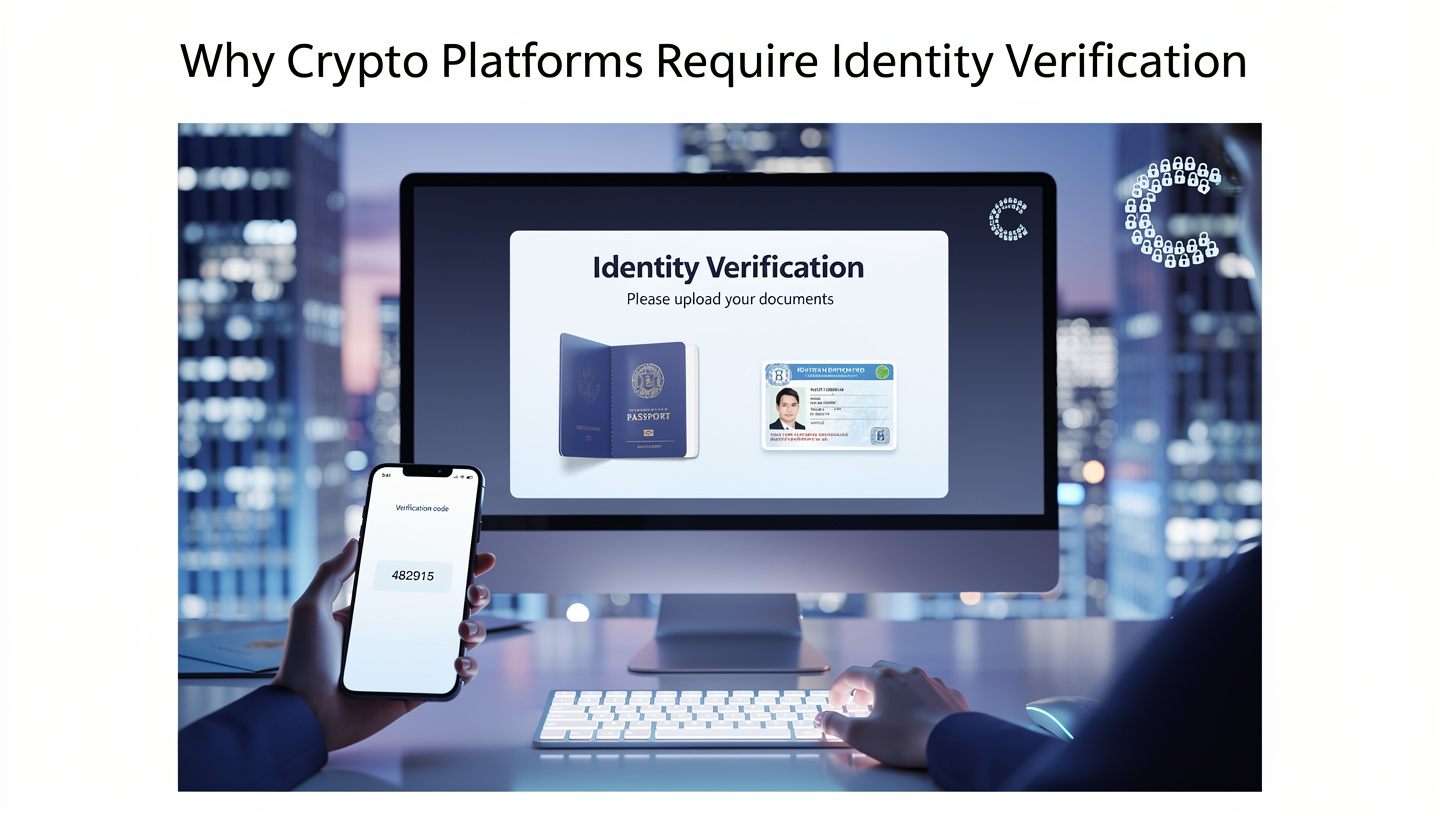
Cryptocurrency was conceived as a peer-to-peer financial system that could operate without centralized intermediaries. Early adopters associated it with pseudonymity, censorship resistance, and frictionless global transfers. Yet today, most major crypto platforms—particularly exchanges, custodians, and fiat on-ramps—require users to submit government-issued identification, biometric verification, and proof of address before accessing core services.
This shift is not accidental. It is structural.
Identity verification in crypto is the result of converging legal mandates, financial crime prevention frameworks, market integrity concerns, and institutional capital requirements. It is also a reflection of how digital asset markets have integrated into the global financial system. This article explains in detail why crypto platforms require identity verification, what regulatory doctrines compel it, how compliance architectures function, and what this means for users and the future of decentralized finance.
The Regulatory Foundation: AML and KYC Obligations
The primary driver of identity verification in crypto platforms is compliance with Anti-Money Laundering (AML) and Know Your Customer (KYC) regulations.
The Global AML Framework
AML regimes are coordinated internationally through the Financial Action Task Force (FATF), an intergovernmental body that sets standards to combat money laundering, terrorist financing, and proliferation financing. FATF’s recommendations are adopted and implemented by national regulators across more than 200 jurisdictions.
In 2019, FATF extended its standards explicitly to “Virtual Asset Service Providers” (VASPs), including:
- Centralized crypto exchanges
- Custodial wallet providers
- Crypto payment processors
- Certain token issuance platforms
This move formally placed much of the crypto industry under the same compliance umbrella as banks and broker-dealers.
KYC Requirements
KYC is the operational mechanism through which AML is enforced. Platforms must:
- Verify customer identity using reliable documents.
- Assess risk profiles (e.g., politically exposed persons, sanctioned individuals).
- Monitor ongoing transactions for suspicious activity.
- Report suspicious transactions to financial intelligence units.
Failure to implement KYC exposes platforms to severe civil penalties, criminal prosecution, and exclusion from banking systems.
Identity verification is therefore not optional—it is a prerequisite for lawful operation in most developed markets.
The Legal Classification of Crypto Platforms
Crypto platforms that interact with fiat currency are generally classified as regulated financial intermediaries.
In the United States, for example:
- The Financial Crimes Enforcement Network (FinCEN) classifies many crypto exchanges as Money Services Businesses (MSBs).
- The Securities and Exchange Commission (SEC) may regulate platforms listing securities-like tokens.
- The Commodity Futures Trading Commission (CFTC) oversees certain crypto derivatives.
In the European Union, the Markets in Crypto-Assets (MiCA) framework imposes licensing and compliance requirements on Crypto-Asset Service Providers (CASPs). Similar regimes exist in Singapore, Japan, the United Kingdom, and Australia.
Once classified as regulated entities, crypto platforms inherit the same identity verification obligations as traditional financial institutions.
Preventing Money Laundering and Illicit Finance
One of the most cited reasons for identity verification is preventing the use of crypto for illicit purposes.
Common Illicit Use Cases
Without identity controls, platforms could facilitate:
- Laundering proceeds from cybercrime
- Sanctions evasion
- Terrorist financing
- Fraud and phishing operations
- Darknet market transactions
Blockchain transactions are transparent, but pseudonymous. Without linking wallet addresses to real-world identities at the on-ramp or off-ramp stage, law enforcement would struggle to connect illicit flows to individuals.
Identity verification allows:
- Address clustering linked to verified users
- Suspicious Activity Reports (SARs)
- Law enforcement subpoenas tied to known accounts
This framework has enabled authorities to trace and recover funds in high-profile crypto crime cases.
The Travel Rule and Data Transmission
FATF’s “Travel Rule” significantly strengthened identity requirements.
Under the Travel Rule:
- When a crypto transfer exceeds a specified threshold, the sending platform must transmit identifying information about the sender and recipient to the receiving platform.
This mirrors traditional wire transfer requirements.
Compliance with the Travel Rule necessitates robust identity systems capable of:
- Verifying users before transaction execution
- Storing structured identity data
- Transmitting standardized compliance information
Without identity verification at onboarding, Travel Rule compliance is impossible.
Banking Relationships and Fiat Integration
Crypto platforms rely on traditional banks to process fiat deposits and withdrawals. Banks, in turn, are heavily regulated.
Banks will not maintain correspondent relationships with entities that:
- Lack AML controls
- Fail to conduct KYC
- Cannot demonstrate transaction monitoring systems
Identity verification is therefore essential for:
- Maintaining banking partnerships
- Accessing payment rails (SWIFT, ACH, SEPA)
- Issuing debit cards
- Supporting stablecoin reserves
Platforms that fail compliance risk “de-banking,” which effectively cripples operations.
Institutional Investors and Market Legitimacy
Institutional capital requires regulatory certainty.
Asset managers, hedge funds, pension funds, and public companies cannot allocate capital to platforms that operate outside AML/KYC frameworks. Compliance reduces counterparty risk and reputational exposure.
Identity verification contributes to:
- Market integrity
- Reduced wash trading
- Lower manipulation risk
- Enhanced reporting standards
The entrance of institutional investors has directly correlated with stronger compliance infrastructures.
Fraud Prevention and Platform Security
Identity verification also protects users.
Without KYC, platforms become vulnerable to:
- Account takeover fraud
- Synthetic identity fraud
- Bot-driven manipulation
- Market spoofing
Modern identity systems incorporate:
- Liveness detection
- Biometric matching
- Device fingerprinting
- Behavioral analytics
These controls reduce fraudulent withdrawals and coordinated abuse.
While users may perceive identity checks as intrusive, platforms view them as essential risk mitigation tools.
Sanctions Compliance
Crypto platforms must comply with sanctions lists maintained by authorities such as:
- The Office of Foreign Assets Control (OFAC)
- The United Nations
- The European Union sanctions authority
Identity verification enables:
- Screening against sanctions databases
- Geo-blocking restricted jurisdictions
- Blocking designated individuals
Without verified identities, sanctions enforcement would be ineffective.
Tax Reporting Obligations
Governments increasingly require crypto platforms to report user transactions for tax purposes.
In the United States:
- The Internal Revenue Service mandates reporting of certain crypto transactions.
- Form 1099 reporting is expanding under infrastructure legislation.
The OECD’s Crypto-Asset Reporting Framework (CARF) similarly mandates cross-border tax transparency.
Tax reporting cannot occur without identity data tied to transaction histories.
Centralized vs. Decentralized Platforms
Not all crypto platforms require identity verification.
Centralized Exchanges (CEX)
Examples include:
- Coinbase
- Binance
- Kraken
These entities:
- Custody user funds
- Interface with fiat systems
- Operate under licensing regimes
Identity verification is mandatory.
Decentralized Exchanges (DEX)
Protocols such as Uniswap operate via smart contracts without centralized custody.
DEXs generally do not require KYC at the protocol level because:
- There is no central operator onboarding users
- Users interact via self-custody wallets
However, regulatory scrutiny is increasing, particularly for front-end operators and liquidity providers.
Risk-Based Verification Tiers
Many platforms implement tiered access:
- Basic tier: Limited trading, email verification only.
- Intermediate tier: Government ID required.
- Advanced tier: Proof of address, enhanced due diligence.
This risk-based approach aligns with AML principles, balancing compliance with usability.
Data Protection and Privacy Concerns
Identity verification introduces significant data governance responsibilities.
Platforms must comply with:
- GDPR in the European Union
- CCPA in California
- Local data protection statutes
Security failures involving identity databases can be catastrophic.
Therefore, platforms invest in:
- Encrypted storage
- Zero-knowledge identity proofs (experimental)
- Secure multiparty computation
- Vendor audits
Identity verification expands the attack surface; cybersecurity must scale accordingly.
The Philosophical Tension: Privacy vs. Regulation
Crypto emerged with privacy-oriented narratives. Identity verification appears contradictory.
However, the distinction lies between:
- Protocol-level pseudonymity (Bitcoin, Ethereum)
- Platform-level compliance (exchanges)
Users remain free to transact peer-to-peer without KYC. But when interacting with regulated intermediaries, identity becomes mandatory.
This bifurcation defines modern crypto markets.
Future Directions: Digital Identity in Crypto
Emerging innovations attempt to reconcile compliance and privacy:
- Decentralized Identifiers (DIDs)
- Verifiable Credentials
- Zero-knowledge KYC proofs
- On-chain compliance attestations
These technologies aim to allow users to prove regulatory compliance without revealing excessive personal data.
Regulators are observing these developments closely.
Why Platforms Cannot Avoid Identity Verification
Crypto platforms require identity verification because:
- AML laws mandate it.
- FATF standards enforce it globally.
- Banking access depends on it.
- Institutional capital demands it.
- Sanctions enforcement requires it.
- Tax reporting depends on it.
- Fraud prevention benefits from it.
Absent compliance, platforms risk fines, license revocation, criminal liability, and market exclusion.
Conclusion
Identity verification in crypto is not a deviation from the system’s design; it is a consequence of integration with the global financial architecture.
Crypto protocols remain permissionless. But crypto platforms that custody assets, process fiat transactions, and operate within regulated jurisdictions function as financial intermediaries. Financial intermediaries are bound by AML, KYC, sanctions, and tax reporting obligations.
The result is a hybrid ecosystem:
- Permissionless base-layer networks.
- Regulated access points.
As regulatory frameworks mature and digital identity systems evolve, the balance between privacy and compliance will continue to shift. What remains constant is this: any crypto platform seeking long-term legitimacy, banking access, and institutional participation will require identity verification.
It is not a choice. It is infrastructure.