Cryptocurrency exists at the intersection of technology, finance, and sovereignty. It challenges conventional monetary systems, unsettles regulatory frameworks, and forces governments to confront a structural question: should digital assets be governed—or prohibited?
The distinction between regulation and bans is not semantic. It defines the trajectory of innovation, capital formation, investor protection, and state authority. In the crypto domain, the choice between regulation and prohibition shapes whether markets mature under oversight or migrate into opaque, extraterritorial spaces.
This article provides a comprehensive, research-oriented examination of the difference between regulation and bans in crypto. It analyzes legal theory, economic impact, enforcement mechanics, international case studies, and long-term systemic consequences. The objective is clarity: to define what regulation means, what a ban entails, and why the difference determines the future of digital finance.
Defining Regulation in the Context of Crypto
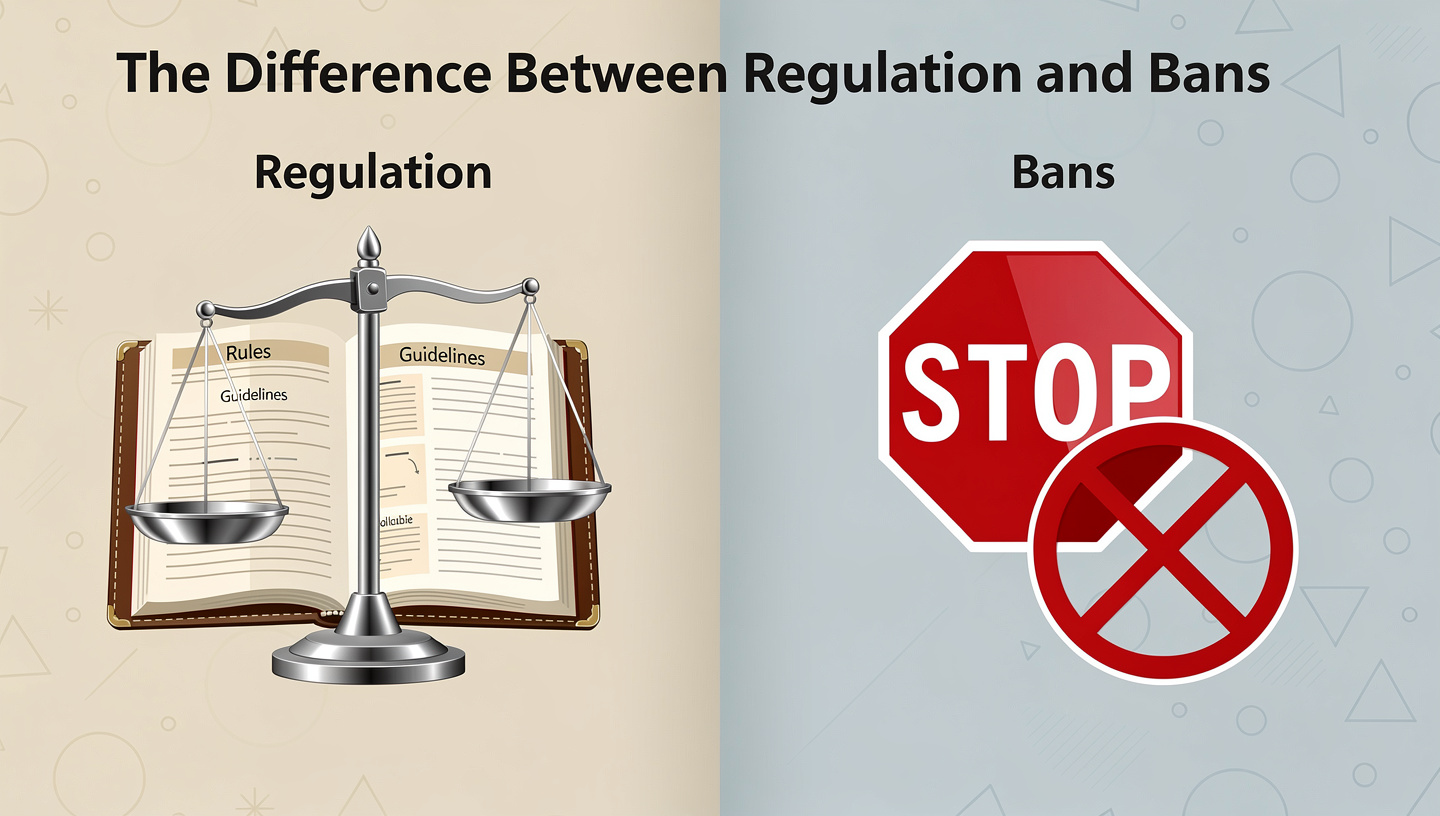
Regulation is the formal application of legal frameworks to govern behavior within a jurisdiction. It does not eliminate activity. It conditions it.
In crypto, regulation typically includes:
- Licensing requirements for exchanges and custodians
- Anti-money laundering (AML) and know-your-customer (KYC) obligations
- Disclosure and investor protection rules
- Tax classification and reporting standards
- Prudential standards for stablecoins
- Securities classification tests for tokens
Regulation acknowledges the existence of crypto markets and seeks to manage associated risks while allowing participation.
Regulatory Classification: The Core Problem
The first regulatory question is definitional: what is a crypto asset?
In the United States, classification often depends on the interpretation of the Howey Test, derived from SEC v. W.J. Howey Co. (1946), applied by the U.S. Securities and Exchange Commission to determine whether a token constitutes a security.
If a token is deemed a security, it falls under securities law—requiring registration, disclosure, and compliance. If it is classified as a commodity, oversight may shift to the Commodity Futures Trading Commission.
Other jurisdictions have opted for tailored frameworks. The European Union introduced MiCA (Markets in Crypto-Assets Regulation), a unified regime across member states. The approach is regulatory integration, not prohibition.
Regulation, therefore, formalizes the market.
Defining a Ban in the Context of Crypto
A ban is a legal prohibition that criminalizes or renders unlawful specific crypto activities. Unlike regulation, a ban does not set conditions for participation. It eliminates legality.
Bans vary in scope:
- Full ban: Prohibits possession, trading, mining, and usage.
- Transactional ban: Forbids financial institutions from servicing crypto.
- Mining ban: Targets energy-intensive proof-of-work operations.
- Exchange ban: Outlaws centralized trading platforms.
A ban attempts to remove crypto from the domestic economic system. It does not manage risk—it rejects the activity.
De Jure vs. De Facto Bans
Some jurisdictions impose explicit statutory prohibitions. Others create regulatory uncertainty so severe that participation becomes practically impossible.
For example, when China prohibited cryptocurrency exchanges and later mining operations in 2021, it enacted a clear de jure ban. Mining power rapidly migrated to jurisdictions such as the United States and Kazakhstan.
By contrast, jurisdictions that deny banking access to crypto firms without explicit prohibition create de facto bans. The activity remains technically legal but functionally constrained.
The Economic Logic Behind Regulation
Regulation exists to balance three objectives:
- Market integrity
- Consumer protection
- Financial stability
Crypto markets introduce volatility, asymmetrical information, custody risk, and fraud potential. Regulation aims to mitigate these risks without extinguishing innovation.
Investor Protection
The collapse of centralized platforms such as FTX exposed systemic weaknesses in governance, custody segregation, and transparency. Regulatory oversight—capital requirements, auditing mandates, and fiduciary standards—would have altered risk exposure.
Regulation reduces informational opacity.
Financial Stability
Stablecoins such as Tether and Circle function as quasi-banking instruments. Without prudential oversight, reserve transparency and redemption risk become macroeconomic concerns.
Regulatory supervision ensures reserve composition, redemption guarantees, and systemic safeguards.
Taxation and Capital Formation
Regulation enables tax capture. Governments cannot effectively tax banned markets; they can tax regulated ones.
Furthermore, venture capital flows into jurisdictions with legal clarity. Regulatory certainty lowers legal risk premiums and attracts institutional capital.
The Political Logic Behind Bans
Governments pursue bans for distinct reasons:
- Monetary sovereignty protection
- Capital controls
- Political control
- Systemic risk aversion
Monetary Sovereignty
Crypto undermines central bank control over monetary supply and cross-border flows. In jurisdictions with strict capital controls, decentralized currencies offer exit mechanisms.
A ban reasserts sovereign control over currency issuance.
Political Control and Surveillance
Permissionless networks reduce transaction traceability through pseudonymity. In states prioritizing centralized oversight, crypto represents a structural challenge to enforcement visibility.
Bans function as control mechanisms.
Risk Elimination vs. Risk Management
Regulation manages risk. Bans attempt elimination.
However, bans do not eliminate technological capacity. They shift activity offshore or underground. Mining rigs relocate. Exchanges operate extraterritorially. Peer-to-peer markets proliferate.
Prohibition displaces risk; it does not remove it.
Case Study: Regulatory Framework – United States
The United States has not banned crypto. Instead, it applies existing financial statutes through enforcement and litigation.
The U.S. Securities and Exchange Commission has pursued enforcement actions against token issuers and exchanges, asserting securities violations. The Commodity Futures Trading Commission oversees derivatives markets tied to digital assets.
Simultaneously, federal courts evaluate whether tokens such as Bitcoin and Ethereum fall outside securities classification.
This regulatory approach produces friction but preserves legality. The U.S. crypto industry operates within compliance constraints rather than criminalization.
Case Study: Prohibition – China
China banned crypto exchanges in 2017 and expanded prohibitions to mining in 2021. The policy objective included:
- Preventing capital flight
- Reducing financial speculation
- Controlling systemic risk
- Supporting the rollout of the digital yuan
Mining activity dropped domestically but resurged internationally. Hashrate redistribution demonstrated the mobility of decentralized infrastructure.
China eliminated domestic participation but did not eliminate global crypto markets.
Regulatory Externalities: Innovation and Talent Migration
Jurisdictions that regulate attract infrastructure: exchanges, custody providers, compliance firms, blockchain developers.
Jurisdictions that ban experience capital and talent outflow.
For example, following China’s mining prohibition, the United States became the dominant location for Bitcoin mining capacity. This shift illustrates a structural reality: crypto infrastructure is geographically mobile.
Regulation captures economic value. Bans export it.
Legal Certainty vs. Legal Vacuum
Regulation provides rule-based clarity. Firms understand compliance expectations. Investors assess risk under defined frameworks.
Bans create black markets or legal vacuums. Activity persists without oversight, increasing fraud risk and reducing transparency.
From a governance perspective, regulation is information acquisition. Bans are information forfeiture.
Impact on Decentralized Finance (DeFi)
Decentralized finance protocols operate without centralized intermediaries. Regulation can target:
- Front-end operators
- Developers
- Token issuers
- On/off-ramps
A ban would attempt to criminalize interaction with protocols themselves, but enforcement becomes technically complex.
Blockchain networks such as Ethereum are globally distributed. Prohibiting code execution requires extensive surveillance and enforcement capacity.
Thus, bans are easier to implement against centralized exchanges than decentralized protocols.
Enforcement Realities
Regulation relies on licensing, reporting, audits, and penalties.
Bans rely on criminalization, surveillance, and sanctions.
Enforcement costs differ significantly:
- Regulatory compliance can be delegated to firms.
- Prohibition requires state-driven enforcement.
In open internet systems, enforcement against decentralized networks is technically constrained.
Market Perception and Institutional Participation
Institutional capital—pension funds, asset managers, sovereign wealth funds—requires regulatory clarity.
The approval of Bitcoin exchange-traded products by the U.S. Securities and Exchange Commission marked institutional validation under regulatory supervision.
Bans deter institutional capital entirely. Regulation channels it.
Comparative Analysis
| Dimension | Regulation | Ban |
|---|---|---|
| Legal Status | Conditional legality | Illegality |
| State Objective | Risk management | Risk elimination |
| Market Effect | Formalization | Displacement |
| Innovation Impact | Encourages structured growth | Forces relocation |
| Enforcement | Administrative | Criminal |
| Tax Revenue | Capturable | Lost |
| Transparency | Increased | Reduced |
Long-Term Strategic Implications
For Governments
Regulation positions a jurisdiction within global financial innovation. Bans isolate it from emerging infrastructure.
Digital assets intersect with:
- Central bank digital currencies (CBDCs)
- Tokenized securities
- Cross-border payment rails
- Programmable financial instruments
Engagement through regulation enables policy influence. Prohibition forfeits participation.
For Investors
Regulated markets reduce counterparty and custody risk. Banned environments increase peer-to-peer exposure and legal risk.
For Technology Development
Blockchain ecosystems evolve rapidly. Jurisdictions that regulate host developer communities, research hubs, and capital flows.
Jurisdictions that ban depend on foreign infrastructure for future integration.
The Illusion of Absolute Prohibition
Crypto is software. Software is replicable and borderless.
Bans operate at jurisdictional boundaries; blockchain networks operate globally. Unless coordinated internationally, prohibition remains porous.
Even coordinated bans face technical circumvention through:
- Virtual private networks
- Decentralized exchanges
- Self-custody wallets
Absolute elimination is technologically implausible without comprehensive internet control.
Regulatory Evolution: The Middle Ground
Many governments adopt hybrid approaches:
- Ban specific high-risk activities (e.g., algorithmic stablecoins)
- Regulate exchanges
- Permit custody under licensing
- Impose taxation
This calibrated approach acknowledges risk without rejecting innovation.
Conclusion
The difference between regulation and bans in crypto is structural.
Regulation integrates crypto into existing financial systems. It formalizes participation, mitigates risk, captures tax revenue, and attracts capital. It assumes crypto will persist and seeks to shape its development.
A ban rejects integration. It attempts suppression. It reduces domestic exposure but displaces activity beyond jurisdictional reach.
Historically, transformative technologies are rarely extinguished by prohibition. They are reshaped through governance.
In crypto, regulation is engagement. A ban is withdrawal.
The choice determines whether a jurisdiction becomes an architect of digital finance—or an observer of it.