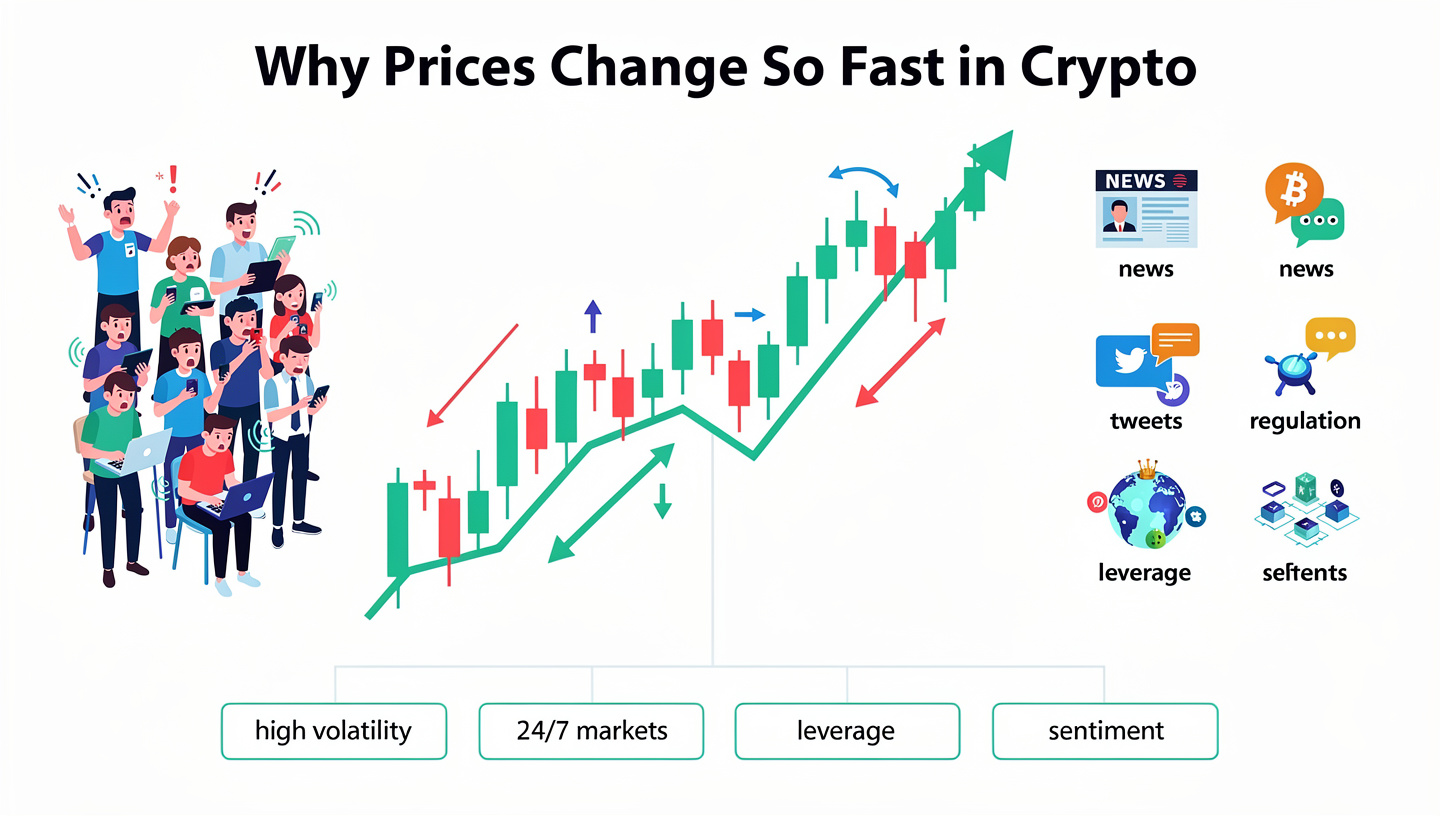
Cryptocurrency markets are structurally different from traditional financial markets. They operate continuously, without centralized control, across a globally distributed network of participants. These design characteristics—combined with market microstructure, leverage, liquidity fragmentation, reflexive narratives, and algorithmic trading—produce a price environment defined by extreme velocity.
Understanding why prices change so fast in crypto requires a layered analysis. The volatility is not random noise. It is the output of identifiable mechanisms: supply constraints coded into protocols, demand shocks amplified by social coordination, derivatives-driven feedback loops, shallow order books, macro-liquidity sensitivity, and behavioral reflexivity. This article dissects those mechanisms in technical depth.
1. Structural Foundations: A 24/7, Borderless Market
Unlike equities or commodities, cryptocurrency markets never close. Exchanges such as Binance, Coinbase, and Kraken operate continuously. There is no overnight pause, no settlement window, and no circuit breaker regime equivalent to the New York Stock Exchange.
Continuous Price Discovery
In traditional markets, volatility clusters around open and close sessions due to liquidity concentration. In crypto:
- Trading is 24/7.
- Global participants enter at different time zones.
- Information is absorbed instantly, without scheduled halts.
This creates uninterrupted price discovery. Any macro headline, protocol exploit, regulatory rumor, or large transaction can trigger immediate repricing.
No Central Stabilizing Authority
Central banks intervene in foreign exchange markets. Governments back sovereign currencies. Crypto assets—such as Bitcoin and Ethereum—have no price-supporting institution.
Without a lender of last resort or balance sheet backstop, prices adjust entirely based on order flow. When selling pressure emerges, there is no structural buyer mandated to stabilize the market.
2. Liquidity Depth and Market Microstructure
Liquidity determines how much price moves in response to trade size. Crypto markets remain structurally thinner than major equity or FX markets.
Order Book Thinness
Even the largest crypto trading pairs exhibit relatively shallow order books compared to traditional markets. A market order worth a few million dollars can move price significantly, especially outside peak liquidity hours.
Price impact follows a nonlinear curve:
- Small trades → minimal slippage.
- Large aggressive trades → cascading slippage through order book levels.
Because liquidity providers widen spreads during volatility, price swings amplify once volatility begins.
Fragmented Liquidity
Crypto liquidity is fragmented across dozens of centralized exchanges and decentralized protocols. There is no consolidated tape.
Arbitrageurs synchronize prices across venues, but synchronization lags during stress. When fragmentation increases, dislocations widen, accelerating volatility.
3. Leverage and Liquidation Cascades
Leverage is one of the most powerful volatility accelerants in crypto.
Perpetual futures markets allow traders to use 10x, 25x, 50x, or even 100x leverage. Exchanges like Bybit and OKX offer high-leverage instruments tied to spot prices.
The Liquidation Mechanism
When leveraged traders’ collateral falls below maintenance margin, exchanges forcibly close their positions. This creates:
- Automatic market sell orders in a downturn.
- Automatic market buy orders in a rally.
These liquidations create feedback loops:
- Price drops.
- Long positions get liquidated.
- Liquidation selling pushes price further down.
- More positions reach liquidation thresholds.
The result is a cascade. These cascades can erase billions in open interest within minutes.
Open Interest Reflexivity
High open interest combined with directional positioning increases fragility. When positioning becomes crowded, volatility risk increases exponentially.
Leverage transforms ordinary volatility into violent, nonlinear price movement.
4. Fixed Supply Narratives and Demand Shocks
Bitcoin’s issuance schedule is algorithmically fixed. The total supply cap of 21 million coins is enforced at the protocol level.
Supply Inelasticity
In traditional commodities:
- Higher prices incentivize more production.
In Bitcoin:
- Higher prices do not increase supply.
Supply is inelastic in the short and long term. Therefore, price becomes the sole adjustment mechanism when demand changes.
Demand shocks—such as institutional adoption announcements or ETF approvals—must be absorbed entirely by price movement.
5. Macro Liquidity Sensitivity
Crypto behaves as a global liquidity barometer.
Monetary policy shifts from institutions like the Federal Reserve influence risk assets. When liquidity expands:
- Crypto rallies aggressively.
When liquidity contracts: - Crypto declines sharply.
Because crypto is perceived as a high-beta asset class, it exhibits amplified reactions relative to equities.
Dollar Liquidity and Stablecoins
Stablecoins such as Tether and USD Coin function as on-chain liquidity rails. Rapid issuance or redemption of stablecoins correlates with directional flows.
Liquidity creation or contraction in stablecoins translates directly into crypto price acceleration.
6. Retail Dominance and Behavioral Reflexivity
Crypto markets contain a higher proportion of retail participants than most traditional asset classes.
Retail trading behavior tends to be:
- Momentum-driven.
- Narrative-sensitive.
- Influenced by social media amplification.
Information spreads rapidly across platforms. Coordinated buying or selling—whether organic or algorithmic—can occur within minutes.
Reflexivity
George Soros’ theory of reflexivity applies strongly in crypto markets:
- Rising prices create bullish narratives.
- Bullish narratives attract new buyers.
- New buyers push prices higher.
The same dynamic applies in reverse.
7. Derivatives Outpacing Spot Markets
In many cycles, derivatives volume exceeds spot volume.
Perpetual swaps, options, and structured products dominate price discovery. This shifts volatility from fundamental valuation toward positioning dynamics.
Funding rates—periodic payments between long and short traders—signal crowd imbalance. When funding becomes extreme, mean-reversion risk rises sharply.
8. Absence of Valuation Anchors
Equities can be valued using:
- Discounted cash flow.
- Earnings multiples.
- Revenue growth.
Commodities can be valued relative to:
- Production costs.
- Inventory levels.
Many crypto assets lack cash-flow anchors. Their valuation depends on:
- Network effects.
- Usage growth.
- Tokenomics.
- Narrative conviction.
When valuation is expectation-driven rather than cash-flow-driven, repricing can be abrupt.
9. Market Psychology and Narrative Cycles
Crypto markets operate in rapid narrative cycles:
- “Digital gold”
- “DeFi revolution”
- “NFT boom”
- “Layer-2 scaling”
- “AI + crypto”
Each cycle attracts capital concentration. When narrative momentum fades, capital rotates quickly.
The speed of digital communication compresses cycle duration compared to historical asset classes.
10. Whale Concentration and On-Chain Transparency
Blockchain transparency allows market participants to monitor large wallet movements in real time.
When a large holder (“whale”) moves funds to an exchange, traders anticipate selling pressure. This anticipation alone can trigger front-running and volatility.
Because token ownership is often concentrated:
- A small number of wallets can materially affect supply dynamics.
11. Regulatory Sensitivity
Regulatory clarity remains uneven globally.
Announcements from bodies such as the U.S. Securities and Exchange Commission frequently trigger rapid repricing.
Uncertainty commands a volatility premium. Sudden enforcement actions or policy shifts introduce binary risk.
12. Technological and Security Risks
Protocol exploits, smart contract vulnerabilities, and exchange failures produce immediate market responses.
Historical collapses—such as FTX—demonstrate how counterparty risk can catalyze systemic volatility.
Crypto markets price technological risk continuously.
13. Volatility as an Emergent Property
Crypto volatility is not a defect; it is an emergent property of:
- Open, permissionless access.
- Fixed supply economics.
- High leverage.
- Narrative-driven demand.
- Fragmented liquidity.
- Continuous global trading.
These characteristics compound.
A simplified volatility model would include:
- Liquidity depth (L)
- Leverage ratio (λ)
- Narrative momentum (N)
- Macro liquidity (M)
- Supply elasticity (S)
Volatility ∝ (λ × N × M) / (L × S)
In crypto:
- λ is high.
- N fluctuates rapidly.
- M is cyclical.
- L is thinner than legacy markets.
- S is near zero for capped assets.
The result is structurally elevated volatility.
14. Why Volatility Persists
Volatility will not disappear as long as:
- Leverage remains accessible.
- Liquidity remains fragmented.
- Supply remains inelastic.
- Market participants remain globally distributed.
Institutional adoption reduces some inefficiencies but introduces new derivatives complexity.
15. Is Rapid Price Change a Weakness?
Fast price movement serves functional roles:
- Accelerated price discovery.
- Capital reallocation efficiency.
- Incentive alignment for early risk.
High volatility attracts traders and liquidity providers, increasing ecosystem robustness over time.
However, volatility also:
- Discourages conservative capital.
- Increases liquidation risk.
- Amplifies systemic fragility during stress.
Conclusion
Crypto prices change rapidly because the system is engineered for open access, fixed supply, leverage-enabled speculation, and continuous global trading. There is no central stabilizer, no valuation floor enforced by earnings, and no pause in price discovery.
Volatility emerges from structural conditions—not randomness.
As market depth improves and leverage regulation matures, volatility may compress at the margin. However, as long as crypto remains a global, permissionless financial system with inelastic supply and reflexive demand, rapid price movement will remain intrinsic.
Price velocity is not an anomaly. It is the logical output of the architecture.