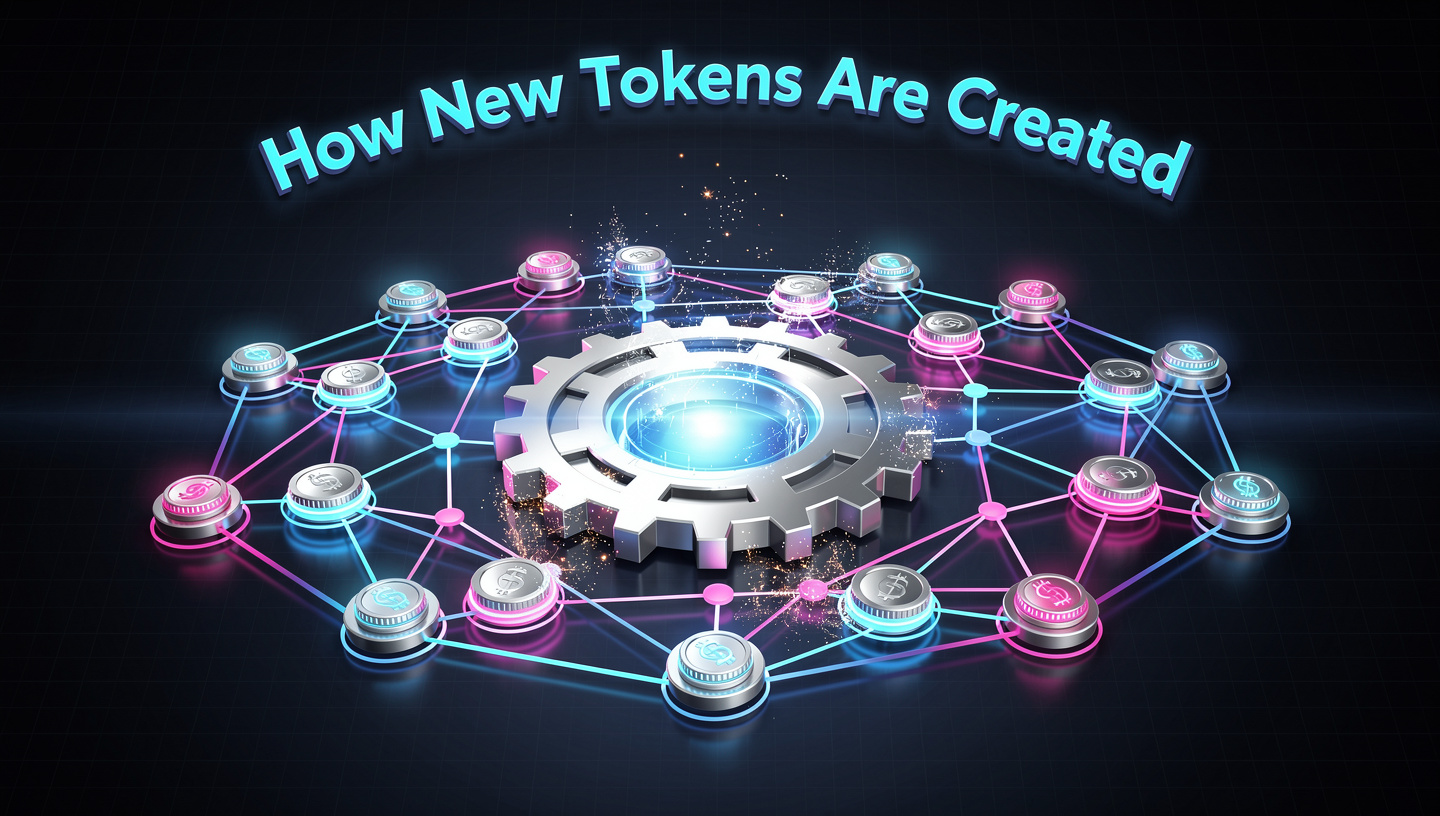
The creation of new crypto tokens is often misunderstood. Many assume that “minting a token” is a trivial technical action—press a button, deploy a contract, and a new digital asset exists. In reality, token creation is a layered process that sits at the intersection of cryptography, distributed systems, monetary design, and economic incentives.
New tokens can emerge from protocol-level issuance, smart contract deployment, governance mechanisms, algorithmic supply rules, or cryptographic proofs of work or stake. Some tokens are native assets embedded into a blockchain’s consensus mechanism. Others are application-level instruments deployed on programmable platforms. Each category follows distinct technical and economic constraints.
This article provides a comprehensive, research-oriented analysis of how new tokens are created. It covers native coin issuance, token standards, smart contract deployment, minting mechanisms, tokenomics design, governance-driven supply changes, and the role of cryptographic primitives. The goal is clarity, precision, and structural understanding.
1. Defining “Token” in Crypto Systems
In crypto infrastructure, the term “token” refers to a unit of value represented on a blockchain. Tokens fall into two broad categories:
- Native coins – Built directly into a blockchain protocol.
- Application-layer tokens – Created through smart contracts on programmable chains.
For example:
- Bitcoin is a native coin created by its protocol rules.
- Ether is the native asset of Ethereum.
- ERC-20 tokens such as Uniswap are smart contract-based tokens deployed on Ethereum.
Understanding how tokens are created requires distinguishing between protocol-level issuance and contract-level issuance.
2. Native Token Creation at the Protocol Layer
Native tokens are embedded into a blockchain’s consensus rules. Their issuance is governed by code that defines supply schedules, reward mechanisms, and inflation dynamics.
2.1 Proof-of-Work Issuance
In Proof-of-Work (PoW) systems, new tokens are created through block rewards.
In Bitcoin:
- Miners compete to solve a cryptographic hash puzzle.
- The winning miner proposes a new block.
- The protocol allows the miner to include a “coinbase transaction.”
- That transaction mints new BTC according to predefined rules.
Key characteristics:
- Supply is deterministic.
- Issuance halves approximately every four years.
- Total supply is capped at 21 million BTC.
- No central authority decides new issuance.
The creation mechanism is inseparable from network security. Token creation compensates miners for expending computational resources.
2.2 Proof-of-Stake Issuance
In Proof-of-Stake (PoS) systems, new tokens are issued to validators for securing the network.
On Ethereum (post-Merge):
- Validators stake ETH.
- Validators propose and attest to blocks.
- Protocol-defined issuance rewards validators.
- Slashing penalizes misbehavior.
Token creation is algorithmic and linked to:
- Total ETH staked
- Network participation rate
- Monetary policy updates via governance
Issuance is dynamic rather than fixed. Additionally, transaction fee burning (EIP-1559) introduces supply contraction, making issuance net-inflationary or net-deflationary depending on usage.
3. Smart Contract–Based Token Creation
Most new tokens today are not native coins. They are created via smart contracts.
3.1 Token Standards
On Ethereum, token creation is standardized through interfaces such as:
- ERC-20 (fungible tokens)
- ERC-721 (non-fungible tokens)
- ERC-1155 (multi-token standard)
The ERC-20 standard defines required functions such as:
- totalSupply()
- balanceOf()
- transfer()
- approve()
- transferFrom()
Deploying an ERC-20 contract creates a token. The contract stores balances in a mapping structure and defines minting logic.
3.2 Deployment Process
Token creation via smart contract follows this process:
- Write token contract code.
- Define initial parameters (name, symbol, decimals, supply).
- Compile to EVM bytecode.
- Deploy to the network.
- Pay gas fees in ETH.
- Contract address becomes the token identifier.
After deployment, the token exists as state data within the blockchain.
No separate blockchain is required. The host chain provides:
- Security
- Execution environment
- State persistence
- Transaction ordering
4. Minting Mechanisms
Token minting is the act of increasing total supply. Minting logic depends entirely on how the smart contract is written.
4.1 Fixed Supply Tokens
Some tokens mint total supply at deployment and never increase it.
Example structure:
- constructor() mints X tokens to deployer.
- No further mint() function exists.
- totalSupply is immutable.
This model mimics scarcity similar to Bitcoin but implemented at contract level.
4.2 Mintable Tokens
Other tokens allow controlled minting.
Common patterns:
- Owner-only minting (centralized control)
- Role-based minting (using access control libraries)
- Governance-based minting (DAO-controlled)
- Algorithmic minting (programmatic rules)
4.3 Algorithmic Supply Expansion
Some tokens increase supply according to predefined logic, such as:
- Emission schedules
- Staking rewards
- Liquidity mining incentives
- Elastic supply (rebasing)
Algorithmic minting often involves:
- Block-based calculations
- Time-based functions
- Supply ratios
- Oracle-fed parameters
These designs must prevent arbitrary inflation or malicious supply manipulation.
5. Token Creation via Governance
In decentralized systems, supply changes may require governance approval.
Governance frameworks include:
- On-chain voting
- Token-weighted proposals
- Multisig-controlled minting
For example, a DAO may vote to:
- Mint tokens for ecosystem incentives
- Fund development grants
- Expand liquidity programs
Governance-driven issuance introduces:
- Political dynamics
- Economic risk
- Centralization trade-offs
Token supply is no longer purely algorithmic but becomes socio-technical.
6. Launch Mechanisms for New Tokens
Creating a token contract is technical. Launching a token is economic.
6.1 Initial Coin Offerings (ICOs)
Historically, ICOs involved:
- Deploying token
- Selling portion to public
- Using funds for development
This model peaked in 2017.
6.2 Liquidity Bootstrapping
Modern token launches often use decentralized exchanges like Uniswap.
Steps:
- Deploy token
- Create liquidity pool
- Deposit token + ETH
- Market sets price via AMM curve
No centralized exchange listing is required.
6.3 Fair Launch
Some tokens distribute supply via mining or staking instead of pre-allocation.
Example: early Bitcoin mining.
Fair launch implies:
- No pre-mine
- No insider allocation
- Transparent issuance rules
7. Tokenomics Design
Token creation is not only technical; it is economic engineering.
Key considerations:
7.1 Supply Cap
- Fixed maximum supply
- Inflationary supply
- Deflationary mechanisms
7.2 Distribution Model
- Team allocation
- Investor allocation
- Community incentives
- Treasury reserve
7.3 Utility Model
Tokens may represent:
- Governance rights
- Utility access
- Payment medium
- Collateral asset
- Staking instrument
Poor tokenomics design often leads to:
- Hyperinflation
- Dump pressure
- Centralization
- Governance capture
Sound token creation requires modeling incentives over long time horizons.
8. Stablecoin Creation
Stablecoins represent a specialized token category.
8.1 Fiat-Backed Stablecoins
Tokens are minted when fiat is deposited.
Example:
- User deposits USD.
- Issuer mints equivalent tokens.
- Redemption burns tokens.
This model requires centralized custody.
8.2 Crypto-Collateralized Stablecoins
Overcollateralized models lock crypto assets in smart contracts to mint stable tokens.
Minting depends on:
- Collateral ratios
- Oracle price feeds
- Liquidation thresholds
Supply expands and contracts dynamically.
9. NFT Creation
Non-fungible tokens (NFTs) are created via ERC-721 or ERC-1155 contracts.
Minting involves:
- Generating unique token ID
- Assigning metadata URI
- Storing ownership mapping
NFT creation does not create currency supply but creates unique digital assets.
10. Security Considerations in Token Creation
Token contracts introduce risk.
Common vulnerabilities:
- Integer overflow (historically)
- Reentrancy
- Improper access control
- Mint function exposure
- Upgradeability flaws
Audits are critical before deployment.
11. Cross-Chain Token Creation
Tokens may be bridged between chains.
Mechanism:
- Lock token on Chain A.
- Mint wrapped token on Chain B.
- Burn wrapped token to redeem original.
Wrapped tokens depend on bridge security.
12. Regulatory Considerations
Token creation may fall under securities law depending on:
- Distribution method
- Profit expectation
- Central control
- Marketing language
Jurisdiction determines compliance requirements.
13. The Cryptographic Foundation
Token creation relies on:
- Public/private key cryptography
- Hash functions
- Digital signatures
- Merkle trees
- Deterministic state transitions
Without cryptographic guarantees, token issuance would not be trust-minimized.
14. Economic Finality of Token Creation
Once deployed:
- Smart contracts are immutable (unless upgradeable).
- Minting rules persist.
- Supply transparency is public.
- All balances are verifiable.
Token creation is permanent infrastructure deployment.
Conclusion
New tokens are created through structured, deterministic processes embedded either at the blockchain protocol level or within smart contracts. The act of minting is not arbitrary; it is defined by cryptographic rules, economic logic, and consensus enforcement.
Native tokens emerge from block production mechanisms. Smart contract tokens arise from deployment and controlled minting logic. Stablecoins rely on collateral frameworks. NFTs encode uniqueness. Governance may expand supply. Bridges may replicate representations across chains.
Token creation is best understood as programmable monetary engineering. It combines distributed consensus, cryptographic verification, economic modeling, and incentive alignment into a single system.
The future of token creation will increasingly emphasize:
- Modular issuance frameworks
- Cross-chain composability
- On-chain governance
- Regulatory clarity
- Formal verification of minting logic
Understanding how new tokens are created is foundational to understanding crypto itself.