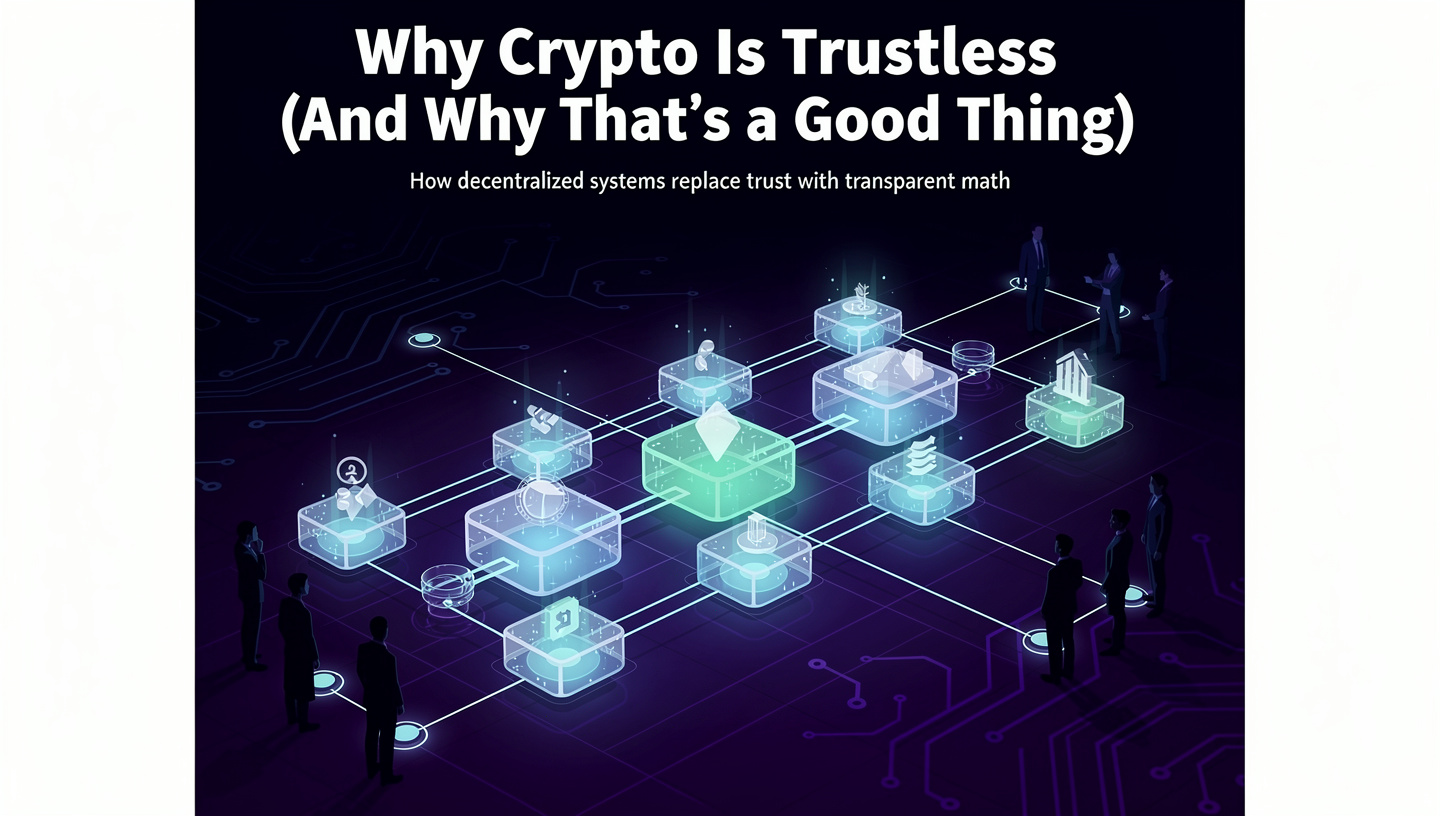
For centuries, economic coordination has depended on institutional trust. Banks safeguard deposits. Governments issue currency. Clearinghouses settle trades. Courts enforce contracts. These intermediaries function as guarantors of integrity. They are trusted because they are regulated, capitalized, audited, and embedded within legal frameworks.
Cryptocurrency systems propose a fundamentally different architecture. Rather than relying on institutional credibility, they rely on cryptographic proof, distributed consensus, and transparent execution. The industry describes this design as trustless.
The term is frequently misunderstood. Trustless does not mean “based on no trust whatsoever.” It means “does not require trust in specific counterparties.” Instead of trusting a bank not to misappropriate funds, a user verifies balances on a public ledger. Instead of trusting an exchange to settle trades honestly, a smart contract enforces deterministic settlement rules. Instead of trusting a central authority not to inflate the currency supply, issuance rules are encoded and enforced by network consensus.
This article examines what trustlessness actually means, how it is implemented in systems such as Bitcoin and Ethereum, and why this property—often framed as a radical departure from tradition—represents a structural improvement in digital economic infrastructure.
1. The Historical Problem of Trust in Financial Systems
Modern financial systems are layered architectures of delegated authority:
- Commercial banks hold customer deposits.
- Central banks manage monetary policy.
- Clearinghouses reconcile obligations between institutions.
- Payment processors facilitate consumer transactions.
- Courts adjudicate disputes.
Each layer introduces counterparty risk. Trust must be extended vertically (to institutions) and horizontally (to counterparties). This model has enabled global commerce, but it also produces:
- Single points of failure
- Systemic contagion risk
- Opaque balance sheet exposures
- Political capture of monetary systems
- Censorship and access control
Trust, in this context, is not merely interpersonal confidence. It is structural dependency on centralized verification and enforcement.
Cryptocurrency systems aim to reduce this dependency by replacing discretionary authority with algorithmic determinism.
2. Defining Trustlessness Precisely
In technical terms, a trustless system is one in which:
- Verification is independent and permissionless.
- Rules are transparent and publicly auditable.
- State transitions are validated by consensus.
- Enforcement is cryptographic rather than institutional.
- No single actor can unilaterally alter the ledger.
Trustlessness does not eliminate trust entirely. Users still trust:
- The correctness of cryptographic primitives.
- The open-source implementation.
- The economic incentives of network participants.
However, this trust is distributed and minimized. It is not concentrated in a single intermediary whose failure compromises the system.
This shift—from trust in institutions to trust in mathematics and game theory—is the core innovation introduced by Bitcoin in 2009.
3. Cryptographic Foundations of Trustlessness
3.1 Public-Key Cryptography
Ownership in crypto systems is defined by possession of private keys. A user does not need a bank to confirm account control. The ability to produce a valid digital signature is sufficient proof.
This mechanism provides:
- Non-repudiation
- Authorization without identity disclosure
- Global interoperability
Trust in custodianship is replaced with cryptographic possession.
3.2 Hash Functions and Immutability
Cryptographic hash functions create tamper-evident chains of blocks. Altering a historical transaction changes the hash of that block and all subsequent blocks, making retroactive manipulation computationally infeasible.
Immutability is not a legal promise; it is an economic constraint enforced by computational cost.
3.3 Consensus Mechanisms
Distributed consensus protocols coordinate agreement across thousands of nodes.
- Bitcoin uses Proof of Work (PoW).
- Ethereum uses Proof of Stake (PoS).
These mechanisms ensure that:
- Ledger updates are validated collectively.
- Malicious behavior incurs economic penalties.
- Control cannot be seized cheaply.
Consensus is the operational engine of trustlessness.
4. From Trusted Third Parties to Trust-Minimized Protocols
Traditional digital systems rely on trusted third parties. For example:
- Payment processors verify transactions.
- Social platforms moderate content.
- Exchanges settle trades internally.
Blockchain-based systems replace these intermediaries with protocols.
Example: Settlement Finality
In traditional finance:
- A transaction may take days to clear.
- Finality depends on clearinghouses and legal enforcement.
In crypto:
- Once confirmed, transactions are final according to protocol rules.
- No institution can reverse them unilaterally.
This reduces settlement risk and counterparty exposure.
5. Smart Contracts and Deterministic Execution
The launch of Ethereum extended trustlessness beyond payments into programmable logic.
Smart contracts execute automatically when conditions are met. Their properties include:
- Determinism
- Transparency
- Censorship resistance
- Composability
A decentralized exchange (DEX), for example, does not require users to trust a central operator. Trade execution is governed by code.
The result is the emergence of decentralized finance (DeFi), where lending, derivatives, and asset issuance operate under transparent rules rather than discretionary oversight.
6. Transparency as a Structural Feature
Trustless systems are typically public.
Blockchains provide:
- Open transaction history
- Verifiable supply schedules
- Auditable smart contract code
This transparency reduces information asymmetry. In traditional finance, balance sheets may be opaque until audited. In crypto, liabilities and reserves can be monitored in real time.
Transparency shifts trust from narrative assurances to verifiable data.
7. Censorship Resistance and Sovereignty
Trustless networks are resistant to censorship because:
- Anyone can run a node.
- Transactions propagate peer-to-peer.
- Validation is decentralized.
This has implications for:
- Financial inclusion
- Political neutrality
- Cross-border commerce
Users are not dependent on a bank’s approval to transact. Access is governed by possession of cryptographic keys, not institutional discretion.
8. Game Theory and Incentive Alignment
Trustlessness is sustained by economic incentives.
In Proof of Work:
- Miners are incentivized to follow protocol to earn block rewards.
In Proof of Stake:
- Validators stake capital that can be slashed for malicious behavior.
Game-theoretic equilibrium discourages attacks because the cost of subversion exceeds the potential benefit.
The system relies on rational economic actors rather than moral trust.
9. Why Trustlessness Is Economically Valuable
Trustless architecture provides several systemic advantages:
9.1 Reduced Counterparty Risk
Users do not need to trust intermediaries with custody.
9.2 Lower Transaction Costs
Automation reduces overhead.
9.3 Global Accessibility
Anyone with internet access can participate.
9.4 Neutral Infrastructure
No single entity controls access.
9.5 Predictable Monetary Policy
Supply rules are encoded rather than discretionary.
For example, Bitcoin has a fixed issuance schedule. Monetary policy is transparent and algorithmic.
10. Addressing Common Misconceptions
“Trustless Means Lawless”
Incorrect. Trustless systems operate alongside legal frameworks. Many crypto businesses are regulated entities. The protocol layer is trust-minimized; application layers may incorporate compliance mechanisms.
“Trustless Means No Trust Required”
Also incorrect. Trust shifts from institutions to cryptography, open-source code, and decentralized incentives.
“Trustlessness Eliminates Fraud”
No system eliminates fraud. However, verifiability and transparency reduce certain categories of abuse.
11. Tradeoffs and Limitations
Trustlessness introduces new challenges:
- Key management risk
- Smart contract vulnerabilities
- Scalability constraints
- Governance disputes
Self-custody increases responsibility. Code immutability can amplify design errors. Decentralized governance may be slower and more contentious than centralized control.
Trustlessness optimizes for resilience and neutrality, not convenience.
12. Trust Minimization vs. Centralization
In practice, crypto ecosystems exist on a spectrum.
Centralized exchanges, custodians, and stablecoin issuers reintroduce trusted intermediaries. However, the base layer remains verifiable and permissionless.
The optimal architecture often combines:
- Trust-minimized settlement layers
- Regulated service providers at the edge
- Open verification mechanisms
The core innovation lies in optionality: users can exit custodial arrangements and verify independently.
13. Macro Implications: Institutional Redesign
Trustless systems challenge core assumptions of institutional design:
- Monetary sovereignty becomes programmable.
- Financial rails become borderless.
- Settlement layers become public goods.
The model resembles open-source software governance more than corporate hierarchy.
This is not a rejection of institutions. It is a reconfiguration of where trust resides.
14. The Strategic Significance of Trustlessness
In an era defined by:
- Data breaches
- Financial crises
- Political polarization
- Institutional erosion
Systems that reduce reliance on centralized discretion gain structural relevance.
Trustlessness does not eliminate the need for governance. It constrains it. Rules become transparent and enforceable by code.
This property transforms blockchain networks from speculative assets into infrastructure.
15. Conclusion: Trustless as a Civilizational Upgrade
Crypto is not trust-free. It is trust-minimized.
It replaces:
- Institutional guarantees with cryptographic proof
- Opaque balance sheets with transparent ledgers
- Discretionary enforcement with deterministic execution
The emergence of Bitcoin and Ethereum represents a transition from trusted intermediaries to verifiable protocols.
Trustlessness is a design principle that enhances resilience, neutrality, and sovereignty in digital systems. It reduces systemic fragility by distributing verification and aligning incentives.
In this context, “trustless” is not a liability. It is an engineering achievement.