The cryptocurrency industry was born in turbulence. Volatility, ideological battles, technical experimentation, and spectacular failures defined its formative years. From the publication of the Bitcoin: A Peer-to-Peer Electronic Cash System by Satoshi Nakamoto to the explosive rise of decentralized finance, crypto has thrived on disruption.
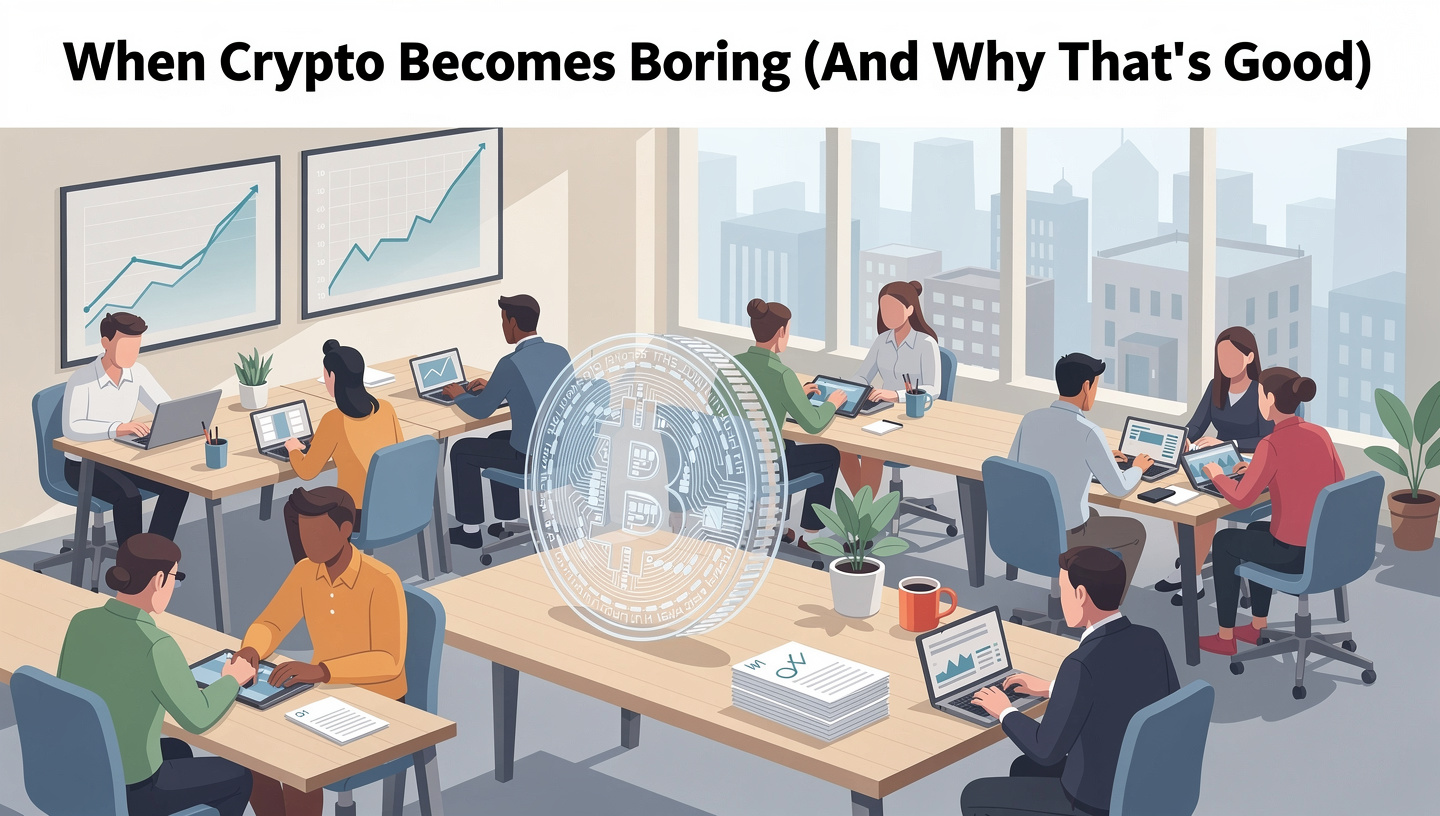
Yet the long-term success of any financial technology depends not on excitement, but on stability. When crypto becomes boring—predictable, regulated, integrated, and infrastructural—it signals maturity. In financial systems, boredom is not stagnation; it is reliability. It is the point at which innovation transitions from spectacle to substrate.
This article examines why the normalization of crypto is both inevitable and desirable. It analyzes the structural shift from speculative mania to infrastructural utility, the technological evolution toward stability, the regulatory convergence with global finance, and the economic implications of a world where crypto ceases to dominate headlines and instead powers background systems.
In short: crypto becoming boring is the clearest signal that it has succeeded.
1. Speculation as a Transitional Phase
Early-stage technologies often pass through speculative bubbles. This is not an anomaly; it is a structural pattern described by innovation diffusion models and capital formation theory.
In crypto, speculation served several essential functions:
- It financed open-source infrastructure development.
- It incentivized miners, validators, and early adopters.
- It distributed tokens widely, albeit unevenly.
- It attracted talent and venture capital at scale.
The rise of Ethereum Foundation and the launch of Ethereum introduced programmable money, expanding use cases beyond simple value transfer. Subsequent cycles brought ICOs, DeFi protocols, NFTs, and algorithmic stablecoins.
Each cycle featured extreme volatility, followed by consolidation. The speculative layer, while noisy, financed experimentation. But speculation is not an end state. It is a bootstrapping mechanism.
Financial systems become durable only when speculative dominance declines relative to transactional and infrastructural usage.
2. From Narrative Volatility to Infrastructure Reliability
Early crypto adoption was narrative-driven: “digital gold,” “bankless finance,” “Web3,” “tokenized everything.” Price movements reinforced or shattered these narratives.
A boring crypto ecosystem exhibits different characteristics:
- Stable transaction fees.
- Predictable confirmation times.
- Reduced chain reorganizations.
- Minimal existential governance crises.
- Diminished dependence on celebrity endorsements.
For example, the transition of Ethereum from proof-of-work to proof-of-stake—known as The Merge—marked a structural pivot toward long-term sustainability. The shift reduced energy consumption and altered the network’s economic issuance dynamics, prioritizing efficiency over spectacle.
Similarly, the continued block production stability of Bitcoin demonstrates infrastructural consistency. Bitcoin’s predictable issuance schedule and difficulty adjustments are not exciting; they are deterministic. That determinism is its strength.
When crypto infrastructure behaves like plumbing—unnoticed until malfunction—it has matured.
3. Stablecoins: The First Boring Breakthrough
If one segment of crypto has already become boring, it is stablecoins.
USDC and USDT now settle billions of dollars daily. For many users in emerging markets, stablecoins function as dollar-denominated savings accounts. For institutions, they provide liquidity rails across exchanges and custodians.
Stablecoins lack the dramatic upside narratives of volatile tokens. Their value proposition is stability, not growth. They represent crypto’s transition from speculative asset class to financial settlement layer.
Boring financial tools scale more sustainably than volatile ones.
4. Regulatory Convergence and Institutionalization
Regulation reduces volatility in two ways: it constrains risk-taking and increases predictability.
The integration of crypto into traditional financial institutions—custodians, asset managers, banks—marks a decisive shift toward normalization. When regulated entities hold digital assets on balance sheets, governance standards rise.
For example, asset management firms began offering exchange-traded products tied to Bitcoin exposure. This does not create technological innovation; it creates accessibility within regulated frameworks.
Institutional custody solutions evolved in response to early exchange collapses, such as FTX. The failure of centralized platforms catalyzed compliance improvements, auditing requirements, and proof-of-reserves transparency efforts.
Boring compliance mechanisms—audits, disclosures, risk controls—reduce systemic fragility. They suppress dramatic failures but enhance long-term credibility.
5. The Decline of “Revolutionary” Rhetoric
Technologies that endure tend to shed utopian rhetoric.
Early crypto discourse framed the technology as an immediate replacement for central banks, sovereign currencies, and nation-states. Over time, the narrative has shifted toward interoperability, programmable finance, and complementary roles within existing systems.
Even central banks began exploring digital currency issuance through CBDC research programs. The ideological confrontation gave way to technical evaluation.
When revolutionary language fades, engineering discipline strengthens.
6. Infrastructure over Tokens: The Stack Consolidates
The first decade of crypto emphasized token proliferation. Tens of thousands of tokens were launched, many without durable use cases.
The next phase prioritizes infrastructure:
- Layer-2 scaling.
- Rollups.
- Interoperability bridges.
- Zero-knowledge proofs.
- Custody standards.
- Identity primitives.
Networks like Solana optimized throughput and latency. Layer-2 ecosystems expanded around Ethereum to address scalability.
These developments are technical, not theatrical. They prioritize reliability over token price speculation. Engineering progress, unlike hype cycles, is incremental and cumulative.
Boring engineering produces enduring systems.
7. Reduced Volatility as a Feature, Not a Flaw
Volatility attracts traders but repels users.
For crypto to function as:
- A unit of account,
- A medium of exchange,
- A long-term store of value,
it must reduce volatility relative to traditional benchmarks.
Macro correlations have increased over time. Bitcoin now reacts to interest rate expectations and liquidity cycles similarly to risk assets. This convergence indicates integration into global capital markets.
As market depth grows, price swings moderate. Liquidity dampens shocks. Arbitrage efficiency improves. Derivatives markets hedge exposures.
Reduced volatility decreases headline appeal but increases economic utility.
8. User Experience: Invisible Crypto
The early user experience of crypto required:
- Seed phrase memorization.
- Manual gas fee adjustments.
- Chain selection awareness.
- Private key management.
Mainstream adoption requires abstraction.
Wallet providers increasingly implement account abstraction, social recovery, and gas sponsorship. Applications embed crypto rails without exposing users to blockchain complexity.
When users transact without knowing which chain processes the transaction, crypto has succeeded as infrastructure.
Boring user interfaces indicate system maturity.
9. Security Models Mature
Early crypto security relied heavily on personal responsibility. Self-custody failures, phishing attacks, and key loss were common.
Over time:
- Multi-party computation (MPC) improved institutional custody.
- Hardware wallet adoption expanded.
- Smart contract auditing firms formalized review processes.
- Bug bounty programs incentivized vulnerability disclosure.
Security practices moved from informal best-effort approaches to standardized frameworks.
The absence of catastrophic exploits for extended periods signals maturity. Financial systems are defined by resilience, not experimentation.
10. The Economic Function of Boring Finance
Modern financial infrastructure—ACH transfers, SWIFT messaging, clearinghouses—is technologically unremarkable but operationally critical.
Crypto’s ultimate trajectory mirrors this path:
- Settlement layers embedded in payment processors.
- Tokenized securities clearing on-chain.
- Automated compliance checks.
- Smart contract escrow for trade finance.
The value lies not in spectacle but in efficiency gains:
- Reduced counterparty risk.
- Faster settlement cycles.
- Lower reconciliation costs.
- Global liquidity pools.
When crypto becomes a backend layer for supply chains, capital markets, and remittances, it exits the hype cycle permanently.
11. Governance Becomes Procedural
Contentious hard forks and ideological schisms once defined crypto governance.
As networks mature:
- Improvement proposals formalize change management.
- Voting participation stabilizes.
- Governance tokens consolidate.
Predictable governance reduces existential uncertainty. Markets price stability favorably.
Procedural governance lacks drama. That absence of drama reflects robustness.
12. Environmental Optimization
Energy criticism shaped crypto’s public narrative. The proof-of-work model of Bitcoin remains energy-intensive, though increasingly powered by renewables.
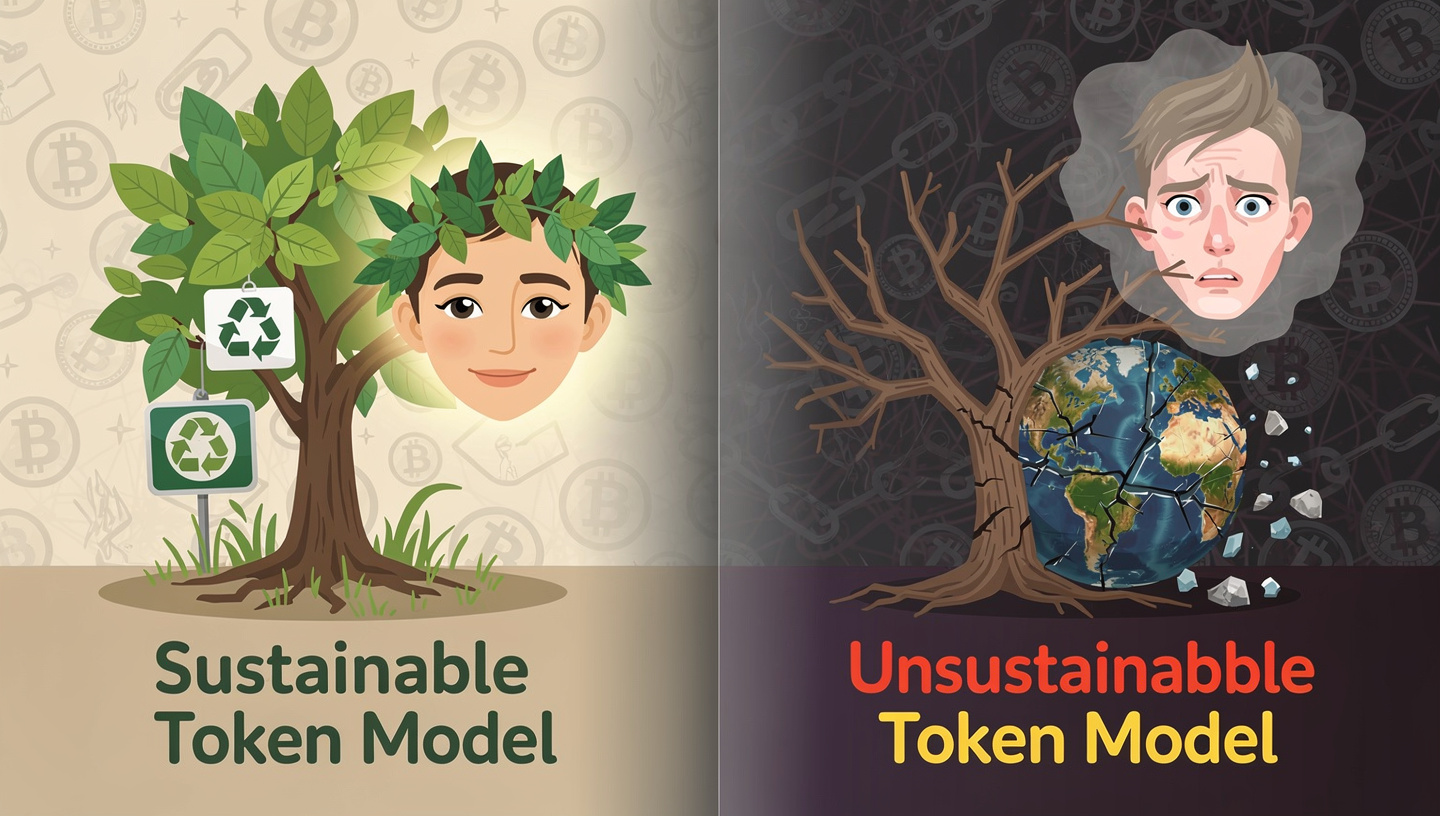
Proof-of-stake networks reduced consumption significantly. Sustainability reporting, carbon disclosures, and ESG integration reduced reputational risk.
Environmental normalization reduces political friction and investor hesitation.
Again, normalization equals boredom.
13. Talent Migration from Speculation to Systems
During peak cycles, crypto talent concentrated in token launches and yield optimization.
As the industry matures:
- Developers focus on interoperability standards.
- Cryptographers refine zero-knowledge circuits.
- Economists model incentive stability.
- Compliance experts integrate AML frameworks.
This transition reflects sectoral stabilization. Long-term systems demand methodical optimization rather than opportunistic innovation.
14. Crypto as Financial Plumbing
The ultimate success of crypto is indistinguishability from infrastructure.
Users will not discuss block times. They will not debate consensus algorithms. They will transact, settle, lend, insure, and remit seamlessly.
At that stage:
- Volatility is muted.
- Governance is procedural.
- Compliance is standardized.
- Infrastructure is interoperable.
The conversation shifts from “Should crypto exist?” to “How do we optimize throughput?”
That shift is the definition of maturity.
15. Why Boring Crypto Is Economically Superior
Speculative environments create misallocation of capital. Bubbles distort price signals and resource allocation.
A boring crypto ecosystem:
- Prices risk more accurately.
- Attracts conservative capital.
- Integrates with pension funds and sovereign wealth funds.
- Reduces systemic contagion.
Predictability lowers discount rates applied to future cash flows. Lower discount rates increase sustainable valuations.
Financial systems thrive on trust. Trust thrives on consistency. Consistency appears boring.
16. The Innovation Paradox
Innovation often requires instability. But institutionalization requires stability.
The paradox resolves when innovation shifts layers:
- Base layers stabilize.
- Application layers innovate.
- Governance frameworks codify processes.
The internet followed this trajectory. TCP/IP is stable; applications evolve. Crypto is following a similar structural pattern.
When base-layer experimentation slows, application-layer creativity accelerates.
17. Market Psychology and the End of Euphoria
Retail-driven hype cycles diminish over time as market participants gain experience.
Experienced participants:
- Hedge exposures.
- Price regulatory risk.
- Avoid unsustainable yield schemes.
- Demand audited codebases.
Collective memory reduces susceptibility to mania.
The absence of mass hysteria is not a loss; it is a gain in market intelligence.
Conclusion: Boredom as a Milestone
Crypto began as a rebellion. It matured through speculation. It endured through crises. It now approaches normalization.
When crypto becomes boring:
- It is stable.
- It is integrated.
- It is regulated.
- It is infrastructural.
The transition from volatility to predictability marks the shift from experiment to system.
Financial technologies do not achieve permanence by remaining exciting. They achieve permanence by becoming dependable.
Boring crypto is not a failure of imagination. It is the completion of the innovation cycle.