The first era of crypto was dominated by tokens as abstract representations of value. Protocol tokens, governance tokens, utility tokens, meme tokens—each promised future upside, network growth, or community alignment. The dominant financial primitive was appreciation. Price charts replaced income statements.
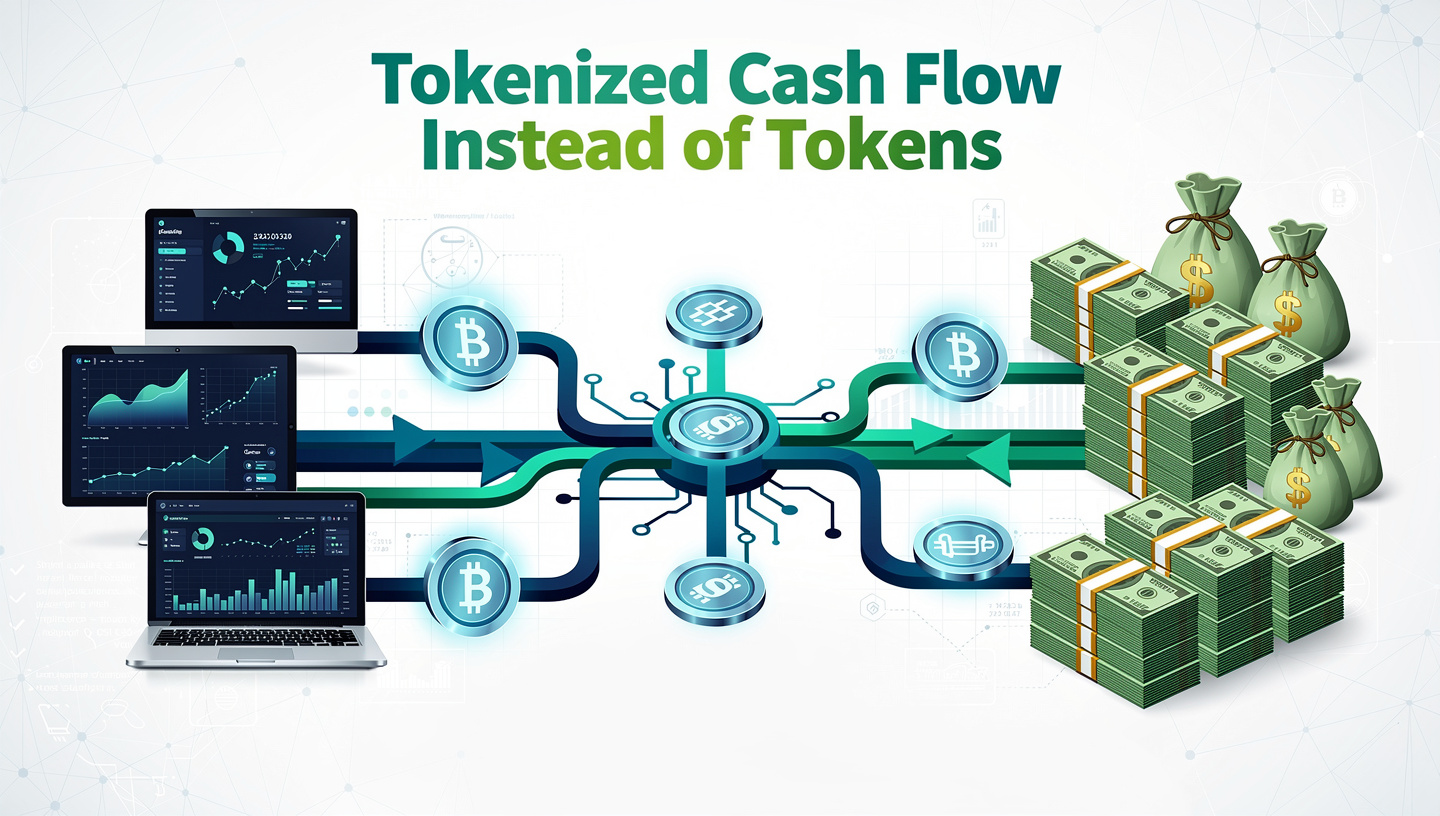
A new phase is emerging. Instead of issuing tokens that represent potential, protocols and builders are beginning to tokenize cash flow itself. The focus shifts from speculative price discovery to programmable, on-chain revenue distribution. Rather than holding a token in expectation of capital gains, participants hold a claim on actual, verifiable economic output.
This transition—from token-centric design to cash-flow-centric design—marks a structural evolution in crypto finance. It aligns blockchain infrastructure with traditional capital markets logic while preserving the programmability, transparency, and composability that make decentralized systems unique.
This article examines the architecture, economics, regulatory implications, and technical mechanisms behind tokenized cash flow models. It outlines how protocols can move beyond symbolic assets and toward revenue-backed instruments that create durable value.
1. The Limits of Token-Centric Design
1.1 The Abstract Token Model
Early token models followed a simple pattern:
- Issue a fixed or inflationary supply.
- Attach governance rights or protocol utility.
- Incentivize liquidity and adoption.
- Expect price appreciation as usage grows.
This structure was formalized in ecosystems such as Ethereum, where ERC-20 tokens became the default issuance mechanism. Decentralized exchanges like Uniswap and lending protocols like Compound distributed governance tokens to bootstrap liquidity and align users with protocol growth.
The result was rapid network expansion. However, value accrual mechanisms were often weak or indirect. Governance tokens frequently lacked enforceable rights to revenue. Their valuation relied on expectations rather than cash distribution.
1.2 Reflexivity and Volatility
Token prices often reflected narrative momentum rather than measurable income streams. Incentive emissions created inflationary pressure. Liquidity mining campaigns generated short-term total value locked (TVL) spikes without durable retention.
Without embedded cash flow, tokens behaved more like venture equity without dividends—yet without formal shareholder protections. This structural gap created misalignment between protocol usage and token holder returns.
1.3 Governance Without Economics
Many governance tokens grant voting power but no revenue rights. While governance is important, it is not a sufficient basis for sustainable valuation. Decision-making authority without economic participation can lead to disengagement or speculative flipping.
The absence of direct yield mechanisms is increasingly seen as a design flaw.
2. Defining Tokenized Cash Flow
Tokenized cash flow refers to blockchain-based instruments that represent claims on revenue, fees, yield, or profit generated by an on-chain or off-chain system.
This differs from conventional tokens in three ways:
- Explicit revenue linkage – Income distribution is programmatically defined.
- Verifiable accounting – Cash flows are recorded on-chain or anchored to auditable sources.
- Automated distribution – Smart contracts handle payout allocation.
In essence, tokenized cash flow transforms revenue streams into programmable financial assets.
3. Architectural Components
3.1 Revenue Sources
Revenue can originate from:
- Transaction fees (e.g., DEX trading fees)
- Lending spreads
- Validator rewards
- Real-world asset yields
- Subscription payments
- API usage fees
- Infrastructure provisioning
For example, staking on Ethereum generates validator rewards, which can be tokenized into liquid staking derivatives.
3.2 Smart Contract Escrow and Distribution
Revenue is routed into a smart contract vault. Distribution logic defines:
- Proportional allocation
- Vesting schedules
- Performance thresholds
- Dynamic fee sharing
The contract acts as an automated clearinghouse, minimizing discretionary control.
3.3 Token Representation
Tokenized cash flow can take multiple forms:
- Revenue-sharing tokens
- Yield-bearing tokens
- NFT-based income claims
- Streaming payment rights
- Securitized revenue notes
Standards such as ERC-4626 (tokenized vaults) simplify yield-bearing token issuance by abstracting deposit and redemption mechanics.
4. Comparative Financial Analysis
4.1 Tokens vs. Cash Flow Instruments
| Dimension | Speculative Token | Tokenized Cash Flow |
|---|---|---|
| Value basis | Market narrative | Measured revenue |
| Income | None or indirect | Programmatic |
| Accounting | Often opaque | On-chain verifiable |
| Volatility | High | Moderated by yield |
| Investor profile | Speculative | Income-focused |
The shift parallels the evolution from growth stocks to dividend-yielding assets in equity markets.
4.2 Discounted Cash Flow in Crypto
Traditional valuation methods—discounted cash flow (DCF), net present value (NPV), yield spread analysis—become applicable when revenue is explicit.
Protocols with predictable income can be modeled using:
- Fee growth projections
- Risk-adjusted discount rates
- Revenue volatility bands
- Terminal value assumptions
This allows institutional-grade analysis rather than narrative-driven pricing.
5. Real-World Asset (RWA) Integration
One major catalyst for tokenized cash flow is the rise of real-world asset tokenization.
Platforms are issuing on-chain claims on:
- Treasury bills
- Corporate bonds
- Real estate rent streams
- Infrastructure revenue
These models bridge blockchain rails with conventional income-generating instruments.
Protocols operating on Ethereum increasingly tokenize U.S. Treasury exposure, enabling on-chain yield anchored to sovereign debt markets.
This represents a convergence between decentralized finance and traditional fixed-income markets.
6. Mechanism Design and Incentive Alignment
6.1 Sustainable Emission Replacement
Instead of subsidizing growth through inflationary emissions, protocols can:
- Redirect actual revenue to participants.
- Reward long-term holders with yield.
- Reduce speculative churn.
6.2 Stakeholder Alignment
Cash flow alignment encourages:
- Long-term holding behavior.
- Governance participation based on economic interest.
- Capital discipline in protocol upgrades.
6.3 Dynamic Fee Allocation
Protocols can algorithmically adjust:
- Treasury retention rates.
- Payout percentages.
- Buyback mechanisms.
- Insurance reserves.
Such dynamic control creates financial resilience without opaque discretion.
7. Legal and Regulatory Implications
Tokenized cash flow often resembles securities under many jurisdictions. Revenue-sharing instruments may trigger:
- Securities classification.
- Disclosure requirements.
- KYC obligations.
- Tax reporting complexity.
Compliance frameworks must consider:
- Jurisdictional token distribution.
- Accredited investor rules.
- Prospectus requirements.
- Secondary market restrictions.
Some projects structure revenue-sharing indirectly—through buybacks or staking rewards—to mitigate classification risk. However, regulatory clarity remains uneven globally.
8. Technical Infrastructure
8.1 On-Chain Accounting
Accurate revenue tracking requires:
- Transparent fee routing.
- Immutable logs.
- Auditable smart contracts.
Subgraphs and indexers facilitate real-time reporting.
8.2 Oracles for Off-Chain Revenue
When income originates off-chain (e.g., real estate rent), oracle systems are necessary to feed verified data into contracts.
The reliability of oracle infrastructure directly affects investor confidence.
8.3 Composability
Tokenized cash flow instruments can be:
- Used as collateral.
- Integrated into lending markets.
- Aggregated into yield indices.
- Structured into derivatives.
Composability enhances capital efficiency.
9. Risks and Structural Challenges
9.1 Revenue Concentration
Single-source revenue streams create fragility. Diversification across multiple income channels mitigates systemic exposure.
9.2 Smart Contract Risk
Bugs or exploits can disrupt revenue distribution. Formal verification and audits are mandatory.
9.3 Liquidity Constraints
Income-bearing instruments may trade at discounts if secondary liquidity is thin.
9.4 Regulatory Intervention
Revenue-linked tokens may face enforcement actions depending on jurisdiction.
10. Emerging Models
10.1 Fee Switch Activation
Some decentralized exchanges periodically debate enabling direct fee distribution to token holders, shifting from governance-only models to revenue-linked designs.
10.2 Revenue Buybacks
Protocols use revenue to repurchase tokens from open markets, creating indirect cash flow realization.
10.3 Streaming Payments
Continuous revenue distribution via payment streaming protocols reduces lump-sum volatility.
10.4 NFT-Based Revenue Rights
NFTs representing fractional ownership of income streams introduce programmable royalties and secondary market liquidity.
11. Economic Implications
11.1 Stabilization of Crypto Markets
Revenue-backed instruments reduce reliance on speculative inflows. Yield floors anchor valuations.
11.2 Institutional Participation
Institutions require measurable cash flow. Tokenized revenue aligns with pension funds, hedge funds, and asset managers seeking predictable returns.
11.3 Transition to On-Chain Capital Markets
As revenue tokenization scales, crypto becomes a parallel capital market infrastructure rather than an isolated speculative arena.
12. Strategic Implementation Framework
Protocols aiming to implement tokenized cash flow should:
- Identify recurring revenue streams.
- Quantify historical revenue volatility.
- Determine sustainable payout ratios.
- Design distribution contracts.
- Conduct formal audits.
- Establish transparent reporting dashboards.
- Model regulatory exposure.
- Stress-test liquidity scenarios.
This systematic approach prevents ad hoc financial engineering.
13. The Philosophical Shift
Crypto originally emphasized decentralization and censorship resistance. While these remain foundational, economic sustainability now defines protocol longevity.
Tokenized cash flow represents maturation:
- From ideology to infrastructure.
- From narrative to accounting.
- From speculation to income.
The blockchain ceases to be merely a ledger of token balances and becomes a programmable clearing system for global revenue distribution.
Conclusion: A Post-Speculative Crypto Architecture
Token issuance alone does not create value. Cash flow does.
The next generation of crypto protocols will not compete solely on token design, branding, or incentive campaigns. They will compete on revenue generation efficiency, yield transparency, and capital allocation discipline.
Tokenized cash flow is not a minor refinement. It is a structural realignment that redefines what blockchain-based finance can be. By embedding revenue directly into programmable assets, crypto transitions from an experiment in digital scarcity to a platform for global, automated income distribution.
The era of abstract tokens is giving way to measurable yield. And in capital markets—on-chain or off—cash flow remains the ultimate arbiter of value.