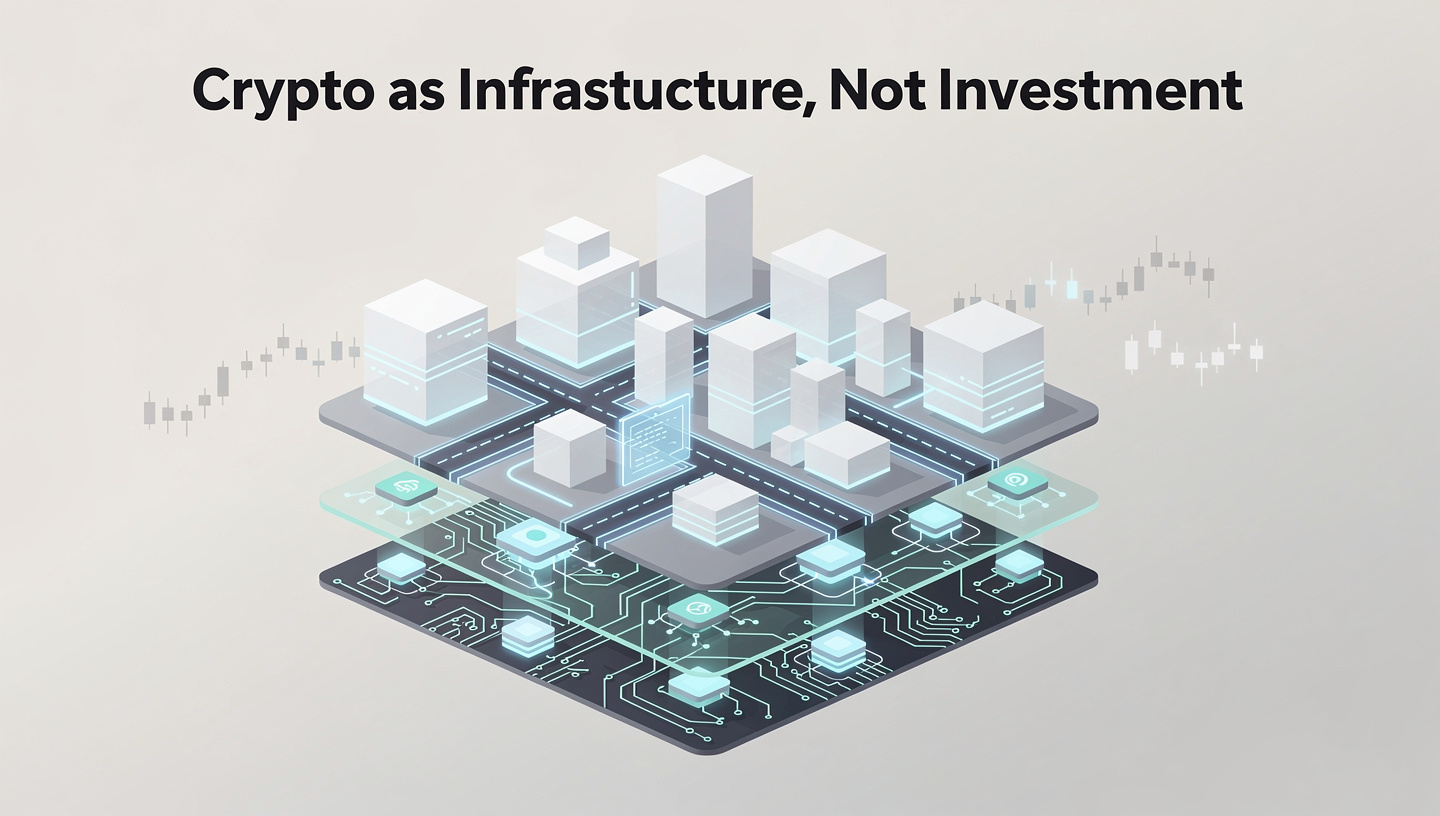
Since the emergence of Bitcoin in 2009, public discourse has framed crypto primarily as an asset class. Media cycles revolve around price volatility. Institutional entrants are measured by inflows. Retail narratives oscillate between speculation and fear. This framing is analytically incomplete.
Crypto is not fundamentally an investment vehicle. It is programmable infrastructure: a distributed settlement layer, an execution environment, and a coordination substrate for digital societies. Tokens are not merely speculative instruments; they are resource allocation primitives within decentralized systems. To treat crypto exclusively as “digital gold” or “high-risk equity” is to misclassify a general-purpose technological stack as a trading instrument.
This article examines crypto through an infrastructural lens. It analyzes base layers, execution layers, governance mechanisms, economic design, regulatory implications, and long-term innovation trajectories. The objective is precision: to articulate why crypto should be evaluated as critical digital infrastructure and how that shift changes design, policy, and capital allocation decisions.
1. Defining Infrastructure in the Digital Era
Infrastructure has specific characteristics:
- Foundationality: Other systems depend on it.
- Interoperability: It supports multiple applications.
- Longevity: It is built for decades, not quarters.
- Neutrality: It operates as a shared substrate.
- Public Utility Function: It enables economic coordination.
Historically, infrastructure includes roads, railways, power grids, telecommunications networks, and the internet’s TCP/IP stack. The latter—protocol-based, permissionless, interoperable—provides the closest analog to crypto systems.
Crypto networks share these properties:
- Open participation models.
- Shared state machines.
- Protocol-enforced rules.
- Global addressability.
- Cryptographic guarantees rather than institutional trust.
To call crypto an “investment” is analogous to calling fiber-optic cable an investment class. Fiber is infrastructure; companies leveraging it may be investments. The distinction is foundational.
2. Layered Architecture: Crypto as a Digital Utility Stack
Crypto infrastructure can be decomposed into layers analogous to internet architecture.
2.1 Settlement Layer
The settlement layer provides finality and censorship resistance. Examples include:
- Bitcoin (monetary settlement).
- Ethereum (programmable settlement).
These systems maintain distributed ledgers validated by decentralized consensus. They serve as base layers upon which higher-order financial and non-financial applications are built.
From an infrastructural perspective, these networks resemble digital sovereign clearinghouses. They provide:
- Immutable transaction ordering.
- Cryptographic auditability.
- Global uptime.
- Economic security via incentive alignment.
2.2 Execution Layer
Smart contract platforms extend settlement into programmable execution. On Ethereum, decentralized applications (dApps) encode logic directly into the base protocol.
Execution layers transform blockchains from passive ledgers into:
- Deterministic virtual machines.
- Autonomous financial engines.
- Governance orchestration systems.
- Decentralized identity anchors.
This is infrastructure because it standardizes computation with trust-minimized guarantees.
2.3 Scaling and Interoperability
Layer-2 systems, rollups, and cross-chain protocols reduce congestion and improve throughput. Projects such as Solana experiment with monolithic high-performance architectures. Others, like Polkadot, prioritize interoperability.
From an infrastructure standpoint, these are not “competitors” in the narrow sense. They are architectural experiments in throughput, decentralization, and composability trade-offs.
3. Tokens as Resource Allocation Mechanisms
The financialization of tokens obscures their functional role.
3.1 Access Rights and Usage Fees
Tokens often function as:
- Payment for computational resources (gas).
- Collateral in decentralized finance.
- Governance voting weight.
- Security bonding for validators.
In this context, tokens resemble:
- Bandwidth credits.
- Compute credits.
- Security deposits.
- Governance shares.
The speculative overlay emerges from secondary markets, but the primary function remains infrastructural.
3.2 Security Budget and Economic Alignment
Proof-of-work (PoW) and proof-of-stake (PoS) systems rely on economic incentives. For example:
- Bitcoin uses PoW to secure transaction finality.
- Ethereum transitioned to PoS in 2022 to reduce energy intensity.
The token provides the economic security budget. Without a token, decentralized consensus lacks a native incentive mechanism. Thus, tokens are not optional financial wrappers; they are integral to system integrity.
4. Decentralized Finance as Financial Infrastructure
Decentralized finance (DeFi) exemplifies crypto as infrastructure.
Protocols such as:
- Uniswap (automated market making),
- Aave (decentralized lending),
- MakerDAO (collateral-backed stablecoins),
replace institutional intermediaries with algorithmic logic.
These systems provide:
- Liquidity provision.
- Credit markets.
- Stable-value instruments.
- Derivatives.
- Synthetic assets.
They operate continuously, globally, and permissionlessly. Their tokens are not merely equity proxies. They coordinate liquidity, governance, and risk allocation.
From an infrastructural perspective, DeFi is a programmable clearing and settlement layer for capital markets.
5. Stablecoins and Monetary Plumbing
Stablecoins are one of crypto’s most infrastructural innovations. Tether and Circle (issuer of USDC) provide dollar-pegged instruments used across exchanges and DeFi protocols.
Stablecoins function as:
- Digital cash equivalents.
- Cross-border payment rails.
- On-chain settlement instruments.
They reduce volatility exposure and allow enterprises to use blockchain networks without speculative risk.
If crypto is infrastructure, stablecoins are its monetary plumbing.
6. Governance as Protocol-Level Coordination
Infrastructure must evolve. Crypto governance mechanisms include:
- On-chain voting.
- Off-chain signaling.
- Validator consensus.
- Social coordination.
For instance, protocol upgrades on Ethereum require coordination among developers, validators, and users.
Unlike corporations, crypto governance is open-source and participatory. It resembles open internet standards processes more than boardroom decisions.
This governance structure introduces:
- Transparent rule modification.
- Fork-based dispute resolution.
- Community-led protocol evolution.
These are infrastructural governance dynamics, not traditional shareholder dynamics.
7. Regulatory Implications of the Infrastructure Frame
If crypto is infrastructure, regulatory treatment must reflect that.
7.1 Securities vs. Protocols
Regulators often attempt to classify tokens as securities. However, infrastructure tokens often:
- Do not represent claims on profits.
- Do not convey ownership in an issuing entity.
- Serve functional network purposes.
Misclassification risks stifling innovation by applying inappropriate financial regulations to network utilities.
7.2 Public Goods and Systemic Risk
As infrastructure, crypto networks raise systemic questions:
- Who maintains uptime?
- How is security audited?
- What happens during network failure?
- How do stablecoins integrate with traditional banking?
Policy must evolve beyond speculative protection to infrastructure resilience frameworks.
8. Crypto and Global Coordination
Crypto’s most transformative property is global, trust-minimized coordination.
Unlike traditional infrastructure:
- No central operator controls access.
- Participation is pseudonymous.
- Cross-border transfers are native.
- Code is transparent.
This allows:
- Borderless capital formation.
- Decentralized autonomous organizations (DAOs).
- Open-source funding mechanisms.
- Machine-to-machine economic activity.
These capabilities extend beyond investment returns. They redefine how economic coordination occurs.
9. Energy, Sustainability, and Infrastructure Trade-offs
Energy debates have focused heavily on proof-of-work systems like Bitcoin. Infrastructure analysis reframes the question:
- What security guarantees justify energy expenditure?
- Can alternative consensus reduce costs?
- How do networks internalize environmental externalities?
Ethereum’s transition to PoS significantly reduced energy usage. Competing architectures experiment with throughput and efficiency.
Infrastructure design requires explicit trade-offs among:
- Security.
- Decentralization.
- Scalability.
- Sustainability.
These are engineering parameters, not investment narratives.
10. Enterprise Adoption: Infrastructure Integration
Enterprises increasingly integrate crypto for:
- Supply chain tracking.
- Settlement optimization.
- Tokenized assets.
- Identity management.
When corporations use blockchain rails, they are not speculating; they are leveraging distributed infrastructure.
Tokenization of real-world assets—bonds, equities, commodities—moves traditional markets onto programmable settlement layers. This suggests a long-term convergence of financial infrastructure and blockchain networks.
11. Innovation Trajectories
Viewing crypto as infrastructure clarifies innovation vectors:
11.1 Modularity
Rollups and modular chains decouple execution, data availability, and settlement. This reduces bottlenecks and enhances specialization.
11.2 Cryptographic Advances
Zero-knowledge proofs enable:
- Privacy-preserving transactions.
- Scalable validation.
- Cross-chain interoperability.
These are infrastructural cryptographic primitives.
11.3 Identity and Reputation
Decentralized identity systems create portable, user-controlled credentials. Infrastructure-level identity reduces reliance on centralized databases.
12. Capital Allocation in an Infrastructure Paradigm
If crypto is infrastructure:
- Capital should fund protocol research and security.
- Long-term horizon dominates short-term price movement.
- Token models must sustain validator incentives.
- Governance must prioritize resilience over yield.
Investors become infrastructure backers. Time preference shifts from speculative cycles to durability metrics.
13. Risk Analysis
Infrastructure carries systemic risk:
- Smart contract vulnerabilities.
- Consensus failures.
- Regulatory shocks.
- Stablecoin depegging events.
Risk mitigation strategies include:
- Formal verification.
- Audits.
- Decentralized validator sets.
- Transparent reserves.
Infrastructure demands engineering discipline, not trading enthusiasm.
14. Cultural Reorientation
The speculative framing of crypto distorts its design priorities. Infrastructure framing emphasizes:
- Stability over volatility.
- Utility over hype.
- Security over marketing.
- Long-term viability over rapid appreciation.
Cultural realignment is necessary for maturation.
Conclusion: Toward a Protocol-Centric Future
Crypto’s enduring contribution will not be price charts. It will be the establishment of a decentralized, programmable infrastructure layer for global coordination.
Like the internet before it, crypto’s value compounds through usage, not speculation. Base protocols such as Bitcoin and Ethereum should be evaluated as digital public utilities—secure, resilient, and interoperable.
Treating crypto as infrastructure clarifies its design, governance, regulation, and innovation pathways. It shifts attention from quarterly returns to generational durability.
Infrastructure endures. Investments fluctuate.
Crypto belongs in the former category.