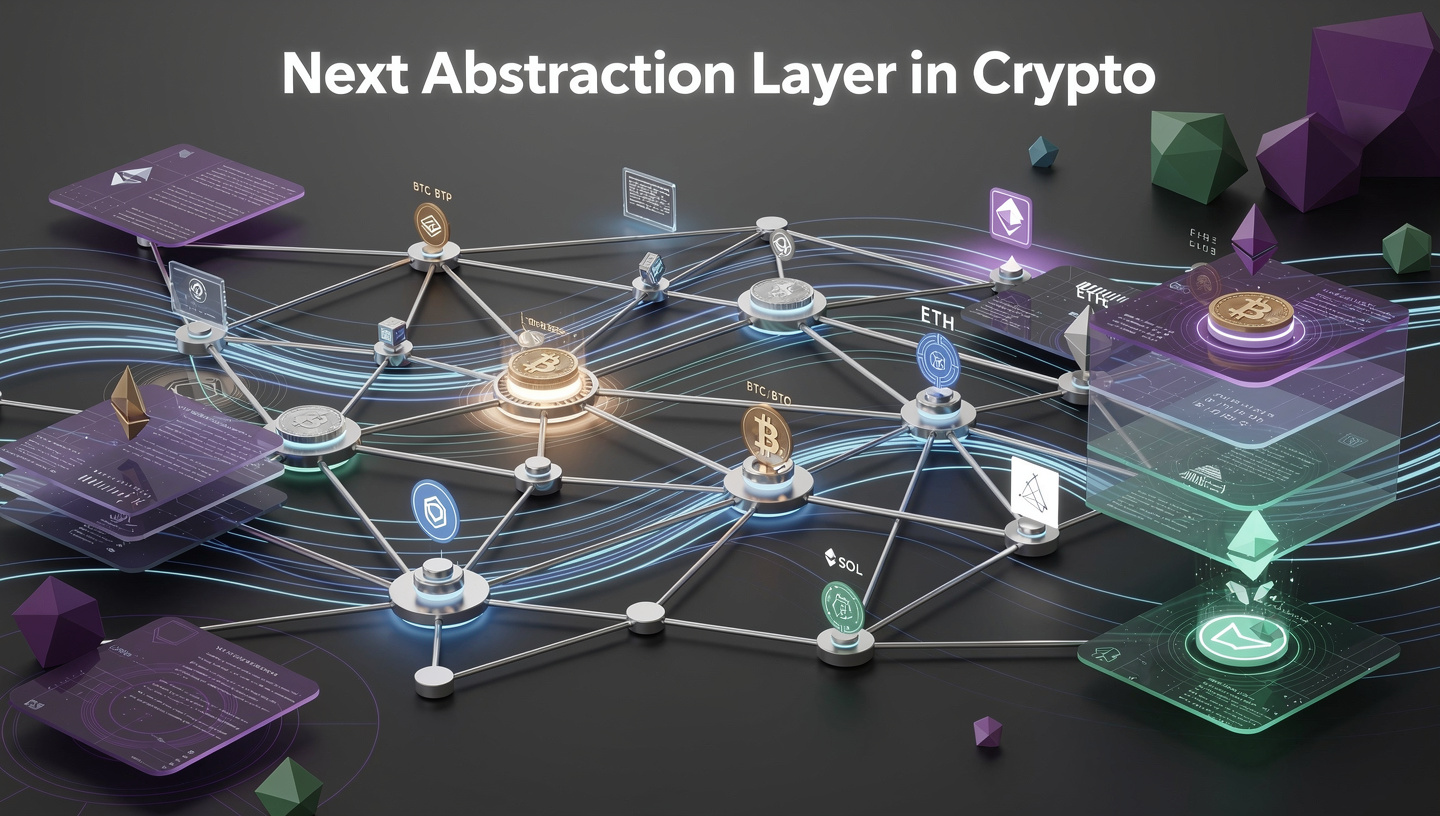
Every enduring technological revolution has advanced through abstraction. The history of computing is not merely a history of faster processors or larger memory banks; it is a history of progressively hiding complexity. Assembly language gave way to high-level programming languages. Monolithic servers evolved into cloud-native architectures. TCP/IP dissolved into invisible plumbing beneath application interfaces.
Crypto is undergoing the same transformation.
The early phase of blockchain innovation was dominated by base-layer experimentation—consensus algorithms, block sizes, throughput, and cryptographic guarantees. Systems like Bitcoin introduced censorship-resistant digital scarcity through Proof-of-Work. Ethereum generalized programmable settlement via smart contracts. Subsequent networks optimized scalability, privacy, or modularity.
Yet today’s frontier is no longer raw protocol construction. It is abstraction.
The next abstraction layer in crypto will determine how decentralized systems scale to billions of users, interoperate across heterogeneous environments, and integrate with existing financial and computational infrastructure. This layer is not about replacing blockchains. It is about making them composable, programmable at higher levels, and operationally invisible.
This article examines the architecture, drivers, design principles, economic implications, and likely trajectories of this next abstraction layer in crypto. It approaches the subject not as speculative futurism but as a structured analysis of emergent patterns across infrastructure, developer tooling, governance, and user experience.
1. What Is an Abstraction Layer in Crypto?
An abstraction layer is a structural mechanism that reduces cognitive and operational complexity by encapsulating lower-level functions behind standardized interfaces.
In crypto, abstraction layers have evolved through several identifiable phases:
- Cryptographic Primitives — Hash functions, digital signatures, Merkle trees.
- Consensus Protocols — Proof-of-Work, Proof-of-Stake, Byzantine fault tolerance.
- Execution Environments — Virtual machines (EVM, WASM).
- Application Protocols — DeFi, NFTs, DAOs.
- Interface Layers — Wallets, SDKs, APIs.
The next abstraction layer sits above protocol-level complexity and below application-level UX. It aims to unify fragmented ecosystems, manage cross-chain interactions, encapsulate security models, and transform cryptographic guarantees into programmable services.
The goal is not merely to simplify usage. It is to make decentralized infrastructure behave like programmable cloud primitives.
2. Historical Precedent: Abstraction in Computing
To understand crypto’s trajectory, consider parallels in computing:
- Operating systems abstracted hardware.
- Virtual machines abstracted operating systems.
- Cloud providers abstracted physical servers.
- Serverless frameworks abstracted infrastructure management.
- APIs abstracted backend logic into consumable services.
Crypto is currently at a stage analogous to early cloud computing—powerful but operationally burdensome. Developers must reason about gas costs, key management, transaction finality, chain-specific semantics, and cross-chain bridges.
The next abstraction layer will perform for crypto what Kubernetes did for container orchestration: unify heterogeneous environments behind programmable control planes.
3. Drivers of the Next Abstraction Layer
Several structural pressures are forcing the emergence of this layer.
3.1 Multi-Chain Fragmentation
The ecosystem now spans L1s, L2 rollups, app-chains, modular data availability layers, and specialized execution environments. A developer building across Ethereum, Solana, and Cosmos must handle different virtual machines, fee models, and finality assumptions.
Without abstraction, composability fractures.
3.2 UX Constraints
Mainstream adoption is blocked by wallet complexity, seed phrases, gas estimation, transaction simulation failures, and bridge risks. End-users cannot be expected to understand signing domains or replay attacks.
Abstraction must collapse cryptographic mechanics into user-intuitive actions.
3.3 Institutional Integration
Enterprises require deterministic compliance surfaces, auditable execution, and risk controls. Raw blockchain primitives are insufficient. They require middleware that translates decentralized trust models into enterprise governance models.
3.4 Security Externalities
Bridges, smart contract exploits, and governance attacks demonstrate that composability without abstraction increases systemic risk. The abstraction layer must incorporate security policy enforcement and risk isolation mechanisms.
4. Components of the Emerging Abstraction Layer
The next abstraction layer is not a single protocol. It is a stack composed of interoperable primitives.
4.1 Account Abstraction
Account abstraction redefines wallet architecture. Instead of externally owned accounts controlled solely by private keys, programmable smart contract accounts enforce custom logic—multi-sig, social recovery, session keys, or automated gas sponsorship.
In the context of Ethereum, proposals like ERC-4337 enable user accounts to behave as programmable objects rather than static key pairs.
Implications:
- Gas abstraction (third-party payment).
- Bundled transactions.
- Conditional execution logic.
- Institutional custody models.
Account abstraction transforms identity from cryptographic possession into programmable state machines.
4.2 Chain Abstraction
Chain abstraction aims to make blockchain selection invisible to users. Instead of manually bridging assets between networks, users interact with a unified state layer that routes transactions across chains.
Mechanisms include:
- Intent-based architectures.
- Cross-chain message relays.
- Liquidity virtualization.
- Aggregated finality layers.
The goal: eliminate chain-specific cognitive overhead.
4.3 Modular Execution and Settlement
Modular architectures decouple execution, consensus, and data availability. Instead of monolithic blockchains, systems specialize:
- Execution layers process transactions.
- Data availability layers store proofs.
- Settlement layers enforce finality.
This abstraction allows applications to choose components like cloud services, rather than deploying on vertically integrated chains.
4.4 Intent-Based Systems
Rather than specifying transactions, users specify intents. For example:
- “Swap 1 ETH for the best available stablecoin rate.”
- “Stake assets in the highest risk-adjusted yield vault.”
Solvers compete to fulfill intents across chains. This model abstracts routing complexity and market microstructure.
Intent layers represent a shift from deterministic transaction execution to competitive fulfillment networks.
4.5 Programmable Custody and Compliance Layers
Institutional adoption requires policy enforcement. The abstraction layer can incorporate:
- Identity attestation.
- Permissioned smart contracts.
- Jurisdiction-aware transaction routing.
- Automated compliance reporting.
This enables coexistence between permissionless infrastructure and regulated environments.
5. Technical Architecture of the Next Abstraction Layer
At a systems level, the next abstraction layer will include:
- Unified Identity Frameworks
- Cross-Domain Message Buses
- Programmable Account Controllers
- Liquidity Routing Engines
- Security Policy Engines
- Risk Isolation Mechanisms
- Meta-Transaction Infrastructure
These components operate analogously to middleware in distributed systems.
5.1 Unified Identity
Persistent identities must operate across chains. This may involve decentralized identifiers (DIDs), zero-knowledge attestations, or account registries.
Identity abstraction reduces friction in cross-protocol interactions.
5.2 Cross-Domain Messaging
Cross-chain interoperability requires secure messaging frameworks with provable state verification. Optimistic relays, zk-verified proofs, and light-client architectures compete here.
5.3 Liquidity Virtualization
Instead of siloed liquidity pools, abstraction layers can virtualize liquidity across chains, reducing slippage and fragmentation.
6. Economic Implications
Abstraction alters economic structures.
6.1 Fee Markets
If gas becomes abstracted, end-users may no longer see chain-level fees. Aggregators or solvers internalize cost optimization.
This shifts revenue flows from L1 miners/validators toward middleware operators.
6.2 MEV Redistribution
Intent-based systems and solver markets restructure Miner Extractable Value (MEV). Competitive solvers may reduce adversarial extraction while preserving arbitrage efficiency.
6.3 Value Capture Migration
In early crypto, value accrued primarily to base layers. In mature ecosystems, value migrates upward into application and orchestration layers.
The next abstraction layer will become a major value capture locus.
7. Security Considerations
Abstraction does not eliminate risk; it redistributes it.
7.1 Aggregation Risk
Centralized relayers or solvers can become systemic choke points.
7.2 Cross-Chain Contagion
Abstraction layers that unify chains may transmit exploits across domains.
7.3 Governance Attack Surface
Meta-protocol governance introduces additional vectors.
Design must emphasize:
- Formal verification.
- Fail-safe mechanisms.
- Progressive decentralization.
- Incentive alignment.
8. Developer Experience (DX) as a Strategic Lever
The next abstraction layer is fundamentally a developer tooling revolution.
SDKs, API gateways, test environments, and deployment frameworks will reduce blockchain interaction to modular service calls.
Developers should not manually:
- Encode transactions.
- Estimate gas.
- Manage nonce ordering.
- Monitor finality windows.
These should be abstracted into orchestration frameworks.
9. Institutional Infrastructure Convergence
Traditional finance operates on layered abstraction—clearinghouses, custodians, settlement networks.
Crypto’s abstraction layer enables:
- Tokenized asset issuance.
- Programmable compliance.
- Cross-border real-time settlement.
Integration becomes feasible when abstraction normalizes trust semantics.
10. The Strategic Question: Who Owns the Abstraction Layer?
The abstraction layer can be controlled by:
- Base-layer protocols.
- Independent middleware networks.
- Centralized service providers.
- DAO-governed orchestration frameworks.
The control plane determines power concentration.
History suggests:
- Early decentralization.
- Middleware consolidation.
- Eventual re-decentralization.
11. Comparative Analysis: L1 vs Middleware Dominance
In computing:
- TCP/IP did not capture the majority of value.
- Cloud providers did.
In crypto:
- L1 tokens capture value today.
- Middleware orchestration may capture more tomorrow.
The transition will be measurable via:
- Revenue concentration.
- Developer dependency metrics.
- Liquidity routing volume.
- Cross-chain transaction percentages.
12. The User Experience Endgame
In the mature state:
- Users do not know which chain they use.
- Gas is invisible.
- Keys are abstracted.
- Assets move frictionlessly.
- Security policies are enforced silently.
Crypto becomes infrastructure, not interface.
13. Design Principles for the Next Abstraction Layer
To succeed, abstraction layers must satisfy:
- Deterministic Security Guarantees
- Composability Across Heterogeneous Environments
- Economic Sustainability
- Minimal Trust Assumptions
- Modular Extensibility
- Interoperable Standards
Over-centralization undermines decentralization. Over-fragmentation undermines usability.
Balance is required.
14. Long-Term Trajectory
The next abstraction layer will likely evolve in stages:
- Account abstraction adoption.
- Intent-layer deployment.
- Cross-chain liquidity virtualization.
- Institutional middleware integration.
- Consolidation of orchestration frameworks.
- Standardization across ecosystems.
Eventually, the crypto stack may resemble:
- Base Layers (Settlement)
- Modular Services (Execution/Data)
- Abstraction Middleware (Orchestration)
- Applications (User Interfaces)
This hierarchy mirrors modern computing stacks.
Conclusion: Infrastructure Becomes Invisible
Crypto began as a radical transparency experiment. Every transaction visible. Every consensus rule explicit. Every fee measurable.
Its next evolution is invisibility.
The next abstraction layer in crypto will not compete on ideology. It will compete on integration, orchestration, and reduction of friction. It will determine whether decentralized systems remain niche financial experiments or evolve into global programmable infrastructure.
The winning architectures will not merely process transactions; they will manage complexity at planetary scale.
In technological revolutions, the most valuable layer is rarely the most visible. The future of crypto lies not in louder consensus debates, but in quieter orchestration frameworks that make decentralization function without being seen.
That is the next abstraction layer.