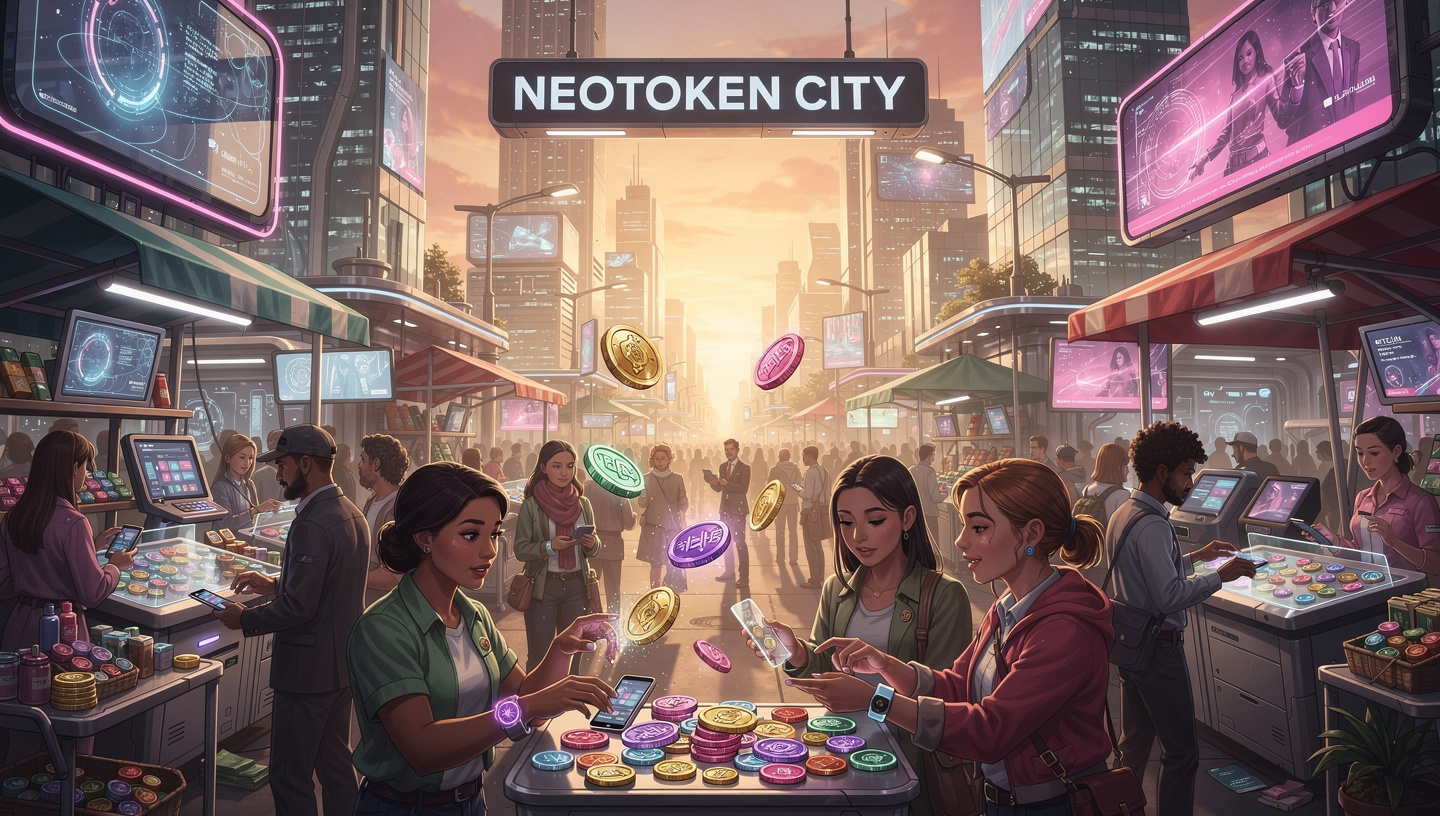
Most blockchain projects are engineered as products. A minority are architected as protocols. Almost none are designed as worlds.
Yet the most resilient crypto ecosystems—those that sustain developer mindshare, capital formation, cultural production, and adversarial pressure—function less like applications and more like environments. They exhibit coherent internal logic, economic gravity, social stratification, conflict surfaces, and historical continuity. They are not merely networks; they are simulated polities.
From Bitcoin’s austere monetary cosmos to Ethereum’s programmable jurisdiction, from Solana’s high-throughput economic zone to Cosmos’s federated archipelago, each credible crypto ecosystem operates under a set of world rules. These rules are encoded in consensus mechanisms, fee markets, governance processes, and incentive gradients. They define what can exist, what can scale, what can attack, and what can survive.
This article examines what makes a crypto world feel real. It does not approach the question narratively. It treats crypto as institutional design, economic engineering, and distributed systems architecture. The objective is to identify the structural properties that transform a codebase into a credible world.
The central thesis: a crypto world feels real when its constraints, incentives, governance, culture, and failure modes interlock into a self-consistent system that produces emergent order under adversarial conditions.
1. Coherent Ontology: Clear Definitions of Assets, Actors, and Authority
A world begins with ontology: what exists and what has rights.
In crypto, ontology is formalized through:
- Asset classes (native tokens, stablecoins, NFTs, governance tokens)
- Actor roles (validators, delegators, developers, users, arbitrageurs)
- Authority primitives (consensus rules, upgrade mechanisms, slashing conditions)
A crypto world feels real when these categories are sharply defined and enforced by code, not convention.
Monetary Ontology
In Bitcoin, the ontology is minimal:
- UTXOs exist.
- Private keys authorize movement.
- Supply issuance is deterministic.
- Consensus is governed by proof-of-work.
There are no built-in hierarchies beyond hash power and node validation. This minimal ontology yields clarity. Scarcity is algorithmic. Ownership is cryptographic. Authority emerges from economic alignment between miners and full nodes.
Contrast this with Ethereum, where ontology expands:
- Accounts (EOAs and smart contracts)
- Gas markets
- Token standards (ERC-20, ERC-721)
- Validators staking under proof-of-stake
Ethereum’s ontology permits institutional complexity. DeFi protocols, DAOs, and on-chain governance constructs become native inhabitants.
A crypto world without a defined ontology devolves into incoherence. When asset rights are ambiguous, or authority structures are mutable without constraint, the world feels unstable—more sandbox than civilization.
2. Constraint-Driven Realism: Scarcity, Latency, and Cost
Physical worlds feel real because they impose friction. Crypto worlds must replicate constraint through computational and economic limits.
Three forms of constraint are essential:
- Scarcity (monetary limits)
- Latency (block time and finality)
- Cost (transaction fees and resource pricing)
Scarcity as Gravity
Monetary policy defines gravitational pull. A capped supply, as in Bitcoin, creates deflationary expectations. Inflationary models, common in proof-of-stake networks, create yield-bearing incentive layers.
Scarcity shapes long-term behavior:
- Hoarding vs spending
- Security budgets
- Capital formation cycles
Without credible scarcity, there is no macroeconomic coherence.
Latency as Spatial Reality
Block time and finality introduce temporal structure. A six-block confirmation rule on Bitcoin produces probabilistic finality. Ethereum’s post-merge architecture provides faster economic finality.
Time matters because:
- It defines settlement risk.
- It constrains arbitrage windows.
- It shapes user experience.
If latency is unpredictable or arbitrary, the world feels inconsistent.
Cost as Thermodynamics
Gas fees and execution costs function as thermodynamic laws. In Ethereum, gas markets price computation. In Solana, throughput optimization compresses cost per transaction.
A world without cost boundaries invites spam and collapse. Conversely, excessive cost destroys usability.
Realism requires calibrated friction.
3. Incentive Architecture: Behavior as Engine
A crypto world does not rely on trust; it relies on incentive alignment.
Incentive design determines:
- Who secures the network.
- Who extracts value.
- Who bears risk.
- Who accumulates power.
Security Incentives
Proof-of-work in Bitcoin rewards hash contribution; proof-of-stake in Ethereum rewards capital lockup.
Both systems:
- Penalize deviation.
- Reward compliance.
- Encode economic consequences for misbehavior.
If attacks are cheaper than compliance, the world dissolves.
Application-Level Incentives
DeFi ecosystems introduce secondary incentive layers:
- Liquidity mining.
- Governance token emissions.
- Yield optimization loops.
Projects like Uniswap illustrate how fee-sharing mechanisms create durable liquidity equilibria.
When incentives are short-term and extractive, the ecosystem experiences mercenary capital churn. When incentives align long-term stakeholders—validators, developers, and users—the world stabilizes.
Real crypto worlds design for adversarial rational actors, not idealists.
4. Governance as Legitimacy
A world without governance is static; a world with chaotic governance is unstable.
Governance in crypto exists along a spectrum:
- Off-chain social consensus (Bitcoin)
- On-chain proposal systems (many DAOs)
- Hybrid models (Ethereum Improvement Proposals)
Legitimacy arises when:
- Rules for change are predictable.
- Power concentration is bounded.
- Stakeholders perceive fairness.
Bitcoin’s conservatism stems from social-layer governance, anchored by node operators and developer norms. Ethereum’s adaptability stems from coordinated upgrades via EIPs and client implementations.
Governance realism requires friction. If upgrades occur too easily, monetary policy loses credibility. If upgrades are impossible, the system ossifies.
A credible crypto world balances adaptability with institutional inertia.
5. Economic Interdependence: Layered Complexity
A world feels real when actors depend on each other.
In crypto ecosystems, interdependence manifests as:
- Validators depending on delegators.
- Protocols depending on liquidity providers.
- DAOs depending on token holders.
- Stablecoins depending on collateral frameworks.
Consider the role of Tether in global liquidity provisioning. Stablecoins create transactional stability within volatile markets. Remove them, and capital velocity drops sharply.
Similarly, cross-chain systems like Cosmos introduce federated interdependence via IBC. Zones rely on shared security models or liquidity bridges.
Interdependence introduces systemic risk. It also introduces realism. When one subsystem fails, ripple effects propagate.
Fragility signals authenticity; isolation signals artificiality.
6. Historical Continuity and Fork Memory
Real worlds accumulate history. Crypto worlds encode it.
Blockchains are append-only ledgers. Every transaction, fork, exploit, and governance vote persists in immutable records.
The 2016 DAO exploit led to the Ethereum hard fork, resulting in two networks:
- Ethereum
- Ethereum Classic
This schism demonstrates civilizational branching. Forks are not bugs; they are political events.
A crypto world without conflict history lacks depth. Historical memory:
- Shapes risk perception.
- Influences governance norms.
- Informs capital allocation.
Institutional scars add realism.
7. Cultural Production and Narrative Sovereignty
Markets alone do not sustain worlds; culture does.
Crypto-native memes, documentation, conferences, and public discourse create identity layers. Developer ecosystems generate tooling, research papers, and protocol experiments.
Ethereum’s ethos emphasizes credible neutrality and programmability. Bitcoin culture emphasizes immutability and sound money. Solana communities emphasize performance and user-scale applications.
Narrative coherence attracts builders. Builders create infrastructure. Infrastructure attracts capital.
When narrative contradicts economic reality, credibility collapses. Authentic culture aligns with encoded rules.
8. Adversarial Testing: Surviving Attack Surfaces
Real worlds are contested.
Crypto ecosystems face:
- 51% attacks.
- Smart contract exploits.
- Governance capture attempts.
- Economic manipulation.
Resilience under attack produces legitimacy.
For example, stress periods during market collapses test stablecoin pegs, liquidation engines, and validator participation rates. Systems that degrade gracefully, rather than implode catastrophically, reinforce trust.
Attack resistance requires:
- Formal verification.
- Incentive-aligned slashing.
- Transparent auditing.
- Redundant client implementations.
Without adversarial testing, a crypto world remains theoretical.
9. Layered Infrastructure and Developer Sovereignty
Infrastructure depth determines generative capacity.
Ethereum’s ecosystem includes:
- Client diversity.
- Layer-2 rollups.
- Developer frameworks.
- On-chain analytics tools.
Layer-2 ecosystems reduce congestion and expand economic surface area. This layered architecture resembles federal governance: base-layer settlement with modular extensions.
When developers can deploy new primitives permissionlessly, innovation compounds. When infrastructure is opaque or centralized, development stagnates.
Developer sovereignty is a precondition for world growth.
10. Exit, Fork, and Competition
The ability to fork ensures competitive discipline.
In crypto:
- Code is open-source.
- Users can migrate capital.
- Developers can replicate protocols.
This creates Darwinian pressure.
Bitcoin Cash forked from Bitcoin over block size disputes. Ethereum Classic preserved the original chain. Competing Layer-1 networks challenge Ethereum’s dominance.
Competition enforces realism. If a world cannot survive comparative evaluation, it collapses.
11. Capital Formation and Long-Term Sustainability
Speculation bootstraps liquidity. Sustainability requires productive capital loops.
Key metrics:
- Fee revenue vs token emissions.
- Validator profitability.
- Developer funding mechanisms.
- Treasury runway.
Ethereum’s burn mechanism reduces net issuance under high activity, aligning user demand with monetary contraction.
A crypto world reliant solely on token inflation for security funding cannot persist indefinitely.
Realism requires sustainable security budgets and value accrual mechanisms.
12. Simulation and Predictive Governance
Advanced ecosystems conduct simulations before protocol changes:
- Economic stress testing.
- Game-theoretic modeling.
- Validator incentive analysis.
This resembles central banking stress scenarios but executed transparently.
Simulation-driven governance reduces unintended consequences. Worlds that model second-order effects maintain coherence.
13. UX, Accessibility, and Cognitive Coherence
A world must be navigable.
Wallet infrastructure, block explorers, developer documentation, and onboarding flows determine accessibility.
High technical sophistication without user coherence creates elite enclaves rather than civilizations.
Usability is not cosmetic; it determines economic throughput.
14. Institutional Interfaces: Bridges to Off-Chain Systems
Crypto worlds do not exist in isolation. They interact with:
- Regulatory regimes.
- Traditional finance.
- Payment networks.
- Custodial services.
Stablecoins bridge fiat systems into blockchain economies. Institutional custody expands capital access.
Worlds that cannot interface with external capital remain insular. Worlds that integrate responsibly expand influence.
15. Failure Modes and Graceful Degradation
The ultimate test of realism is failure.
Questions:
- What happens when validators drop offline?
- What happens during liquidity crunches?
- What happens under governance capture attempts?
Graceful degradation includes:
- Circuit breakers.
- Slashing penalties.
- Emergency governance processes.
Designing for collapse scenarios increases survivability.
Conclusion: From Protocol to Polity
A crypto world feels real when:
- Its ontology is explicit.
- Its constraints are binding.
- Its incentives align rational actors.
- Its governance is legitimate.
- Its culture matches its code.
- Its history encodes conflict.
- Its infrastructure enables generativity.
- Its economic loops sustain security.
- Its systems survive adversarial pressure.
Crypto began as digital currency. It is evolving into institutional architecture.
The most successful ecosystems—Bitcoin’s monetary minimalism, Ethereum’s programmable jurisdiction, Solana’s performance domain, Cosmos’s federated topology—are not simply technologies. They are structured environments with encoded law, economic gravity, and historical continuity.
Reality in crypto is not aesthetic. It is structural.
When code, capital, governance, and culture interlock into a coherent system under constraint, a network becomes a world.