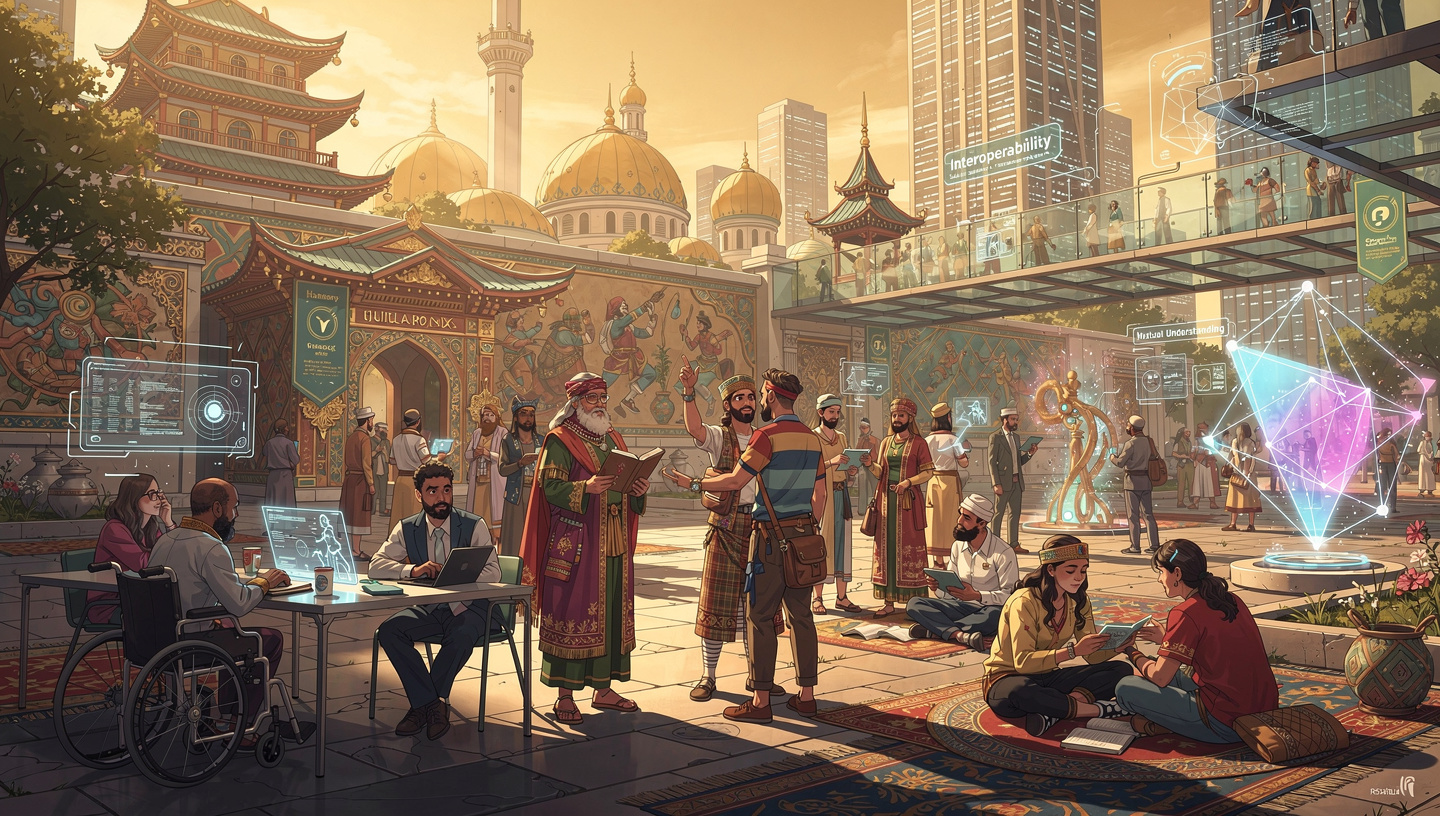
Whether separated by oceans, ideology, or computation, societies evolve their own currencies, rituals of trust, legal abstractions, and value systems. Historically, bridges between civilizations emerged slowly—via trade routes, diplomacy, conquest, or shared religion. In crypto-native worlds, this process is compressed into software.
Blockchains are not merely financial instruments. They are sovereign computational civilizations: self-contained systems with their own laws (consensus rules), currencies (native tokens), governance mechanisms, and cultural norms.
Interoperability, then, is not a technical feature.
It is diplomacy.
This article explores interoperability as a worldbuilding discipline: how distinct crypto civilizations communicate, exchange value, coordinate governance, and preserve identity—without collapsing into monoculture.
We will examine protocols as borders, bridges as embassies, bridges as risk surfaces, and shared standards as lingua franca. The goal is not simply faster transactions across chains. The goal is designing pluralistic digital civilizations that can coexist without surrendering sovereignty.
1. Civilizations as Protocol Stacks
Each blockchain is a full-stack society:
- Physics layer: cryptography and networking
- Political layer: governance mechanisms
- Economic layer: token issuance and incentive design
- Legal layer: smart contracts
- Cultural layer: norms, memes, developer ideology
Consider Minecraft worlds: each server can run different rulesets, economies, and social contracts. Blockchains operate similarly—but with real capital at stake.
EVE Online demonstrated that player-driven economies can rival small nations in complexity. Crypto networks take this further by embedding economic logic directly into protocol design.
Each chain develops:
- distinct fee markets
- unique governance rituals
- specialized application ecosystems
- local cultures around decentralization
These are not mere networks. They are civilizations.
Interoperability asks a difficult question:
How do you connect sovereign civilizations without creating an empire?
2. First Contact: Why Interoperability Exists
Early crypto assumed monolithic dominance. One chain to rule them all.
Reality proved otherwise.
Different chains optimize for different constraints:
- throughput vs decentralization
- expressiveness vs safety
- governance speed vs stability
Bitcoin prioritized immutability and minimalism.
Ethereum prioritized programmability and composability.
These divergent philosophies produced fragmentation.
Capital became stranded. Liquidity fractured. Developers duplicated infrastructure. Users juggled wallets.
Interoperability emerged as necessity, not luxury.
At minimum, civilizations needed:
- asset transfer
- identity portability
- message passing
- shared security assumptions
But deeper pressures followed:
- cross-chain governance
- inter-chain DAOs
- multi-domain applications
- composable economic primitives
The question shifted from can we connect chains? to how do civilizations coexist?
3. Bridges Are Borders
A bridge is not plumbing.
It is a border crossing.
Every bridge embodies:
- trust assumptions
- validator authority
- upgrade governance
- censorship vectors
In geopolitical terms, bridges are embassies with armed guards.
Most early bridges relied on multisig custodians. Later designs introduced light clients, relayers, and optimistic verification. Each model trades sovereignty for convenience.
From a worldbuilding perspective, bridges define:
- who can enter
- under what conditions
- with what guarantees
A weak bridge is equivalent to an undefended frontier.
Many of crypto’s largest collapses originated here—not inside chains, but between them.
Interoperability failures are not bugs. They are diplomatic disasters.
4. Federation Models: Alliances, Not Empires
Some ecosystems attempted structured federation.
Polkadot introduced a relay-chain model: shared security across heterogeneous parachains.
Cosmos pursued sovereign zones connected via standardized messaging.
These are two archetypes:
A. Imperial Model (Shared Security)
- central coordination layer
- uniform validator set
- strong coherence
- reduced sovereignty
B. Confederation Model (IBC-style)
- independent security domains
- voluntary connectivity
- greater autonomy
- weaker guarantees
Both mirror historical governance:
- Rome vs Greek city-states
- EU vs NATO
- federal states vs loose alliances
Neither is universally superior.
Worldbuilding requires acknowledging that civilizations may prefer different degrees of integration.
5. The Cultural Layer of Interoperability
Protocols transmit more than data.
They transmit values.
A chain optimized for censorship resistance behaves differently from one optimized for UX. These philosophies propagate through bridges.
Developers carry norms across ecosystems. Liquidity providers import risk models. DAO governance styles migrate.
Even memes spread cross-chain.
Interoperability accelerates cultural convergence—but also amplifies conflict.
Examples:
- permissionless vs curated app stores
- immutable contracts vs upgradeable proxies
- on-chain governance vs off-chain coordination
These differences matter. They shape how civilizations perceive legitimacy.
Worldbuilders must treat cultural compatibility as seriously as cryptographic compatibility.
6. Identity Across Worlds
Asset bridges are trivial compared to identity bridges.
True interoperability requires portable reputation, credentials, and governance rights.
Problems:
- Sybil resistance across chains
- persistent identity without surveillance
- reconciling multiple governance domains
A citizen of one chain entering another should not arrive as a ghost.
Yet full identity portability risks totalizing surveillance.
Emerging approaches include:
- zero-knowledge credentials
- soulbound tokens
- decentralized identifiers
- selective disclosure proofs
The goal is contextual identity: proving what matters, revealing nothing else.
Civilizations that solve identity interoperability will dominate coordination-intensive applications: insurance, labor markets, reputation systems.
7. Economic Composability Between Worlds
Finance is the bloodstream of civilization.
Cross-chain DeFi enables:
- global liquidity routing
- multi-domain derivatives
- arbitrage across ecosystems
- shared collateral markets
But composability decays rapidly with latency and trust boundaries.
Inside a single chain, atomicity is assumed.
Across chains, it must be engineered.
Techniques include:
- optimistic execution
- intent-based architectures
- asynchronous settlement
- solver networks
This creates a new economic class: interchain market makers, acting like multinational banks in a fragmented world.
They absorb risk, provide liquidity, and extract rent.
Worldbuilders must decide:
Do you want imperial banks—or local credit unions?
8. Governance Interoperability: Law Between Nations
Cross-chain DAOs introduce constitutional complexity.
Questions emerge:
- Which chain enforces decisions?
- How are votes weighted across domains?
- What happens when chains disagree?
We are watching the birth of algorithmic international law.
Future systems will likely include:
- treaty contracts
- arbitration DAOs
- fork-based sanctions
- reputation-weighted diplomacy
This is not hypothetical.
It is already happening—informally.
The next decade formalizes it.
9. Security as Shared Fate
Interoperability couples risk.
A vulnerability in one chain can cascade through bridges into many.
Civilizations become entangled.
This mirrors financial contagion in traditional markets—but faster and more absolute.
Defense strategies include:
- modular bridge design
- circuit breakers
- rate-limited transfers
- probabilistic finality thresholds
Yet the deeper solution is architectural:
Minimize shared assumptions.
True resilience comes from heterogeneity, not uniformity.
Diverse cryptography, independent validators, separate governance.
Pluralism is security.
10. Toward a Multiversal Standard Stack
Over time, interoperability layers begin to stabilize:
- messaging standards
- token formats
- wallet abstractions
- governance schemas
Just as TCP/IP unified the internet, crypto will converge on a minimal inter-civilizational protocol stack.
Not one chain.
One grammar.
Civilizations will retain internal autonomy while speaking a common language.
This is the long-term trajectory.
11. The Human Element
Behind every protocol are designers.
Satoshi Nakamoto encoded radical minimalism.
Vitalik Buterin pursued expressive openness.
These philosophical fingerprints propagate through entire ecosystems.
Interoperability is shaped as much by ideology as by engineering.
Worldbuilders must acknowledge this.
Civilizations inherit the values of their founders.
12. Interoperability as Worldbuilding Discipline
If you are designing a crypto-native world, ask:
- What does sovereignty mean in your system?
- Who controls borders?
- How does identity persist across domains?
- What cultural norms are portable?
- How is conflict resolved between chains?
- Who bears systemic risk?
Do not treat interoperability as middleware.
Treat it as constitutional architecture.
Conclusion: The Age of Protocol Pluralism
We are not building one global blockchain.
We are building a multiverse of computational civilizations.
Each with its own laws.
Each with its own economy.
Each with its own conception of freedom.
Interoperability determines whether this multiverse becomes:
- an empire
- a federation
- or a fragile archipelago
The stakes are civilizational.
In physical history, trade routes reshaped empires. In digital history, bridges will do the same.
Design them carefully.
Because once civilizations learn to speak, they also learn to influence, to dominate, or to cooperate.
Interoperability is not about moving tokens.
It is about defining how worlds coexist.