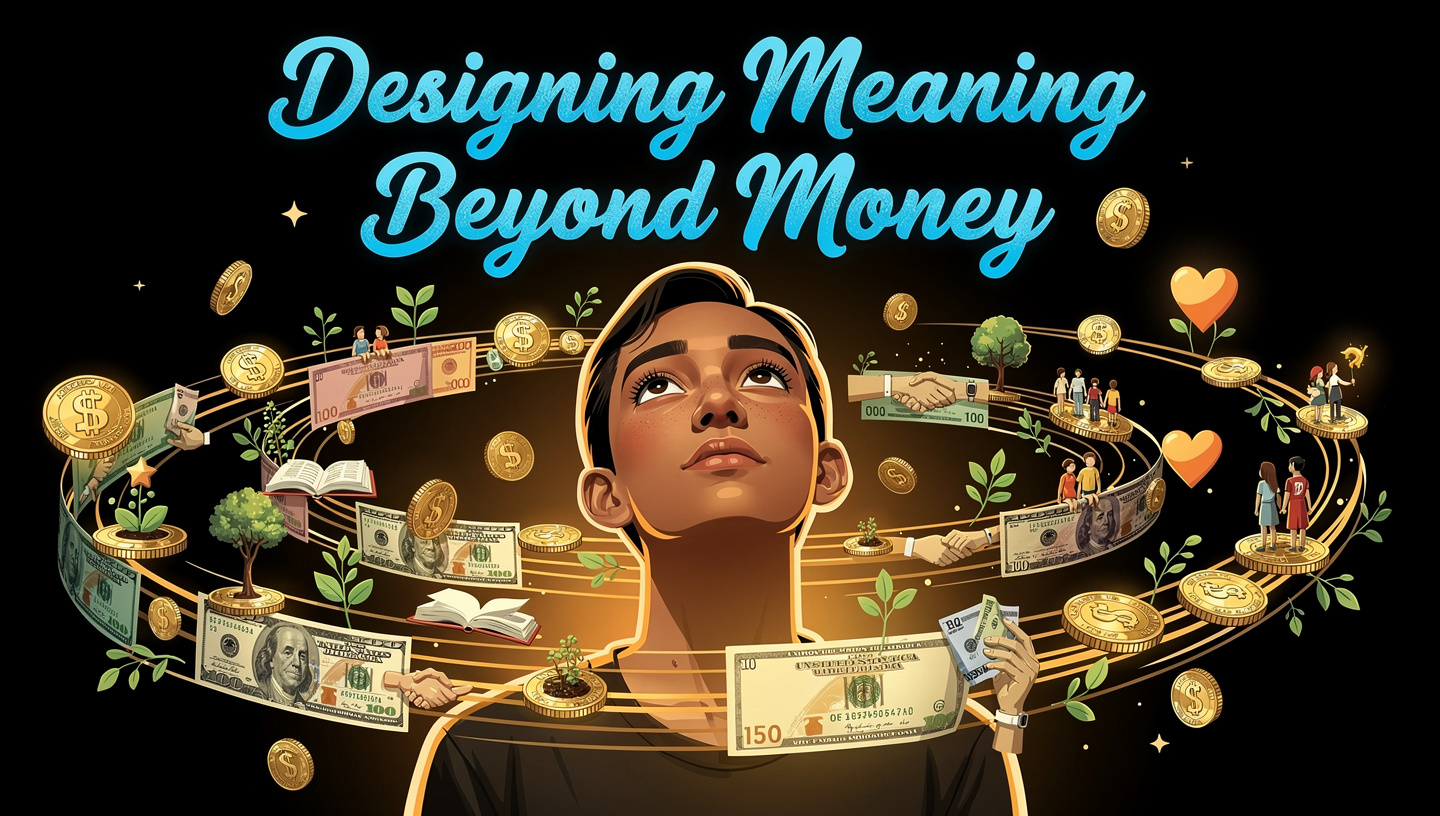
Crypto began as a monetary experiment. It is becoming something else entirely.
What started with a pseudonymous whitepaper by Satoshi Nakamoto has evolved into a global laboratory for governance, identity, creativity, coordination, and belief. Markets still dominate headlines. Price charts still command attention. But beneath that surface, a deeper transformation is underway: crypto is quietly becoming a medium for designing meaning.
This article explores crypto not as finance, but as worldbuilding infrastructure. We examine how decentralized systems create shared values, social rituals, digital identities, collective myths, and new forms of belonging—without relying on states, churches, or traditional institutions. The central thesis is simple:
Crypto is no longer just about money. It is about constructing meaning at scale in a post-sovereign world.
1. From Currency to Culture
Every monetary system embeds assumptions about trust, authority, and human coordination. Fiat currencies encode faith in governments and central banks. Gold encoded scarcity and empire. Crypto encodes something radically different: verifiable consensus without centralized power.
This shift matters far beyond payments.
Blockchains provide:
- Immutable public memory
- Permissionless participation
- Programmable institutions
- Native digital property
- Algorithmic enforcement
Together, these properties form a new substrate for social organization.
Crypto networks increasingly behave like proto-civilizations:
- They have origin stories (genesis blocks, early hacks, legendary founders).
- They develop dialects (“gm,” “wagmi,” “fork,” “rug”).
- They form tribes (Bitcoin maximalists, DAO citizens, NFT communities).
- They ritualize events (hard forks, token launches, governance votes).
Money was simply the gateway drug.
2. Meaning Emerges from Coordination, Not Ideology
Traditional societies generate meaning through religion, nationalism, or shared geography. Crypto societies generate meaning through coordination mechanics.
This is a crucial distinction.
Crypto does not begin with belief systems. It begins with protocols. Values emerge downstream.
Smart contracts define what is possible. Tokenomics shape incentives. Governance frameworks determine voice and legitimacy. Over time, participants internalize these structures and form narratives around them.
In other words: architecture precedes ideology.
Consider decentralized autonomous organizations (DAOs). They do not ask members to subscribe to a manifesto. They invite them to interact with code. Meaning arises from repeated participation:
- proposing changes
- voting on outcomes
- funding projects
- resolving disputes
Shared purpose is not declared. It is practiced.
This aligns with the institutional economics work of Elinor Ostrom, who demonstrated that communities can self-govern shared resources without centralized authorities—provided the rules are transparent and collectively enforced. Crypto operationalizes this insight at global scale.
3. Protocols as Moral Engines
Every protocol embeds ethics.
Block time defines patience. Fee markets encode fairness. Slashing mechanisms formalize accountability. On-chain transparency reframes corruption.
These are not neutral design choices. They are moral positions expressed in software.
For example:
- Proof-of-stake prioritizes economic alignment over raw computation.
- Quadratic voting attempts to balance minority and majority power.
- Public ledgers privilege radical transparency over privacy by default.
As users adapt to these systems, they internalize their logic. Over time, this shapes norms:
- Self-custody becomes personal responsibility.
- Open-source becomes civic virtue.
- Composability becomes creative expectation.
Crypto teaches people how to behave by constraining how they can behave.
This is governance through interface.
4. Identity Without Passports
In crypto-native worlds, identity is not granted by states. It is constructed through keys, wallets, and reputation graphs.
A wallet address becomes:
- your financial history
- your governance footprint
- your creative portfolio
- your social signal
Participation replaces paperwork.
This produces a radically different conception of personhood. Instead of nationality or legal name, identity becomes a bundle of verifiable actions:
- contracts signed
- tokens staked
- proposals authored
- communities joined
Reputation becomes composable. Credentials become portable. Belonging becomes voluntary.
This shift enables fluid, overlapping affiliations: you can simultaneously be a DAO contributor, NFT curator, liquidity provider, and open-source maintainer—without asking permission from any central registry.
Crypto is quietly dismantling the monopoly states once held over identity.
5. NFTs and the Re-Sacralization of Digital Space
Non-fungible tokens are often dismissed as speculative JPEGs. That misses their deeper function.
NFTs are instruments of symbolic ownership.
They allow communities to:
- canonize moments
- memorialize contributors
- encode provenance
- attach narrative to digital artifacts
This is not trivial. Human societies have always used symbolic objects to anchor meaning—flags, relics, artworks, monuments. NFTs bring this capability into cyberspace with cryptographic guarantees.
Creators are no longer platform-dependent. Patrons become stakeholders. Collections evolve into micro-cultures with their own aesthetics, lore, and hierarchies.
Digital space, once purely functional, is becoming ceremonial.
6. Forks, Schisms, and Constitutional Moments
Crypto networks do not resolve disagreements through courts or parliaments. They fork.
A fork is not merely a technical event. It is a constitutional rupture. A collective decision about values, encoded into diverging ledgers.
When communities split, they also divide their myths:
- Which chain is “legitimate”?
- Which history matters?
- Which future feels authentic?
These moments resemble religious schisms or political revolutions—except they unfold through GitHub commits and validator upgrades.
Forks demonstrate a powerful idea: exit is always possible.
In crypto, dissent does not require overthrow. It requires replication.
This radically alters power dynamics. Authority becomes conditional. Legitimacy becomes optional.
7. DAOs as Experimental Polities
Decentralized autonomous organizations are not companies. They are not governments. They are something new: programmable polities.
DAOs experiment with:
- liquid democracy
- on-chain treasuries
- algorithmic budgeting
- open membership
- transparent deliberation
Some fail quickly. Others evolve slowly. All generate data about what works.
Unlike traditional institutions, DAOs are forkable, auditable, and globally accessible. Anyone can inspect their rules. Anyone can clone their structure. Anyone can propose improvements.
This creates an evolutionary environment for governance itself.
The result is a Cambrian explosion of political design.
8. The Role of Builders as Cultural Architects
Developers in crypto are not just engineers. They are world designers.
Every API decision, governance parameter, and token distribution shapes emergent culture. Builders implicitly decide:
- who has power
- who gets rewarded
- who feels welcome
- who gets excluded
The architects of major ecosystems—such as Vitalik Buterin and organizations like the Ethereum Foundation—are effectively drafting constitutions for digital societies.
This carries ethical weight.
Infrastructure is destiny.
9. Narrative as a Scaling Primitive
Crypto projects do not scale solely through technology. They scale through stories.
Whitepapers become origin myths. Roadmaps become prophecies. Tokenomics become social contracts. Memes become ideological shorthand.
Narrative coherence attracts contributors. Shared metaphors accelerate adoption. Collective imagination sustains participation during drawdowns.
Markets fluctuate. Stories persist.
Successful crypto networks cultivate narrative gravity: a sense that participants are part of something larger than themselves.
Meaning is the retention engine.
10. Toward a Post-Monetary Crypto
As infrastructure matures, the financial layer will become invisible—like TCP/IP or electricity. What remains is the social layer.
Future crypto-native worlds will prioritize:
- collective intelligence
- peer-to-peer welfare
- decentralized science
- open education
- algorithmic public goods
Value will be measured not only in tokens, but in:
- contributions
- impact
- trust
- reputation
- resilience
Economic incentives will coexist with cultural commitments.
Crypto will stop asking, “How much is this worth?”
It will start asking, “What kind of world does this create?”
Conclusion: Meaning Is the Real Scarcity
Money is abundant. Attention is scarce. Meaning is scarcer still.
Crypto’s deepest contribution is not financial sovereignty. It is existential experimentation.
For the first time in history, large populations can:
- opt into custom governance
- hold assets without intermediaries
- build institutions without permission
- encode values directly into infrastructure
This is not merely a technological shift. It is a civilizational one.
Designing meaning beyond money requires intentional protocol design, ethical engineering, and narrative stewardship. It demands that builders think like philosophers and users behave like citizens.
Crypto is no longer just a tool.
It is a canvas for collective purpose.
And the world it is quietly assembling will not be defined by markets alone—but by the values we choose to encode, the communities we sustain, and the futures we dare to coordinate into existence.