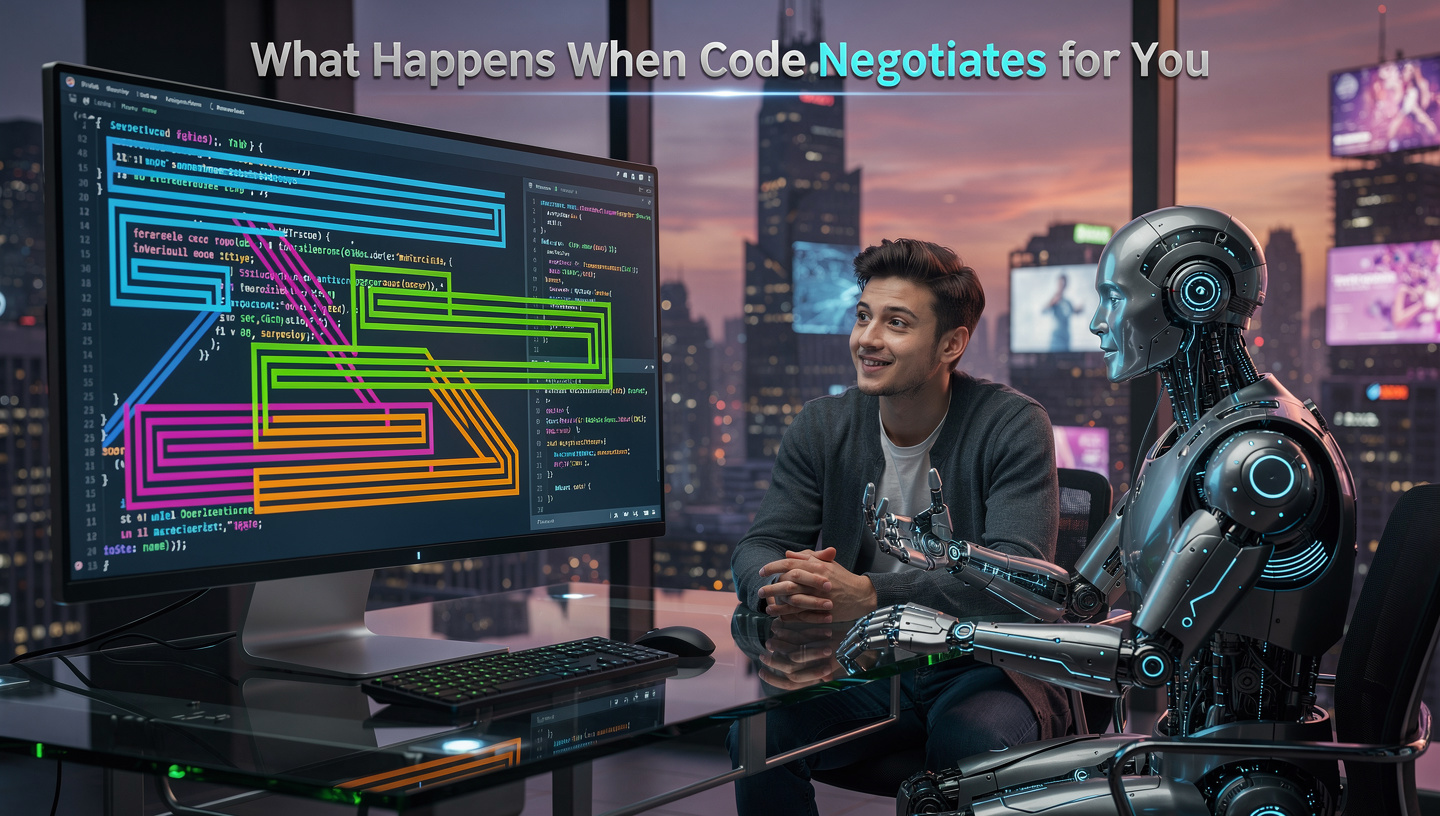
For most of recorded history, negotiation has been inseparable from human presence. Trade required voices. Contracts required signatures. Diplomacy required emissaries. Even in the digital age, software largely played a passive role: databases stored terms, platforms facilitated exchange, and automation handled execution after people reached agreement.
Crypto changes this order.
In cryptographic economies, code itself becomes a negotiating actor. Smart contracts propose terms. Autonomous agents rebalance portfolios. Protocols compete for liquidity by dynamically adjusting incentives. Entire markets form, clear, and dissolve without a single human conversation.
This is not simply “automation.” It is a transition from human-mediated economics to machine-mediated civilization.
This article explores that transition as a worldbuilding problem: what kind of society emerges when code negotiates for you? How do values, power structures, labor, governance, and trust evolve when software becomes an economic participant? And what does it mean for identity, agency, and sovereignty when negotiation is no longer interpersonal—but computational?
We will treat crypto not merely as financial infrastructure, but as the substrate of a new civilizational layer.
1. Negotiation as a Primitive of Civilization
Negotiation is foundational. It underlies:
- Markets (price discovery)
- Law (contracts and enforcement)
- Politics (coalition formation)
- Social coordination (resource allocation)
Historically, negotiation has required:
- Subjective intent
- Communication bandwidth
- Enforcement mechanisms
- Trust or coercion
Crypto collapses these into programmable systems.
Smart contracts encode intent. Peer-to-peer networks provide communication. Blockchains enforce execution. Cryptography replaces trust.
When these components converge, negotiation becomes a computational primitive.
Instead of two people bargaining over terms, two programs exchange state transitions.
Instead of legal ambiguity, deterministic execution.
Instead of reputational trust, mathematical finality.
This is a qualitative shift.
2. Smart Contracts as Negotiating Entities
A smart contract is often described as “code that runs on a blockchain.” That description understates its civilizational role.
In crypto worlds, a smart contract is:
- A rule-based negotiator
- A custodian of assets
- A market participant
- A policy engine
Consider a lending protocol. It does not merely execute loans. It continuously negotiates interest rates with the market via algorithmic feedback loops. Liquidity providers respond. Borrowers adjust behavior. The contract mediates between competing economic pressures.
No human sits at the table.
The table is the code.
These contracts operate using languages such as Solidity, but their significance is not linguistic—it is institutional. They are automated institutions, instantiated directly in cryptographic space.
Once deployed, they cannot be persuaded, bribed, or emotionally influenced. They respond only to inputs.
This produces a new class of actors: non-sentient economic agents with binding authority.
3. Protocols as Sovereign Market Actors
At scale, smart contracts aggregate into protocols. Protocols behave less like software products and more like autonomous economic organisms.
They:
- Set policy (fee structures, reward curves)
- Compete for capital
- Coordinate contributor labor
- Accumulate treasuries
- Evolve through governance mechanisms
Some even employ formal voting systems and delegate structures, forming proto-states.
A decentralized exchange, for example, continuously negotiates with traders by adjusting spreads and liquidity incentives. Yield platforms negotiate with depositors through emissions schedules. Stablecoin systems negotiate with markets via arbitrage mechanics.
These are not metaphors. They are literal economic negotiations encoded in logic.
One can observe this dynamic clearly in automated market makers such as Uniswap, where pricing is determined entirely by mathematical curves and pool balances. Every trade is a negotiation between human intent and algorithmic constraints.
Over time, these protocols develop recognizable “personalities”: conservative, aggressive, experimental, risk-averse.
They become actors in their own right.
4. Delegated Agency: When Your Wallet Becomes Your Diplomat
The next phase is agent abstraction.
Instead of manually interacting with protocols, users increasingly delegate strategy to software agents:
- Rebalancing portfolios
- Routing trades across venues
- Managing collateral
- Optimizing yields
Your wallet ceases to be a passive container and becomes an active representative.
In effect, you appoint code as your economic diplomat.
This delegation transforms the meaning of participation. Humans specify high-level goals (“maximize yield under X risk”), while agents handle continuous negotiation at machine speed.
The implications are profound:
- Markets accelerate beyond human reaction times
- Strategy becomes parameterization
- Economic literacy shifts from intuition to configuration
In such systems, advantage accrues to those who can better formalize their preferences.
Not those who argue persuasively.
5. From Legal Contracts to Cryptographic Commitments
Traditional contracts rely on interpretation. Courts resolve disputes. Enforcement is external.
Smart contracts eliminate ambiguity by design.
They are self-executing commitments backed by cryptography. If conditions are met, outcomes occur. There is no appeal.
This creates a world where:
- Intent must be formalized in advance
- Edge cases become existential risks
- Bugs are equivalent to legal loopholes
The famous mantra “code is law” is not philosophical—it is operational reality.
The organization behind one of the largest smart-contract ecosystems, Ethereum Foundation, helped catalyze this paradigm. Its co-founder Vitalik Buterin has repeatedly emphasized that cryptographic systems replace trust with verifiability.
In worldbuilding terms, this produces a civilization where law is compiled.
6. Machine-Readable Incentives and Algorithmic Game Theory
Once negotiation becomes code, incentives become data structures.
Every protocol embeds game theory:
- Reward curves
- Slashing penalties
- Vesting schedules
- Liquidity mining programs
Participants respond to these structures algorithmically. Bots arbitrage price discrepancies. Liquidators monitor health factors. Validators optimize uptime.
Human intuition gives way to automated strategy.
This environment favors:
- Speed over deliberation
- Formal modeling over social signaling
- Optimization over compromise
Conflicts are resolved not through discussion but through state transitions.
In effect, crypto worlds operate as continuous, global, real-time game engines.
7. DAOs and the Emergence of Collective Machine Governance
Decentralized Autonomous Organizations (DAOs) introduce another layer: collective negotiation mediated by code.
In DAOs:
- Proposals are on-chain artifacts
- Votes are cryptographic signatures
- Treasuries are smart contracts
- Execution is automated
This collapses governance into software.
But more interestingly, DAOs increasingly integrate automated proposal generation, treasury optimization, and contributor compensation. Hybrid systems emerge where humans define direction and machines manage operations.
These are not corporations.
They are algorithmically assisted polities.
Over time, DAOs develop constitutions encoded in smart contracts. Amendments occur through protocol upgrades. Citizenship is tokenized.
We are witnessing the birth of programmable nations.
8. Labor in a World of Autonomous Negotiators
When code negotiates, labor markets transform.
Tasks become bounties. Contributions become on-chain attestations. Compensation becomes streaming payments.
More importantly, machines themselves participate in labor markets:
- Trading bots generate yield
- AI agents curate content
- Oracles provide data feeds
- Keepers maintain protocol health
These agents earn revenue. They pay gas fees. They reinvest profits.
They are economic actors without biology.
Humans increasingly design, deploy, and supervise fleets of such agents, creating a new class of meta-labor: managing automated workers.
The traditional employer–employee relationship dissolves into protocol–participant dynamics.
9. Trust Replaced by Transparency
In crypto worlds, trust is not assumed. It is computed.
Every transaction is auditable. Every contract is inspectable. Every balance is public.
Negotiation no longer relies on reputation alone. It relies on open state.
This transparency reshapes social norms:
- Privacy becomes a premium feature
- Accountability becomes default
- Surveillance becomes ambient
Participants learn to reason about systems instead of personalities.
This favors analytical competence over charisma.
10. Power Structures in Machine-Negotiated Societies
Power does not disappear. It reconfigures.
It accrues to:
- Those who control protocol upgrades
- Those who own governance tokens
- Those who deploy capital at scale
- Those who understand system dynamics
Whales influence votes. Developers shape code paths. Early adopters capture outsized rewards.
But unlike traditional systems, these power flows are visible in real time.
Every governance action leaves an on-chain trace.
Authority becomes measurable.
11. Identity in Cryptographic Space
When code negotiates, identity fragments.
A single person may operate dozens of wallets. A single AI agent may manage thousands.
Reputation becomes address-based. Credentials become NFTs. History becomes transaction graphs.
Citizenship is replaced by key ownership.
In such worlds, identity is modular, portable, and revocable.
This has implications far beyond finance—it reshapes how communities form and dissolve.
12. Macroeconomics Without Central Banks
Crypto economies operate without central monetary authorities.
Supply rules are embedded in protocols. Monetary policy becomes immutable code.
Markets negotiate inflation expectations directly through token prices.
This produces radical experiments in economic design: algorithmic currencies, elastic supply systems, reflexive incentives.
Entire macroeconomic regimes are deployed as software.
13. Failure Modes: When Negotiation Breaks
Machine-mediated systems fail differently than human ones.
They fail catastrophically and instantly.
A single exploit can drain billions. A flawed incentive curve can collapse liquidity. A governance attack can rewrite protocol rules.
There is no gradual erosion—only state changes.
Worldbuilders must account for these discontinuities. Resilience requires redundancy, formal verification, and adversarial modeling.
14. Toward Fully Autonomous Economic Civilizations
The trajectory is clear:
- Smart contracts handle execution
- Agents handle strategy
- Protocols handle governance
- AI handles optimization
At that point, humans become high-level designers rather than daily participants.
Economic life proceeds continuously, negotiated by machines, bounded by cryptography.
This is not science fiction. It is an extrapolation of existing primitives.
The question is not whether code will negotiate for you.
It already does.
The question is what kind of civilization you build on top of that fact.
Conclusion: The End of Bargaining, the Beginning of Design
When code negotiates for you, society shifts from persuasion to parameterization.
Values become variables. Policies become functions. Power becomes liquidity.
Humanity moves from arguing over outcomes to engineering systems that produce them.
Crypto is not merely a financial innovation. It is a new substrate for collective organization—a world where institutions are executable, agreements are atomic, and agents are synthetic.
In such a world, the primary civic skill is no longer rhetoric.
It is system design.