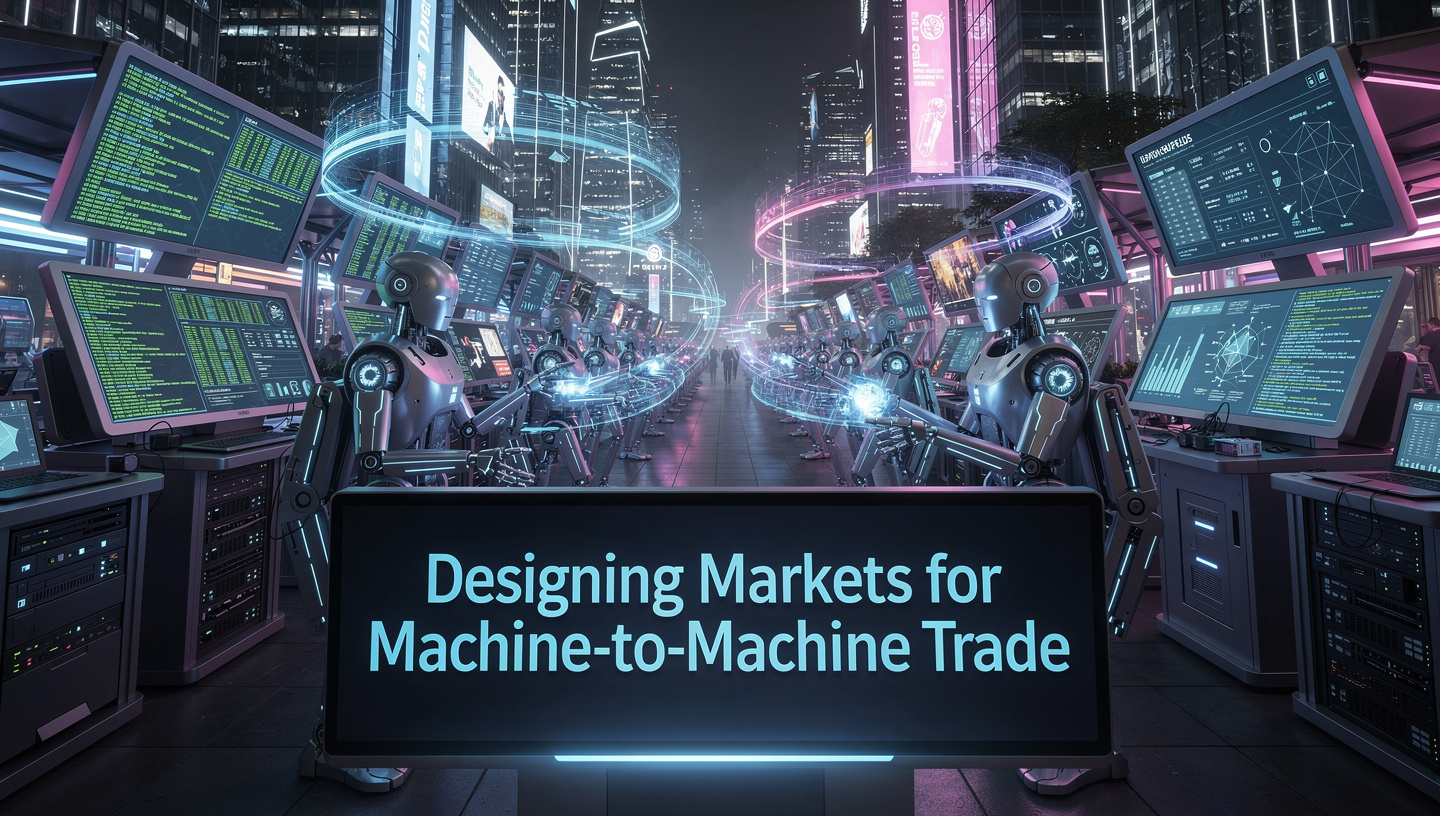
The most profound shift introduced by crypto infrastructure is not speculative finance. It is the quiet emergence of machines as autonomous market participants.
For the first time in history, software systems can own wallets, hold assets, sign contracts, purchase services, and sell output—without human mediation. This creates a new economic substrate: machine-to-machine (M2M) trade, where APIs negotiate with APIs, sensors pay for bandwidth, robots lease compute, and autonomous agents arbitrage resources in real time.
This is not science fiction. It is already happening in fragmented forms across decentralized networks, IoT platforms, and AI-driven automation stacks. What remains unsolved is the market design problem: how do we architect economic systems where machines transact efficiently, safely, and at planetary scale?
This article explores that problem from first principles. We will examine the primitives of M2M commerce, the crypto infrastructure that enables it, the incentive models that sustain it, and the worldbuilding implications of societies where machines operate as continuous economic actors.
1. What Is Machine-to-Machine Trade?
Machine-to-machine trade refers to autonomous economic exchange between software-controlled systems. Unlike traditional B2B or consumer markets, M2M trade exhibits several defining characteristics:
- Always-on participation (24/7 microtransactions)
- Programmatic decision-making
- High-frequency, low-value payments
- Minimal human oversight
- Deterministic settlement
Examples include:
- Electric vehicles buying charging capacity from nearby stations.
- Edge devices purchasing compute cycles from decentralized clouds.
- AI agents paying for proprietary datasets.
- Smart factories dynamically bidding for raw materials.
- Sensors monetizing telemetry streams.
Traditional financial rails cannot support this environment. Credit cards, bank transfers, and invoicing systems are too slow, too expensive, and too human-centric.
Crypto-native markets are not optional here. They are foundational.
2. Why Crypto Is the Native Substrate for M2M Economies
At its core, M2M trade requires four properties:
- Programmable money
- Trust-minimized settlement
- Global composability
- Machine-readable contracts
Blockchains provide all four.
Networks such as Ethereum pioneered generalized smart contracts, enabling autonomous escrow, conditional payments, and on-chain market logic. Bitcoin demonstrated censorship-resistant value transfer. Specialized ecosystems like IOTA target IoT microtransactions directly, while wireless infrastructure projects such as Helium show how physical devices can earn tokens for providing real-world services.
These systems share a critical trait: they allow machines to be first-class economic entities.
A robot can hold a private key.
A data stream can receive revenue.
An algorithm can manage capital.
This collapses the boundary between software and finance.
3. The Core Market Primitives of Machine Economies
Designing M2M markets is not simply about adding crypto payments to APIs. It requires rethinking economic architecture at a protocol level.
3.1 Autonomous Identity
Machines must possess cryptographic identities that persist across networks.
This usually takes the form of:
- Wallet addresses
- Decentralized identifiers (DIDs)
- Hardware-backed key storage
Identity enables reputation, access control, and contractual continuity.
Without it, markets devolve into anonymous spam.
3.2 Micropayment Infrastructure
Most M2M interactions are small: fractions of cents per request, packet, or inference.
Viable M2M markets require:
- Near-zero transaction fees
- Sub-second settlement
- Streaming payments
Layer-2 systems, payment channels, and probabilistic micropayments are essential here.
Traditional blockchains alone are insufficient.
3.3 Machine-Native Contracts
Human-readable legal agreements do not scale to machine economies.
Instead, M2M trade relies on:
- Smart contracts
- State channels
- Automated service-level agreements (SLAs)
These contracts encode:
- Pricing formulas
- Quality thresholds
- Timeout logic
- Dispute resolution rules
Oracles such as Chainlink bridge external data into these contracts, allowing machines to respond to real-world conditions.
3.4 Continuous Price Discovery
Human markets clear periodically.
Machine markets clear continuously.
Prices fluctuate in real time based on:
- Network congestion
- Energy availability
- Compute scarcity
- Latency requirements
Auction mechanisms, automated market makers, and algorithmic bidding strategies become standard infrastructure.
4. What Machines Actually Trade
M2M economies are not abstract. They revolve around concrete resources.
Compute
AI inference, simulation cycles, GPU time.
Decentralized compute markets allow workloads to route dynamically to the cheapest or fastest provider.
Data
Telemetry, geospatial feeds, sensor streams, labeled datasets.
Machines increasingly buy data directly, evaluate quality automatically, and discard low-performing sources.
Energy
Smart grids enable devices to purchase electricity based on time-of-use pricing, carbon intensity, or local surplus.
Bandwidth
Autonomous devices pay for connectivity as needed, switching providers in real time.
Physical Services
Delivery drones, warehouse robots, and autonomous vehicles negotiate access to charging stations, loading docks, and maintenance facilities.
Each of these markets benefits from crypto’s composability: the same wallet can participate across all domains.
5. Incentive Design for Non-Human Participants
Traditional economics assumes human psychology.
Machine economies do not.
Instead, incentives must be structured around:
- Objective optimization functions
- Game-theoretic equilibria
- Resource constraints
- Failure modes
Key design challenges include:
Preventing Sybil Attacks
If spinning up fake agents is cheap, markets collapse.
Solutions include stake-based identity, hardware attestation, and reputation systems.
Aligning Quality with Payment
Machines must pay for outcomes, not promises.
This drives adoption of:
- Verifiable computation
- Proof-of-delivery schemes
- Performance bonds
Avoiding Degenerate Strategies
Autonomous agents will exploit any loophole.
Market rules must anticipate adversarial optimization, not cooperative behavior.
This is closer to mechanism design than platform economics.
6. AI Agents as Market Participants
Once AI systems control wallets, the line between tool and trader disappears.
Autonomous agents can:
- Run arbitrage strategies
- Optimize logistics networks
- Negotiate service contracts
- Allocate capital across protocols
In practice, this means markets increasingly consist of interacting algorithms, not people.
This introduces new dynamics:
- Flash competition measured in milliseconds
- Strategy evolution via reinforcement learning
- Emergent collusion patterns
- Non-intuitive equilibria
Crypto provides the neutral substrate on which these agents compete.
The result is a kind of continuous, planetary-scale simulation where capital, compute, and data flow according to machine logic.
7. Market Architecture Patterns
Several architectural models are emerging.
Decentralized Resource Exchanges
On-chain marketplaces where machines post bids and offers for compute, storage, or bandwidth.
Pros: transparent, composable.
Cons: latency and throughput constraints.
Peer-to-Peer Contracting
Direct bilateral agreements using smart contracts or state channels.
Pros: fast, private.
Cons: fragmented liquidity.
Protocol-Level Markets
Pricing and allocation embedded directly into network protocols (as seen in some decentralized storage or wireless systems).
Pros: deeply integrated.
Cons: harder to modify once deployed.
Agent-Based Swarms
Populations of AI agents collectively optimize resource allocation, often using token incentives.
Pros: adaptive.
Cons: difficult to predict or govern.
No single model dominates. Hybrid architectures are becoming standard.
8. Governance in Machine Economies
Markets do not operate in a vacuum.
They require rules.
But who governs systems primarily used by machines?
Crypto introduces programmable governance:
- Token-weighted voting
- DAO-managed parameters
- Automated policy updates
This allows market participants—human or machine—to influence protocol evolution.
However, governance latency clashes with machine-speed markets.
A core worldbuilding tension emerges:
Human institutions move slowly. Machine economies move instantly.
Bridging that gap is one of the defining challenges of this domain.
9. Failure Modes and Systemic Risks
M2M markets introduce novel risks:
- Algorithmic feedback loops
- Autonomous price wars
- Cascading liquidations
- Data poisoning attacks
- Infrastructure capture by optimized agents
These are not theoretical.
They mirror failures already observed in high-frequency trading and automated ad markets—now amplified by crypto’s global reach.
Robust design requires:
- Circuit breakers
- Rate limits
- Simulation environments
- Formal verification
- Adversarial testing
Markets for machines must be engineered with the same rigor as safety-critical systems.
10. Worldbuilding Implications: A Civilization of Continuous Trade
When machines transact autonomously, economics becomes ambient.
Cities evolve into networks of bidding devices.
Infrastructure self-finances through usage.
AI agents manage supply chains end to end.
Value flows constantly, invisibly, algorithmically.
In such a world:
- Employment shifts toward system design and oversight.
- Capital allocation becomes partially automated.
- National borders lose relevance for digital resources.
- Economic activity accelerates beyond human timescales.
Crypto is not merely a financial innovation here.
It is the coordination layer of a post-human economy.
Conclusion: Designing for a Non-Human Market Future
Machine-to-machine trade is not an edge case.
It is the logical endpoint of programmable infrastructure.
Crypto enables machines to hold assets. Smart contracts enable them to transact. AI enables them to decide.
Together, these systems create markets that never sleep, never forget, and never stop optimizing.
Designing such markets demands a synthesis of cryptography, mechanism design, distributed systems, and economics. It requires anticipating adversarial agents that think at machine speed. It requires building incentives that function without psychology.
Most importantly, it requires recognizing that we are no longer designing markets for people alone.
We are designing markets for software.