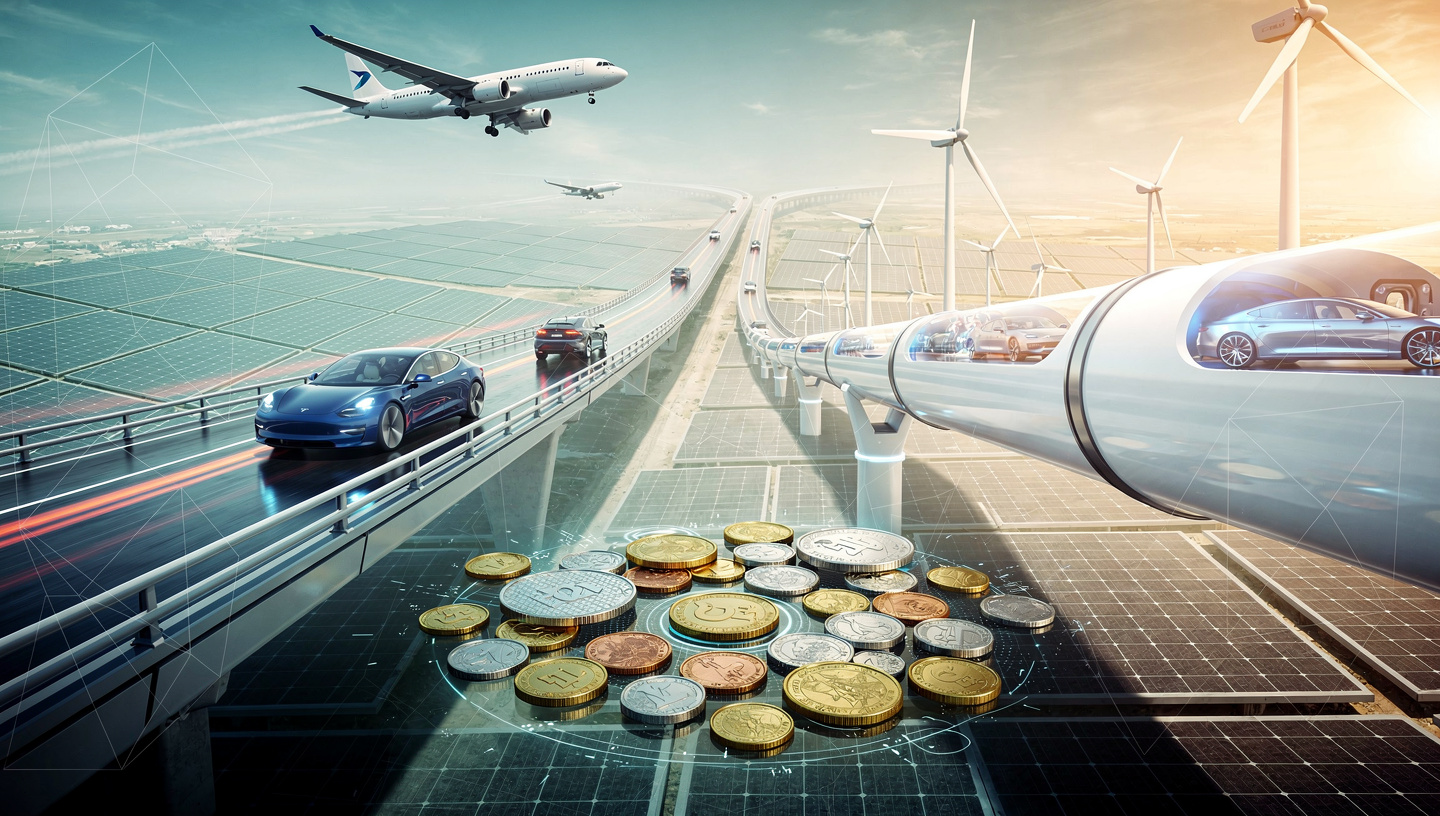
Blockchains are often framed as financial networks. That framing is incomplete.
In any mature crypto society—whether speculative, experimental, or fully realized—tokens do not merely represent value. They coordinate motion, allocate energy, and synchronize physical systems. Transportation and power are not peripheral concerns; they are the substrate. Without credible models for mobility and energy, tokenized worlds collapse into abstractions.
This article treats transportation, energy, and tokens as a single integrated system: a cyber-physical stack where cryptography governs logistics, markets regulate electrons, and urban form evolves around programmable incentives. This is not fiction. It is worldbuilding grounded in existing technology trajectories, cryptoeconomic theory, and infrastructure economics.
The objective is precise: outline how a token-native civilization would move people, route power, and price reality.
1. Tokens as Infrastructure Primitives
Traditional cities rely on centralized authorities to coordinate transport and utilities. Crypto societies replace administrative hierarchy with mechanism design.
A token, in this context, is not merely money. It is:
- A unit of access (who can use a road, charger, or rail slot)
- A signal of scarcity (energy at peak hours, curb space, bandwidth)
- A coordination layer (aligning millions of micro-decisions)
- A governance primitive (voting on routes, capacity, expansion)
Where legacy systems use permits and bureaucratic allocation, crypto systems use market-clearing protocols.
This creates a new design rule:
If a resource is scarce, it must be tokenized. If it is tokenized, it becomes programmable.
Transportation lanes become time-sliced NFTs. Charging stations expose real-time price curves. Freight corridors auction throughput. Energy grids publish marginal costs per kilowatt-second.
Everything is liquid.
2. Transportation in a Tokenized World
2.1 From Roads to Markets
In a crypto-native city, roads are not free public goods. They are continuously priced networks.
Each vehicle—human-driven, autonomous, or drone—maintains a wallet. Every intersection publishes congestion prices. Every kilometer has a dynamic throughput market.
Instead of traffic lights, there are clearing engines.
Vehicles bid for right-of-way. High-priority cargo pays more. Emergency services carry protocol-level overrides. Low-value trips are routed to off-peak corridors.
This replaces static urban planning with real-time spatial economics.
Congestion ceases to be a political problem. It becomes a pricing function.
2.2 Mobility Tokens
Personal movement is governed by mobility credits:
- Commuter tokens for daily transit
- Freight tokens for logistics
- Micro-mobility tokens for scooters and pedestrian augmentation
- Airspace tokens for drones and VTOL craft
These tokens are not speculative assets. They are consumable utilities, burned per kilometer or per minute.
Ownership of mobility infrastructure—rails, tunnels, landing pads—is fractionalized. Citizens stake tokens to fund expansions and receive yield from usage fees.
Transit authorities disappear. Protocols replace them.
2.3 Autonomous Fleets as Economic Actors
Autonomous vehicles do not merely transport humans. They operate as independent balance sheets.
Each fleet vehicle:
- Optimizes routes based on fee markets
- Arbitrages energy prices
- Sells idle compute
- Provides mobile storage
- Votes in infrastructure DAOs
Fleet operators resemble hedge funds more than taxi companies.
Early glimpses of this model already exist in centralized form through companies like Tesla, whose vehicles integrate navigation, energy management, and software-defined behavior. Crypto removes the corporate layer and replaces it with on-chain coordination.
Vehicles become sovereign.
3. Energy: The Economic Bedrock
Transportation collapses without energy. In crypto societies, energy is not a utility—it is the primary commodity.
3.1 Tokenized Electrons
Every kilowatt-hour is represented as a tokenized claim on generation capacity. These energy tokens carry metadata:
- Source (solar, wind, nuclear, geothermal)
- Carbon intensity
- Location
- Time of availability
Consumers do not buy electricity from monopolies. They assemble portfolios of energy assets.
Peak demand prices spike. Storage releases supply. Distributed generators sell directly to neighbors.
The grid becomes a continuous auction.
3.2 Microgrids and Local Sovereignty
Large centralized grids are brittle. Crypto cities fragment them into interoperable microgrids.
Each neighborhood maintains:
- Local generation
- Battery buffers
- Tokenized reserves
- Emergency islanding capability
During disruptions, districts detach and operate autonomously.
Energy sovereignty replaces national grids.
This model aligns with research emerging from institutions such as Massachusetts Institute of Technology, which has explored decentralized energy markets and peer-to-peer power exchange for over a decade.
Crypto provides the missing coordination layer.
3.3 Storage Is Strategy
Batteries are no longer passive assets. They are market participants.
A household battery arbitrages price volatility. A vehicle fleet offers grid services. Data centers monetize thermal output.
Storage capacity is staked into energy protocols and earns yield by stabilizing supply.
In this world, resilience is not mandated. It is profitable.
4. The Transport–Energy Feedback Loop
Transportation consumes energy. Energy production requires transportation (materials, maintenance, labor).
Tokens bind these loops.
Consider a simple flow:
- Solar farm mints energy tokens.
- Autonomous trucks purchase tokens to recharge.
- Trucks deliver replacement panels to the solar farm.
- The farm stakes transport tokens to secure priority logistics.
- Yield flows back to infrastructure owners.
This is a closed economic circuit.
Nothing is abstract. Every token corresponds to physical throughput.
The city becomes a living organism, metabolizing electrons and motion.
5. Urban Form in Crypto Civilizations
Cities reorganize around latency and energy density.
5.1 Proximity Economies
High-frequency interaction zones cluster tightly:
- Compute hubs
- Financial clearing nodes
- Medical facilities
- Advanced manufacturing
Low-frequency zones sprawl:
- Agriculture
- Raw energy generation
- Long-term storage
Zoning is not legislated. It emerges from transaction costs.
Vertical density increases where mobility tokens are expensive. Horizontal sprawl dominates where energy is abundant.
5.2 Transit-Oriented Yield
Real estate is no longer valued solely by location. It is valued by protocol adjacency:
- Distance to charging liquidity
- Access to freight corridors
- Voting weight in transport DAOs
- Share of congestion fee revenue
Buildings become infrastructure nodes.
Landlords resemble network operators.
6. Governance Without Ministries
There is no Department of Transportation. No Energy Regulatory Commission.
Instead:
- Road parameters are adjusted by token-weighted votes.
- Grid expansions are funded via bonding curves.
- Safety rules are enforced by cryptographic attestations.
- Maintenance crews are paid per verified repair.
Governance is continuous, not electoral.
This approach traces philosophically to early crypto thinkers such as Satoshi Nakamoto, who demonstrated that large-scale coordination could occur without centralized trust.
Modern protocol foundations—like Ethereum Foundation—extend this logic into programmable governance and decentralized infrastructure.
The result is a city that updates itself.
7. Incentive Design: Preventing Collapse
Tokenized systems fail if incentives misalign.
Common failure modes:
- Speculation overwhelming utility
- Wealth concentration controlling chokepoints
- Underinvestment in maintenance
- Externalities leaking off-chain
Crypto urbanism addresses this through:
7.1 Burn Mechanisms
Mobility and energy tokens are partially burned on use, forcing continuous reinvestment.
7.2 Anti-Hoarding Curves
Idle infrastructure decays in value unless actively staked.
7.3 Proof-of-Service
Validators earn rewards only by demonstrating real-world performance: uptime, throughput, safety metrics.
7.4 Quadratic Access
Basic mobility and energy allowances are distributed universally, preventing exclusion while preserving market pricing above subsistence levels.
This is not utopian. It is applied game theory.
8. Case Study Archetype: The Crypto Port City
Imagine a coastal crypto metropolis modeled loosely on logistics hubs like Singapore, but governed entirely by protocols.
Characteristics:
- Autonomous container terminals
- Tokenized berths auctioned by minute
- AI traffic routing through underground freight tunnels
- Offshore wind farms minting energy credits
- Residential districts staking surplus power
- Citizens receiving baseline mobility dividends
Imports clear via smart contracts. Customs becomes a compliance oracle. Port fees dynamically fund seawall upgrades.
No ministry coordinates this. The system equilibrates itself.
9. Security and Physical Integrity
When tokens control bridges and substations, attack surfaces multiply.
Crypto cities require:
- Hardware attestation on every actuator
- Redundant mesh routing
- Offline fallback modes
- Slashing penalties for malicious infrastructure operators
Physical sabotage is treated as protocol violation. Insurance markets price risk. Repair DAOs dispatch crews.
Security is economic, not militarized.
10. Human Experience Inside the Machine
From a citizen’s perspective:
- Commutes are smoother because congestion has a price.
- Power outages are rare because storage earns yield.
- Housing adapts to energy markets.
- Mobility feels fluid, not bureaucratic.
Citizens do not file permits. They interact with dashboards.
Daily life becomes an interface to infrastructure.
11. Why This Matters Now
The convergence of:
- Autonomous transport
- Distributed energy
- Cryptographic coordination
- On-chain governance
creates a narrow historical window.
If these systems are designed poorly, cities harden into algorithmic feudalism.
If designed well, they produce:
- Resilient infrastructure
- Transparent pricing
- Reduced waste
- Adaptive urban form
- Voluntary coordination at planetary scale
Transportation and energy are not side domains of crypto.
They are its proving ground.
Conclusion: Tokens Are the New Asphalt
Civilizations are defined by how they move and how they power themselves.
Roman roads. Industrial railways. Electrical grids.
Crypto civilizations will be defined by tokenized motion and programmable energy.
In this emerging paradigm, infrastructure is no longer poured in concrete and regulated by committees. It is encoded in contracts, balanced by markets, and evolved through continuous feedback.
Transportation becomes a liquidity problem. Energy becomes a financial instrument. Cities become distributed systems.
And tokens—properly designed—become the invisible architecture that binds electrons to asphalt, software to steel, and human intent to physical reality.
This is not speculative futurism.
It is the logical endpoint of programmable trust applied to the built world.
The next great cities will not be planned.
They will be compiled.