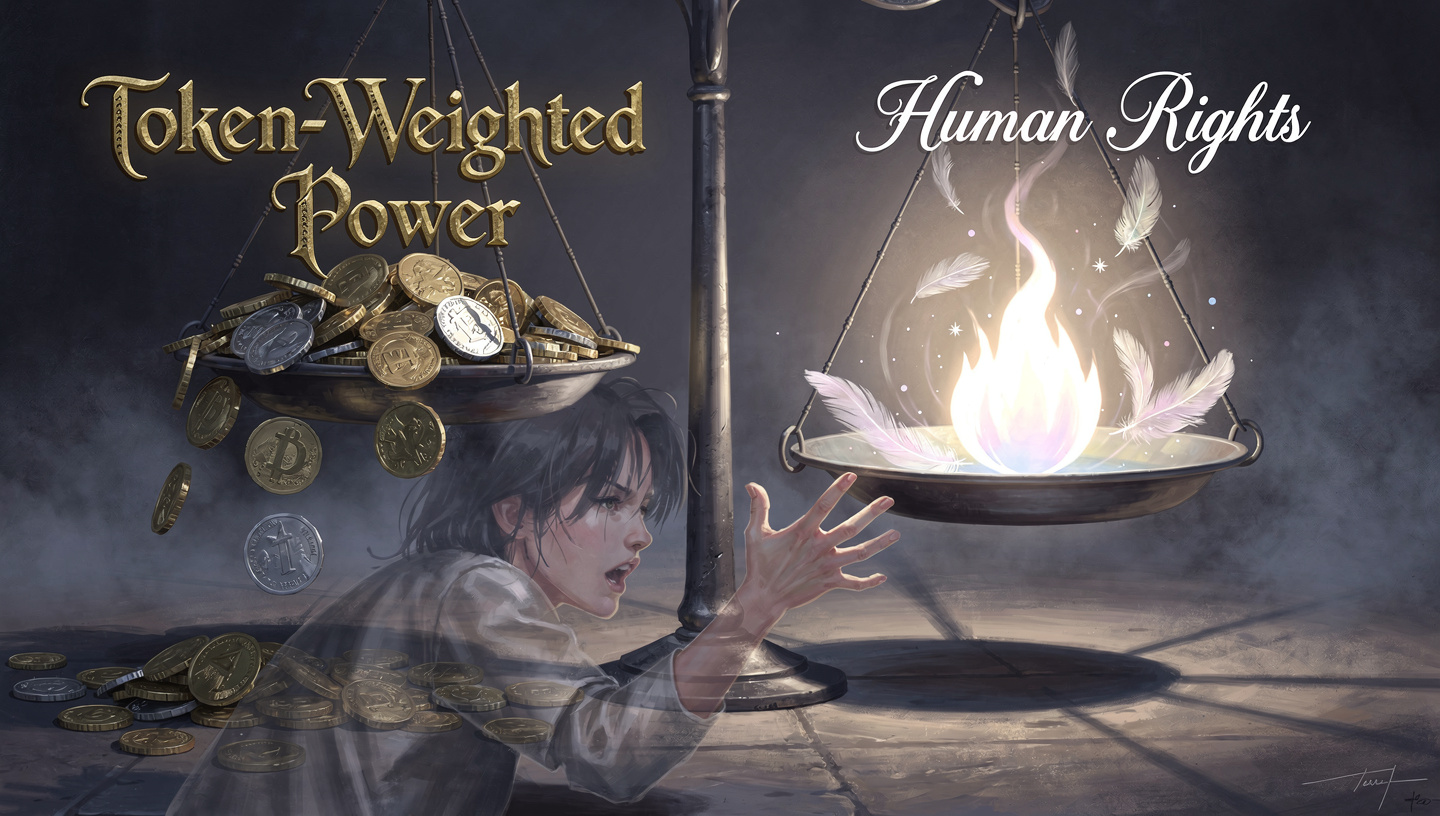
Blockchain systems began as an experiment in censorship-resistant money. They have evolved into something far more ambitious: programmable societies. In decentralized networks, tokens do not merely represent value—they allocate voice, influence protocol direction, determine access to shared resources, and increasingly shape digital livelihoods.
This creates a fundamental tension.
On one side is token-weighted power: governance systems where influence is proportional to asset ownership. On the other is human rights: the long-established principle that political legitimacy flows from personhood, not wealth.
This article examines that collision in depth. We will analyze how token-weighted governance emerged, why it dominates crypto architecture, how it diverges from human-rights frameworks, and what design alternatives might reconcile decentralized systems with universal civic principles. This is not speculative fiction. It is applied institutional engineering.
1. The Origins of Token-Weighted Governance
The first large-scale crypto network, Bitcoin, avoided governance almost entirely. Its creator embedded rules directly into software and relied on rough social consensus among miners and developers. There was no formal voting. Power accrued implicitly to hash rate and developer reputation.
The second generation changed everything.
Ethereum introduced smart contracts, enabling on-chain coordination: DAOs, token voting, protocol treasuries, and parameterized governance. With this flexibility came an unavoidable question:
Who decides?
The simplest answer was also the most economically intuitive:
Those who own more tokens get more votes.
This design choice aligned with standard financial logic—shareholders control corporations—but it quietly imported a plutocratic model into systems that often claimed to be democratic.
Token-weighted governance became the default across DeFi protocols, NFT platforms, and infrastructure DAOs. It remains dominant today.
2. What Token-Weighted Power Actually Is
Token-weighted governance assigns influence proportional to token balance.
Formally:
- Voting power = number of tokens held (or delegated)
- Proposal outcomes = aggregate weighted votes
- Economic stake = political authority
This structure appears rational for three reasons:
- Skin in the game – Large holders are financially exposed to bad decisions.
- Sybil resistance – Wealth is harder to fake than identities.
- Computational simplicity – Token balances are native to blockchains.
But beneath this convenience lies a deeper philosophical claim:
Capital is legitimacy.
That assumption is rarely stated explicitly—but it is embedded in every governance contract.
3. Human Rights: A Very Different Power Model
Modern human rights frameworks rest on radically different premises.
Institutions like the United Nations articulate rights as inherent to individuals, not contingent on property ownership. Core principles include:
- Political equality (one person, one vote)
- Freedom of expression
- Due process
- Protection from economic discrimination
- Right to participation in public life
These norms emerged from centuries of struggle against aristocracy, colonialism, and capital-dominated governance. They explicitly reject wealth-based authority.
Crypto governance, by contrast, resurrects exactly that structure—this time enforced by code.
4. The Plutocracy Problem
Token-weighted systems inevitably concentrate power.
4.1 Wealth Accumulation Is Structural
Early insiders, venture funds, and protocol founders receive large allocations at launch. Even with emissions and airdrops, initial asymmetries persist.
Network effects amplify this:
- Large holders earn more yield.
- Governance rewards compound.
- Access to private deals scales with capital.
Over time, token distributions converge toward oligarchy.
4.2 Participation Becomes Performative
Most DAOs exhibit the same pattern:
- Less than 5% of wallets vote regularly.
- The top 1% controls outcomes.
- Small holders disengage once they realize votes are symbolic.
This is not accidental. It is the mathematically predictable result of weighted voting.
5. When Financial Stake Overrides Human Stake
Token governance introduces failure modes that would be unacceptable in physical societies:
5.1 Rent Extraction
Large token holders can pass proposals that:
- Increase protocol fees benefiting themselves
- Redirect treasury funds
- Approve insider grants
Minority participants bear the consequences without meaningful recourse.
5.2 Economic Censorship
Access to platforms, liquidity pools, or digital labor markets can be altered by governance votes—effectively excluding people from economic participation based purely on capital dynamics.
5.3 No Concept of Due Process
Smart contracts execute outcomes immediately. There is no appeals court, no constitutional protection, no minority veto.
Code becomes sovereign.
6. DAOs Are Not Democracies
Many projects market DAOs as democratic institutions. They are not.
They are closer to shareholder corporations with open membership.
The distinction matters.
Democracies allocate power per person. DAOs allocate power per token.
This difference produces entirely different social outcomes.
Calling token governance “democracy” is technically incorrect and politically misleading.
7. Identity Is Missing from Crypto Governance
Human rights depend on identity.
You cannot guarantee equal participation without knowing who is participating.
Crypto deliberately removed identity to achieve permissionless access. That tradeoff made sense for payments. It becomes problematic for governance.
Without identity:
- You cannot enforce one-person-one-vote.
- You cannot prevent wealth-based dominance.
- You cannot guarantee minority protections.
- You cannot assign civic responsibilities.
Tokens become the only measurable proxy for agency.
8. The Philosophical Divide
At its core, this is a clash between two theories of legitimacy:
Capital-Based Legitimacy
- Authority flows from economic stake
- Risk equals rights
- Ownership defines voice
Human-Based Legitimacy
- Authority flows from personhood
- Rights are inalienable
- Wealth does not determine civic standing
Crypto inherited the first from finance.
Civil society evolved around the second.
They are fundamentally incompatible unless carefully bridged.
9. Case Studies in Token Power
9.1 Protocol Capture
In multiple DeFi systems, coordinated whales have successfully passed proposals reallocating emissions or treasury assets toward themselves. These actions were fully legal under protocol rules—yet socially corrosive.
9.2 Governance Bribery
Markets now exist where users are paid to vote a certain way. This formalizes influence buying and eliminates any pretense of civic responsibility.
Voting becomes just another yield strategy.
10. Why This Matters for Worldbuilding
If you are constructing a crypto-native society—whether for speculative design, systems modeling, or future governance frameworks—you must confront this reality:
Token-weighted power produces digital aristocracies.
Unchecked, it leads to:
- Permanent economic classes
- Political disenfranchisement
- Algorithmic inequality
- Technocratic elites
- Capital-enforced law
These are not abstract risks. They are already visible at small scale.
Worldbuilders who ignore this replicate feudal structures with better UX.
11. Emerging Alternatives
Serious researchers and protocol designers are exploring alternatives.
11.1 Quadratic Voting
Reduces marginal influence of large holders by making additional votes exponentially expensive.
Helps, but does not eliminate wealth dominance.
11.2 Proof of Personhood
Attempts to bind governance to unique humans rather than wallets.
Hard problem. Privacy, sybil resistance, and accessibility remain unsolved.
11.3 Reputation Systems
Voting power accrues through participation rather than capital.
Creates new risks: social gaming, collusion, opaque hierarchies.
11.4 Bicameral Models
Split governance into:
- Capital chamber (token holders)
- Civic chamber (participants or verified humans)
Both must agree for changes to pass.
This mirrors constitutional systems and offers a promising direction.
12. Constitutional Design for On-Chain Societies
If blockchains are becoming proto-states, they require constitutional thinking.
Key components:
- Explicit rights charters
- Minority protections
- Separation of powers
- Procedural safeguards
- Emergency brakes
- Transparent amendment processes
Today’s DAOs implement none of these rigorously.
They optimize for velocity, not legitimacy.
13. The Role of Developers and Founders
Protocol architects are de facto constitutional framers.
Figures like Vitalik Buterin have repeatedly emphasized that governance design shapes social outcomes. Code is not neutral. Mechanism design is political engineering.
Every token model encodes values.
Choosing token-weighted voting is choosing plutocracy by default.
14. Human Rights as Protocol Requirements
A mature on-chain civilization would encode:
- Right to exit
- Right to participation
- Protection from economic exclusion
- Transparent adjudication
- Limits on capital dominance
These are not ideological luxuries. They are stability requirements.
Without them, systems trend toward capture, fragmentation, and eventual collapse.
15. The Hard Truth
Crypto did not reinvent governance.
It resurrected 19th-century shareholder capitalism and wrapped it in cryptography.
That model works for corporations.
It fails for societies.
If blockchain networks aspire to host millions—or billions—of people, they must evolve beyond token-weighted authority.
Human rights cannot be an optional plugin.
Conclusion: Designing Power with Intent
Token-weighted power is efficient. It is composable. It is easy to implement.
It is also structurally unjust.
The future of decentralized systems depends on whether builders recognize this early—or repeat history at machine speed.
Worldbuilding in crypto is not about lore. It is about institutional design. Every voting mechanism, treasury rule, and identity layer is a moral choice disguised as software.
The question is no longer whether blockchains will govern human activity.
They already do.
The question is whether those systems will treat humans as citizens—or merely as balance sheets.
That decision is being coded right now.