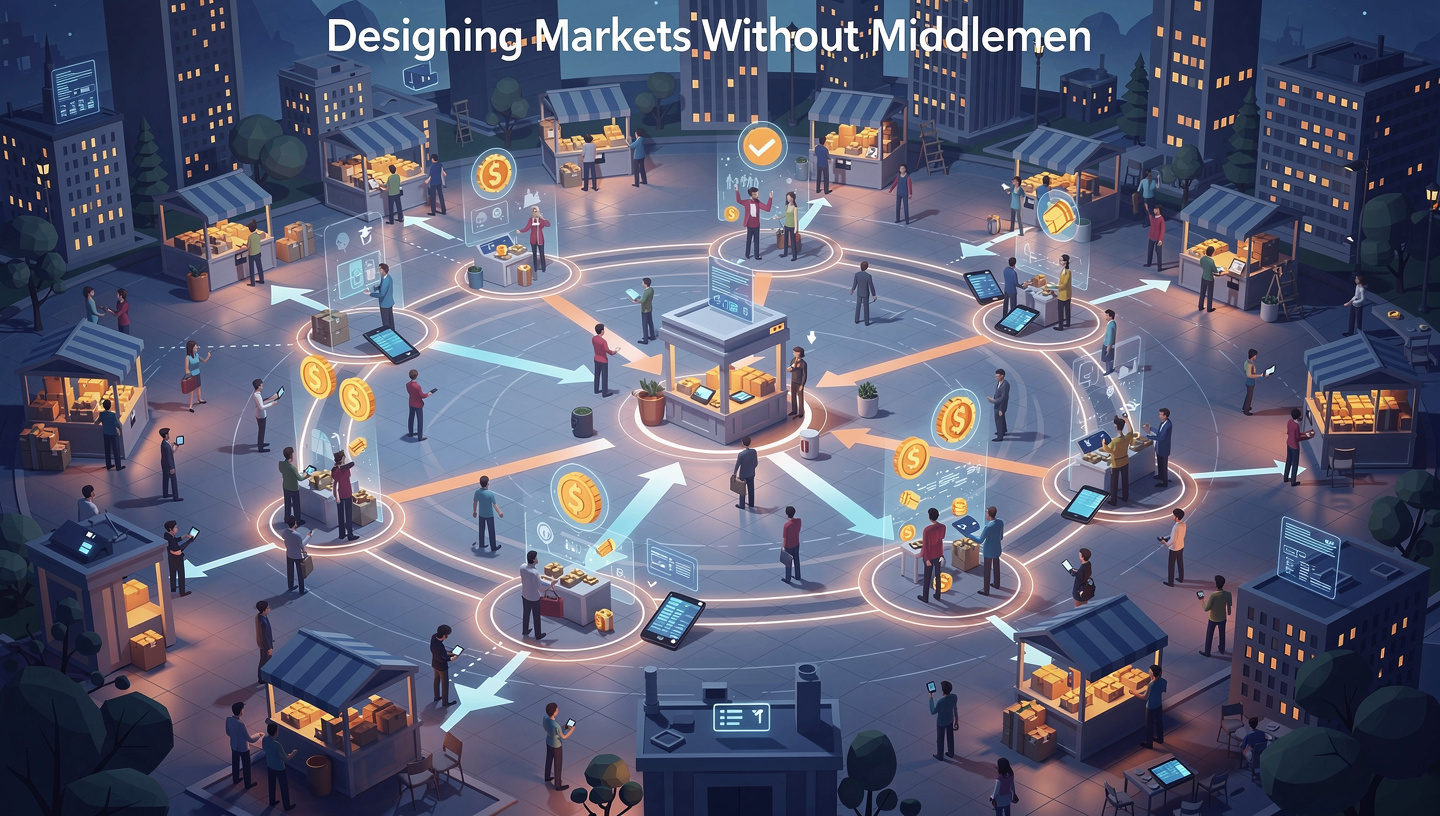
Merchants verified quality. Banks cleared payments. Brokers matched buyers and sellers. Governments enforced contracts. Platforms aggregated demand. Clearinghouses reduced counterparty risk. These institutions emerged for good reasons: coordination is hard, trust is expensive, and information is asymmetric.
Crypto challenges every one of those assumptions.
Blockchains introduce a new primitive: credible neutrality enforced by code. Instead of trusting an institution, participants verify a ledger. Instead of relying on clerks, they execute smart contracts. Instead of centralized order books, they use automated market makers. Instead of permissioned access, they connect through wallets and cryptographic signatures.
This is not simply a technological upgrade. It is a structural redesign of markets themselves.
“Designing markets without middlemen” is the discipline of building exchange systems where coordination, settlement, custody, governance, and incentives are handled by open protocols rather than centralized actors. It sits at the intersection of cryptography, mechanism design, distributed systems, and political economy.
This article examines how these markets are constructed, what makes them work, where they fail, and what they imply for a future where economic infrastructure becomes software.
1. What Middlemen Actually Do
Before removing intermediaries, it is necessary to understand their functions. Traditional market middlemen provide five core services:
- Discovery – finding counterparties and aggregating liquidity
- Trust – guaranteeing execution and reducing fraud
- Settlement – transferring value and recording ownership
- Risk management – absorbing volatility and defaults
- Governance – resolving disputes and enforcing rules
Crypto does not eliminate these needs. It replaces the mechanisms.
Discovery moves from proprietary platforms to open liquidity pools.
Trust moves from institutions to cryptography and transparency.
Settlement moves from banking rails to blockchains.
Risk is redistributed via overcollateralization and automated liquidation.
Governance moves from courts and regulators to token-weighted voting and protocol upgrades.
The shift is not from “mediated” to “unmediated.” It is from human institutions to programmable coordination.
This distinction matters.
Markets without middlemen are still highly structured. They simply encode structure in software.
2. The Core Stack of Disintermediated Markets
Every crypto-native market is built on a layered architecture:
Base Layer: Distributed Ledgers
Blockchains provide:
- Immutable transaction history
- Global state synchronization
- Permissionless participation
- Native asset issuance
The most influential general-purpose platforms include Ethereum and Bitcoin, which pioneered trustless settlement and programmable money.
These networks replace clearinghouses and registries with consensus algorithms.
Ownership becomes a public fact.
Execution Layer: Smart Contracts
Smart contracts automate:
- Trade execution
- Collateral management
- Fee distribution
- Liquidations
- Governance
They remove discretion from operators. If conditions are met, code executes. There is no customer service desk, no account manager, no manual override.
This is the defining property of crypto markets: rules become software.
Liquidity Layer: On-Chain Market Mechanisms
Instead of traditional order books managed by exchanges, crypto introduced automated liquidity.
The canonical example is Uniswap, which popularized the constant-product automated market maker (AMM). Liquidity providers deposit asset pairs into pools. Prices adjust algorithmically. Traders interact directly with contracts.
No brokers. No matching engines. No centralized custody.
Liquidity is crowdsourced.
Identity Layer: Wallets and Signatures
Users authenticate via cryptographic keys, not accounts. A wallet is both identity and payment rail.
This collapses onboarding, compliance, and access control into a single primitive: possession of a private key.
Markets become globally accessible by default.
3. Automated Market Makers: Replacing the Order Book
Traditional exchanges rely on limit order books: buyers and sellers submit bids and asks, and a centralized engine matches them.
AMMs invert this model.
Instead of matching people, they match people with pools.
The pool itself is the counterparty.
Mathematically defined pricing curves determine exchange rates based on available reserves. Liquidity providers earn fees proportional to usage. Arbitrageurs keep prices aligned with external markets.
The implications are profound:
- Continuous liquidity, even for long-tail assets
- Permissionless listing
- No centralized operator
- Fully transparent pricing
However, AMMs introduce new risks:
- Impermanent loss for liquidity providers
- Slippage in low-liquidity pools
- MEV (miner/maximal extractable value)
Designing middleman-free markets therefore becomes an exercise in mechanism design: aligning incentives so that rational actors collectively maintain stability.
4. Decentralized Lending: Banking Without Banks
Crypto lending protocols replace banks with smart contracts.
Users deposit assets into pools. Borrowers draw against collateral. Interest rates adjust algorithmically based on utilization. Liquidations occur automatically when collateral ratios fall below thresholds.
No loan officers. No credit committees. No balance sheets.
Leading systems like Aave and Compound demonstrate how capital markets can function with:
- Overcollateralized loans
- Real-time transparency
- Programmatic interest rates
- Non-custodial control
Risk is managed through:
- Conservative collateral ratios
- On-chain price oracles
- Automated liquidators
- Protocol reserves
These systems are brutally efficient. They do not negotiate. They do not extend grace periods. They enforce margin requirements with machine precision.
This rigidity is not a flaw. It is the tradeoff for trust minimization.
5. Oracles: Reintroducing the Outside World
Blockchains are closed systems. They cannot natively observe real-world prices, events, or identities.
Enter oracles.
Oracles feed external data into smart contracts: asset prices, interest rates, weather conditions, election outcomes.
They are unavoidable points of fragility in otherwise trustless systems.
Projects like Chainlink attempt to decentralize this layer by aggregating data from multiple sources and incentivizing honest reporting.
Market designers must treat oracles as critical infrastructure. A corrupted price feed can drain lending pools or manipulate derivatives markets in seconds.
Removing middlemen does not remove dependency. It redistributes it.
6. Governance Without Executives
In protocol-based markets, there is no CEO to set policy.
Instead, governance is handled by token holders.
Proposals are submitted on-chain. Votes are weighted by stake. Approved changes are executed by contracts.
This model—pioneered by decentralized autonomous organizations (DAOs)—transfers strategic control from boards to distributed communities.
While imperfect, DAO governance introduces:
- Radical transparency
- Open participation
- Programmable upgrades
- Public accountability
It also introduces new attack surfaces:
- Voter apathy
- Whale dominance
- Governance capture
- Low-signal proposal spam
Designing markets without middlemen therefore requires designing political systems, not just financial ones.
7. Incentives as Architecture
Traditional platforms motivate behavior through contracts, salaries, and regulation.
Crypto motivates behavior through token economics.
Participants are rewarded for:
- Providing liquidity
- Securing networks
- Reporting prices
- Building applications
- Governing protocols
Tokens are not merely assets. They are coordination instruments.
They encode rights (voting), claims (fees), and responsibilities (staking). Poorly designed incentives lead to mercenary capital and short-term extraction. Well-designed incentives bootstrap durable ecosystems.
This is why market design in crypto increasingly resembles applied game theory.
Every parameter matters.
8. Failure Modes in Middleman-Free Markets
Disintermediated markets are not utopian. They fail in distinct, technical ways:
Smart Contract Risk
Code bugs can lock or drain funds permanently.
There is no undo.
Liquidity Fragility
Liquidity is mobile. Capital can exit instantly, amplifying volatility.
MEV and Transaction Ordering
Block producers can reorder transactions for profit, extracting value from users.
Governance Attacks
Accumulating governance tokens can enable hostile protocol takeovers.
User Error
Self-custody means users bear full responsibility for key management.
These are not edge cases. They are structural properties.
Market design must explicitly account for adversarial behavior.
9. Interoperability and Composability
One of crypto’s most powerful features is composability.
Protocols are open APIs. Developers stack them like financial Lego:
- DEX liquidity feeds lending markets
- Lending tokens back derivatives
- Derivatives collateralize stablecoins
- Stablecoins settle NFT trades
This creates an emergent financial system where applications interlock without permission.
The result is rapid innovation—and cascading risk.
A bug in one protocol can propagate across dozens of others.
Designing markets without middlemen therefore also means designing interfaces between markets.
10. From Platforms to Protocols
Web2 markets are platform-centric. Users are tenants. Data is proprietary. Rules are mutable.
Crypto markets are protocol-centric. Users are sovereign. State is public. Rules are explicit.
This shift alters power dynamics:
- Builders cannot arbitrarily change terms
- Liquidity cannot be locked in
- Forking is always an option
- Competition is one click away
Protocols compete on trust, liquidity, and developer mindshare—not marketing budgets.
This is why crypto-native markets tend toward commodification and openness.
Monopolies are harder to sustain.
11. Regulatory Gravity and the Edge of the System
Markets without middlemen do not exist in a vacuum.
They interface with:
- Fiat onramps
- Physical goods
- Tax regimes
- National laws
Regulators struggle because there is no clear entity to license or fine. Protocols are software. DAOs are amorphous. Users are global.
Some jurisdictions attempt to regulate access points. Others target developers. Others focus on stablecoins and custodians.
This tension will define the next decade of crypto market design: how to reconcile borderless protocols with territorial law.
12. Design Principles for Middleman-Free Markets
After a decade of experimentation, several principles have emerged:
1. Make Rules Explicit
Ambiguity breeds exploitation. Encode constraints directly in contracts.
2. Assume Adversaries
Every system is attacked. Design for worst-case behavior.
3. Minimize Trusted Dependencies
Each oracle, multisig, or admin key is a potential failure point.
4. Align Long-Term Incentives
Reward sustained participation, not short-term extraction.
5. Optimize for Exit
Users must be able to leave. Lock-in erodes legitimacy.
6. Favor Simplicity
Complex mechanisms hide risk.
These principles are not philosophical. They are operational.
13. What Comes Next
The current generation of crypto markets still mirrors traditional finance: exchanges, loans, derivatives, insurance.
The next wave will likely focus on:
- On-chain labor markets
- Creator economies without platforms
- Machine-to-machine commerce
- Autonomous agent markets
- Tokenized real-world assets
As AI agents gain wallets, markets will increasingly transact at machine speed, governed by smart contracts and optimized by algorithms.
Human middlemen will not vanish—but they will move to the edges: research, strategy, interface design, and regulation.
The core rails will be software.
Conclusion: Markets as Public Infrastructure
Designing markets without middlemen is not about removing people.
It is about relocating trust—from institutions to protocols, from discretion to determinism, from opaque systems to verifiable code.
Crypto replaces centralized operators with open mechanisms. It transforms finance from a service industry into an engineering discipline.
In doing so, it forces a deeper question:
If markets can run themselves, what should humans do?
The answer will not be found in whitepapers alone. It will emerge from millions of transactions, thousands of experiments, and a global community learning—often painfully—how to encode cooperation.
Markets without middlemen are not the end of economic organization.
They are its next abstraction layer.