Nationality is one of humanity’s most powerful abstractions.
It determines who you are in the eyes of institutions. It defines your legal rights, economic opportunities, mobility, and social obligations. It assigns you to a flag, a passport, and a jurisdiction—often before you can speak.
But nationality is also a historical artifact.
It emerged in an era when geography defined power, when armies marched across land, when trade followed shipping lanes, and when governance required physical proximity. It made sense in a world where coordination required territory.
Crypto changes that assumption.
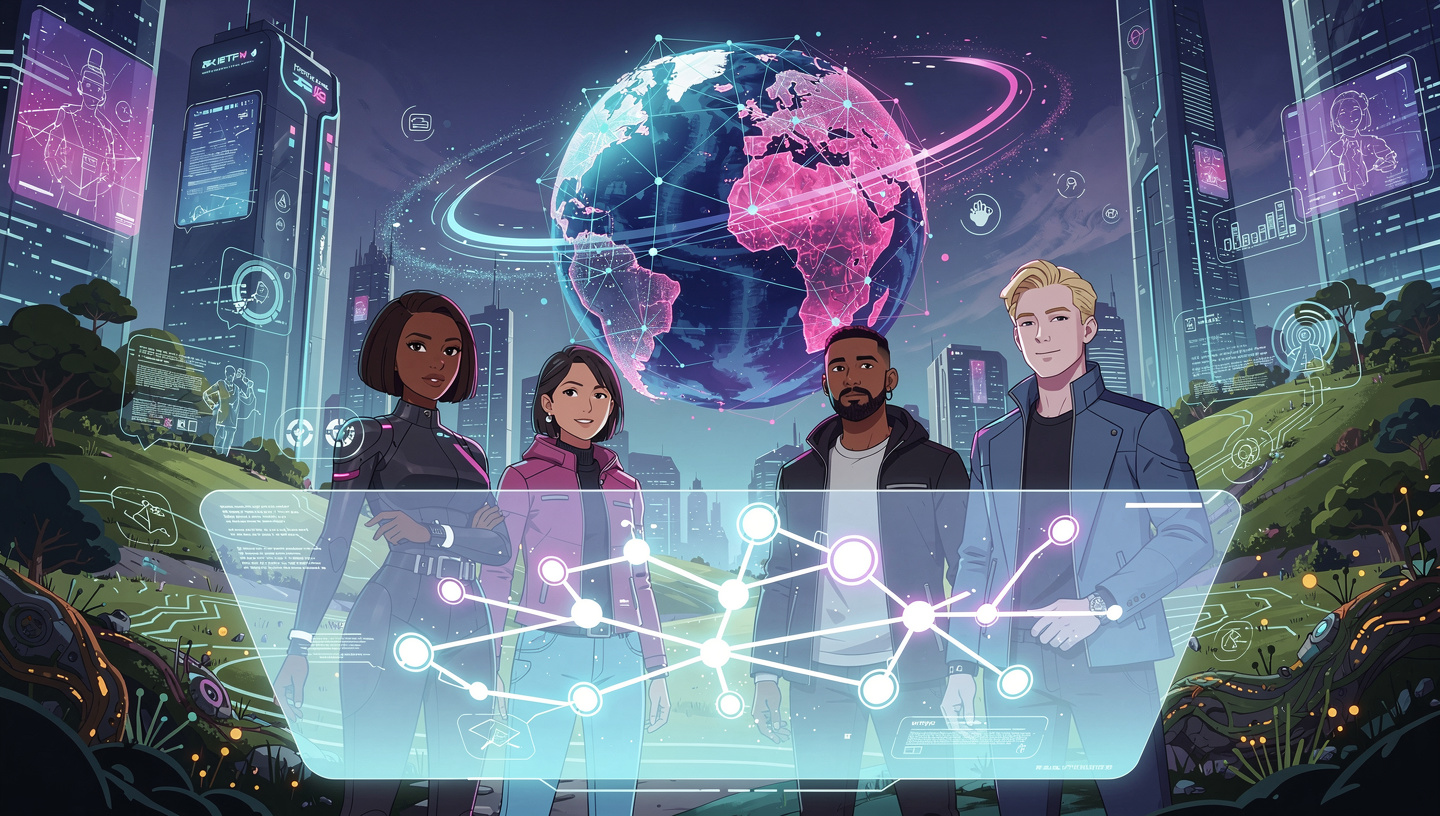
Decentralized networks operate without borders. Distributed organizations recruit globally by default. Value moves at internet speed. Governance is executed in smart contracts. Identity becomes composable. Belonging becomes programmable.
In this context, a profound question arises:
If societies reorganize around decentralized autonomous organizations (DAOs), what replaces nationality?
This article explores that question through first principles. We will examine how citizenship functions today, why DAOs invalidate its traditional foundations, and what new structures emerge when coordination becomes digital-first.
This is not speculative fiction. These mechanisms are already forming.
1. What Nationality Actually Does (and Why It Exists)
Nationality is not merely cultural identity. It is a bundled protocol with five core functions:
1.1 Legal Identity
Nationality establishes a person as a legal subject inside a sovereign system. It answers:
- Which laws apply to you?
- Which courts have authority over you?
- Which rights and duties you possess?
Your passport is effectively a cryptographic proof—issued by a state—that you belong to a specific legal domain.
1.2 Economic Access
Nationality governs access to:
- Labor markets
- Banking systems
- Property ownership
- Welfare infrastructure
Where you are born statistically predicts your lifetime income more than any personal attribute.
1.3 Political Participation
Citizenship defines who can vote, run for office, or influence policy. It determines whose voice matters in governance.
1.4 Social Trust Layer
Nationality functions as a coarse reputation system. Shared nationality implies shared norms, education, language, and institutional expectations.
1.5 Military and Security Alignment
States provide defense in exchange for loyalty and taxation. Nationality is the enrollment mechanism for that protection contract.
Together, these functions form a vertically integrated stack: identity, economy, governance, trust, and security—all bundled into one territorial framework.
DAOs unbundle that stack.
2. Why DAOs Break the Nation-State Model
DAOs are organizations coordinated primarily through code, tokens, and on-chain governance. They operate globally from inception. They are permissionless by default.
Their existence challenges every assumption embedded in nationality.
2.1 Geography Stops Being a Constraint
A DAO does not care where you live.
Your location does not affect:
- Your ability to contribute
- Your right to vote
- Your capacity to earn tokens
- Your access to organizational resources
A developer in Lagos, a designer in Hanoi, and a strategist in Berlin participate on equal footing.
This is historically unprecedented.
2.2 Identity Becomes Wallet-Based
In DAOs, identity is expressed through cryptographic keys, not passports.
Your wallet address represents:
- Your assets
- Your voting power
- Your on-chain history
- Your reputation signals
Identity becomes self-sovereign and portable across organizations.
2.3 Governance Is Modular
Rather than a single government controlling all domains of life, DAOs allow individuals to opt into multiple governance systems simultaneously:
- One DAO for work
- Another for finance
- Another for social belonging
- Another for shared infrastructure
You no longer belong to one state. You belong to many protocols.
2.4 Economic Participation Is Permissionless
You don’t need visas or work permits to earn crypto.
If you can contribute value, you can be paid. This directly undermines the nation-state’s monopoly on labor mobility.
3. From Citizenship to Membership: The Core Transition
Nationality is passive. You are born into it.
DAO participation is active. You opt in.
This single difference reshapes everything.
In a DAO world, belonging is not inherited—it is earned, maintained, and sometimes revoked.
Instead of citizenship, we see the rise of membership primitives.
These include:
- Token ownership
- Reputation scores
- Contribution history
- Governance participation
- Social attestations
Each DAO defines its own criteria for inclusion.
There is no universal standard. There is no global passport authority.
Belonging becomes pluralistic.
4. Tokens as the New Citizenship Layer
Tokens perform many of the functions historically handled by nationality.
4.1 Economic Rights
Holding governance tokens often grants:
- Revenue share
- Treasury access
- Staking rewards
- Priority participation
Your economic standing inside a DAO is proportional to your token stake or contribution weight.
4.2 Political Power
Tokens enable voting on:
- Protocol upgrades
- Treasury allocations
- Leadership structures
- Strategic direction
Unlike nation-states, governance power is often continuous rather than binary. Influence scales with stake or reputation.
4.3 Exit Rights
Citizens rarely have meaningful exit options.
Token holders do.
If you disagree with governance, you can sell your tokens and leave. This creates market-driven accountability.
Governments do not compete for citizens.
DAOs do.
5. Reputation Systems Replace National Identity
Nationality bundles identity into a single static label.
DAOs replace this with dynamic reputation graphs.
Your on-chain footprint includes:
- Past proposals
- Voting behavior
- Completed tasks
- Peer endorsements
- Financial interactions
This data becomes a living résumé.
Projects like Ethereum Name Service already allow wallet-based identities to carry human-readable names and metadata.
Over time, layered reputation systems will emerge across protocols, enabling portable credibility.
Instead of saying “I am Vietnamese” or “I am German,” you will say:
“I am a contributor to X, a delegate in Y, and a verified builder in Z.”
Your identity becomes composable.
6. DAOs as Network States
Some DAOs already resemble proto-nations.
They have:
- Treasuries larger than small countries
- Full-time contributors
- Legal entities
- Internal courts
- Constitutions encoded in smart contracts
Early governance experiments like MakerDAO and Aragon demonstrate how decentralized institutions can manage billions in assets without centralized leadership.
These systems lack armies and borders, but they possess something equally powerful:
Capital + coordination.
In the digital era, that combination rivals territorial control.
7. What Replaces Passports?
In a DAO world, passports are replaced by cryptographic credentials.
These include:
7.1 Wallet Addresses
Your primary identity anchor.
7.2 Verifiable Credentials
Signed attestations proving skills, education, or DAO participation.
7.3 Soulbound Tokens (SBTs)
Non-transferable tokens representing achievements, memberships, or reputation.
Together, these form a decentralized identity stack.
Access to services becomes conditional on credential possession, not nationality.
A protocol doesn’t ask where you were born.
It asks what you’ve done.
8. Legal Jurisdiction Becomes Optional (but Not Obsolete)
DAOs currently exist in a gray zone.
They rely on traditional legal systems for:
- Dispute resolution
- Intellectual property
- Physical-world enforcement
But internally, many DAOs already use on-chain arbitration, multisig governance, and smart contract enforcement.
Over time, we will see hybrid models:
- Off-chain legal shells
- On-chain constitutions
- Private arbitration networks
Law becomes another modular service layer.
Not a monopoly.
9. Security Without States
Nation-states justify themselves largely through protection.
DAOs cannot provide military defense.
Instead, they offer:
- Financial security through diversification
- Economic resilience through global participation
- Governance stability through transparency
- Censorship resistance through decentralization
This is a different kind of safety.
Not physical.
Systemic.
Your wealth, identity, and access are protected by cryptography rather than borders.
10. Cultural Belonging in a Post-National World
Nationality also provides meaning.
Flags. Anthems. Shared myths.
DAOs are beginning to generate their own cultures:
- Memes
- Rituals
- Community calls
- Internal slang
- Narrative identity
These cultures form around purpose rather than place.
People rally around missions: open finance, decentralized identity, collective ownership.
The emotional core shifts from homeland to shared goals.
11. Inequality Does Not Disappear—It Mutates
DAO societies are not inherently egalitarian.
Power concentrates around:
- Early adopters
- Capital holders
- Core contributors
Token-weighted governance risks plutocracy.
Reputation systems risk exclusion.
However, unlike nation-states, these systems are forkable.
If governance becomes unfair, communities can split and form alternatives.
Exit is always available.
This creates evolutionary pressure toward better models.
12. The Role of Crypto Protocols in This Transition
The infrastructure enabling this shift is built on decentralized blockchains like Ethereum, originally conceptualized by Vitalik Buterin.
Earlier systems such as Bitcoin demonstrated sovereign digital money.
Ethereum extended this into programmable governance.
Together, they form the substrate for post-national coordination.
13. What Replaces Nationality? A Layered Answer
There is no single replacement.
Nationality dissolves into components:
| Function | DAO Equivalent |
|---|---|
| Legal identity | Wallet + credentials |
| Economic access | Tokens + DeFi |
| Political participation | On-chain governance |
| Social trust | Reputation graphs |
| Security | Cryptographic guarantees |
Instead of one citizenship, you hold many memberships.
Instead of one state, you interact with dozens of protocols.
Instead of being assigned belonging, you curate it.
14. The Emerging Human Pattern
The DAO world produces a new archetype:
The network citizen.
This individual:
- Participates in multiple DAOs
- Earns income globally
- Builds reputation across protocols
- Votes in digital governance
- Maintains sovereign identity
- Exits systems that no longer align
They are not stateless.
They are multi-aligned.
Conclusion: From Birthright to Participation
Nationality is an artifact of the industrial age.
DAOs belong to the network age.
As coordination migrates on-chain, identity follows.
What replaces nationality is not another flag.
It is a constellation of memberships, credentials, reputations, and economic relationships—assembled voluntarily, maintained transparently, and enforced cryptographically.
In this world, belonging is no longer something you inherit.
It is something you actively construct.
The DAO does not ask where you come from.
It asks what you contribute.
And that single shift may redefine civilization itself.