For most of human history, borders have been physical artifacts. Rivers, walls, oceans, and checkpoints determined who belonged, who could trade, who could vote, and who could stay. Citizenship was inherited or granted by sovereign states. Identity was issued on paper. Membership was enforced by force.
Crypto breaks this paradigm.
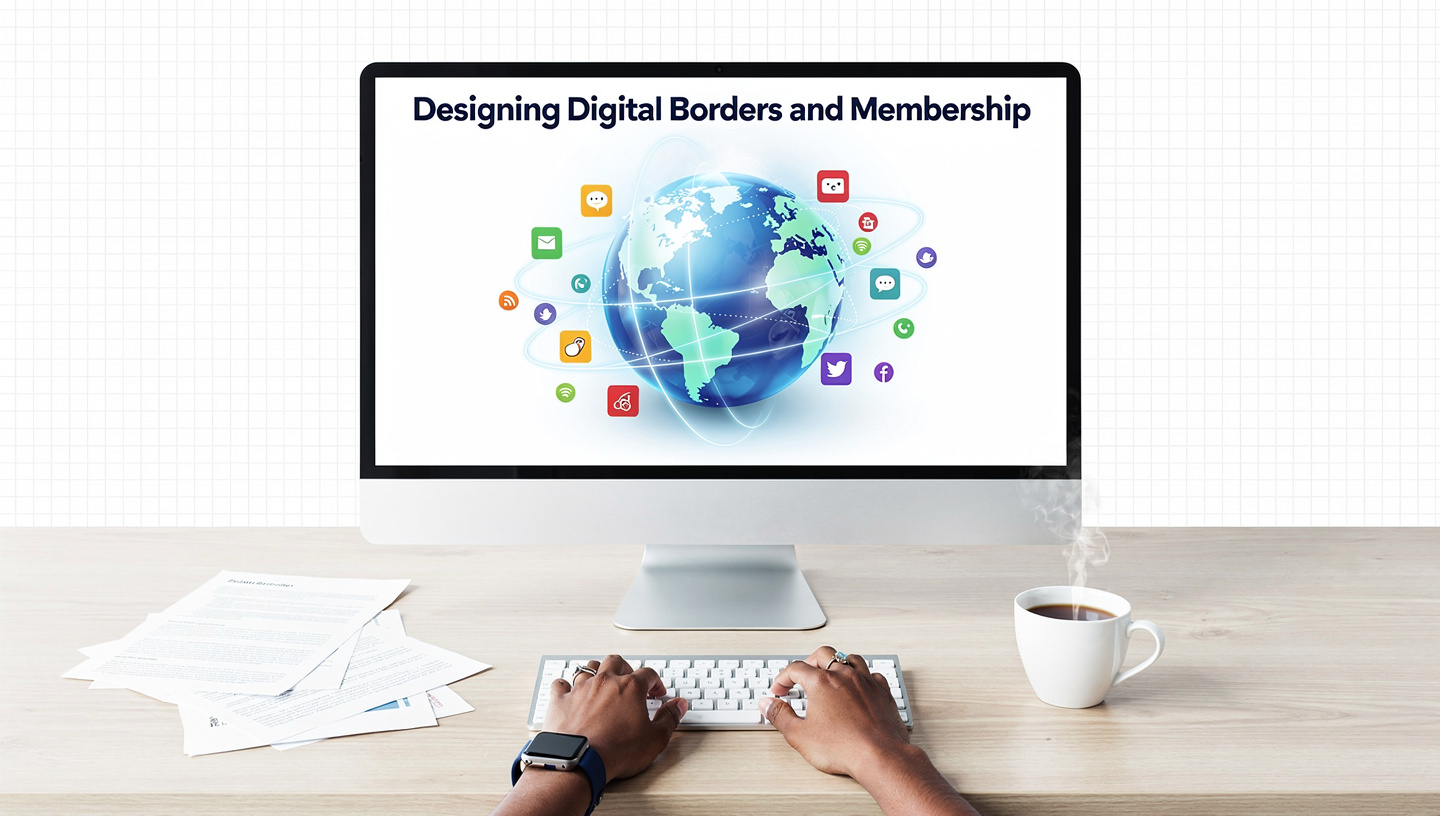
Blockchains introduce a radically different primitive: programmable belonging. In a networked world where capital, labor, and culture already move at internet speed, crypto adds something unprecedented—digitally enforced borders and memberships that exist entirely in code.
This is not a metaphor. It is an emerging design space.
Wallets replace passports. Tokens replace visas. Smart contracts replace bureaucracies. Reputation replaces nationality. And participation replaces residency.
This article explores how digital borders are constructed, how crypto-native membership works, and what it means to design societies that exist primarily on-chain. This is worldbuilding—not fiction, but systems thinking applied to cryptographic civilization.
1. From Territorial States to Network States
Traditional borders are territorial. Crypto borders are topological.
In a blockchain-native environment, there is no land to defend. There are only:
- Address spaces
- Consensus rules
- Access permissions
- Economic incentives
- Cryptographic identity
Membership is no longer granted by birthright or immigration office. It is acquired through keys, tokens, participation, or stake.
A wallet address becomes your sovereign interface with the system.
This shift reframes the meaning of borders:
| Physical World | Crypto World |
|---|---|
| Territory | Protocol |
| Passport | Wallet |
| Citizenship | Tokenized Membership |
| Immigration | Permissionless Entry |
| Law Enforcement | Smart Contract Execution |
| National ID | Decentralized Identity |
Crypto networks like Bitcoin and Ethereum demonstrate this clearly. Anyone can join. No one asks for papers. Entry is cryptographic, not political.
Yet despite this openness, crypto systems still require boundaries.
Because without borders, there is no coordination.
2. Why Digital Borders Are Inevitable
A common misconception is that decentralization eliminates borders. In reality, it multiplies them.
Every protocol defines:
- Who can read
- Who can write
- Who can validate
- Who can govern
- Who can extract value
These are borders.
They are encoded in smart contracts, token economics, and governance mechanisms.
Even fully permissionless networks impose constraints:
- Gas fees filter participation by wealth.
- Validator requirements filter by capital and technical capacity.
- Governance tokens filter political power.
In other words, crypto replaces geographic borders with economic and cryptographic borders.
Designing digital borders is not optional. It is fundamental.
The real question is: what kind of borders do you build?
3. The Core Primitives of Digital Membership
Crypto-native membership is assembled from composable primitives.
Let’s examine the most important ones.
3.1 Wallets as Identity Anchors
At the foundation lies the wallet.
A wallet is not merely a payment tool. It is:
- Your legal signature
- Your asset registry
- Your reputation container
- Your governance credential
- Your social graph
In crypto societies, the wallet replaces both passport and bank account.
Everything attaches to it:
- NFTs signal cultural membership
- Tokens signal economic stake
- Transaction history signals behavior
- Signatures signal consent
This creates persistent, portable identity across platforms.
Unlike traditional IDs, wallets are self-sovereign. No central authority can revoke them. Lose your keys, lose your identity.
This shifts responsibility from institutions to individuals.
3.2 Tokens as Membership Badges
Tokens formalize belonging.
They can represent:
- Citizenship
- Residency
- Access rights
- Voting power
- Social status
Examples include:
- Governance tokens (political membership)
- NFTs (cultural membership)
- Soulbound tokens (reputation membership)
- Utility tokens (economic membership)
Token ownership becomes a machine-readable proof of inclusion.
This enables something radical: membership as a programmable asset class.
You can:
- Buy into communities
- Earn your way into networks
- Stake for privileges
- Delegate your voice
- Exit instantly
Citizenship becomes liquid.
3.3 Smart Contracts as Border Guards
In physical states, borders are enforced by people.
In crypto societies, borders are enforced by code.
Smart contracts automatically:
- Grant access
- Deny permissions
- Distribute rewards
- Apply penalties
- Execute governance outcomes
There is no appeal process. There is no discretion.
The contract executes.
This produces a new legal philosophy: code is jurisdiction.
Every protocol is a micro-state with its own constitution embedded directly in software.
4. Models of Crypto Membership
Different projects implement digital belonging in radically different ways.
Here are the dominant models.
4.1 Capital-Based Membership
The simplest model: you belong if you pay.
Buy tokens → gain access.
This mirrors shareholder capitalism:
- More capital = more influence
- Governance is plutocratic
- Borders are economic
Many DAOs operate this way by default.
Advantages:
- Efficient capital formation
- Clear incentives
- Fast scaling
Risks:
- Wealth concentration
- Oligarchic governance
- Extractive dynamics
This is the digital equivalent of investor citizenship.
4.2 Contribution-Based Membership
Here, membership is earned through labor or participation.
You gain status by:
- Writing code
- Creating content
- Moderating communities
- Providing liquidity
- Evangelizing networks
Tokens are distributed retroactively or continuously based on contribution.
This resembles meritocratic citizenship.
Advantages:
- Aligns incentives with value creation
- Builds strong community culture
- Reduces purely speculative participation
Challenges:
- Measuring contribution is hard
- Sybil resistance is complex
- Subjectivity creeps in
4.3 Identity-Based Membership
Some systems attempt to tie membership to unique humans rather than wallets.
This involves biometric verification, social graphs, or proof-of-personhood systems.
Projects inspired by ideas from Vitalik Buterin explore “soulbound” identity credentials—non-transferable tokens representing achievements, affiliations, or trust.
Goal: one person, one voice.
Advantages:
- Democratic governance
- Reduced Sybil attacks
Risks:
- Privacy erosion
- Surveillance creep
- Centralized verification
Identity-based borders are the most politically charged.
They reintroduce the state—just in cryptographic form.
5. Designing On-Chain Citizenship
If digital societies are inevitable, then citizenship must be intentionally designed.
Key dimensions include:
5.1 Entry Criteria
Who gets in?
Options include:
- Open access
- Token purchase
- Contribution thresholds
- Identity verification
- Invitation-only
Each choice shapes culture.
Open systems scale fast but attract extractors.
Closed systems build coherence but risk elitism.
5.2 Rights and Responsibilities
Membership must define both privileges and obligations.
Rights might include:
- Voting
- Revenue share
- Platform access
- Governance proposals
Responsibilities might include:
- Staking
- Participation
- Moderation
- Code maintenance
Without obligations, membership degenerates into speculation.
5.3 Exit Mechanics
Crypto uniquely allows instant exit.
Sell your tokens. Burn your NFTs. Withdraw liquidity.
This creates hyper-liquid citizenship.
Designers must account for:
- Capital flight
- Governance instability
- Rage quitting
Exit is power.
6. Digital Borders as Economic Firewalls
Borders are not just social constructs. They are economic instruments.
Crypto borders regulate:
- Inflation exposure
- Labor markets
- Capital access
- Resource distribution
Token-gated systems create internal economies protected from external extraction.
This enables:
- Local monetary policy
- Community treasuries
- On-chain public goods
Every DAO treasury is effectively a sovereign wealth fund.
Every protocol is a micro-economy.
7. Cultural Layer: Memes, Norms, and Narrative
No society survives on code alone.
Digital borders are reinforced culturally through:
- Memes
- Shared language
- Rituals (airdrops, votes, launches)
- Symbols (logos, NFTs, slogans)
These soft borders determine who feels like they belong.
In crypto, culture often precedes structure.
People join narratives before they join protocols.
8. Failure Modes of Poorly Designed Membership
Bad border design produces predictable pathologies:
- Whale capture
- Governance apathy
- Identity farming
- Token mercenaries
- Cultural decay
When membership is purely financial, communities hollow out.
When identity is centralized, trust collapses.
When contribution is mismeasured, incentives rot.
Worldbuilders must treat membership architecture as critical infrastructure.
9. Toward Composable Digital Nations
The future is not one global crypto state.
It is thousands of interoperable micro-polities, each with:
- Their own membership rules
- Their own economies
- Their own cultures
Users will hold portfolio citizenship across many networks simultaneously.
You might belong to:
- A DeFi protocol
- A creator collective
- A gaming DAO
- A research guild
Each grants different rights.
Each demands different contributions.
Identity becomes modular.
Belonging becomes composable.
Conclusion: Borders Without Walls
Crypto does not eliminate borders.
It redesigns them.
Digital borders are:
- Voluntary
- Programmable
- Economic
- Cultural
- Portable
They replace territorial sovereignty with protocol sovereignty.
They replace passports with wallets.
They replace citizenship with tokenized participation.
Designing digital borders and membership is not a technical footnote. It is the central challenge of crypto worldbuilding.
Because whoever controls belonging controls civilization.
And in a world governed by smart contracts, belonging is no longer granted by governments.
It is engineered.