Citizenship has always been an infrastructure problem disguised as a social contract.
Passports, birth certificates, voting registries, tax IDs, and residency permits are all artifacts of centralized record-keeping. They emerged in an era when identity had to be anchored to paper, territory, and institutional trust. Crypto-native systems challenge every one of those assumptions.
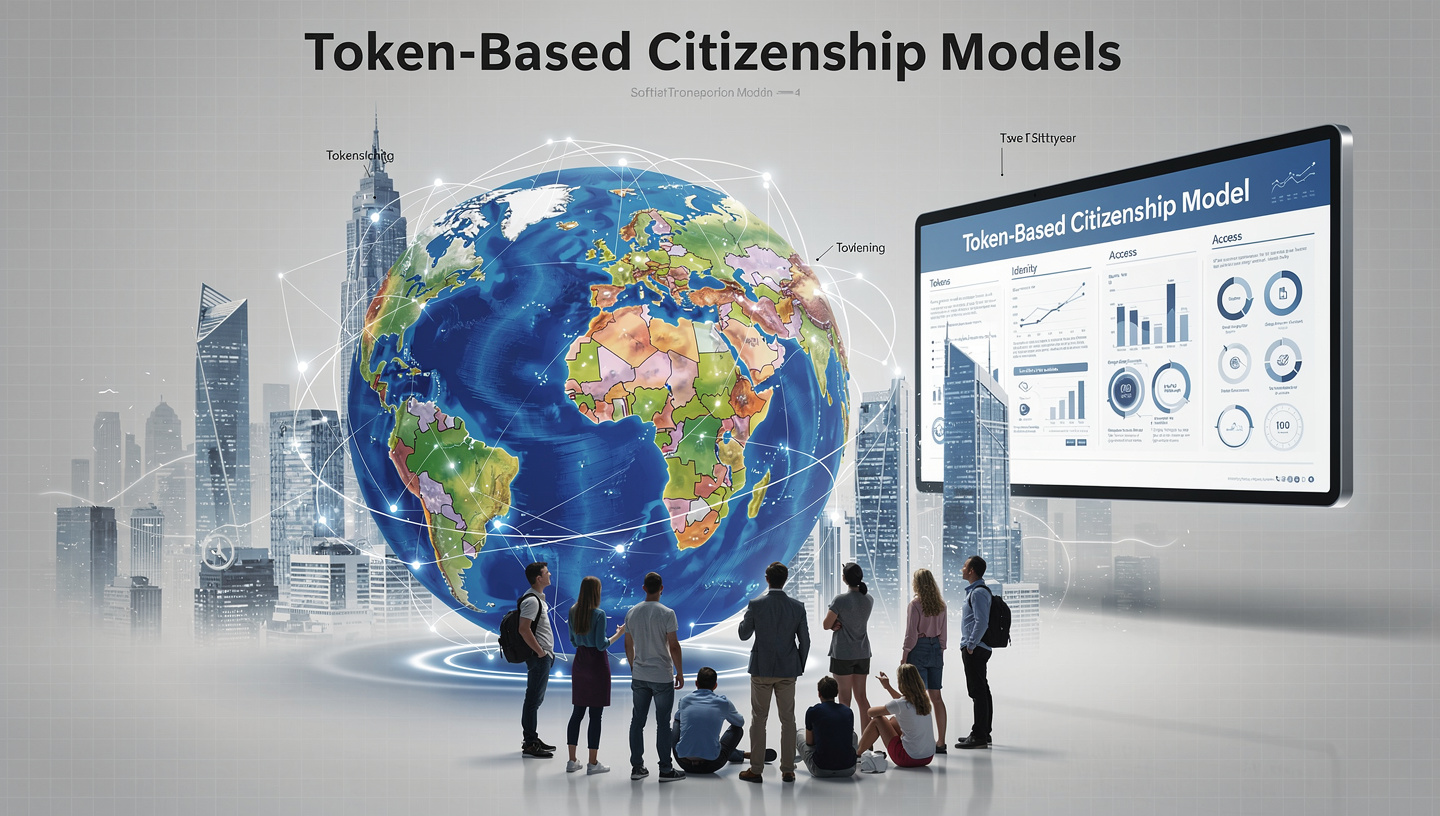
Token-based citizenship models propose something radically different: membership in a polity defined not by geography, but by cryptographic ownership and participation.
This is not speculative fantasy. It is an emerging design space at the intersection of blockchain governance, decentralized identity, programmable law, and digital economics. Around it forms a new discipline: citizenship engineering.
This article explores that discipline in depth—covering architecture, governance primitives, economic incentives, legal interfaces, attack vectors, and long-term societal implications. This is worldbuilding, but grounded in real cryptographic capabilities and institutional pressures.
1. What Is Token-Based Citizenship?
At its core, token-based citizenship replaces or augments traditional state membership with on-chain credentials represented by cryptographic tokens.
A “citizen” becomes a wallet that holds one or more citizenship tokens. These tokens encode rights and responsibilities:
- Voting power
- Access to public goods
- Tax obligations
- Eligibility for social services
- Jurisdictional protections
- Participation in governance
Instead of being issued by ministries or registrars, citizenship is minted by smart contracts according to predefined rules.
Instead of being revoked by decree, it is modified by protocol.
The result is a programmable polity.
Key Characteristics
A token-based citizenship system typically includes:
- Identity Layer
Cryptographic identity tied to wallets, potentially augmented with zero-knowledge proofs. - Citizenship Token
A non-transferable or conditionally transferable token (often soulbound) representing membership. - Governance Engine
On-chain voting, proposal systems, and policy execution. - Economic Substrate
Treasury contracts, taxation logic, and incentive distribution. - Legal Interface
Bridges to off-chain recognition, compliance, and dispute resolution.
This stack creates what can be called a Network State Primitive: a digitally-native civic entity.
2. Why Citizenship Is Being Rewritten
Three structural pressures are forcing experimentation.
A. The Crisis of Territorial Governance
Modern states are bound to geography, but economic activity is not.
Remote work, digital assets, and globalized capital allow individuals to extract value from one jurisdiction while physically residing in another. Tax bases erode. Regulatory reach weakens.
States struggle to compete for talent while maintaining legacy bureaucracies.
Tokenized citizenship offers a way to compete directly in cyberspace.
B. Declining Trust in Institutions
Public confidence in centralized governance continues to fall. Citizens increasingly see states as inefficient intermediaries rather than legitimate coordinators.
Blockchain systems replace discretionary authority with deterministic execution.
This appeals to populations who prefer rules over rulers.
C. Native Digital Communities Want Sovereignty
Online communities already behave like micro-nations: they raise funds, coordinate labor, arbitrate disputes, and distribute resources.
Token-based citizenship formalizes what already exists informally.
3. The Architecture of a Token Nation
Let’s break down a canonical model.
3.1 Identity Without Surveillance
Traditional citizenship depends on invasive identity collection.
Token citizenship uses cryptographic proofs instead.
A wallet proves:
- uniqueness
- age eligibility
- residency status
- contribution history
without revealing raw personal data.
Zero-knowledge credentials allow a citizen to vote or receive benefits while remaining pseudonymous.
This is critical: surveillance states collapse participation. Privacy-preserving identity enables scale.
3.2 Citizenship Tokens: Design Patterns
Not all tokens are equal.
Common implementations include:
Soulbound Citizenship Tokens
- Non-transferable
- Permanently linked to a wallet
- Revocable only via governance
Used to prevent black markets in citizenship.
Conditional Tokens
- Transferable under strict rules
- May decay if participation drops
- Can be slashed for violations
These introduce accountability.
Tiered Citizenship
Multiple token classes:
- Resident
- Contributor
- Validator
- Governor
Each tier unlocks different rights.
Citizenship becomes earned, not assigned.
3.3 Governance Mechanics
Token nations replace parliaments with protocol logic.
Typical components:
- Proposal contracts
- Quadratic or reputation-weighted voting
- Timelocked execution
- Emergency veto modules
Policy becomes code.
Once passed, it executes automatically: budgets move, parameters update, access changes.
No committees. No delays. No interpretation.
4. Economic Models of Citizenship
A state is ultimately a financial machine.
Token-based citizenship systems expose that machinery.
4.1 On-Chain Taxation
Taxes can be:
- Transaction-based
- Income-proportional
- Participation-weighted
Collected automatically by smart contracts.
No filings. No auditors. No enforcement agencies.
Treasuries become transparent pools visible to every citizen in real time.
4.2 Universal Protocol Dividends
Instead of welfare programs, citizens receive:
- staking rewards
- protocol revenue shares
- inflationary distributions
Public goods are funded directly from chain-native yield.
Every citizen becomes a stakeholder.
4.3 Exit Is Always Available
Traditional states rely on coercion.
Token nations rely on optionality.
Any citizen can exit by burning their token or migrating to another network polity.
This creates market discipline: governance failures cause capital flight immediately.
5. Legal Interfaces: Where Code Meets the Physical World
Purely digital citizenship is incomplete without real-world recognition.
Some jurisdictions already experiment with crypto-aligned identity frameworks. For example, Estonia pioneered e-residency, offering a glimpse of how digital membership can interface with state systems.
Cities like Dubai have built regulatory sandboxes for blockchain governance.
Global policy organizations such as the World Economic Forum actively publish frameworks for digital identity and decentralized governance.
Token citizenship systems must integrate with:
- courts
- property registries
- healthcare providers
- immigration authorities
This is typically done through legal wrapper entities: foundations, cooperatives, or DAOs with statutory recognition.
The long-term trajectory is hybrid sovereignty: protocol-native governance backed by selective state enforcement.
6. Citizenship Without Borders: Network States
A token-based citizen may live in one country, work for a DAO in another, and participate politically in a third digital polity.
This fractures the Westphalian model.
Instead of one state per person, individuals may hold multiple concurrent citizenship tokens, each representing membership in different economic and cultural networks.
Citizenship becomes composable.
7. Security and Attack Surfaces
Token nations face threats unknown to legacy states.
7.1 Sybil Attacks
If one actor can mint thousands of identities, democracy collapses.
Mitigations include:
- proof-of-personhood
- biometric attestations
- social graph verification
- economic bonding
Each has tradeoffs between privacy and robustness.
7.2 Governance Capture
Whales can accumulate voting power.
Solutions:
- quadratic voting
- reputation decay
- contribution-based weighting
- capped influence curves
Governance design becomes game theory engineering.
7.3 Smart Contract Risk
A bug in fiscal logic can drain a treasury instantly.
Token nations require:
- formal verification
- staged rollouts
- circuit breakers
- insurance pools
The constitution is software. Software fails.
8. Cultural Consequences of Programmable Citizenship
Token-based citizenship changes how people relate to authority.
8.1 Citizenship as Participation
You are not born into these systems.
You opt in.
You contribute.
You earn status.
This produces highly engaged populations—but also excludes those unwilling or unable to perform digitally.
8.2 Meritocracy or Plutocracy?
Design choices determine outcomes.
Poorly structured token systems drift toward wealth concentration.
Well-designed systems reward labor, reputation, and public contribution.
Citizenship models embed ideology at the protocol level.
9. The Builders Behind the Paradigm
The intellectual foundations of token citizenship trace back to early blockchain thinkers and protocol architects.
Figures like Vitalik Buterin have written extensively on decentralized governance, quadratic voting, and soulbound identity—concepts now central to civic crypto design.
These ideas are no longer academic. They are being implemented in production systems across decentralized communities.
10. A Reference Model: The Fully On-Chain City
To synthesize everything discussed, imagine a mature token-based polity:
- Citizenship issued via zero-knowledge identity proofs
- Tiered tokens granting voting and service access
- On-chain treasury funded by transaction taxes
- Universal protocol dividends
- Algorithmic zoning rules for digital land
- Smart contract courts with appeal layers
- Real-world service providers integrated via oracles
- Exit rights encoded into the constitution
No mayor.
No ministries.
Just code, capital, and consensus.
This is not utopian. It is an engineering roadmap.
11. Long-Term Implications
If token-based citizenship scales, several outcomes follow:
- States compete directly with protocols for residents.
- Talented individuals hold multiple civic memberships.
- Governance becomes a product users can switch.
- Legal systems modularize.
- National identity fragments into network affiliation.
Citizenship becomes a market.
Sovereignty becomes optional.
Conclusion: Citizenship as a Software Primitive
Token-based citizenship models represent a structural inversion.
Instead of governments issuing identity, networks grant belonging.
Instead of laws being written in language, they are deployed as code.
Instead of borders defining rights, wallets do.
This is not merely a crypto experiment. It is a re-architecture of collective organization.
The modern nation-state was built for an industrial world.
Token citizenship is being built for a programmable one.
And like every major governance transition before it, the change will not arrive politely. It will emerge through parallel systems, voluntary migration, and relentless iteration—until digital polities become as ordinary as passports once were.
In that future, citizenship is no longer something you inherit.
It is something you compile.