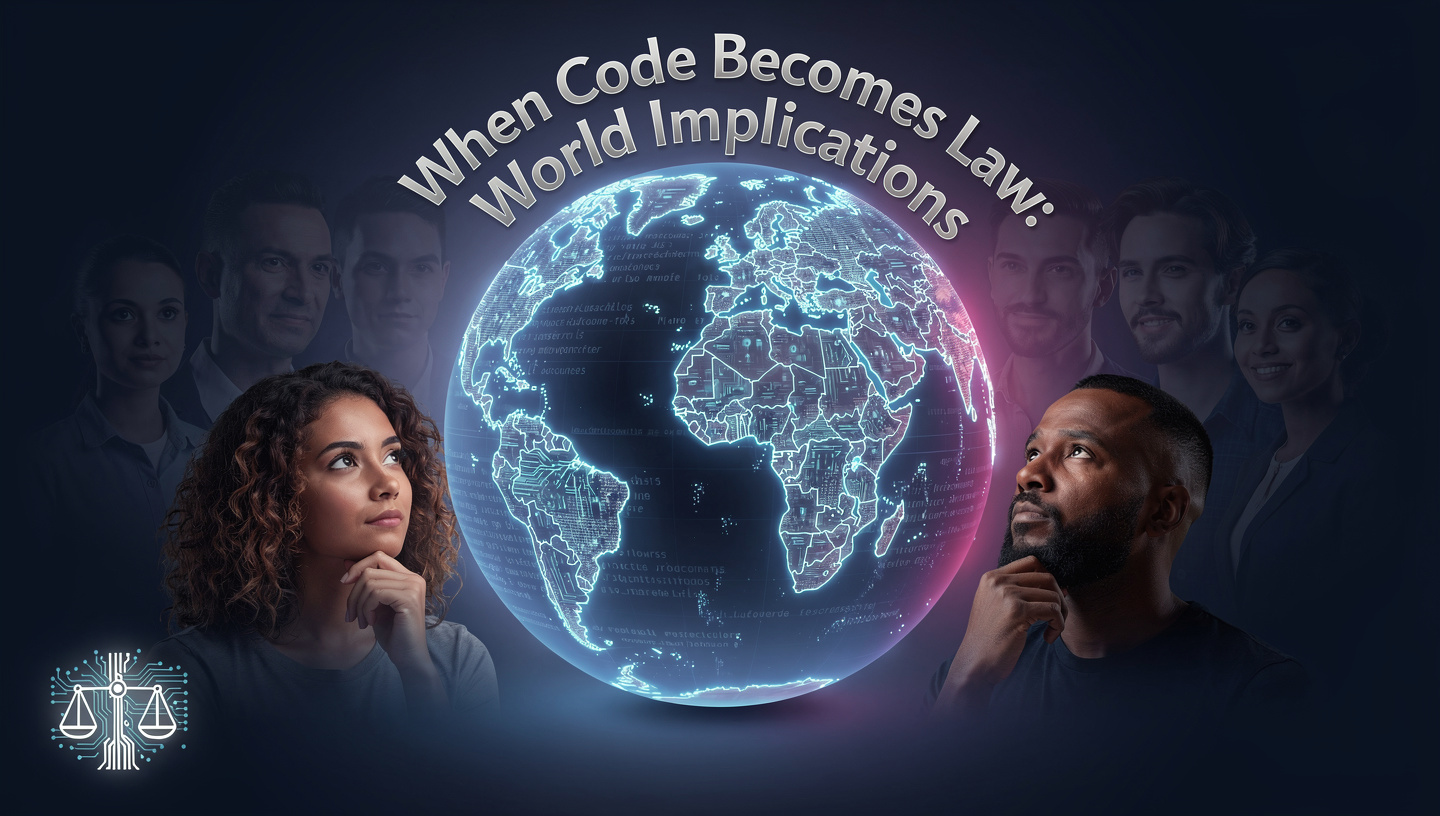
The phrase “code is law” began as a technical provocation. Today, it functions as a serious geopolitical hypothesis.
What started with a pseudonymous whitepaper by Satoshi Nakamoto has evolved into a planetary-scale experiment: replacing institutional trust with executable logic. Smart contracts, decentralized finance, algorithmic governance, autonomous protocols—these are no longer fringe concepts. They are early components of an emerging civilizational stack.
This article does not speculate through narrative. It approaches crypto worldbuilding as systems design: if software truly becomes the primary regulator of economic and social behavior, what happens to states, markets, identity, justice, and power?
We will examine that question across infrastructure, governance, labor, sovereignty, and human agency—treating blockchain not as a product category, but as a structural force.
1. From Legal Text to Executable Reality
Traditional law is interpretive. It is written in natural language, debated in courts, and enforced through human institutions.
Code is different.
Code executes.
When contractual logic moves from legal documents to smart contracts, enforcement becomes automatic. There is no appeal process inside a blockchain. A condition either evaluates to true or false. Funds either move or they don’t.
This is a fundamental shift:
- Law becomes deterministic
- Compliance becomes mechanical
- Enforcement becomes embedded
Smart contracts collapse the distance between rulemaking and execution. In legacy systems, a law exists first, and enforcement follows. In crypto-native systems, enforcement is the law.
That inversion changes everything.
2. Programmable Trust and the End of Intermediaries
Historically, societies relied on intermediaries:
- Banks to hold money
- Courts to resolve disputes
- Governments to issue identity
- Corporations to coordinate labor
Crypto protocols aim to displace these roles with mathematics.
Instead of trusting institutions, users trust cryptography, consensus algorithms, and open-source codebases. The implication is radical: trust becomes infrastructural rather than social.
This transition produces second-order effects:
- Reduced transaction friction
- Global permissionless access
- Continuous operation without centralized control
- Automated compliance
It also introduces new risks:
- Code bugs replace human corruption
- Governance attacks replace coups
- Protocol upgrades replace legislation
In this world, the primary vulnerability is no longer political instability—it is software failure.
3. Governance Without Governments
Decentralized Autonomous Organizations (DAOs) represent early experiments in machine-mediated governance. Voting rights are tokenized. Proposals are executed automatically. Treasury management is algorithmic.
Advocates argue this removes bureaucratic inefficiency. Critics point out that plutocracy is merely being re-encoded.
The deeper implication is structural:
If governance logic lives on-chain, sovereignty becomes portable.
A DAO does not require territory. It does not need citizenship. It exists wherever the internet exists. Members coordinate across borders, jurisdictions, and time zones. Capital flows instantly. Decisions finalize in minutes.
This introduces a competing model of political organization—one that bypasses nation-states entirely.
Some governments are already engaging with this reality. Estonia’s digital residency program and Dubai’s blockchain-forward regulatory frameworks are early indicators of state adaptation rather than resistance.
But adaptation has limits.
Nation-states rely on taxation, borders, and monopoly on force. Crypto-native systems rely on cryptography, incentives, and consensus. These logics are not easily reconciled.
4. Economic Architecture in a Code-Led World
In a fully crypto-integrated society, money is no longer a static instrument. It becomes programmable infrastructure.
Consider the implications:
Programmable Salaries
Wages can be streamed per second, not paid monthly.
Conditional Spending
Funds can be restricted to specific uses at the protocol level.
Automated Taxation
Revenue can be routed instantly to public wallets.
Algorithmic Welfare
Benefits can trigger based on on-chain indicators rather than human applications.
Capital becomes responsive, dynamic, and context-aware.
This transforms macroeconomics.
Central banks lose their monopoly over monetary policy. Inflation becomes protocol-dependent. Financial crises propagate at machine speed. Liquidity becomes global by default.
Economic cycles shorten. Volatility increases. Financial literacy becomes a survival skill.
Labor markets also evolve. Smart contracts enable trustless freelancing. Identity becomes wallet-based. Reputation is recorded on-chain. Employment becomes modular, project-based, and borderless.
The result is a planetary gig economy governed by code.
5. Identity as a Cryptographic Primitive
In legacy systems, identity is issued by states and corporations.
In crypto-native systems, identity emerges from key ownership.
Your wallet becomes your passport.
Decentralized identity frameworks propose that individuals control their credentials: education, medical records, employment history—all selectively disclosed through cryptographic proofs.
This model eliminates centralized identity providers, but introduces a new existential risk:
Lose your keys, lose yourself.
There is no customer support for cryptography.
Social recovery mechanisms attempt to mitigate this, but the philosophical shift remains: personhood becomes mathematically anchored.
Identity is no longer something you have. It is something you compute.
6. Justice in an Algorithmic Society
What happens to justice when enforcement is automatic?
Smart contracts do not understand context. They do not consider intent. They do not recognize hardship. They execute logic.
This creates a rigid moral landscape.
In such a system:
- Errors become irreversible
- Edge cases become catastrophic
- Mercy disappears
Some projects attempt to reintroduce human arbitration layers, but this reopens the door to subjectivity—the very thing code was meant to eliminate.
The deeper tension is unavoidable:
Human societies are fuzzy. Software systems are binary.
Bridging that gap requires hybrid models: algorithmic enforcement with human override. But every override weakens decentralization.
There is no clean solution—only tradeoffs.
7. Power, Capital, and Protocol Capture
Decentralization does not automatically produce equality.
Early adopters accumulate disproportionate influence. Large token holders dominate governance. Infrastructure providers centralize critical services. Mining and validation concentrate in regions with cheap energy.
Code can be neutral. Outcomes are not.
Without careful design, crypto systems replicate existing inequalities—sometimes amplifying them.
Protocol capture becomes the new regulatory capture.
Instead of lobbying lawmakers, powerful actors accumulate tokens.
Instead of influencing legislation, they influence consensus.
This is not hypothetical. It is already observable across major networks and DAOs.
8. The Corporate Response
Enterprises are not ignoring this shift.
Major institutions study blockchain integration through consortiums and policy forums such as the World Economic Forum. Developers like Vitalik Buterin and organizations such as the Ethereum Foundation actively shape protocol standards that corporations increasingly rely upon.
Corporations adapt by:
- Tokenizing assets
- Automating supply chains
- Embedding compliance into smart contracts
- Building internal blockchains
Rather than resisting code-as-law, they attempt to domesticate it.
The long-term outcome is likely a hybrid world: legacy institutions layered atop decentralized infrastructure, with constant tension between openness and control.
9. Geopolitics After Borders
Crypto networks do not respect geography.
This destabilizes traditional power structures.
Sanctions become harder to enforce. Capital flight accelerates. Shadow economies expand. Individuals in restrictive regimes gain access to global finance.
States respond with surveillance, regulation, and national digital currencies.
But the asymmetry remains: decentralized systems innovate faster than governments legislate.
In a world where wealth is portable and governance is optional, citizenship loses leverage.
People affiliate with protocols rather than passports.
This is not a collapse of the nation-state—but it is a dilution of its authority.
10. Worldbuilding the Code-First Civilization
If we project forward several decades, a plausible code-dominant civilization exhibits the following characteristics:
- Economic activity occurs primarily on-chain
- Identity is wallet-native
- Governance is protocol-mediated
- Contracts are self-executing
- Organizations are autonomous
- Borders are economically porous
- Law is embedded in software
- Trust is cryptographic
Cities compete by offering regulatory compatibility with decentralized systems. Education emphasizes cryptography and systems theory. Children learn key management alongside literacy.
Social status correlates with on-chain reputation.
Crime evolves into protocol exploitation.
Philosophy grapples with algorithmic morality.
Human values must coexist with machine determinism.
Conclusion: The Final Authority
“When code becomes law,” authority migrates from institutions to infrastructure.
This is not utopian.
It is not dystopian.
It is architectural.
Blockchain does not promise fairness. It promises consistency. It does not eliminate power. It reassigns it. It does not create virtue. It enforces rules.
The world implications are profound:
- Sovereignty becomes modular
- Trust becomes technical
- Justice becomes computational
- Identity becomes cryptographic
- Society becomes programmable
Humanity has never before delegated this much agency to machines.
The open question is not whether this transition will happen.
It is whether we will design it deliberately—or inherit it accidentally.
In a code-governed world, the ultimate law is not written in statutes.
It is compiled.