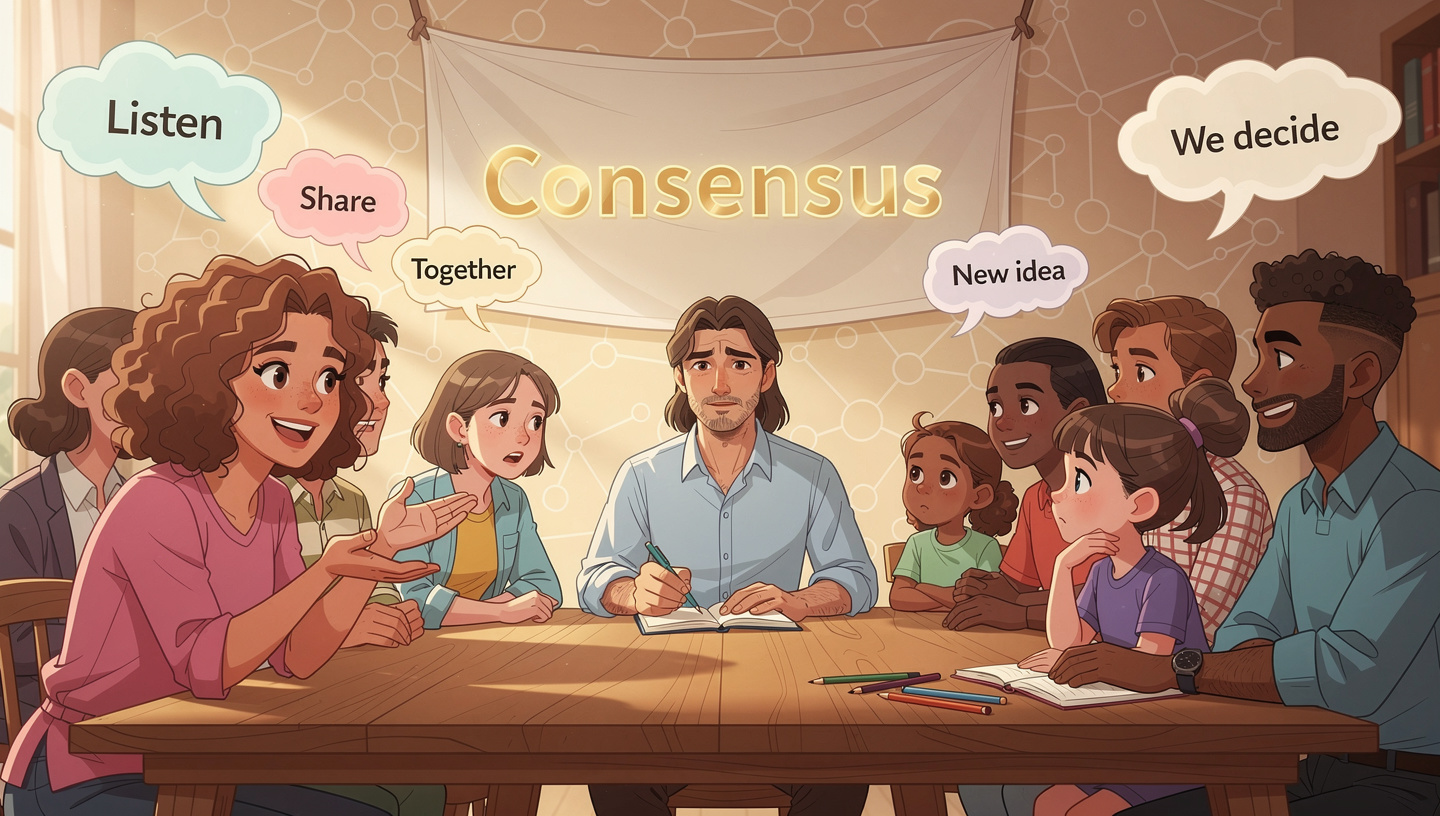
Consensus is usually treated as an abstract technical mechanism—something buried deep in distributed systems papers or cryptography forums. In reality, consensus is one of the most powerful invisible forces shaping modern civilization. It governs how value moves, how trust is established, how records persist, and increasingly, how everyday decisions are automated.
Crypto did not invent consensus. Societies have relied on it for millennia—through laws, currencies, religions, and institutions. What crypto did was formalize consensus into code, making it programmable, global, and independent of centralized authority. Once that happened, consensus stopped being merely social. It became computational.
This article explores how cryptographic consensus models reshape daily life—not through speculative price action, but through infrastructure, incentives, governance, and behavior. This is worldbuilding: a systems-level examination of a planet quietly reorganizing itself around algorithmic agreement.
1. From Social Contracts to Cryptographic Contracts
Every functioning society runs on shared assumptions:
- This money has value.
- This signature is valid.
- This ledger is authoritative.
- This rule applies to everyone.
Historically, these assumptions were enforced by states, banks, courts, and cultural norms. Crypto introduced a parallel system: rules enforced by mathematics and distributed networks.
When Satoshi Nakamoto published the Bitcoin whitepaper, the breakthrough wasn’t just digital money—it was a trustless consensus engine. For the first time, strangers across the globe could agree on the state of a ledger without relying on a central administrator.
That shift has consequences far beyond finance.
Consensus moved from boardrooms to blockchains.
2. What “Consensus” Actually Means in Crypto
In crypto systems, consensus answers one fundamental question:
What is true right now?
Who owns which assets?
Which transactions happened first?
Which smart contracts executed?
Different networks solve this differently, but all consensus mechanisms perform the same core functions:
- Order events
- Prevent double-spending
- Resolve conflicts
- Create finality
Proof of Work, Proof of Stake, delegated models, and hybrid approaches are simply variations on how participants coordinate to produce a single shared reality.
This matters because once consensus is machine-enforced, behavior becomes programmable.
Instead of asking permission from institutions, applications query the chain.
Instead of trusting intermediaries, users trust verification.
That subtle transition reshapes daily life.
3. The Invisible Infrastructure of Agreement
Most people don’t “use crypto” in an obvious way. They interact with it indirectly:
- Stablecoins settle remittances behind mobile apps.
- Supply chains anchor records to public ledgers.
- Games store digital ownership on-chain.
- DAOs vote on budgets that pay real workers.
Consensus operates quietly beneath these surfaces.
Consider a basic scenario: paying someone across borders.
Traditionally, this requires correspondent banks, clearinghouses, FX desks, and compliance layers. With blockchain-based settlement, consensus replaces that entire stack. The network itself becomes the clearing system.
The implications:
- Faster transfers
- Lower costs
- Reduced dependency on legacy rails
- Programmable compliance
These aren’t theoretical. They are already embedded in fintech pipelines worldwide.
Consensus is becoming background infrastructure, like TCP/IP.
4. Economic Gravity in a Programmable World
Consensus doesn’t just record transactions—it shapes incentives.
In crypto-native economies:
- Validators earn rewards for honesty.
- Developers earn tokens for building.
- Users earn yield for participation.
- Governance voters influence protocol direction.
This creates micro-economies around every major network.
People begin optimizing their daily behavior around these incentives:
- Choosing wallets based on gas efficiency
- Timing transactions for lower fees
- Delegating stake for passive income
- Participating in governance proposals
Economic gravity shifts from centralized platforms to protocol ecosystems.
Organizations such as the Ethereum Foundation actively fund research into scalability and governance because consensus quality directly determines real-world usability.
Better consensus means cheaper interactions. Cheaper interactions mean more applications. More applications mean deeper integration into everyday routines.
This feedback loop accelerates adoption.
5. Governance: When Code Becomes Law (and Law Becomes Code)
Traditional governance relies on representation and enforcement.
Crypto governance relies on participation and execution.
Token holders vote.
Smart contracts implement outcomes.
Treasuries move funds automatically.
There is no delay between decision and action.
This collapses bureaucracy.
It also introduces radical transparency: every vote, every transfer, every proposal is publicly auditable.
Some governments and research institutions—including groups at Massachusetts Institute of Technology—study blockchain governance models to understand how decentralized coordination could inform future civic systems.
The worldbuilding implication is profound:
We are experimenting with machine-mediated democracy at planetary scale.
Not perfect. Not complete. But undeniably active.
6. Identity in a Consensus-Driven Society
Identity is next.
Crypto consensus enables:
- Self-sovereign IDs
- Verifiable credentials
- On-chain reputation
- Zero-knowledge attestations
Instead of accounts owned by platforms, individuals increasingly control cryptographic keys that represent them everywhere.
This changes daily interactions:
- Logging into services without passwords
- Proving age or credentials without exposing personal data
- Carrying portable reputations across applications
Your identity becomes composable.
This dismantles data silos and weakens monopolistic platforms whose power depends on owning user relationships.
Consensus becomes the arbiter of authenticity.
7. Work, Coordination, and the Rise of Protocol Labor
In crypto-native environments, people don’t just work for companies.
They work for protocols.
Contributors receive tokens.
Bounties are posted on-chain.
Tasks are completed pseudonymously.
Payments execute automatically.
This creates a new labor category: protocol labor.
A developer in Vietnam, a designer in Poland, and a strategist in Argentina can coordinate without a legal entity, payroll department, or HR stack.
They share a treasury governed by smart contracts.
Consensus replaces corporate hierarchy.
The result is a global, permissionless labor market governed by code.
8. Time, Finality, and Psychological Shifts
Crypto introduces a new perception of time.
Blocks arrive at predictable intervals.
Finality is probabilistic or deterministic.
History is append-only.
People begin thinking in confirmation counts, epochs, and settlement windows.
This subtly changes expectations:
- Waiting minutes instead of days for payments
- Expecting irreversible transactions
- Treating records as permanent
When financial and social actions gain cryptographic finality, behavior adapts.
Mistakes become costly.
Planning becomes precise.
Automation becomes essential.
Consensus reshapes psychology.
9. Macro Signals: Why Institutions Are Paying Attention
Global organizations track this transformation closely.
The World Economic Forum regularly publishes frameworks on blockchain governance, digital assets, and decentralized infrastructure.
Why?
Because consensus networks are no longer fringe experiments. They are emerging coordination layers for trade, identity, and capital.
Once value transfer becomes native to the internet, every connected device becomes an economic actor.
That changes geopolitics.
10. Worldbuilding Forward: A Planet Running on Agreement
Project this forward.
Imagine:
- Cities issuing bonds on-chain
- Utilities managed by DAOs
- Autonomous vehicles paying tolls directly
- AI agents negotiating micro-contracts
- Citizens voting on budgets in real time
All of this depends on one primitive: shared, verifiable truth.
That is consensus.
Crypto doesn’t merely provide alternative money. It provides alternative coordination.
Daily life in such a world feels different:
- Less paperwork
- Fewer intermediaries
- More automation
- Greater transparency
- Continuous governance
You don’t notice consensus any more than you notice DNS—until it fails.
Conclusion: Consensus Is the New Social Layer
“How Consensus Shapes Daily Life” is not about block times or validator sets. It is about civilization retooling its trust mechanisms.
We are moving from institutional trust to computational trust.
From opaque processes to auditable systems.
From centralized permission to decentralized participation.
Crypto consensus is becoming a social substrate—quietly influencing how people work, transact, govern, and identify themselves.
This is not a story. It is an architectural shift.
And like all deep infrastructure changes, its most important effects are not spectacular.
They are mundane.
They show up in how you get paid.
How you prove who you are.
How communities organize.
How value flows.
Consensus is no longer just something networks achieve.
It is something society is becoming.